
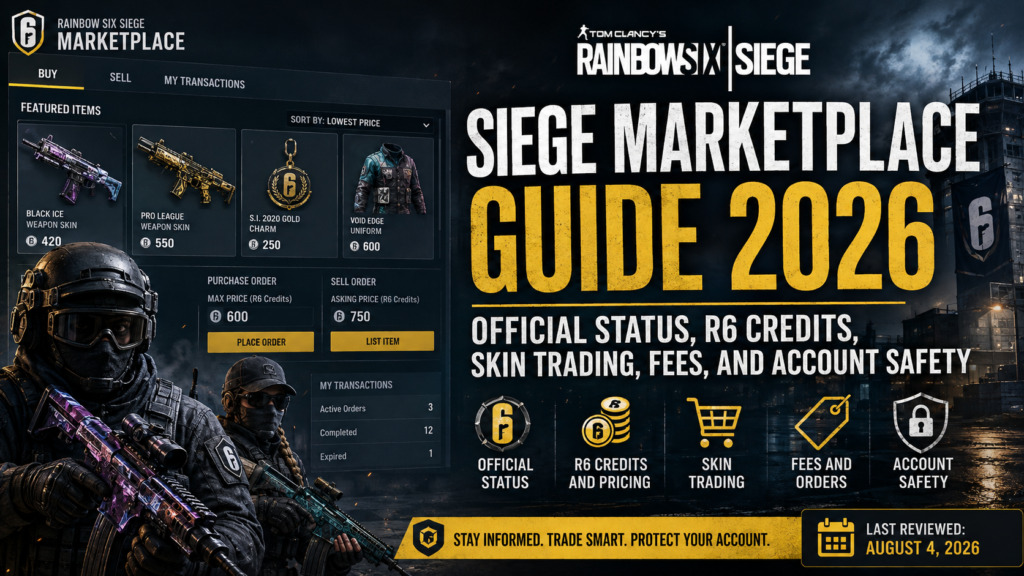
The Siege Marketplace, officially called the Rainbow Six Siege Marketplace, was created as an Ubisoft-operated platform where eligible players could buy and sell approved cosmetic items using R6 Credits. It allowed players to search for older weapon skins, sell unwanted inventory items, manage purchase orders, and trade through an anonymous matching system rather than dealing directly with another player.
The platform is currently closed. In an official update published on June 30, 2026, Ubisoft said the Marketplace would remain unavailable while the company rebuilt important security and economic systems. Ubisoft identified account theft, bot activity, credit transfers, malicious transactions, unstable pricing, distorted item circulation, and broader economic imbalances as major concerns. The company has not announced a confirmed reopening date.
Players can still learn how the previous system operated and prepare their accounts for a possible return. However, old requirements should not be treated as guaranteed future rules. A rebuilt Siege Marketplace may introduce stronger identity checks, different trading limits, revised fees, new item restrictions, or additional safeguards.
Check the Current Siege Marketplace Status
The Siege Marketplace remains closed according to Ubisoft’s latest dedicated announcement. Ubisoft explained that immediately restoring the previous system would also restore the security risks and economic problems that had developed around it. The company therefore chose to rebuild key foundations instead of applying temporary fixes.
Ubisoft said the new direction would include stronger account protection, improved monitoring tools, and a trading system designed to operate within a more balanced in-game economy. The company described the project as a long-term effort and stated that its immediate development priority would remain gameplay improvements.
No official reopening date has been published. Players should be cautious about videos, social posts, forum comments, or websites claiming to know the exact return date. A date should only be treated as confirmed when it appears in an official Ubisoft announcement, Rainbow Six Siege news post, Marketplace page, or Ubisoft Help update.
| Marketplace detail | Confirmed position as of August 4, 2026 |
|---|---|
| Current status | Closed |
| Latest dedicated Ubisoft update | June 30, 2026 |
| Confirmed reopening date | Not announced |
| Main security concerns | Account theft, botting, credit transfers, and malicious transactions |
| Main economic concerns | Price instability, distorted circulation, and broader imbalances |
| Ubisoft’s stated objective | Build a safer, fairer, and more sustainable trading system |
The closure applies to Marketplace trading rather than the entire Rainbow Six Siege ecosystem. The game, Battle Pass, seasonal content, in-game store, R6 Credit purchases, events, and regular updates can continue independently of the Marketplace. Ubisoft’s current in-game store still lists R6 Credits, featured cosmetics, packs, Battle Pass content, and other offers.
Secure Your Ubisoft Account Before Trading Returns
Players should strengthen their Ubisoft account security before the Siege Marketplace reopens. A Marketplace inventory can contain older cosmetics, rare skins, unopened packs, or substantial R6 Credit value, making poorly protected accounts more attractive to attackers.
Use a unique password that is not shared with an email account, console account, social platform, or another gaming service. Password reuse creates unnecessary risk because credentials leaked from an unrelated website may be tested against Ubisoft accounts.
Enable app-based two-factor authentication when it is available for your account. The previous public Marketplace launch required two-factor authentication, and Ubisoft has continued emphasizing stronger account protection as part of its response to account theft and malicious Marketplace activity.
Review linked platforms, active devices, recovery details, and email security. A protected Ubisoft password offers limited value when an attacker can access the associated email account and reset it.
Never provide a login code, recovery code, password, or authenticator code to another player. Someone offering to verify an item, estimate your inventory, complete a trade, or obtain a rare skin does not need control of your account.
The official Marketplace was built as an anonymous system. Buyers and sellers did not need to message one another, exchange usernames, visit an external payment page, or share account credentials. Ubisoft originally described the Marketplace as a secure and anonymous web platform for eligible players.
Confirm Eligibility Through Official Ubisoft Requirements
When the Marketplace reached its full public launch in June 2024, Ubisoft required players to reach at least Clearance Level 25 and enable two-factor authentication. Players without immediate access could be asked to complete a match that granted XP to verify eligibility. Ubisoft also stated that account sanctions or in-game sanctions could affect access.
These conditions explain how the previous version operated, but they should not be presented as permanent requirements. Ubisoft’s 2026 rebuild may change the minimum level, verification process, authentication method, transaction limits, account-age requirements, sanction rules, or regional availability.
Players can still prepare by maintaining an account in good standing. Avoid cheating tools, account sharing, fraudulent credit transfers, abusive behavior, and other activities that may result in restrictions.
An account should also have accurate recovery information. Confirm that the email address is accessible and protected, especially before making purchases or holding valuable inventory.
When Ubisoft announces the Marketplace return, check the official eligibility page before creating orders. Third-party guides may continue displaying old rules long after the platform has changed.
Learn How Siege Marketplace Orders Were Matched
The Siege Marketplace did not function like a direct person-to-person classifieds website. Players created purchase or sale orders, and Ubisoft’s system matched compatible orders without requiring communication between the buyer and seller.
A buyer selected an eligible item and entered the highest number of R6 Credits they were willing to pay. Ubisoft’s Marketplace page explained that this amount acted as a maximum. The system searched for the lowest compatible sale order and completed the transaction when it found a matching seller.
For example, a player might place a purchase order with a maximum price of 600 R6 Credits. When a matching seller became available at a lower compatible price, the system could complete the purchase without requiring the buyer to negotiate manually.
A seller selected an eligible item from the Sell section, entered an asking price, and created an order. The transaction completed when the system found a compatible buyer. Ubisoft retained a transaction fee from the completed sale.
Players could review active purchase orders, active sale orders, completed trades, expired listings, and transaction history through the My Transactions section. Unfulfilled orders could be updated or canceled before a match occurred. Expired orders remained visible so players could list them again more easily.
This order-based structure reduced the need for direct contact, but it did not eliminate economic manipulation. Ubisoft later reported botting, malicious credit transfers, distorted circulation, and unstable pricing, which contributed to the decision to rebuild the system.
Identify Tradable Siege Skins and Cosmetics
Not every cosmetic in a Rainbow Six Siege inventory could be sold. Ubisoft only displayed approved items in the Marketplace Sell section. When an owned item did not appear there, it was not tradable at that time.
The previous Marketplace included categories such as weapon skins, attachment skins, operator uniforms, headgear, charms, operator portraits, card backgrounds, and other eligible customization items. Availability depended on whether Ubisoft had added the item to the tradable catalogue.
Current-season cosmetics were generally restricted from immediate trading. Ubisoft explained that items from the active season would not become tradable until the following season arrived. This delay helped separate newly released content from the player resale economy.
Ownership did not guarantee future eligibility. An item could remain unavailable because of its release method, promotional status, licensing conditions, seasonal restrictions, or Ubisoft’s economic policies.
Players should therefore avoid building a trading plan around the assumption that every rare item will become sellable. The rebuilt Marketplace may use different rules to control item circulation and reduce price instability.
The safest method is to check the official Sell inventory after the Marketplace returns. If Ubisoft lists the item there, the account can create a sale order under the current rules. If it is absent, no external website or buyer can make it officially tradable.
Buy Siege Marketplace Items With a Defined Budget
A buyer should decide on a maximum price before creating an order. A fixed budget reduces emotional spending and prevents a temporary price increase from consuming more R6 Credits than the cosmetic is worth to the player.
Begin by confirming the exact item name, weapon, operator, collection, and cosmetic type. Rainbow Six Siege contains similarly named skins, universal patterns, seasonal designs, attachment skins, and operator-specific items. Buying the wrong version may leave the player with an item they cannot use as intended.
Review recent completed prices rather than focusing only on current listings. A high sale order shows what one seller wants, not what buyers have consistently paid. Completed transactions provide stronger evidence of actual demand.
Compare three figures when the platform returns:
- The lowest active sale price.
- The highest active purchase order.
- The recent completed transaction range.
The gap between purchase and sale orders can reveal market uncertainty. A narrow gap suggests buyers and sellers are relatively close to agreement. A wide gap can indicate low activity, limited supply, price speculation, or disagreement about the item’s value.
Avoid increasing an order only because an item is gaining attention on social media. Creator videos, esports appearances, seasonal announcements, operator updates, and community hype can cause temporary demand spikes.
Buy cosmetics for their practical or collection value. A weapon skin can improve personal enjoyment, but it does not guarantee future Marketplace profit. R6 Credits operate within Ubisoft’s digital environment and should not be treated as a conventional financial investment.
Sell Siege Marketplace Items With a Pricing Plan
A seller should first confirm that the item is genuinely unwanted. Older cosmetics may be difficult or expensive to reacquire later, particularly when supply is limited.
Check completed sales and active purchase orders before setting the price. An item listed for 10,000 R6 Credits is not necessarily worth 10,000 credits when no buyer is willing to pay that amount.
A player who prioritizes speed may place an order near the strongest existing purchase price. A player who prioritizes a higher return can set a larger asking price and wait, but the order may expire without completing.
Consider supply as well as rarity. A rare label does not automatically produce strong demand. A lower-rarity cosmetic connected to a popular weapon or operator may attract more buyers than a formally rarer item with limited visual appeal.
Avoid repeatedly undercutting a price by large amounts. One aggressive listing can reduce the seller’s return without significantly improving the chance of a completed trade.
Review the net amount after fees before confirming an order. The sale price is not the same as the amount received.
Players should also remain aware that previous pricing behavior may not predict the rebuilt Marketplace. Ubisoft has specifically stated that the old system produced pricing instability and distorted item circulation. New trading controls may change how quickly orders are matched or how prices move.
Calculate the Previous 10 Percent Selling Fee
Ubisoft’s previous Marketplace rules applied a 10 percent transaction fee to completed sales. The company retained the fee from the sale amount, which meant the seller received 90 percent of the listed price.
The calculation was:
Seller’s net credits = Sale price × 0.90
| Completed sale price | Previous Ubisoft fee | Seller received |
|---|---|---|
| 120 R6 Credits | 12 | 108 R6 Credits |
| 500 R6 Credits | 50 | 450 R6 Credits |
| 1,000 R6 Credits | 100 | 900 R6 Credits |
| 2,500 R6 Credits | 250 | 2,250 R6 Credits |
| 5,000 R6 Credits | 500 | 4,500 R6 Credits |
| 10,000 R6 Credits | 1,000 | 9,000 R6 Credits |
A seller who wanted to receive 4,500 R6 Credits needed a completed sale of 5,000 credits under the previous fee structure.
Players should not assume that 10 percent will remain the permanent rate. Ubisoft may preserve, reduce, increase, or restructure the fee as part of its economic rebuild.
Check the official Marketplace rules before listing an item after reopening. A fee change can significantly affect the return from expensive cosmetics or multiple transactions.
Evaluate Siege Skin Prices With Reliable Signals
Cosmetic prices can be influenced by item supply, active buyer demand, weapon popularity, operator selection rates, visual design, release history, collection size, trading eligibility, and the number of owners willing to sell.
Rarity is only one signal. An Epic skin can trade above a Legendary skin when it has stronger visual appeal or is attached to a more popular weapon. A formally rare item may still struggle to sell when few players want it.
Use a range rather than a single transaction to estimate value. Review multiple completed trades across several days and compare the lowest, median, and highest prices.
A sudden price increase deserves additional scrutiny. One unusual transaction may reflect low liquidity, manipulation, a mistaken order, or temporary hype rather than a lasting market change.
Price history is most useful when it shows repeated buyer behavior. A cosmetic that completes several transactions near the same level has a clearer market range than an item with one sale and many unfilled listings.
Operator and weapon changes may also affect demand. A balance update, operator rework, new loadout, esports appearance, or seasonal event can make related cosmetics more noticeable.
The rebuilt system may provide different pricing tools because Ubisoft has acknowledged instability and circulation problems. Players should rely on the tools available in the new version rather than depending entirely on screenshots or historical prices from the previous Marketplace.
Compare the Siege Marketplace With the In-Game Store
The Siege Marketplace and the Rainbow Six Siege store perform different functions. The store sells content offered directly through Ubisoft, while the Marketplace was designed to let eligible players exchange approved inventory items.
| Feature | Siege Marketplace | In-game Siege store |
|---|---|---|
| Source of items | Eligible player inventories | Ubisoft’s current catalogue |
| Pricing | Player purchase and sale orders | Ubisoft-set prices |
| Main currency | R6 Credits | R6 Credits and supported store options |
| Direct player contact | Not required | Not applicable |
| Item availability | Approved tradable cosmetics | Current packs, bundles, passes, and offers |
| Selling fee | Previously 10 percent | Not applicable |
| Current status | Closed | Operating separately |
Ubisoft’s in-game item page continues to display R6 Credit packages, seasonal packs, featured content, Battle Pass options, esports bundles, and other direct offers.
An item appearing in the store does not mean it is immediately tradable. Under the previous Marketplace model, active-season content was generally delayed until the next season, and some items were never added to the tradable catalogue.
The store is the appropriate place for current official offers. The Marketplace, when available, is designed for eligible resale trading involving approved inventory items.
Avoid Third-Party Siege Marketplace Scams
Use only official Ubisoft services when Marketplace trading returns. A website can copy Ubisoft branding, item images, names, price charts, or login screens without being authorized.
Do not enter Ubisoft credentials after following an unsolicited message, private chat, social media post, giveaway link, or “price checker” advertisement. Open Ubisoft services through an official application or a trusted saved page.
Avoid offers involving direct cash payments, discounted credit transfers, account rentals, skin duplication, guaranteed profits, or private item delivery. The official Marketplace used R6 Credits and anonymous order matching rather than direct payments between strangers.
Be suspicious when someone claims they must log in to inspect an inventory. A legitimate valuation discussion can use item names or screenshots without requiring account access.
Do not approve unexpected two-factor authentication requests. An unrequested login code often indicates that someone already has the password and is attempting to complete the sign-in.
Avoid coordinated price manipulation groups. Some communities may encourage players to buy a specific cosmetic, creating temporary demand while early participants sell their own holdings. A rising listing price does not prove sustainable buyer interest.
Ubisoft has already identified botting, credit transfers, malicious transactions, and account theft as serious Marketplace problems. Those confirmed risks make account security and source verification essential rather than optional.
Prepare Your Inventory for the Marketplace Return
Organize your Rainbow Six Siege inventory before trading resumes. Separate items into three groups: cosmetics you want to keep, items you may sell at the right price, and duplicates or unused items you are comfortable trading.
Record the full item name, category, associated weapon or operator, collection, and rarity. Accurate records reduce confusion when multiple cosmetics have similar designs or names.
Set a total R6 Credit budget for purchases. A Marketplace can make individual orders feel inexpensive, but several small transactions can quickly consume a large balance.
Create a separate list of priority items. Rank them according to personal use rather than online hype. A skin for a weapon used regularly may provide more value than a rare cosmetic that remains unused.
Secure the account before any reopening announcement. Increased public attention can attract phishing campaigns, fake login pages, fraudulent giveaways, and account-recovery scams.
Wait for official rules before making final plans. Historical access conditions, transaction fees, tradable categories, and order systems provide useful background, but Ubisoft has stated that the Marketplace requires foundational rebuilding.
Observe the market before making a large first-day transaction. Reopening may create unstable supply and demand as players relist inventories, place old wish-list orders, and test the rebuilt system.
Verify Siege Marketplace Information Through Official Sources
Check Ubisoft’s Rainbow Six Siege news page for major announcements. Ubisoft published its June 30, 2026 Marketplace and economy update through that channel, making it the strongest source for the platform’s current strategic direction.
Use the official Marketplace page for operating instructions, tradable item rules, order mechanics, transaction history, and fees. The page explains how maximum purchase prices, matching sales, tradable inventories, and previous seller fees worked.
Use Ubisoft Help for account-specific support, eligibility problems, buying issues, selling errors, missing items, or transaction questions. Ubisoft maintains dedicated help entries explaining Marketplace access and purchase or sale processes.
Use season announcements for historical feature changes. Ubisoft’s Operation New Blood page documented the public launch requirements, while Operation Deep Freeze introduced the beta as an anonymous R6 Credit trading platform with a 10 percent fee.
Community guides can provide opinions, pricing observations, or interface tips, but they should not override an official Ubisoft statement about availability, rules, security, or eligibility.
Use the Siege Marketplace With Realistic Expectations
The Siege Marketplace gave Rainbow Six Siege players a structured method for finding older cosmetics and exchanging eligible inventory items for R6 Credits. Its order-matching system reduced the need for direct communication and allowed players to set maximum purchase prices or asking prices.
The platform also created risks that Ubisoft says were serious enough to require a long-term rebuild. Account theft, automated trading, credit transfers, malicious transactions, unstable pricing, and distorted item circulation affected both player safety and the wider in-game economy.
As of August 4, 2026, the Marketplace remains closed and Ubisoft has not announced a return date. Players should not rely on rumors or assume that the previous version’s requirements will return unchanged.
The most useful preparation is straightforward: secure the Ubisoft account, organize the inventory, understand how orders and fees previously worked, establish a spending budget, and monitor official Ubisoft announcements.
When trading eventually returns, careful pricing and account protection will matter more than speculation. A cosmetic’s value depends on genuine demand, available supply, trading rules, and personal usefulness, not simply its rarity label or an unusually high listing.
Review Siege Marketplace FAQs
Is the Siege Marketplace open in 2026?
No. Ubisoft stated on June 30, 2026 that the Marketplace would remain closed while the company rebuilt its security and economic foundations.
When will the Siege Marketplace reopen?
Ubisoft has not announced a confirmed reopening date. The company described the work as a long-term effort and said the Marketplace required foundational changes rather than temporary fixes.
Does the Siege Marketplace use real money?
The official Marketplace used R6 Credits for transactions. It was not designed for direct cash payments between individual buyers and sellers.
How much was the Siege Marketplace selling fee?
The previous system retained 10 percent of the completed sale amount. A 1,000-credit sale therefore gave the seller 900 R6 Credits. Ubisoft may change the fee when the rebuilt platform launches.
Could every Rainbow Six Siege skin be sold?
No. Only approved tradable items appeared in the Sell section. Owned items that did not appear there could not be listed at that time. Active-season items were also generally unavailable until the following season.
Did players need two-factor authentication?
At the previous public launch, players needed two-factor authentication and at least Clearance Level 25. Sanctions could also affect access. Future eligibility requirements have not been confirmed.