
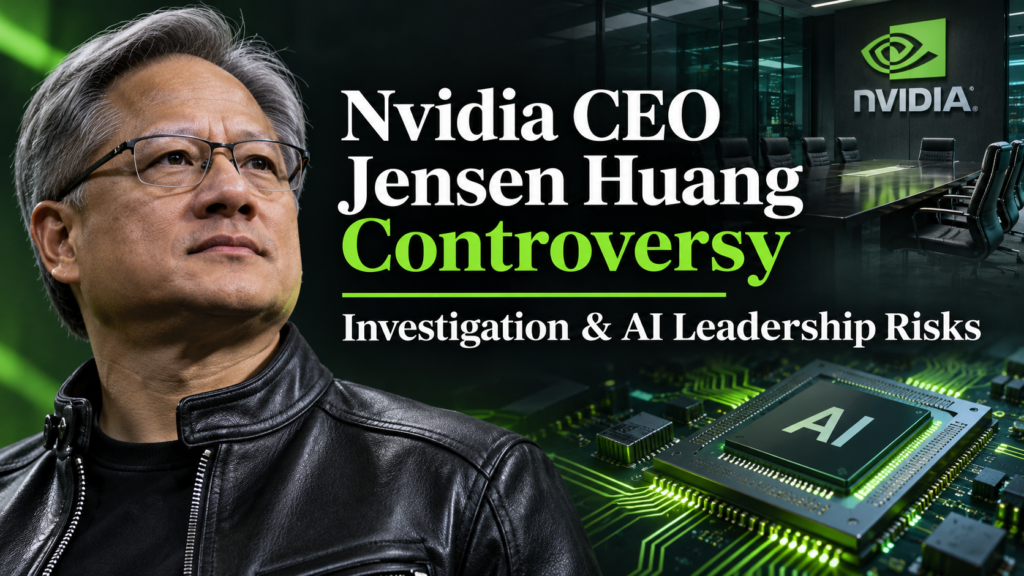
Nvidia CEO Jensen Huang, one of the most influential figures in artificial intelligence, is facing a major controversy that has raised concerns about corporate leadership, national security, and the future of the AI industry.
The billionaire executive, who helped transform Nvidia into a company valued at approximately $4.5 trillion, has acknowledged an extramarital affair amid reports that he may have been targeted by a foreign intelligence operation.
Nvidia’s board has launched an independent investigation, highlighting the risks companies face when their success depends heavily on one powerful leader.
Investigate Nvidia CEO Jensen Huang’s Controversy
Nvidia announced an investigation on November 8 after reports linked Huang to a business executive whom US intelligence officials reportedly suspect of gathering information for China.
Huang admitted to being unfaithful to his wife and apologized for the harm caused to his family. He also expressed support for the company’s investigation.
The board emphasized that it currently has no reason to believe Nvidia’s confidential information or US national security has been compromised. The intelligence allegations remain unproven, and China has rejected them.
Examine Leadership Risks Across the AI Industry
The controversy has exposed a significant weakness known as “key man risk,” where a company’s stability depends heavily on a single executive.
Several major technology companies face similar challenges:
-
Nvidia: Jensen Huang directs its AI chip strategy and global partnerships.
-
Tesla and SpaceX: Elon Musk plays a central role in innovation and business decisions.
-
OpenAI: Sam Altman remains closely associated with the company’s AI ambitions.
-
Meta: Mark Zuckerberg controls major strategic decisions.
-
Anthropic: Dario Amodei guides the company’s AI development and safety direction.
Analysts argue that concentrating leadership responsibilities in a few individuals can create serious challenges during unexpected crises.
Strengthen Corporate Succession Planning
Yale professor Jeffrey Sonnenfeld has raised concerns about Nvidia’s leadership structure and its apparent lack of an obvious successor to Huang.
Unlike JPMorgan Chase, which has developed experienced executives capable of assuming leadership responsibilities, Nvidia relies heavily on its founder’s technical expertise, industry relationships, and strategic vision.
A sudden leadership change could disrupt Nvidia’s operations, partnerships, and investor confidence.
Assess Nvidia’s Future Amid Growing Uncertainty
Huang has played a central role in Nvidia’s growth since co-founding the company in 1993. His influence extends from AI chip development to international technology policy.
However, the investigation has created uncertainty about his future.
Some analysts believe Nvidia could consider restructuring leadership responsibilities if the controversy intensifies. Others argue that Huang’s experience makes him exceptionally difficult to replace.
For now, Huang remains CEO, and Nvidia says its operations will continue without interruption.
Conclusion
The Jensen Huang controversy demonstrates that even the world’s most successful AI companies face leadership vulnerabilities. Strong succession planning, independent oversight, and balanced decision-making are essential for protecting investors and ensuring long-term stability as artificial intelligence becomes increasingly important to the global economy.