
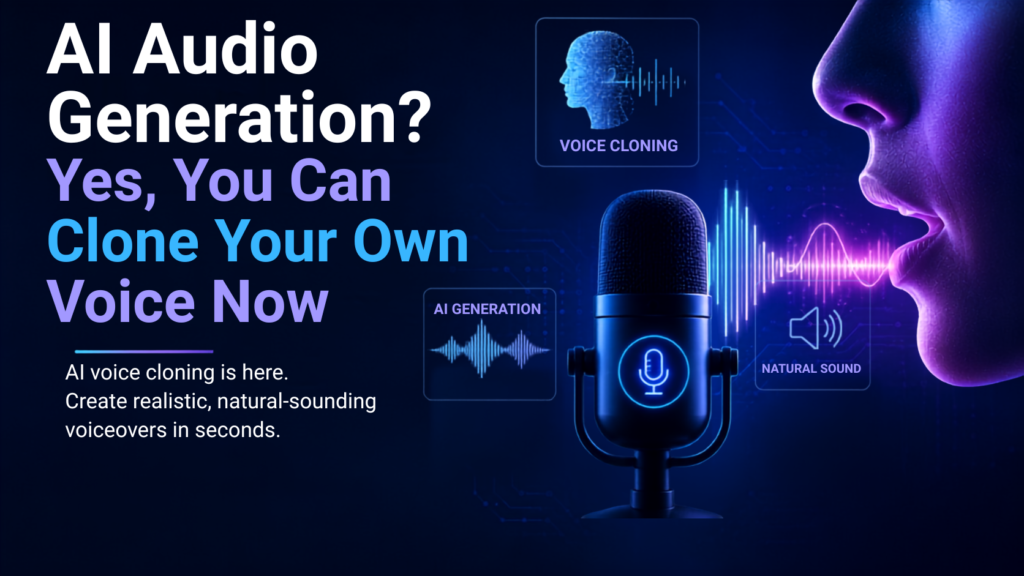
Less than two years ago, AI voice cloning was mostly something people demonstrated for the novelty of hearing a computer imitate a familiar voice. Upload a recording, type a few lines, and the software would produce an approximation that was impressive precisely because it was unexpected.
That novelty phase did not last long.
AI voice cloning and audio generation tools are now being used to repair podcast recordings, narrate videos, create audiobook drafts, localize content into other languages, build accessible speech interfaces, and deliver synthetic voices through software APIs. For creators and businesses producing spoken content regularly, AI-generated audio has moved from an experiment to a practical production option.
The improvement is not simply about making computer-generated speech sound more human. Modern systems can increasingly reproduce pacing, pronunciation patterns, vocal tone, accent characteristics, and elements of emotional delivery. Some tools allow creators to modify speech after recording, while others can generate an entire voiceover from text or reproduce a voice across several languages.
There is also a more serious side to that progress. The same technology that helps a podcaster repair a sentence can be used to impersonate someone who never approved the recording. In a 2025 assessment of six major voice-cloning products, Consumer Reports found that researchers were able to create voice clones from publicly available audio in four of the six services they tested without meaningful technical verification that the speaker had consented.
That finding captures the central tension surrounding AI audio today. The technology is increasingly useful, but the ability to reproduce a recognizable voice makes consent, security, and responsible use just as important as sound quality.
Understand How AI Voice Cloning and Audio Generation Work
What Is AI Voice Cloning and Audio Generation?
AI voice cloning is a form of speech synthesis that creates new spoken audio resembling a particular person’s voice. Instead of selecting only from a library of prebuilt synthetic speakers, a user provides a sample of a real voice. The system studies characteristics that help distinguish that speaker, including pitch, rhythm, accent, pronunciation, pauses, cadence, and tonal patterns.
After the system has created a representation of those vocal characteristics, a text-to-speech model can generate entirely new sentences in a similar voice. The original speaker does not have to record those sentences.
AI audio generation covers a wider range of technologies. It can include cloned voices, ordinary text-to-speech, synthetic dialogue, AI dubbing, speech-to-speech transformation, generated sound effects, and other forms of machine-produced audio.
Different platforms emphasize different parts of that process. A podcast editor may use AI primarily to replace a mistaken sentence. A developer may send text to a TTS API and receive synthesized audio in return. A localization team may generate a translated version of a video while trying to retain some of the speaker’s original vocal identity.
In simple terms, the typical voice-cloning process looks like this:
- The speaker records or uploads sample audio.
- The system analyzes characteristics of the voice.
- A model builds a reusable representation of those vocal patterns.
- The user provides new written text.
- The speech model generates audio based on both the text and the selected voice.
- The resulting speech is delivered as an audio file or, in some systems, streamed in real time.
Current speech models can also consider sentence meaning, punctuation, surrounding words, and delivery style. That allows them to handle pauses and emphasis more naturally than older text-to-speech software that tended to pronounce sentences with a uniform cadence.
Reference quality still matters. A clean recording with one speaker, limited background noise, and consistent microphone placement usually gives the system better material than a compressed clip taken from a noisy video. Longer samples can sometimes provide additional information about variation in the speaker’s delivery, although individual platforms have different requirements.
It is also important to understand that a “clone” is not necessarily a perfect acoustic duplicate. Recent research continues to examine differences between source voices and their synthetic counterparts, including changes in perceived style, accent characteristics, pacing, and personality cues. The practical lesson is simple: similarity should be tested rather than assumed.
Match AI Voice Generation to Real-World Production Needs
AI-generated speech is most useful when spoken content needs to be produced, revised, or localized repeatedly. It can reduce recording friction without necessarily replacing the human judgment behind the final piece.
Produce and Repair Podcasts More Efficiently
Podcast editing is full of small problems that create large inconveniences.
A host may pronounce a sponsor’s name incorrectly, give the wrong date, miss a sentence, or decide after recording that one explanation needs to be clearer. Fixing that mistake conventionally means returning to the microphone and trying to recreate the original recording environment.
The speaker needs similar microphone placement. The room needs to sound roughly the same. Their vocal energy must match. Even then, a replacement sentence can stand out from the surrounding audio.
Voice cloning offers another option.
Descript integrates generated speech with transcript-based audio and video editing. Its AI Speech and Overdub tools allow creators to generate spoken material within the editing environment, making it possible to replace or insert certain lines without rebuilding the entire recording session. Descript describes the workflow as part of its broader text-based media editing system.
That does not make every correction invisible. Delivery differences can still become noticeable, particularly when the original recording contains laughter, excitement, whispering, or highly conversational timing.
For straightforward narration corrections, however, the workflow can save a meaningful amount of production effort.
AI speech can also work before the final recording begins. Podcasters can generate a temporary reading of a script, listen for awkward wording, adjust sentence length, and then record the finished version themselves.
Scale Voiceovers for Content Creators
Video creators often need more narration than they initially expect.
A single tutorial may require an introduction, a corrected product explanation, several short-form versions, an updated call to action, and separate voiceovers for multiple platforms. Recording every variation manually can turn a simple script change into another production session.
AI audio generation makes those revisions easier to handle.
A creator with an authorized clone of their own voice can generate certain updates without returning to the microphone each time. That can be especially useful for software tutorials, educational videos, evergreen explainers, internal training, and social clips that require regular revisions.
The advantage grows when the underlying information changes frequently.
Imagine a software company with 50 training videos. A menu item changes name after a product update. Re-recording every affected section requires scheduling, recording, editing, and matching the original sessions. AI-generated replacements can make that maintenance less disruptive.
Script preparation still has a major effect on quality. Numbers, abbreviations, URLs, acronyms, names, foreign terms, and unusual punctuation can cause unpredictable pronunciation.
Strong AI voice workflows therefore involve more than typing text into a box. They require listening, revising, and regenerating where necessary.
Build Audiobook Narration Workflows
Audiobooks place unusually high demands on a voice.
A narrator may need to maintain consistent pronunciation, character treatment, pacing, energy, and microphone technique over many hours of material. Even small inconsistencies become more noticeable in long-form listening.
AI narration can reduce some of that burden in the right kinds of projects.
Independent publishers may use generated narration for preliminary versions. Educational publishers may use it for instructional books. Authors can create listening drafts before paying for final narration. Frequently revised nonfiction can be updated without re-recording entire chapters.
ElevenLabs provides text-to-speech and voice technologies designed for long-form and multilingual use cases, with different speech models intended for varying priorities such as naturalness, expressiveness, stability, and latency.
That flexibility makes AI increasingly relevant to audiobook production, but it does not eliminate the value of a skilled narrator.
Literary narration involves interpretation. A good performer decides which phrase deserves emphasis, how a character should sound after an emotional event, when to leave silence, and how subtle tonal changes influence meaning.
AI can reproduce many vocal characteristics. Artistic interpretation remains a harder problem.
For that reason, audiobook producers should think in terms of workflow selection rather than replacement. Synthetic narration may be suitable for some titles or production stages while human performance remains preferable for others.
Create Multilingual Dubbing and Localization
Localization is one of the clearest practical applications for AI audio generation.
Suppose a creator publishes a 20-minute English tutorial and wants to reach Spanish, French, German, Arabic, or Japanese audiences. Traditional dubbing can require translators, adapters, voice actors, recording sessions, audio editors, and quality control for each language.
AI can compress portions of that process.
A translated script can be synthesized into another language, and some systems can generate the speech in a voice intended to preserve characteristics of the original speaker.
Play.ht, for example, supports voice cloning and text-to-speech capabilities aimed at multilingual and developer applications. ElevenLabs similarly provides multilingual speech generation and dubbing-related tools.
The opportunity is substantial, but automated localization still needs human review.
Translation can be grammatically correct and still sound wrong to a native speaker. Humor may not transfer. Product terminology may need adaptation. Proper names can be mispronounced. A phrase that takes three seconds in English may require six seconds in another language, creating timing problems in video.
Good localization therefore combines automation with linguistic judgment.
AI can accelerate speech production. Native-language reviewers still need to verify whether the final version actually communicates the intended meaning.
Improve Accessibility and Voice Preservation
AI voice cloning also has uses that have little to do with content marketing.
People who are losing or expect to lose the ability to speak may be able to record voice samples for future use with assistive communication systems. A personalized synthetic voice can preserve something that standard computer voices cannot: a degree of recognizable vocal identity.
That can matter deeply in everyday communication.
Generated speech can also make written material available in audio form for people who have difficulty reading conventional text or who rely more heavily on listening.
These applications increase the importance of data protection.
A voice recording is not merely another media file. It can reveal identity, accent, age-related characteristics, emotional information, and other personal cues. Once a reusable voice model exists, misuse can be more consequential than the unauthorized copying of an ordinary audio clip.
People using voice-preservation tools should therefore examine how reference recordings are stored, whether models can be deleted, what permissions apply, and whether the provider uses submitted data for additional model training.
Generate Marketing, Advertising, and Brand Audio
Marketing teams can produce dozens or hundreds of spoken assets across a single campaign.
There may be social advertisements, landing-page videos, product explainers, sales demonstrations, onboarding sequences, internal training, retail audio, and localized versions for different markets.
AI-generated voices allow some of that material to be produced without arranging a new recording session every time copy changes.
A company might also create an approved synthetic voice for routine branded narration. That can help keep delivery more consistent across campaigns and reduce dependence on studio availability.
The benefit comes with an important contractual question: who controls the voice?
If the voice is based on an employee, actor, contractor, influencer, or spokesperson, the agreement should specify where the synthetic version can be used and for how long.
A brand should not assume that hiring someone for one recording session automatically gives it unlimited permission to generate new performances from that person’s voice years later.
Industry observers increasingly point to this distinction between recording rights and synthetic-replica rights. Permission to publish one recording and permission to generate unlimited future speech are not the same thing.
Compare the Top AI Voice and Audio Tools Worth Knowing
The leading AI voice tools overlap in functionality, but they are not interchangeable. Some focus on high-fidelity speech, some on editing, some on developer infrastructure, and some on business voiceover workflows.
The right choice depends less on which platform has the most impressive demo and more on where the generated speech needs to fit.
ElevenLabs
ElevenLabs is one of the most visible platforms in contemporary AI speech generation and is particularly well known for natural text-to-speech and voice cloning. It was also one of the four platforms named in the Consumer Reports assessment referenced earlier as lacking a technical mechanism to confirm speaker consent — a point worth weighing alongside its speech quality, especially for any commercial or public-facing use.
Its product ecosystem includes text-to-speech, Instant Voice Cloning, Professional Voice Cloning, multilingual speech generation, dubbing tools, voice design, sound effects, and developer access through APIs.
Different speech models are designed around different production priorities. A creator working on expressive narration may have different requirements from a developer building a low-latency conversational application.
For individual creators, ElevenLabs’ appeal lies partly in the combination of relatively accessible voice creation and sophisticated speech quality. For developers, the API allows generated audio to become part of a larger product rather than remaining a manually exported file.
The platform fits projects such as video narration, audiobooks, localization, conversational interfaces, and serialized content where a consistent voice needs to be generated repeatedly.
As with any voice-cloning service, users should still evaluate consent requirements and test output using their own source recordings.
Murf AI
Murf AI approaches AI voice generation more like a production studio.
Its tools are aimed at users creating professional voiceovers for presentations, videos, advertisements, training content, explainers, and business communications. The platform combines synthetic voices with editing controls rather than presenting text-to-speech purely as a technical API.
Murf’s broader offering includes voice generation, different speaking styles, editing tools, dubbing-related capabilities, and developer services.
That makes it particularly relevant to companies that want repeatable voiceover production without building their own speech infrastructure.
A learning and development team, for example, may care less about experimenting with cutting-edge speech models and more about producing clear narration consistently across dozens of training modules.
That difference in workflow matters when comparing platforms.
Descript
Descript stands apart because AI voice generation is embedded inside a broader audio and video editor.
Its core concept is text-based media editing. Recorded audio or video is transcribed, and creators can make certain edits by changing the transcript instead of manipulating only traditional waveforms.
Descript’s AI Speech and Overdub functionality extends that approach by allowing users to generate or replace spoken material within the project.
That makes the platform especially useful for podcasters and video creators.
If a podcast contains an incorrect sentence, a creator does not necessarily want to export the audio, generate a replacement line in another tool, download the file, re-import it, and manually align everything.
An integrated workflow removes several of those steps.
Descript also provides transcription, video editing, captions, cleanup tools, filler-word removal, and other production features. Someone primarily looking for realistic standalone TTS may compare it differently from someone whose main objective is editing existing recordings.
Play.ht

Play.ht, which has also used PlayAI branding across parts of its product offering, combines synthetic voice generation with developer-focused capabilities.
Its services include text-to-speech, voice cloning, multilingual generation, and APIs that can support streamed or real-time speech.
That makes the platform relevant to two different groups.
Creators can use it for narration and voiceover production, while developers can explore generated speech for applications such as conversational interfaces, games, virtual characters, interactive software, and other products where audio must be produced dynamically.
Real-time use introduces requirements that do not matter as much for ordinary voiceovers.
Latency becomes important. Streaming quality matters. The software must handle interruptions, sentence boundaries, and network conditions gracefully.
Anyone evaluating Play.ht for those purposes should test the API under conditions close to the intended application rather than relying only on prerecorded demonstrations.
Fish Audio
Fish Audio occupies a particularly interesting position because its ecosystem combines consumer-accessible speech generation with open-source roots and publicly available model-development work.
The Fish Audio organization maintains Fish Speech on GitHub, giving technically minded users visibility into the research and engineering direction behind parts of the platform. Developers should pay attention to licensing details, however. Current Fish Speech code and model releases may be distributed under specific Fish Audio licensing terms rather than a blanket unrestricted open-source license, so intended commercial use should be checked against the applicable license.
The platform emphasizes natural text-to-speech, voice cloning, multilingual generation, and expressive speech. Its cloning capabilities are designed to reproduce recognizable aspects of a reference voice, with output quality benefiting from clean and representative input recordings.
Fish Audio also provides a TTS API, which makes the service relevant beyond one-off browser generation. Developers can integrate speech into applications, automation pipelines, interactive products, or other systems that need programmatic audio generation.
That combination distinguishes Fish Audio from editor-first tools such as Descript. A podcaster may prefer the convenience of editing speech directly inside an existing episode, while a technical team building a speech-enabled product may place greater value on APIs, model behavior, deployment considerations, and the surrounding development ecosystem.
For users evaluating AI voice cloning quality specifically, Fish Audio is worth testing alongside other leading platforms using the same source clip and script. The most meaningful comparison is not a provider’s showcase demo but how accurately each system handles the speaker, language, pronunciation, and emotional range required by the actual project.
Speechify Studio

Speechify is widely known for turning text into spoken audio, and its broader studio tools extend that experience into voiceover creation and other generated-speech workflows.
Its appeal is accessibility.
A user may not want to manage a complex audio workstation or integrate an API. They may simply want to take written material, choose a suitable voice, adjust the output, and produce narration.
That can make Speechify Studio a practical option for educational content, internal media, creator projects, and straightforward spoken versions of written material.
As with the other platforms in this category, the appropriate choice depends on the job being done rather than the length of the feature list.
Compare AI Voice Generation Tools Side by Side
AI voice platforms package usage in very different ways. Some measure characters or credits, some organize plans around generation allowances, and API pricing may operate separately from creator subscriptions.
For that reason, the table below uses general pricing categories rather than fixed figures that could become outdated quickly.
| Tool | Best For | Standout Feature | General Pricing Tier |
|---|---|---|---|
| ElevenLabs | Narration, audiobooks, dubbing, developers | Expressive TTS with multiple voice-cloning workflows | Free entry option with paid creator, usage-based, and enterprise tiers |
| Murf AI | Training content, presentations, business voiceovers | Studio-style voiceover production environment | Limited/free access with paid business and professional options |
| Descript | Podcasts, videos, recording corrections | Transcript-based editing combined with generated speech | Free or limited tier with paid creator and professional plans |
| Play.ht / PlayAI | Multilingual speech and developer applications | Voice cloning with real-time and API-focused capabilities | Entry-level access with paid usage and enterprise options |
| Fish Audio | Voice cloning, technical experimentation, API projects | Fish Speech ecosystem plus programmable TTS | Limited/free access with paid or usage-based options |
| Speechify Studio | Easy narration and content conversion | Accessible speech-generation workflow | Subscription-based creator options with higher-feature tiers |
Pricing should be compared against actual production volume rather than subscription labels alone.
A creator generating ten short videos a month has different needs from a publisher producing multiple audiobook hours. A developer serving speech to thousands of application requests has another cost profile entirely.
The cheapest entry plan is not necessarily the cheapest operational choice.
Evaluate Consent, Quality, Pricing, and Use-Case Fit Before Choosing
Require Explicit Permission Before Cloning a Voice
Voice consent should be the first requirement, not a legal detail considered after production begins.
Access to a recording does not automatically provide permission to turn the speaker’s voice into a reusable synthetic model.
That distinction matters because a cloned voice can generate statements the original speaker never made. The technology can therefore be used for legitimate narration and accessibility while also creating opportunities for impersonation, fraudulent calls, unauthorized advertisements, deceptive endorsements, and misinformation.
Consumer Reports’ 2025 assessment illustrates how uneven platform protections can be. Researchers tested six voice-cloning products and reported that they could readily create a clone from publicly available audio in four of them without a meaningful technical mechanism confirming the original speaker’s consent.
The lesson for users is not that every AI voice platform is unsafe. It is that platform safeguards do not remove the user’s responsibility to obtain authorization.
Before cloning another person’s voice, establish permission for the specific intended use.
A commercial agreement should ideally clarify:
- who may generate the synthetic voice,
- which projects can use it,
- whether the voice can appear in advertising,
- whether multilingual versions are permitted,
- how long authorization lasts,
- and whether the voice model must be deleted when the relationship ends.
Public availability is not consent. A celebrity, executive, politician, content creator, employee, customer, or family member may have hundreds of recordings online and still have never authorized a synthetic reproduction.
Test Voice Quality With Your Own Material
The most impressive sample on a vendor’s website is rarely the best basis for choosing a tool.
Those demonstrations are naturally selected to show the technology under favorable conditions.
A serious evaluation should use the material the system will actually need to handle.
Test names. Test numbers. Test product terminology. Test long paragraphs. Test whispered or excited delivery if that matters. Test questions, abbreviations, acronyms, addresses, dates, and multilingual sentences.
Then listen closely.
Does the model emphasize the right word? Does it pause naturally? Does a cloned accent remain stable? Does the energy disappear halfway through a paragraph? Does a proper name sound wrong every time it appears?
These problems often matter more in finished production than an abstract judgment about whether a voice sounds “realistic.”
Long-form listening is especially revealing. A voice may sound convincing for 15 seconds but repetitive after 20 minutes because the same rhythm or emotional pattern appears repeatedly.
Choose a tool based on sustained performance, not a single impressive line.
Calculate Pricing Around Output Volume
AI audio prices are difficult to compare because the unit of measurement differs from one provider to another.
One platform may count characters. Another may assign credits. Another may limit generated minutes. Certain voice models, cloning features, or higher-quality modes may consume allowances differently.
Developers can face additional variables such as API usage, concurrent requests, streaming, or premium model access.
Before subscribing, estimate how much usable audio you intend to produce.
Then account for rejected generations.
A five-minute finished narration does not necessarily require only five minutes of generation. You may regenerate a sentence several times because the first version mispronounces a term or stresses the wrong phrase.
That extra usage becomes relevant at scale.
Companies should also examine commercial licensing, team access, usage rights, storage policies, and enterprise requirements instead of treating monthly subscription cost as the only financial consideration.
Choose the Tool That Fits the Workflow
The “best AI voice generator” depends heavily on what happens before and after speech generation.
For a podcaster, Descript’s integrated editing workflow may matter more than access to hundreds of voices.
For a software developer, API documentation, latency, reliability, streaming support, and rate limits can outweigh the convenience of a visual editor.
For an audiobook producer, long-form consistency and expressive control may take priority.
For a corporate learning team, collaboration, predictable licensing, pronunciation controls, and standardized output may matter most.
For a technically oriented team experimenting with speech infrastructure, Fish Audio’s model ecosystem and TTS API may be a more important consideration than traditional media-editing features.
Voice quality is therefore only one column in the buying decision.
Workflow fit determines whether a tool actually saves time.
Build a Responsible AI Audio Workflow
Responsible AI voice production begins before the first synthetic sentence is generated.
Use voices that are authorized for the project. Store reference recordings carefully. Limit access to cloned voices. Keep track of where generated audio is being published. Review every output that will reach an audience.
Do not assume that a generated file is correct simply because it sounds fluent.
AI speech systems can mispronounce names, misunderstand abbreviations, introduce odd pauses, flatten emotional meaning, or read numerical information in an unexpected way. Human review is still part of quality control.
Disclosure should also be considered according to the situation.
A synthetic narrator reading routine instructional content is different from an artificial voice being presented in a context where listeners reasonably believe they are hearing the real person speaking live or making a personal statement.
The greater the possibility of confusion, the stronger the case for clear disclosure.
Organizations should also create policies for voice ownership and authorization.
If an employee provides recordings for a company’s synthetic voice, what happens when that employee leaves? Can the company continue generating new speech? Can it use the voice in advertisements that did not exist when consent was given?
The same questions apply to actors, freelance narrators, influencers, executives, and contractors.
Voice cloning makes reproduction easy. Governance needs to be equally deliberate.
Use AI Voice Generation Where It Adds Genuine Value
The most consequential change in AI audio is not simply that software can imitate a speaker.
It is that spoken content is becoming editable in ways that previously belonged almost exclusively to written text.
A sentence can be rewritten after the original recording session has ended. A tutorial can be adapted for another market. A product team can generate speech inside an application. A narrator can hear a draft before recording the final version. An old training course can be updated without recreating every voiceover from scratch.
Those capabilities change the economics of audio production.
They do not eliminate the value of human performance.
Interviews, dramatic storytelling, character acting, comedy, intimate personal narratives, and emotionally complicated narration still benefit heavily from human interpretation. A performer is doing more than converting words into sound. They are deciding how those words should feel.
AI works best when it solves a production problem rather than when it is used simply because generation is possible.
For repetitive narration, rapid revisions, accessibility, draft production, localization, and software-driven speech, the productivity advantage can be substantial.
For projects built around personality or emotional performance, a human voice may remain the strongest creative choice.
Answer Common Questions About AI Voice Cloning
Can AI really clone my own voice?
Yes. Several AI voice platforms can create a synthetic version of a user’s voice from recorded samples and then generate new sentences from written text.
The quality varies according to the platform, language, reference recording, speaking style, and complexity of the script. Some services can build an initial clone from short samples, while more advanced cloning methods may benefit from additional recorded material.
Which AI voice cloning tool is best?
There is no single best tool for every project.
ElevenLabs is strong for expressive speech and broad voice-generation workflows. Descript is particularly useful for podcasters and video creators who need generated speech inside an editing environment. Murf AI focuses heavily on structured professional voiceover production. Play.ht offers developer-oriented and real-time capabilities. Fish Audio combines voice cloning and text-to-speech with a technically interesting model ecosystem and TTS API.
Test the same script across several platforms before committing to one.
Can AI voice cloning be used commercially?
Many AI voice services offer plans intended for commercial projects, but usage rights vary between providers and subscription tiers.
Commercial access to a platform also does not grant permission to clone someone else’s voice.
Two separate permissions may be involved: the right to use the software commercially and the right to reproduce the voice itself.
Review both before publishing generated audio.
How much audio is needed to clone a voice?
The amount depends on the platform and the type of cloning being used.
Some systems can create an initial clone from a relatively short sample. Higher-fidelity approaches may benefit from longer recordings containing different sentences, tones, and speaking patterns.
Audio quality matters as much as duration.
A clean recording with one clearly audible speaker will generally provide better reference material than a longer recording filled with music, echo, clipping, interruptions, or background conversations.
Will AI-generated voices replace human voice actors?
AI will probably handle an increasing share of repetitive, rapidly changing, or high-volume spoken content.
That includes some training narration, localization, product demonstrations, draft audio, automated announcements, and large-scale content variations.
Human performers continue to offer advantages in emotional interpretation, character development, improvisation, humor, dramatic timing, and artistic direction.
The more likely future is a mixed production environment in which synthetic speech handles certain repetitive tasks while human performers focus on work where performance itself carries much of the value.
Start Experimenting With AI Audio, Carefully
AI voice cloning and audio generation have reached the point where creators can evaluate them as production tools rather than technology demonstrations.
ElevenLabs offers sophisticated speech generation and cloning across creator and developer workflows. Murf AI packages synthetic narration into a studio-oriented environment suited to business content. Descript makes generated speech useful inside podcast and video editing. Play.ht combines voice cloning with multilingual and real-time developer capabilities. Fish Audio brings together capable cloning, text-to-speech, a TTS API, and an unusually visible model-development ecosystem.
Each solves a slightly different problem.
The right starting point is not choosing whichever tool produces the flashiest sample. Start with the work you actually need to complete.
Take a representative script. Use a voice you own or have explicit permission to reproduce. Generate the same passages in several tools. Listen for pronunciation, pacing, emotion, accent consistency, and long-form fatigue. Compare editing workflows, licensing terms, privacy controls, and likely usage costs.
Then decide where synthetic speech genuinely improves production.
For some teams, that may mean fixing a sentence without reopening the studio. For others, it may mean dubbing a video for several markets, preserving a personal voice for accessibility, or delivering speech dynamically inside an application.
AI audio generation is becoming easier to use. The competitive advantage will come from using it selectively, securely, and with enough editorial judgment to know when a generated voice serves the work and when a real human performance still does the job better.