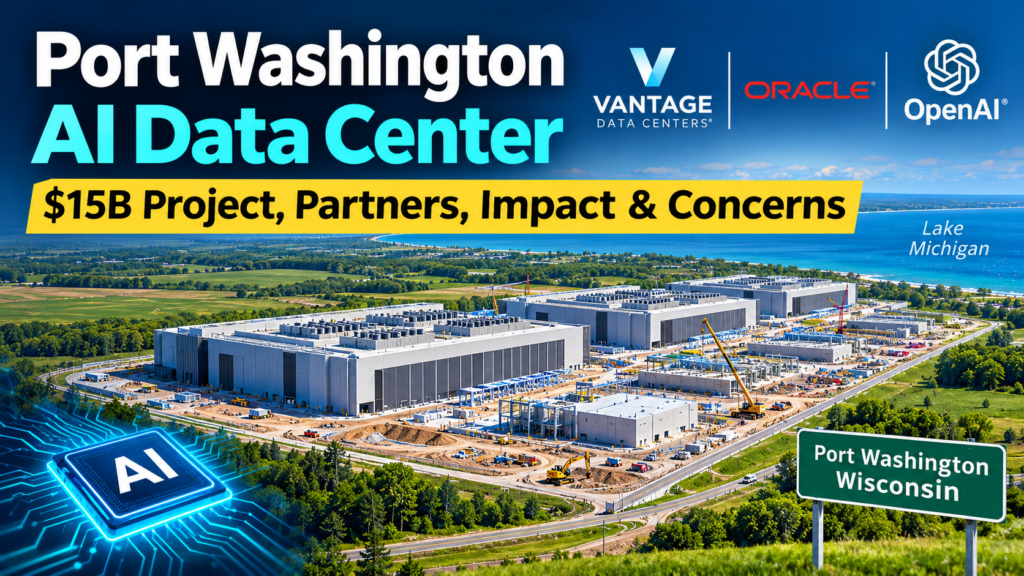
The Port Washington data center is a $15 billion artificial intelligence infrastructure project under construction in Port Washington, Wisconsin. Developed by Vantage Data Centers in partnership with Oracle and OpenAI, the Lighthouse Campus is designed to support advanced AI computing, hyperscale cloud infrastructure, and the growing demand for high-performance data processing.
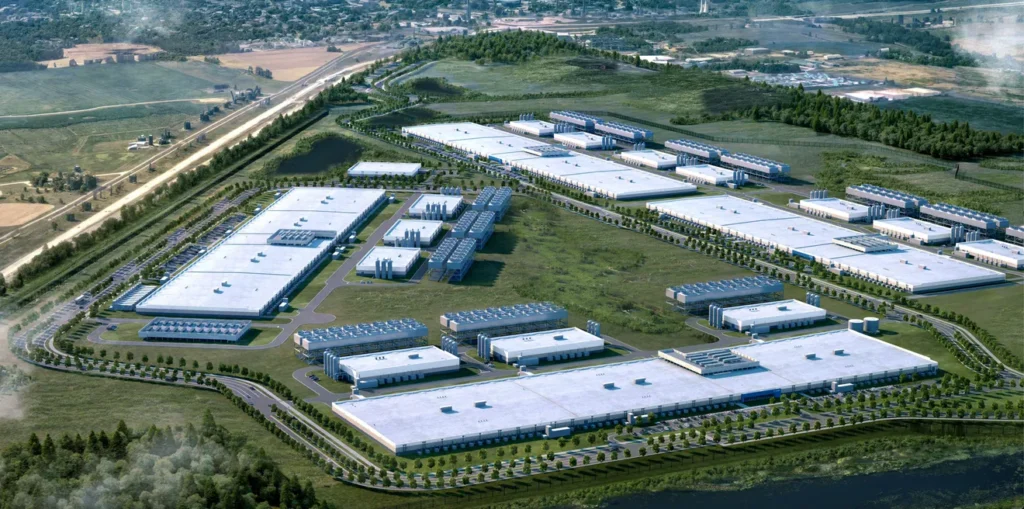
Located in Ozaukee County, approximately one mile inland from Lake Michigan, the development covers 672 acres of previously agricultural land. The project includes four planned data center buildings, nearly one gigawatt of announced AI computing capacity, and major investments in power transmission, cooling technology, and local infrastructure.
The Port Washington AI data center has attracted national attention because of its size, its connection to OpenAI’s Stargate initiative, and its potential economic impact. It has also raised questions about electricity consumption, environmental protection, construction activity, water requirements, and public financial incentives.
According to Vantage’s October 22, 2025 announcement, the campus is scheduled for completion in 2028. As of November 2026, construction is underway, with additional infrastructure planning and regulatory reviews continuing.
This guide examines the project using official information from Vantage Data Centers, Oracle, the Wisconsin Department of Natural Resources, the Public Service Commission of Wisconsin, and local reporting.
1. Locate the Port Washington Data Center and Review Its Site Plans
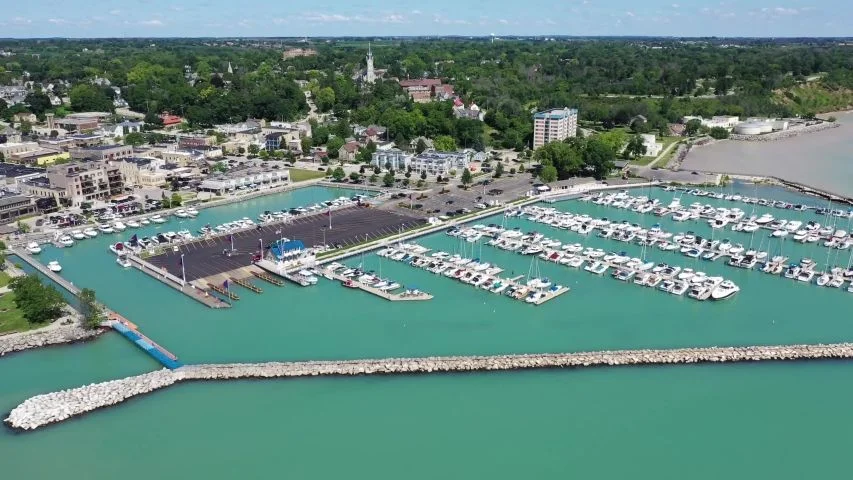
The Port Washington data center is being developed on the northern side of Port Washington, a city in Ozaukee County, southeastern Wisconsin. The property sits approximately one mile inland from Lake Michigan and within reach of Interstate 43, which connects the area with Milwaukee and other regional transportation networks.
The Wisconsin Department of Natural Resources identifies the development as Vantage’s Lighthouse Campus. The agency states that the project occupies 672 acres of former agricultural land and that Vantage owns approximately 1,644 acres in the surrounding area. These figures distinguish the current campus footprint from the developer’s broader landholdings.
Oracle states that the four buildings will occupy approximately 500 acres of the 672-acre campus, with the remaining acreage designated for natural spaces. This arrangement forms part of the project’s published development plan, although the final condition of landscaped and preserved areas will depend on construction and ongoing site management.
Review the Location and Project Specifications
| Project Feature | Reported Details |
|---|---|
| Project name | Lighthouse Campus, also called Project Lighthouse |
| Location | Port Washington, Wisconsin |
| County | Ozaukee County |
| Developer | Vantage Data Centers |
| Technology partners | Oracle and OpenAI |
| Total investment | More than $15 billion announced |
| Campus size | 672 acres |
| Planned buildings | Four |
| Total planned building area | Approximately 2.5 million square feet |
| Announced AI capacity | Close to 1 gigawatt |
| Expected completion | 2028 |
| Current status | Under construction |
The location matters because AI data centers require large development sites, electrical infrastructure, industrial construction resources, and reliable communications networks. Port Washington offers access to southeastern Wisconsin’s regional workforce and established transportation routes.
However, developing an industrial campus on former agricultural land also changes the surrounding landscape. The project’s size makes stormwater management, visual screening, construction traffic, and environmental compliance important throughout development.
2. Identify the Companies Behind the Port Washington AI Data Center
Vantage Data Centers, Oracle, and OpenAI are the principal companies associated with the Port Washington data center. Each contributes different capabilities to the development, from physical infrastructure to cloud services and artificial intelligence computing.
Vantage is responsible for developing the Lighthouse Campus. Oracle is a major technology partner associated with the project’s cloud computing infrastructure, while OpenAI is connected to the AI workloads that the facility is intended to support.
Their collaboration was formally announced on October 22, 2025, when Vantage identified the Wisconsin campus as part of the broader Stargate infrastructure expansion.
Examine Vantage Data Centers’ Role
Vantage Data Centers specializes in developing large-scale facilities for hyperscale and cloud computing customers. Its responsibilities include campus planning, facility engineering, power and cooling infrastructure, physical security, and construction coordination.
At Port Washington, Vantage is overseeing the development of four large data center buildings and their supporting facilities.
The company’s infrastructure experience is relevant because high-density computing environments have demanding operational requirements. Electrical reliability, thermal management, equipment access, and security must be incorporated into building design before the facilities are commissioned.
Examine Oracle’s Role
Oracle operates cloud infrastructure used for enterprise computing, databases, AI applications, and other demanding workloads.
Its participation in Project Lighthouse connects the physical data center facilities to broader computing services. Oracle has also published information about the development’s expected employment, infrastructure investments, cooling strategy, and energy commitments.
On September 17, 2026, Oracle and Vantage announced a campaign outlining the campus’s commitments to Wisconsin communities. The announcement included updated information about electricity sourcing, local infrastructure investments, and anticipated economic benefits.
Examine OpenAI’s Role
OpenAI develops artificial intelligence systems that require specialized computing capacity for training, inference, evaluation, and related processing.
The Lighthouse Campus forms part of the Stargate infrastructure initiative associated with OpenAI and Oracle. The development is intended to support the substantial computational requirements of advanced AI systems.
AI infrastructure differs from conventional business computing in several ways. Large deployments can require densely installed processors, high-speed connections between computing systems, specialized cooling, and continuous operational monitoring.
The Port Washington project reflects the growing importance of purpose-built facilities capable of supporting these technical requirements.
3. Review the $15 Billion Investment and Campus Construction Plans
The Port Washington data center represents an announced investment of more than $15 billion, making it one of Wisconsin’s most prominent technology infrastructure developments.
The project includes four single-story data center buildings with a combined planned area of approximately 2.5 million square feet, according to September 2026 reporting by the Ozaukee Press. The buildings will house computing infrastructure and supporting electrical, mechanical, and operational equipment.
The overall investment extends beyond basic building construction. Large AI data centers require high-capacity electrical distribution equipment, cooling technology, networking systems, security infrastructure, backup generators, and specialized computing hardware.
Examine Major Construction Components
The campus’s four data center buildings will provide space for large computing installations. Their design must support substantial equipment loads, specialized electrical systems, and efficient heat removal.
Electrical infrastructure will connect the buildings to the broader power supply system. This includes substations, transformers, distribution equipment, protective systems, and facility-level power management.
Mechanical infrastructure will support liquid cooling, circulation equipment, ventilation, and environmental monitoring. These systems help maintain operating conditions for high-performance computing hardware.
Site infrastructure includes internal roads, utility connections, stormwater controls, security access, and landscaping. Because the property previously supported agricultural uses, substantial grading and preparation are required.
Evaluate the Financial Scope
An announced project investment does not necessarily represent money already spent or the property’s taxable value.
Different financial figures may include land development, building construction, technology equipment, power infrastructure, and future spending commitments.
For this reason, the estimated $15 billion investment should be distinguished from annual local tax revenue, municipal financing arrangements, and the value of individual construction contracts.
The project’s full economic impact will depend on how much spending occurs locally, the number of jobs actually created, and how long the facilities remain operational.
4. Track Port Washington Data Center Construction Updates and Completion Dates
The Port Washington data center entered its construction phase in late 2025 and continued progressing throughout 2026. Vantage’s original announcement identified 2028 as the planned completion year, although individual buildings may be delivered before the entire campus is finished.
Construction schedules for large data centers typically involve site preparation, foundations, steel structures, building enclosures, electrical installation, cooling systems, technology equipment, and commissioning.
These activities can overlap across multiple buildings. A completed exterior does not establish that a facility is ready to operate, because the installed equipment must undergo extensive testing before live computing workloads begin.
Follow the Major Development Milestones
January 2025: Port Washington officials began publicly discussing a major data center proposal.
October 22, 2025: Vantage Data Centers, Oracle, and OpenAI formally announced the Lighthouse Campus as part of the Stargate infrastructure expansion.
December 2025: Construction activities began on the development.
June 12, 2026: The Wisconsin Department of Natural Resources issued air pollution control permits for 45 diesel-fired emergency generators.
September 2026: Vantage, Oracle, and OpenAI participated in a community information event addressing environmental questions, construction activity, and the development’s expected benefits.
September 18, 2026: American Transmission Company’s revised Ozaukee County Distribution Interconnection Project application entered regulatory review.
October 2026: Local reporting described continued progress on the four-building campus, including staged plans to turn facilities over to technology customers.
November 2026: The campus remains under construction, while water and electrical infrastructure applications continue through regulatory processes.
Check the Expected Opening Date
Vantage’s original completion target is 2028.
However, local reporting in October 2026 indicated that portions of the facilities could begin being turned over to Oracle and OpenAI toward the end of 2027. Construction representatives described a phased process in which some sections may begin operating while other sections remain under development.
This distinction is important for anyone searching for the Port Washington data center opening date. The first operational phase and final completion of the entire campus are separate milestones.
Actual activation dates will depend on construction progress, technology installation, commissioning, and available infrastructure.
5. Examine the Electricity Demand and Energy Supply Strategy
The Port Washington AI data center requires substantial electricity to operate advanced computing equipment, cooling systems, networking infrastructure, and supporting facilities.
Vantage originally announced that the campus would provide close to one gigawatt of AI capacity. One gigawatt equals 1,000 megawatts, although installed capacity does not mean that the facility will consume the same amount of electricity at every moment.
Actual electricity consumption depends on equipment utilization, system efficiency, cooling requirements, and operating conditions.
The project also requires major transmission infrastructure improvements, which are subject to oversight by the Public Service Commission of Wisconsin.
Review the Electrical Transmission Project
American Transmission Company has proposed the Ozaukee County Distribution Interconnection Project to support electrical service associated with the new data center campus.
The project involves substantial transmission infrastructure development and regulatory review. A revised application was filed in September 2026 and was listed as under review by the Public Service Commission.
Transmission infrastructure is necessary because a large AI campus cannot simply connect to a conventional local electricity distribution system without evaluating available capacity.
Utilities must assess reliability, network upgrades, engineering requirements, environmental effects, and the allocation of infrastructure costs.
Evaluate Renewable Energy Commitments
Oracle’s September 17, 2026 announcement states that more than 50% of the power capacity serving the campus is expected to come from carbon-free resources, including wind, solar, and battery storage.
The company also states that the remaining electricity will be matched with renewable energy purchases, prioritizing Wisconsin-based projects.
Oracle has described plans to add approximately two gigawatts of zero-emission power to Wisconsin’s grid as part of the broader energy strategy.
Earlier Oracle information published in January 2026 described a 70% zero-emission energy target. Because the September announcement uses a different measure and description, the figures should not be treated as identical.
The newer statement is particularly relevant when evaluating current electricity commitments.
Assess Potential Electricity Rate Impacts
One of the main concerns surrounding the development is whether the campus will affect electricity bills for Wisconsin residents.
Oracle states that the developers intend to cover the project’s electrical infrastructure costs rather than shifting those expenses to other customers.
On October 2, 2026, Oracle also announced a planned commitment to absorb approximately $300 million in rising Point Beach energy costs associated with an energy arrangement affecting Wisconsin customers. The company noted that its proposed participation remained subject to approval by the Public Service Commission.
These commitments are significant, but their final effects depend on regulatory decisions, utility agreements, and implementation.
For residents, the strongest evidence of long-term rate impacts will come from approved utility filings and actual billing outcomes rather than projections alone.
6. Evaluate Water Consumption and the Closed-Loop Cooling System
The Port Washington data center is designed to use closed-loop, non-evaporative liquid cooling to manage heat generated by computing equipment.
Unlike cooling systems that continuously lose substantial water through evaporation, closed-loop systems recirculate cooling fluid through a controlled network. The fluid absorbs heat from equipment and transfers that heat to other components for removal.
Oracle states that this approach is intended to reduce water consumption compared with more water-intensive cooling designs.
However, a closed-loop cooling system does not eliminate every water requirement. Large industrial campuses still need water for sanitation, maintenance, system filling, and emergency fire protection.
Review the Proposed Water Infrastructure
In July 2026, the City of Port Washington submitted an application to the Public Service Commission of Wisconsin for approximately 4.2 miles of new 16-inch water main.
The project is intended to provide a redundant water supply connection to the Vantage campus.
According to the commission’s application summary, the planned system includes:
- An estimated daily demand of 22,000 gallons.
- A target fire flow of 3,500 gallons per minute for three hours.
- An estimated construction cost of $11.4 million.
- A proposed construction start date of January 4, 2027.
- A proposed completion date of October 29, 2027.
These figures represent information in the utility application, not independently measured operating consumption from a completed campus.
Examine the Water-Positive Commitment
Oracle has announced a goal of making Project Lighthouse water positive through restoration initiatives intended to return more water to the environment than the campus consumes.
Such initiatives can include watershed restoration, wetland improvements, and other water conservation activities.
The practical value of this commitment depends on how projects are measured, whether restoration occurs in relevant watersheds, and whether environmental benefits are independently verified.
Actual water withdrawal data and publicly available monitoring results will provide a clearer assessment after the facility begins operating.
Assess Wastewater and Stormwater Requirements
The development also requires sanitary sewer service and stormwater management.
Sanitary sewer infrastructure handles wastewater generated by onsite facilities. Stormwater systems manage rainwater and snowmelt flowing from developed areas, including roads, roofs, and landscaped surfaces.
Because the campus occupies former farmland, changes in ground coverage and drainage patterns require careful engineering.
The Wisconsin Department of Natural Resources has reviewed relevant plans and applications as part of the project’s environmental oversight.
7. Verify Environmental Permits and Protection Measures
The Wisconsin Department of Natural Resources regulates several environmental aspects of the Port Washington data center, including air emissions, wetlands, stormwater, and related development activities.
Environmental review is important because the project involves extensive land disturbance, permanent industrial structures, backup power equipment, and new utility connections.
The DNR completed an environmental analysis under the Wisconsin Environmental Policy Act. It published an Environmental Analysis Summary in December 2025 and issued supplemental information in June 2026.
These documents provide an official basis for understanding environmental issues, although permit approvals do not eliminate the need for ongoing compliance.
Check the Emergency Generator Permits
On June 12, 2026, the Wisconsin DNR issued air pollution control permits covering 45 diesel-fired emergency generators.
These generators are intended to provide backup electricity when normal power supply conditions are disrupted or when otherwise permitted operating circumstances arise.
Diesel generators can produce nitrogen oxides, particulate matter, and other emissions. Their environmental effects depend on equipment specifications, operating hours, fuel use, and compliance with permit conditions.
The permits followed a public comment period and hearing in spring 2026.
Review Wetland and Land Protection
The Lighthouse Campus occupies land near environmentally sensitive features, including areas requiring wetland review.
Wetlands support water storage, natural drainage, vegetation, and wildlife habitat. Construction near these areas requires attention to grading, sediment control, and water movement.
The DNR has published wetland determinations and environmental documentation associated with the project.
Anyone assessing the project’s land impact should distinguish the approved development footprint from nearby land owned by Vantage that is not necessarily scheduled for immediate construction.
Monitor Noise, Lighting and Construction Activity
Construction equipment, material deliveries, temporary lighting, and large work crews can affect surrounding properties.
Residents have raised concerns about construction noise and light pollution. These issues were also discussed during a September 2026 community event attended by representatives of Vantage, Oracle, and OpenAI.
Landscape buffers, construction scheduling, equipment placement, and lighting controls may help reduce some impacts.
Long-term evaluation will require monitoring conditions after construction is complete, because permanent mechanical systems create different noise characteristics from temporary construction activities.
8. Explore Port Washington Data Center Jobs and Career Opportunities
The Lighthouse Campus is expected to create thousands of construction jobs and support a substantial number of ongoing positions once operations begin.
Oracle projects more than 4,000 union construction jobs and more than 1,000 ongoing project-supported jobs onsite.
The construction workforce includes skilled trades responsible for building the facilities and installing specialized infrastructure. Permanent operations will require personnel to maintain electrical systems, cooling equipment, security, and other critical services.
The number of workers present will vary over time, and projected job totals should not be interpreted as verified numbers of permanent positions already filled.
Identify Construction Jobs
Construction opportunities may include electricians, plumbers, pipefitters, equipment operators, structural steel workers, engineers, mechanical contractors, and safety specialists.
Electrical installation is particularly important because data centers contain extensive distribution systems, switchgear, transformers, and equipment connections.
Mechanical work includes cooling equipment, pumps, piping, ventilation, and industrial control systems.
Civil construction involves foundations, road access, underground utilities, site grading, and drainage infrastructure.
Explore Permanent Data Center Careers
Operating a large AI data center requires a combination of technical, operational, and facility management roles.
Data center technicians monitor equipment and respond to infrastructure issues. Critical facilities engineers oversee electrical and mechanical reliability.
Maintenance specialists inspect cooling equipment, generators, pumps, and supporting systems.
Security personnel manage controlled access, while operations teams coordinate procedures intended to maintain continuous service.
The precise staffing structure will depend on how Vantage and its technology customers divide responsibilities.
Apply Through Verified Recruitment Channels
Job seekers should use official company websites, approved contractors, and recognized trade organizations when evaluating opportunities.
Oracle provides information about data center careers and trainee programs. Vantage’s project communications also direct businesses and residents toward verified development information.
Applicants should confirm that a position is associated with the Port Washington project before submitting sensitive personal information.
Official recruitment channels provide a more reliable starting point than third-party advertisements that do not identify an employer or contractor.
9. Assess Local Economic Benefits and Infrastructure Investment
The Port Washington data center could contribute to the regional economy through construction spending, employment, equipment procurement, and infrastructure development.
Oracle projects more than $11 billion in local economic impact and has announced $175 million in local infrastructure investments.
The infrastructure program includes improvements associated with water supply, wastewater facilities, sewer lines, water mains, a new water tower, and power infrastructure.
These investments may support both the campus and portions of the surrounding community, depending on the specific system design and approved arrangements.
Examine Opportunities for Local Businesses
Large construction projects purchase materials and services from many different industries.
Potential suppliers include electrical equipment distributors, industrial maintenance providers, transportation companies, engineering consultants, construction subcontractors, and safety equipment vendors.
Local hospitality and service businesses may also experience additional demand while construction crews are active.
However, the size of the total project investment does not indicate how much spending will remain within Port Washington. Regional economic estimates should be examined separately from confirmed local contracts and payroll.
Review Community Contributions
Vantage, Oracle, and OpenAI have announced several community-related contributions during 2026.
In August, Oracle reported a combined $225,000 contribution to the Port Washington-Saukville Education Foundation to support educational materials and student programs.
The companies also announced a $60,000 contribution toward restoration of Port Washington’s historic 1860 Light Station.
These initiatives demonstrate specific community spending commitments beyond the campus itself.
Their scale should still be considered separately from the much larger financial questions involving infrastructure, property taxes, public incentives, and long-term municipal revenue.
Evaluate the Long-Term Economic Impact
Construction employment and permanent operations employment have different economic effects.
Construction can generate substantial short-term demand for labor and materials. Permanent operations may produce ongoing tax revenue, technical employment, and specialized service contracts.
The long-term result will depend on the facilities’ assessed values, tax treatment, operating expenditures, employment levels, and municipal financing arrangements.
A realistic assessment should compare documented benefits with infrastructure costs and any public financial commitments.
10. Review Property Taxes, Development Incentives and Public Oversight
The Port Washington data center has generated debate over development incentives and the use of tax incremental financing.
Tax incremental financing allows a municipality to use certain increases in property tax revenue within a designated district to pay eligible development-related costs.
Supporters of these arrangements argue that they can help finance infrastructure and encourage investment. Critics may question their size, financial risks, public oversight, or the timing of community benefits.
The financial effects of any particular district depend on its approved plan, actual project costs, assessed values, and applicable Wisconsin laws.
Examine the April 2026 Referendum
On April 7, 2026, Port Washington residents voted on a proposal requiring voter approval before the city could establish certain large tax incremental financing districts.
The measure passed with approximately 66% support.
The referendum applies to future districts meeting specified financial thresholds. It followed concerns about the city’s earlier financial decisions connected with the Lighthouse Campus.
The vote did not automatically cancel the existing Port Washington data center development.
Assess Transparency and Financial Accountability
Residents evaluating the project’s financial impact should examine approved development agreements, tax incremental district documents, infrastructure obligations, and municipal budget reports.
Important questions include how public spending is financed, which costs the developer must cover, and when the municipality expects to receive additional revenue.
A projected financial benefit is different from revenue already collected.
Similarly, a developer’s announced investment should not be treated as an exact estimate of future property taxes without reviewing applicable assessment and exemption rules.
11. Address Community Concerns About the Port Washington Development
The Port Washington data center has received support for its projected investment and employment opportunities while also generating opposition over environmental effects, infrastructure costs, and changes to the surrounding area.
Residents have raised questions about electricity requirements, water use, noise, traffic, nighttime lighting, construction schedules, and development incentives.
These issues are particularly relevant because the project occupies a large area of formerly agricultural property near existing communities.
Evaluate Construction Traffic and Neighborhood Disruption
Major construction activity involves deliveries of structural materials, mechanical equipment, electrical components, and other industrial supplies.
Truck movements and changing work schedules can affect local traffic and nearby properties.
Construction access planning and communication with residents can help reduce uncertainty around road use and disruptive activities.
The City of Port Washington provides information about project communications and directs construction or safety concerns to Vantage’s dedicated contact channel.
Examine the Visual Impact of the Campus
Four large industrial buildings will permanently change the appearance of the development site.
The buildings, associated infrastructure, access roads, lighting, and security measures will replace portions of the former agricultural landscape.
Vantage has discussed landscaping measures, including tree planting and berms, intended to reduce visual effects.
Whether these measures provide effective screening will depend on installation, plant growth, maintenance, and the viewpoints of nearby properties.
Follow Public Meetings and Community Feedback
A September 10, 2026 community information event brought together representatives from Vantage, Oracle, and OpenAI.
According to Wisconsin Public Radio, attendees asked questions about energy, water, environmental effects, and other aspects of the development.
Public discussion remains important throughout construction because initial approvals do not resolve every operational question.
Residents can continue following public notices from the city, Wisconsin DNR, and Public Service Commission to identify opportunities for comment and review.
12. Compare the Lighthouse Campus With Other Wisconsin Data Center Developments
The Port Washington data center is part of a broader expansion of digital infrastructure in Wisconsin.
Major technology companies increasingly seek large sites with available land, infrastructure access, and regional construction resources to support cloud services and AI computing.
Wisconsin has also attracted other technology infrastructure investments, including Microsoft’s data center development in Mount Pleasant. These projects are separate, with different developers, customers, schedules, and infrastructure requirements.
A meaningful comparison should focus on independently documented characteristics rather than investment totals alone.
Compare AI Data Centers With Traditional Facilities
Traditional enterprise data centers commonly support business applications, storage systems, and conventional IT workloads.
Colocation facilities provide space, electricity, connectivity, and cooling for customers that install their own equipment.
Hyperscale AI campuses are designed for large, often specialized computing installations that may require high equipment density, advanced internal networking, and extensive electrical infrastructure.
The Lighthouse Campus falls into the hyperscale AI category and is associated with major technology partners rather than being publicly marketed as a conventional retail colocation service.
Evaluate Wisconsin’s Competitive Position
Wisconsin’s advantages include access to industrial land, regional labor, transportation infrastructure, and utility networks.
However, large computing projects also require electricity generation and transmission investment, permitting, and long-term infrastructure coordination.
These requirements help explain why data center development decisions involve multiple public agencies in addition to local governments.
The Port Washington project demonstrates both the economic opportunities and planning demands associated with attracting AI infrastructure investment.
13. Verify Official Updates Before Making Decisions About the Project
Anyone researching the Port Washington data center should consult official project documents and current regulatory information before relying on construction schedules, investment estimates, or operational claims.
Different sources serve different purposes. Developers provide construction announcements and business commitments, while government agencies document permits and regulatory decisions. Independent local reporting can add information about community concerns and observed construction progress.
Using these sources together provides a more complete understanding than relying solely on promotional materials or unverified online claims.
Check the Most Useful Primary Sources
Vantage Data Centers: The developer provides official project announcements and information about the Lighthouse Campus.
Website: https://vantage-dc.com/
Oracle Port Washington Data Center: Oracle publishes information about projected employment, infrastructure commitments, cooling systems, and energy planning.
Website: https://www.oracle.com/data-centers/port-washington/
Wisconsin Department of Natural Resources: The DNR publishes environmental analyses, permit records, and information about wetlands, stormwater, and air emissions.
Website: https://dnr.wisconsin.gov/topic/EIA/Portwashington.html
Public Service Commission of Wisconsin: The commission provides regulatory information about the water-main project and associated electricity infrastructure proceedings.
Website: https://psc.wi.gov/
City of Port Washington: Municipal resources provide development information, public notices, and project-related communications.
Website: https://www.portwashingtonwi.gov/
Track Future Construction and Operational Milestones
Several developments will be especially important for assessing the project’s progress.
The first is the delivery and commissioning of individual buildings. Operational readiness requires more than structural completion.
The second is the status of electrical transmission and water infrastructure approvals, which affect the project’s ability to support large-scale operations.
The third is actual employment and regional spending. Verified workforce totals will provide a clearer measure of economic benefits than projected job numbers.
Finally, operational energy and water data will help determine whether the facility meets its published resource-management commitments.
14. Assess the Long-Term Future of the Port Washington Data Center
The Port Washington Lighthouse Campus could become an important part of Wisconsin’s AI infrastructure industry if construction, technology deployment, and supporting utilities proceed as planned.
The project combines a major private investment with four large computing facilities, substantial electrical requirements, and participation from well-known technology companies.
Its long-term value will depend on reliable operations, measurable economic benefits, environmental compliance, and effective coordination with the surrounding community.
Evaluate the Expected Technology Impact
Advanced AI systems require significant computing resources for model development and deployment.
The Lighthouse Campus is intended to provide infrastructure that can support these demands at a scale beyond many conventional enterprise computing environments.
Its connection to the Stargate initiative places the Wisconsin development within a broader expansion of large-scale AI infrastructure.
However, the practical contribution of the campus will only become clear as computing systems are installed and operational capacity becomes available.
Measure Economic Results Against Published Projections
The project’s announced investment, employment estimates, and regional economic impact provide useful benchmarks.
Once construction progresses further, these figures can be compared with completed infrastructure, actual jobs, procurement spending, and municipal financial records.
Economic success should be measured using results rather than treating every announced projection as a completed achievement.
Monitor Environmental Performance After Opening
The closed-loop cooling strategy, zero-emission electricity plans, water restoration commitments, and landscaping measures are central to the project’s sustainability claims.
Their effectiveness will depend on implementation and measurable results.
Publicly available operational information, permit compliance records, and utility decisions can help establish whether the project’s environmental performance aligns with its announced goals.
Continued monitoring will remain relevant beyond the planned 2028 construction completion date.
Frequently Asked Questions About the Port Washington Data Center
Where is the Port Washington data center located?
The Port Washington data center is located in Port Washington, Ozaukee County, Wisconsin, approximately one mile inland from Lake Michigan. The Lighthouse Campus occupies 672 acres of formerly agricultural land.
Who is building the Port Washington data center?
Vantage Data Centers is developing the Lighthouse Campus in partnership with Oracle and OpenAI. The project is associated with the Stargate AI infrastructure expansion.
How much does the Port Washington data center cost?
The project represents an announced investment of more than $15 billion. The investment covers large-scale data center development and associated technology infrastructure, although the total announced amount should not be confused with spending already completed.
When will the Port Washington data center be completed?
Vantage originally announced a 2028 completion target. Local reporting in October 2026 indicated that some portions of the campus could be turned over to technology customers beginning in late 2027, with completion and commissioning occurring in phases.
How many jobs will the Port Washington data center create?
Oracle projects more than 4,000 union construction jobs and more than 1,000 ongoing project-supported positions onsite. Actual employment will depend on construction progress and operational requirements.
Will the Port Washington data center affect electricity and water resources?
The campus will require substantial electrical capacity and dedicated utility infrastructure. Oracle plans to use closed-loop, non-evaporative liquid cooling and has announced energy sourcing commitments. The project’s actual resource consumption and financial effects will depend on completed infrastructure, operating conditions, and regulatory decisions.
Conclusion
The Port Washington data center is one of Wisconsin’s largest announced artificial intelligence infrastructure developments. With more than $15 billion in planned investment, four major data center buildings, and technology partnerships involving Vantage Data Centers, Oracle, and OpenAI, the Lighthouse Campus represents an important step in expanding U.S. AI computing capacity.
The project is expected to support thousands of construction jobs, create ongoing technical employment, and contribute to regional infrastructure investment. Its connection to the Stargate initiative also places Port Washington within a wider transformation of cloud and artificial intelligence infrastructure.
At the same time, the development presents important questions about electricity supply, water management, environmental protection, construction activity, and local financial oversight.
As of November 2026, the campus remains under construction, with 2028 identified as its original completion target. Future regulatory decisions, construction milestones, and measured operational performance will determine how fully the development achieves its published commitments.
For residents, workers, contractors, and businesses, the most reliable approach is to follow documented project updates and compare projected benefits with verified results as the Port Washington data center moves toward operation.