
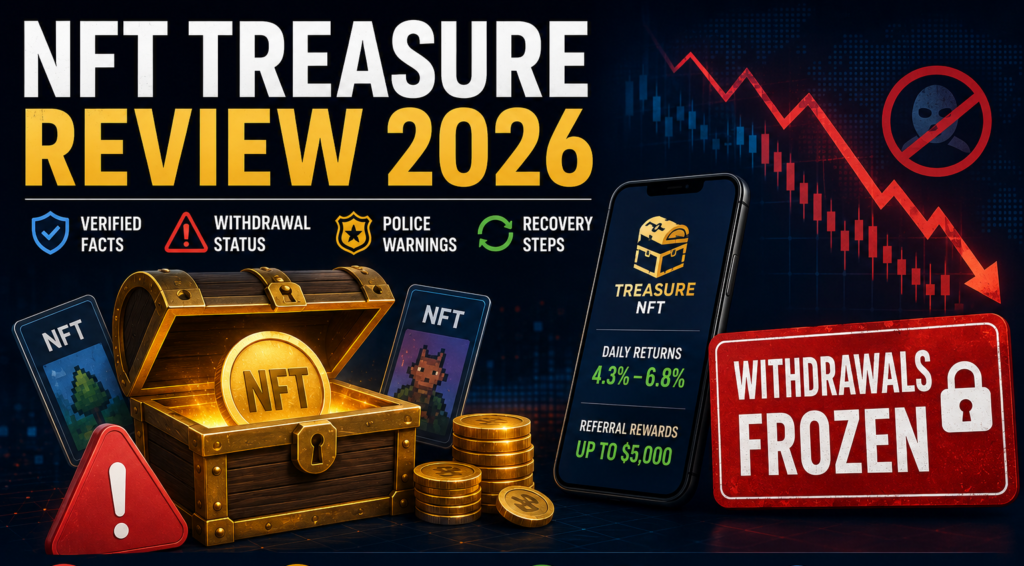
The term NFT Treasure is commonly entered by people searching for Treasure NFT, a platform that promoted AI-powered NFT trading, referral rewards, and unusually high daily returns. Search interest increased after users began reporting delayed or blocked withdrawals in March 2025.
The available evidence gives users substantial reasons for caution. West Bengal Police published a warning about Treasure NFT in April 2025 and followed it with another warning after the operation appeared under the Treasure Fun name. Contemporary reporting also documented changing withdrawal periods, claims of daily returns between 4.3% and 6.8%, and promotional rewards worth up to $5,000. These figures were reported claims, not independently audited investment results.
As of August 4, 2026, the public sources reviewed for this article do not contain an official regulator or police announcement confirming that unrestricted Treasure NFT withdrawals have resumed. Recent cryptocurrency-industry reviews describe the original platform as non-operational, but some of their user totals and loss estimates conflict. Those estimates should not be repeated as established facts.
Confirm Which NFT Treasure Platform You Are Researching
Start by identifying the exact website, application, token, or service involved. Similar names can cause users to connect unrelated projects or send money to a successor platform without understanding the difference.
In this article, NFT Treasure refers to the platform generally called Treasure NFT, which invited users to deposit funds and claimed to produce passive returns through automated NFT trading. Its marketing reportedly included daily income, account levels, referral commissions, and rewards for recruiting or managing teams.
Treasure NFT should not automatically be confused with the separate Treasure ecosystem associated with the MAGIC token. The official Treasure website describes MAGIC as the native token of its own ecosystem. Recent industry analysis also identifies Treasure NFT and TreasureDAO as unrelated projects. A shared word in their names does not establish common ownership, management, or financial activity.
Before taking any action, record the exact domain name, application name, wallet address, token symbol, contact number, and person who introduced the service. Scammers frequently use similar names, copied logos, alternate domains, and unofficial applications to take advantage of confusion around a known brand.
Verify the Current NFT Treasure Withdrawal Status
The first widely reported withdrawal problems appeared in late March 2025. On March 31, The News reported that users were becoming concerned about delayed withdrawals. One interviewed participant said she had recovered her original investment, while newer members remained unable to access their funds. Treasure NFT did not respond to the newspaper’s request for comment.
On April 1, 2025, The Express Tribune reported that withdrawals had been frozen or restricted for many users. The explanation attributed to the platform involved financial-system adjustments and fund-security measures, but the report did not establish that users had regained unrestricted access to their balances.
West Bengal Police published a public warning on April 5, 2025. The post cautioned people against being attracted by promises of doubling money in a short period through Treasure NFT. A second police post on May 5, 2025 warned that Treasure NFT was appearing under the Treasure Fun name and asking people to invest again.
Recent 2026 reviews from ZebPay and CoinDCX describe the original Treasure NFT platform as closed or non-operational. These are secondary industry publications rather than court judgments or regulator notices, but they provide no evidence of a general withdrawal restoration.
Users should therefore reject any exact “withdrawal reopening date” unless it comes from a verified authority and is supported by successful, independently documented withdrawals. A Telegram message, dashboard notice, promoter voice note, or social-media countdown is not sufficient proof.
Review the Exact NFT Treasure Timeline
The following timeline uses exact publication dates where they can be verified. It separates contemporary reporting from later commentary.
| Date | Documented development | Evidence level |
|---|---|---|
| March 26, 2025 | The Express Tribune examined allegations that Treasure NFT was fraudulent | Contemporary news report |
| March 31, 2025 | The News reported growing concern about delayed withdrawals | Contemporary news report |
| April 1, 2025 | The Express Tribune reported frozen or restricted withdrawals | Contemporary news report |
| April 5, 2025 | West Bengal Police publicly warned users about Treasure NFT | Official police warning |
| May 5, 2025 | West Bengal Police warned that Treasure NFT was appearing as Treasure Fun and seeking new investments | Official police warning |
| May 6, 2025 | APAC News Network reported the police warning concerning the Treasure Fun name | Secondary news coverage |
| May 18, 2026 | ZebPay described the original platform as no longer operational in its original form | Secondary industry review |
| August 3, 2026 | CoinDCX published a review describing the platform as collapsed and warning affected users | Secondary industry review |
| August 4, 2026 | No regulator-confirmed general withdrawal restoration was found during this review | Editorial finding based on reviewed sources |
The timeline does not prove the exact date on which every account stopped receiving withdrawals. Some early participants reportedly received money while other requests remained pending. That pattern can create conflicting personal experiences, with one user calling the platform legitimate because of an early payment while another user cannot access a later balance.
A successful early withdrawal is not proof that a platform can meet all future obligations. Investment frauds may make selected payments to build confidence, create testimonials, and encourage participants to deposit more money or recruit additional users.
Audit Every NFT Treasure Number Before Publishing It
Several large figures circulate in Treasure NFT articles, social posts, and videos. Not all have equal evidentiary value.
The most clearly sourced figures come from The News report published on March 31, 2025. The publication attributed the figures to users, team communications, and an industry expert. It did not describe them as audited company records.
| Number | Reported meaning | Accuracy status |
|---|---|---|
| 4.3% to 6.8% | Claimed daily return for each $100 deposited | Reported user claim, not audited |
| $100 | Example minimum amount discussed by users | Reported amount |
| Up to $5,000 | Reported Eid promotional reward | Reported promotion, not verified profit |
| 68 hours | Earlier reported withdrawal-processing time | User-reported |
| 168 hours | Extended reported withdrawal period | User-reported |
| 120 hours | Later promised processing period | User-reported promise |
| About 1,500% | Expert’s description of the claimed annualized return | Published expert assessment |
| More than 700 members | Size of one team addressed in a reported voice message | User-reported |
| $143.8 million | Estimate repeated in a 2026 industry article | Not confirmed by a regulator or police record reviewed here |
| $160 million | Different estimate repeated in later industry coverage | Not confirmed by a regulator or police record reviewed here |
| PKR 45 billion | Another widely repeated estimated total | Not officially verified in the sources reviewed |
The reported 4.3% to 6.8% daily return, $5,000 reward, changing withdrawal periods, 1,500% annualized description, and 700-member team all appear in The News report.
The much larger totals require more caution. ZebPay cited an estimated $143.8 million deposited during a promotion and separately repeated an estimate of PKR 45 billion, or approximately $160 million, in Pakistan. CoinDCX repeated an estimated $160 million figure. Neither article linked those totals to an audited financial statement, official police loss assessment, court filing, or regulator report visible in the reviewed material.
For that reason, an authoritative article should not say, “Treasure NFT stole exactly $160 million.” A more accurate sentence is: “Secondary industry reports have circulated estimates between $143.8 million and $160 million, but an official verified total was not identified.”
Calculate the Reported Daily Returns Accurately
The reported daily return range can be tested with straightforward mathematics. The calculation does not prove that the returns were actually earned. It shows what the promotional claim would imply.
At 4.3% per day, a $100 balance would supposedly earn:
- $4.30 in one day
- $129.00 in 30 days using simple interest
- $1,569.50 in 365 days using simple interest
The resulting balance after one year would be $1,669.50 when the original $100 is included. The simple annual return would equal 1,569.5%.
At 6.8% per day, a $100 balance would supposedly earn:
- $6.80 in one day
- $204.00 in 30 days using simple interest
- $2,482.00 in 365 days using simple interest
The resulting balance after one year would be $2,582.00 when the original $100 is included. The simple annual return would equal 2,482%.
The implications become more extreme when returns are supposedly added to the balance and compounded daily.
A $100 deposit compounding at 4.3% per day would mathematically become approximately $353.61 after 30 days and $471.82 million after 365 days.
A $100 deposit compounding at 6.8% per day would mathematically become approximately $719.68 after 30 days and $2.68 trillion after 365 days.
These figures are mathematical illustrations, not forecasts. They demonstrate why fixed daily-return claims deserve immediate scrutiny. A system capable of reliably compounding $100 into hundreds of millions or trillions of dollars within one year would be economically implausible.
The US Federal Trade Commission advises consumers that guaranteed cryptocurrency profits, large payouts, and assured returns are signs of fraud. It also emphasizes that cryptocurrency investments are not low-risk and that no promoter can honestly guarantee a profit.
Compare the Claims With Verifiable NFT Trading
A genuine NFT trade normally creates information that can be independently inspected on a blockchain. The record may include a token contract, token number, wallet addresses, transaction hash, network fee, sale amount, and timestamp.
An internal dashboard does not provide the same evidence. A platform can display a growing balance without proving that an NFT was purchased, held, or sold. The number represents a real asset only when the user can verify ownership and transfer control.
Treasure NFT reportedly claimed that artificial intelligence identified undervalued NFTs, completed trades, and distributed profits. However, recent industry reviews state that they could not identify verifiable public blockchain activity supporting the advertised trading model.
Users evaluating any NFT service should request:
- The exact blockchain network.
- Published smart-contract addresses.
- Wallet addresses used for trading.
- Transaction hashes for claimed purchases and sales.
- An explanation of asset custody.
- Audited financial or reserve information.
- Identifiable company directors and operating addresses.
Marketing language is not a substitute for transaction evidence. Terms such as artificial intelligence, algorithmic pricing, decentralized finance, multichain liquidity, staking, and fractional NFT ownership can make a platform sound sophisticated without proving that profitable activity exists.
Separate Verified Facts From Disputed Loss Estimates
The absence of an official total matters because inaccurate figures weaken an article’s credibility. Cryptocurrency transfers can pass through multiple wallets, exchanges, user accounts, and currencies. The same funds may also be counted more than once when estimates are assembled from deposit screenshots or blockchain movements.
Current articles repeat at least three major figures: $143.8 million, $160 million, and PKR 45 billion. The last two may be intended as approximate currency equivalents, but exchange rates, counting methods, and affected-user estimates are not clearly documented in the reviewed reports.
A responsible article should use the following wording:
“Public reports suggest substantial losses, but the total has not been confirmed through an audited statement, court record, or official law-enforcement assessment identified during this review.”
The same standard should be applied to claims about the number of victims. A promoter’s team count, a messaging-group membership total, an app-download figure, and the number of actual depositors are not interchangeable.
The News documented one voice message reportedly sent to a group of more than 700 members. That number establishes the reported size of one communication group, not the platform’s total number of investors.
Recognize the Main NFT Treasure Warning Signs
Fixed daily returns provide the clearest warning. NFT values fluctuate according to demand, liquidity, rarity, ownership history, market conditions, and buyer interest. A legitimate trading operation cannot guarantee the same percentage every day.
Referral dependence creates another concern. Referral marketing is not automatically fraudulent, but risk increases when a platform’s growth and participant income depend heavily on bringing in new depositors.
Changing withdrawal periods also deserve attention. The reported processing window moved from 68 hours to 168 hours before a further promise of 120 hours was communicated. Repeatedly changing deadlines can prevent users from taking immediate action while the platform continues requesting patience or deposits.
Rebranding is another major signal. West Bengal Police warned that Treasure NFT had appeared under the Treasure Fun name and was asking users to invest again. The police message advised people not to respond to that request.
Additional warning signs include anonymous leadership, unverifiable trading records, deposits sent to changing wallet addresses, withdrawal fees introduced after the deposit, and requests to upgrade an account before money can be released.
Stop Additional Payments Immediately
Do not send more cryptocurrency to activate an account, pay a withdrawal fee, clear a tax, unlock a balance, enter a higher account level, or migrate funds to Treasure Fun or another successor service.
A displayed balance should not be treated as accessible money until it reaches a bank account or cryptocurrency wallet controlled by the user. A platform can change a dashboard number without holding an equivalent amount of liquid assets.
Do not borrow money to recover an existing balance. The belief that one final payment will unlock a much larger amount is a common method of increasing a victim’s loss.
Stop referring new participants. A person who received an early withdrawal may sincerely believe the platform works, but that experience does not guarantee that later investors will be paid.
Secure any account that shared a password with Treasure NFT. Change reused passwords, protect the connected email account, enable two-factor authentication, and review active devices and login sessions.
Preserve Exact Transaction Evidence
Create a chronological record before messages, websites, or account pages disappear. Include the account-creation date, deposit dates, withdrawal attempts, support conversations, and requests for additional payments.
For each cryptocurrency transfer, save:
- Transaction hash
- Sending wallet address
- Receiving wallet address
- Blockchain network
- Token and amount
- Date and exact time
- Exchange or wallet used
- Local-currency cost
- Screenshot or receipt
Export complete WhatsApp or Telegram conversations where possible. Screenshots are useful, but full message exports can preserve dates, usernames, phone numbers, audio files, and attachments.
Save the promoter’s referral code, group name, account level, team hierarchy, and payment instructions. Also record the name of anyone who claimed to be a country head, team head, support employee, recovery agent, or tax representative.
Never share a wallet seed phrase or private key with a person claiming to investigate the transaction. A legitimate investigator can examine a public wallet address and transaction hash without taking control of the wallet.
Report NFT Treasure Losses Through Official Channels
Pakistan-based users can submit a complaint to the National Cyber Crime Investigation Agency. The official NCCIA complaint portal lists the 24-hour helpline number 1799.
India-based users can report financial cyber fraud through the National Cyber Crime Reporting Portal. The official portal lists 1930 as the cybercrime helpline and 112 as the national emergency police number.
Contact the cryptocurrency exchange used to purchase or transfer the funds. Give the exchange the transaction hash, receiving address, amount, and police complaint reference. The exchange may preserve account records or respond to a lawful request from investigators.
Contact the bank or payment provider connected to the cryptocurrency purchase. Explain that the transaction may relate to investment fraud and request preservation of all relevant records.
Reporting does not guarantee recovery. Cryptocurrency can move through multiple addresses and exchanges quickly. Prompt reporting still gives authorities and service providers a better opportunity to preserve evidence, identify account holders, or restrict funds that remain on a controlled platform.
Avoid NFT Treasure Recovery Scams
Victims may receive messages from people claiming to be lawyers, ethical hackers, blockchain experts, police representatives, exchange employees, or fund-recovery specialists.
Do not trust a recovery offer simply because the sender knows the amount lost or the platform used. Fraud networks may reuse customer lists, referral records, phone numbers, and wallet information.
Reject anyone who guarantees recovery in exchange for an upfront payment. No private recovery company can guarantee that cryptocurrency controlled by an unknown wallet owner will be returned.
Do not install remote-access software at the request of a recovery agent. Remote access may expose banking applications, email accounts, identity documents, cryptocurrency wallets, and security codes.
Government agencies do not require a victim to pay cryptocurrency into a private wallet before investigating a complaint. Taxes and official charges should be verified directly through the relevant government authority.
Apply a Seven-Point Verification Test
Before depositing into any NFT or cryptocurrency platform, verify seven essential areas.
Company identity: Confirm the registered legal name, directors, jurisdiction, physical address, and operating history.
Regulatory position: Determine whether any claimed registration actually covers the investment service being offered. A basic business or money-service registration is not the same as regulatory approval of guaranteed returns.
Blockchain evidence: Verify smart contracts, wallet addresses, transaction histories, and asset ownership through an independent explorer.
Return explanation: Identify the exact activity producing revenue. Reject explanations that depend only on unexplained AI algorithms.
Withdrawal control: Confirm whether the user controls the assets or merely sees a balance inside the platform.
Referral dependence: Calculate how much income depends on genuine customers and how much depends on new member deposits.
Risk disclosure: Reject any platform that guarantees profits, minimizes cryptocurrency risk, or pressures users to act before completing independent research.
A platform that fails several of these checks should not receive a deposit, regardless of professional design, testimonials, early payments, social-media popularity, or endorsements from friends.
Make an Evidence-Based NFT Treasure Decision
The available public record does not support treating Treasure NFT as a normal, transparent NFT marketplace. Users reported delayed withdrawals in March 2025, West Bengal Police issued warnings in April and May 2025, and subsequent industry reports describe the original platform as non-operational.
The reported return range of 4.3% to 6.8% per day is mathematically extreme. Even without compounding, it implies annual simple returns of 1,569.5% to 2,482%. The FTC’s guidance is clear that guaranteed cryptocurrency returns and large assured payouts are fraud indicators.
Large loss figures should still be handled carefully. Estimates of $143.8 million, $160 million, and PKR 45 billion appear in secondary articles, but this review did not identify an official audited total. Accuracy requires acknowledging that uncertainty rather than selecting the largest number for a headline.
Affected users should stop additional payments, preserve wallet and payment evidence, contact their exchange or bank, and report the matter through official cybercrime channels. A new platform name, account migration, withdrawal charge, or recovery promise should not be treated as proof that funds will be released.
Review NFT Treasure Frequently Asked Questions
Is NFT Treasure the same as Treasure NFT?
Yes, NFT Treasure is commonly used as a reversed search phrase for Treasure NFT. However, users should verify the exact domain or application because unrelated projects also use the word Treasure.
Is NFT Treasure real or fake?
Treasure NFT was a real platform in the sense that users could create accounts and deposit funds. That does not validate its advertised investment model. West Bengal Police warned the public about Treasure NFT and later warned against reinvesting through Treasure Fun.
Are NFT Treasure withdrawals working in 2026?
No official regulator or police announcement confirming general withdrawal restoration was identified as of August 4, 2026. Recent industry reviews describe the original platform as non-operational.
How much daily profit did Treasure NFT promise?
The News reported user claims of daily returns between 4.3% and 6.8% for each $100 deposited. These were promotional or user-reported figures, not independently audited returns.
How much money was lost in Treasure NFT?
No official verified total was identified during this review. Secondary articles have circulated estimates of $143.8 million, approximately $160 million, and PKR 45 billion, but those figures should not be presented as confirmed losses.
Where can affected users report Treasure NFT?
Pakistan-based users can contact the NCCIA through its complaint portal or helpline 1799. India-based users can use the National Cyber Crime Reporting Portal or call the financial cyber-fraud helpline 1930.