
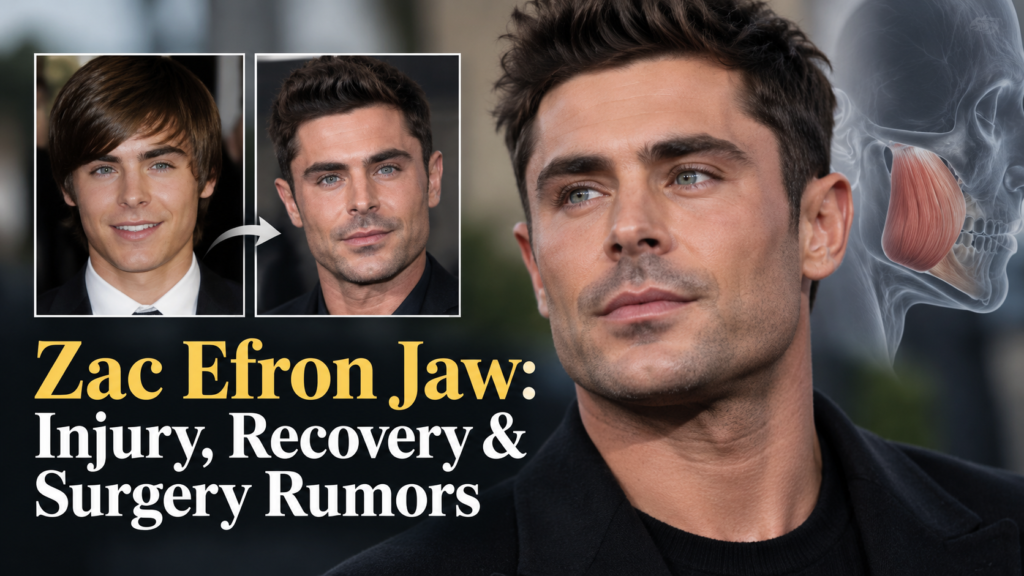
Zac Efron’s jaw has attracted significant public attention since viewers noticed changes in the actor’s facial appearance during a 2021 Earth Day appearance. The discussion quickly expanded across social media, entertainment websites, and celebrity forums, with people questioning whether Efron had undergone plastic surgery, received fillers, changed his jawline, or experienced another type of facial transformation.
The most reliable explanation, however, comes directly from Zac Efron. In a 2022 interview with Men’s Health, the actor described a serious accident in which he struck his chin against the granite corner of a fountain and shattered his jaw. Efron also explained that rehabilitation affected how his facial muscles worked and that his masseter muscles became noticeably larger during recovery.
That account is substantially stronger evidence than conclusions drawn from before-and-after photographs. Images can show that a person’s appearance has changed, but they cannot reliably establish the medical or cosmetic reason for the change.
This guide examines the Zac Efron jaw story using his publicly documented statements, established facial anatomy, and careful distinctions between verified information and online speculation.
Trace the Accident That Injured Zac Efron’s Jaw
The clearest starting point for understanding Zac Efron’s jaw is the accident he described publicly to Men’s Health. Efron said he was running through his home while wearing socks when he slipped. During the fall, he struck his chin against the granite corner of a fountain.
According to Efron, the impact was severe enough that he lost consciousness. When he regained consciousness, he said that his chin bone was hanging away from his face. He later described the injury as having shattered his jaw.
These details matter because they establish a documented traumatic event involving the exact area that later became the subject of public speculation. Rather than beginning with assumptions about cosmetic procedures, an evidence-based account of Efron’s facial changes should begin with the serious injury he personally disclosed.
Efron has experienced other physical injuries during his career, including orthopedic injuries associated with his active lifestyle and training. However, the jaw accident was described as a household accident rather than a movie stunt or workout injury.
The available public account can therefore be summarized clearly:
| Event | Publicly documented information |
|---|---|
| Accident | Efron said he slipped while running in socks at home |
| Point of impact | His chin struck the granite corner of a fountain |
| Severity | Efron said his jaw was shattered |
| Immediate effect | He reported losing consciousness |
| Recovery | He underwent rehabilitation and physical therapy |
| Later facial change | Efron said his masseter muscles became significantly larger |
This sequence provides the foundation for understanding later changes in his lower face.
Follow Zac Efron’s Jaw Recovery and Rehabilitation
Efron said he worked with a specialist and performed physical therapy after his jaw injury. This stage of the story is especially important because his explanation for his changed appearance involves not only the original trauma but also the way the muscles surrounding his jaw responded during rehabilitation.
The human jaw operates through a coordinated system of bones, joints, nerves, and muscles. Following a significant injury, changes in movement patterns can potentially affect how different muscles are used during activities such as chewing or opening and closing the mouth.
Efron explained the process in his own terms. He said that the muscles involved in chewing normally work together “like a symphony.” After his injury, however, he said some muscles began compensating for others.
He specifically identified his masseter muscles as becoming significantly larger.
The masseters are major chewing muscles located on both sides of the lower face. Because of their position, their size contributes to the visible width and contour of the jaw area.
Efron further explained that he had been performing physical therapy designed to help the muscles function properly. During a period when he was living in Australia, he said he stopped doing certain exercises associated with the rehabilitation.
According to Efron, this was when the masseters became particularly enlarged.
His account provides a plausible explanation for why his lower face appeared wider during the period in which public attention intensified. However, it is important to attribute that explanation correctly: it is Efron’s description of his own recovery rather than an independent medical diagnosis made from publicly available photographs.
Understand How Masseter Muscles Can Change Facial Appearance
Understanding the masseter muscles helps explain why Zac Efron repeatedly mentioned them when discussing his jaw.
The masseter is one of the principal muscles used for chewing. It extends along the side of the face between the cheekbone region and the lower jaw. When a person closes the jaw or clenches the teeth, the masseter contracts.
Several muscles participate in jaw movement, including:
- the masseter
- the temporalis
- the medial pterygoid
- the lateral pterygoid
Together, these muscles help control movements required for biting, chewing, opening the mouth, closing the jaw, and moving the mandible from side to side.
Because the masseter lies along the outer portion of the lower face, its size can influence how wide or angular the jaw appears.
A larger masseter does not necessarily mean the underlying jawbone itself has become larger. The visible structure of the lower face results from multiple components, including bone, muscle, fat distribution, connective tissue, skin, dental structure, facial hair, and overall body composition.
This distinction is particularly relevant to the Zac Efron jaw discussion.
Some online posts assumed that a wider lower face automatically indicated jaw implants or another surgical alteration. That conclusion cannot be made reliably from photographs alone.
Efron’s own explanation specifically focuses on muscle enlargement during rehabilitation rather than an elective cosmetic change to his jawbone.
Compare Zac Efron’s Jaw Before and After Public Attention Increased

Public interest in Zac Efron’s face increased dramatically in April 2021 when he appeared in a video associated with Bill Nye’s Earth Day programming.
Many viewers believed Efron’s jaw and lower face looked wider or more prominent than they remembered from earlier periods of his career. Screenshots spread rapidly across social media, leading to extensive discussion about his appearance.
Earlier images of Efron, particularly photographs from his High School Musical years and the early stages of his adult film career, generally showed a comparatively narrow lower face. Later appearances sometimes showed a broader or more muscular-looking jaw.
The difference encouraged before-and-after comparisons.
However, photographic comparisons have significant limitations.
Two images of the same person can look dramatically different because of changes in:
- camera focal length
- camera distance
- head position
- facial expression
- lighting direction
- body weight
- body-fat percentage
- hairstyle
- facial hair
- image processing
- age
- muscle development
A close-range camera, for example, can distort facial proportions differently from a portrait taken with a longer focal length. Strong side lighting can emphasize the jawline, while frontal lighting may make the same contours appear softer.
For that reason, photographs can support the observation that Efron looked different during certain appearances. They cannot establish which medical treatment or cosmetic procedure caused that difference.
Separate Zac Efron’s Explanation From Plastic Surgery Rumors
Plastic surgery became one of the dominant theories surrounding Zac Efron’s jaw after his 2021 appearance.
Online commenters proposed numerous possibilities, including jaw implants, fillers, facial surgery, Botox, and other cosmetic interventions. Some websites repeated these theories, often using before-and-after photographs as supporting material.
The evidentiary problem is straightforward: appearance alone cannot confirm that a specific procedure occurred.
Efron eventually addressed the speculation directly.
During his Men’s Health interview, he indicated that he had not initially been paying close attention to the online discussion about his face. He reportedly became aware of how extensive the speculation had become after his mother contacted him and asked whether he had undergone plastic surgery.
His explanation centered instead on his earlier accident and the enlargement of his masseter muscles during rehabilitation.
This creates an important distinction between two categories of information.
The first category consists of information Efron has personally disclosed:
| Claim | Evidence level |
|---|---|
| Efron suffered a severe jaw injury | Directly stated by Efron |
| He struck his chin on a granite fountain | Directly stated by Efron |
| His jaw was shattered | Directly stated by Efron |
| He underwent rehabilitation | Directly stated by Efron |
| His masseter muscles enlarged | Directly stated by Efron |
| His mother asked about plastic surgery rumors | Reported from his interview |
The second category consists primarily of external speculation:
| Claim | Evidence level |
|---|---|
| Efron definitely received jaw implants | Not established publicly |
| Fillers definitely caused his appearance | Not established publicly |
| He underwent a specific facial surgery | Not established publicly |
| Every facial difference is caused by cosmetic work | Unsupported from photographs alone |
Separating these categories prevents speculation from being presented as medical fact.
Review the 2021 Earth Day Appearance That Sparked the Debate
The 2021 Earth Day appearance was not necessarily the moment Zac Efron’s face changed. It was the moment a large online audience began discussing the change.
Efron appeared in a video connected with Bill Nye’s Earth Day programming in April 2021. Viewers quickly commented on the shape of his jaw and lower face.
Screenshots circulated on Twitter, Instagram, entertainment websites, Reddit, and celebrity-focused communities. Some users compared Efron with photographs taken many years earlier, particularly images from the actor’s High School Musical period.
The resulting discussion was often framed around cosmetic surgery.
This sequence is important because the viral discussion occurred before Efron gave his detailed public explanation in the 2022 Men’s Health interview.
The chronology is therefore:
- Efron experienced the jaw accident.
- He underwent rehabilitation.
- He said his masseter muscles enlarged.
- His 2021 Earth Day appearance attracted widespread attention.
- Plastic surgery theories spread online.
- Efron publicly explained the injury and rehabilitation in 2022.
Understanding that order prevents the later explanation from being treated as something that preceded the controversy.
Distinguish Jaw Muscle Growth From Jawbone Changes
One of the most common misunderstandings in discussions about facial appearance involves treating the jawline as though it were determined solely by bone structure.
The visible jawline is influenced by multiple anatomical structures.
The mandible provides the primary skeletal framework of the lower face. However, muscles sit around the bone, soft tissue covers those muscles, and variations in body composition influence the final external appearance.
The masseters are particularly relevant because they sit near the rear portion of the jawline.
When these muscles become more prominent, the lower face can appear wider or more squared. That visual difference does not necessarily indicate that the mandible itself has changed shape.
Efron’s explanation relies on exactly this distinction.
He did not publicly frame the change simply as his “jawbone getting bigger.” Instead, he identified changes in the muscles surrounding the jaw following his accident and rehabilitation.
That account is consistent with basic anatomy showing that masseter size contributes to the external contour of the lower face.
It does not, however, allow outsiders to determine the exact degree to which muscle development explains every difference visible across Efron’s photographs.
Account for Zac Efron’s Broader Physical Transformations

Another factor complicating Zac Efron before-and-after comparisons is the actor’s history of major physical transformations.
Efron has changed his body composition considerably for different roles.
His transformation for Baywatch became particularly well known because he developed an extremely lean and muscular physique. Other projects required different body types, training methods, grooming choices, and levels of muscular development.
These changes can affect facial appearance.
When someone becomes substantially leaner, reductions in facial fat can make the jawline appear sharper. Weight gain can soften facial contours. Changes in muscle development can alter the relationship between the neck, jaw, cheeks, and shoulders.
Age also matters.
Comparisons between Efron’s teenage photographs and images taken during his 30s inevitably include normal maturation. Adult facial proportions do not remain identical to those seen during adolescence or early adulthood.
These factors should not be used to dismiss Efron’s specific explanation about his jaw injury. Instead, they demonstrate why assigning every visible difference to a single procedure or event is unreliable.
Evaluate Zac Efron Before-and-After Photos Carefully
Before-and-after photographs are frequently used as evidence in celebrity cosmetic surgery discussions, but they are inherently limited.
A photograph captures appearance rather than medical history.
Camera lenses can alter apparent proportions. A wide-angle lens positioned close to someone’s face can produce different proportions from a longer portrait lens positioned farther away.
Lighting also influences facial definition.
Strong overhead or side lighting creates shadows underneath the cheekbones and around the jaw, producing greater apparent definition. Soft frontal lighting reduces those shadows and can make the face look rounder.
Head position creates another variable.
Tilting the head downward can emphasize certain portions of the jaw. Raising the chin changes the relationship between the jawline and neck. Turning slightly sideways can make one masseter appear more prominent than the other.
Facial expressions matter as well.
Speaking, smiling, clenching, or holding the jaw tightly changes the appearance of facial muscles. Because the masseters contract when the jaw closes forcefully, their prominence may differ between frames of the same video.
Consequently, before-and-after images can demonstrate a visible difference, but they should not be treated as diagnostic tools.
Use First-Person Sources for Claims About Zac Efron’s Medical History
When evaluating celebrity health stories, source quality matters.
The strongest public source for the Zac Efron jaw story is Efron himself discussing the accident and recovery in a detailed interview.
A first-person account has obvious advantages over anonymous online speculation because the person experienced the event directly.
However, responsible reporting should still distinguish between a person’s account of their medical experience and independently verified medical documentation.
Efron’s statements support phrases such as:
“Zac Efron said he shattered his jaw.”
They do not justify stronger formulations such as:
“Medical records prove every aspect of Zac Efron’s facial transformation resulted from the accident.”
No complete public medical record has been presented that would allow outsiders to make that broader conclusion.
This distinction strengthens accuracy instead of weakening the article. Reliable health-related reporting should state exactly what the available evidence supports and avoid extending beyond it.
Verify Medical Background With Authoritative Health Sources
Medical background about facial muscles should come from established healthcare or academic sources rather than celebrity blogs.
For example, the Cleveland Clinic describes the masseter as one of the muscles involved in chewing and explains the broader role facial muscles play in jaw movement and facial appearance.
That type of source is useful for understanding the anatomy behind Efron’s explanation.
It does not prove what happened medically in Efron’s individual case.
This difference between general medical information and individual medical evidence is essential.
A medical source can establish that masseter muscles exist, perform a particular function, and influence facial structure. It cannot diagnose a celebrity from photographs.
Similarly, general information about mandibular fractures should not be used to infer treatments Efron has never publicly disclosed.
Responsible coverage combines the two types of evidence appropriately:
Efron’s interview provides information about his personal experience.
Medical references provide general information explaining the relevant anatomy.
Neither should be stretched beyond its purpose.
Avoid Diagnosing Cosmetic Procedures From Photographs
The question “Did Zac Efron get plastic surgery?” remains one of the most frequently associated searches with his jaw.
The accurate answer requires restraint.
Efron has publicly addressed the speculation and attributed his changed jaw appearance to his accident, rehabilitation, and enlargement of his masseter muscles.
That does not provide a basis for outsiders to categorically list every procedure he has or has not received throughout his life.
Likewise, photographs cannot establish that he received a specific cosmetic intervention.
A qualified medical professional normally needs direct examination, medical history, and other relevant clinical information to evaluate a patient’s anatomy or treatment.
Celebrity photos provide none of that.
Claims such as “this definitely looks like fillers” or “this proves he had a jaw implant” therefore remain opinions unless supported by reliable documentation.
Readers should treat confident diagnoses based only on red-carpet photographs, screenshots, or social-media videos with caution.
Follow the Zac Efron Jaw Timeline in Order

The complete story becomes easier to understand when its major events are organized chronologically.
The Jaw Accident
Efron said he slipped while running through his home in socks and struck his chin against the granite corner of a fountain.
The Injury
He described the resulting trauma as a shattered jaw and said he lost consciousness.
The Rehabilitation Period
Efron worked with a specialist and performed physical therapy designed to help his facial and jaw muscles recover.
The Muscle Changes
According to Efron, different muscles began compensating following his injury. His masseters eventually became significantly larger.
The Australia Period
Efron said that while he was in Australia, he stopped doing some of the physical therapy exercises. He connected this period with especially noticeable masseter growth.
The 2021 Viral Appearance
His appearance in an Earth Day video drew substantial online attention to his facial shape.
The Plastic Surgery Speculation
Social-media users and entertainment outlets proposed multiple cosmetic explanations for his appearance.
The 2022 Explanation
Efron discussed the accident, rehabilitation, masseter growth, and public reaction during his interview with Men’s Health.
This timeline supports a more evidence-based interpretation than treating the 2021 video as the beginning of the story.
Recognize the Limits of Public Information About Zac Efron’s Jaw
Several questions about Zac Efron’s treatment cannot be conclusively answered from publicly available information.
Efron has provided meaningful details about his accident and rehabilitation, but that does not mean the public has access to every medical procedure involved in his treatment.
A serious jaw injury may involve different treatments depending on factors such as fracture location, fracture severity, displacement, dental involvement, and surrounding tissue damage.
Those general possibilities should not be converted into statements about Efron specifically.
Unless Efron or a reliable source documents a particular procedure, claims involving jaw reconstruction, implants, fillers, Botox, orthognathic surgery, or other treatments should remain clearly identified as unverified.
This approach is particularly important for health-related information because speculation can easily be repeated until readers mistakenly interpret it as fact.
Apply an Evidence-Based Answer to the Zac Efron Jaw Question
For readers searching simply for an answer to “What happened to Zac Efron’s jaw?”, the available evidence supports a relatively straightforward explanation.
Zac Efron said he suffered a serious accident in which he slipped at home and struck his chin against a granite fountain. He described the injury as a shattered jaw.
During recovery, he underwent rehabilitation and physical therapy.
Efron later said the muscles surrounding his jaw did not initially work together as they had before the injury. He specifically stated that his masseter muscles began compensating and became significantly larger.
When his appearance attracted widespread attention in 2021, viewers proposed numerous cosmetic surgery explanations.
Efron’s subsequent public account instead focused on his previous injury and rehabilitation.
That does not establish every detail of his medical history, but it represents the strongest publicly available first-person explanation of why his jaw appeared different.
Check the Evidence Before Repeating Zac Efron Plastic Surgery Claims
The Zac Efron jaw discussion demonstrates a broader problem with celebrity appearance coverage.
Visual changes often produce immediate theories about cosmetic procedures, particularly when high-profile actors appear substantially different from older photographs.
But several standards can improve the reliability of these discussions.
First, direct statements should be separated from third-party interpretation.
Efron has directly discussed his accident and masseter enlargement. Those statements can be attributed to him.
Second, photographs should be treated as visual evidence rather than medical evidence.
They can demonstrate a change in appearance but cannot reveal a person’s complete treatment history.
Third, general anatomical information should be sourced from reputable medical references.
Fourth, uncertainty should be preserved where public evidence is incomplete.
Applying those standards produces a more useful account than simply repeating viral theories.
Consider Normal Aging When Comparing Zac Efron’s Face Over Time
Many Zac Efron before-and-after comparisons span more than a decade.
Efron was a teenager when he became internationally famous through High School Musical. Images from that period are sometimes placed beside photographs taken when he was well into his 30s.
Such comparisons naturally contain age-related differences.
Faces mature from adolescence through adulthood. Changes can occur in body composition, skin, muscle definition, facial hair, hairstyle, dental appearance, and overall proportions.
Efron has also experienced dramatic changes in fitness and body composition during those years.
Therefore, not every difference between an early-career photograph and a recent image should automatically be assigned to his jaw accident or a cosmetic intervention.
Multiple factors can operate simultaneously.
The jaw injury remains particularly relevant because Efron specifically identified it when discussing his changed appearance, but responsible analysis should not claim that the accident explains every visible difference in his face.
Treat Social Media Claims as Speculation Until Verified
Social media played a major role in spreading the Zac Efron plastic surgery narrative.
Platforms encourage rapid visual comparisons because users can place photographs next to each other and offer immediate explanations. Once a theory becomes popular, other accounts frequently repeat it without checking its original source.
This creates a circular pattern.
One speculative post cites another speculative post, and eventually the repeated claim may appear established even when no original evidence exists.
That problem is especially common with cosmetic surgery speculation.
Terms such as “filler,” “implant,” “Botox,” and “facelift” are often used by non-specialists as catch-all explanations for any visible facial difference.
Reliable coverage should instead ask a basic question:
What is the source for this specific claim?
If the source is merely a photograph or another person’s speculation, the claim should not be presented as confirmed.
In the Zac Efron jaw story, his documented comments about the injury and rehabilitation provide considerably stronger evidence than anonymous cosmetic diagnoses based on screenshots.
Use the Most Reliable Explanation Available
Based on the publicly documented information, the strongest answer to questions about Zac Efron’s jaw remains the explanation Efron himself gave.
He said he experienced a severe accident that shattered his jaw.
He underwent rehabilitation afterward.
He said the muscles surrounding the jaw began compensating differently and that his masseters became unusually large.
Years later, his facial appearance drew widespread attention and generated plastic surgery speculation.
There is no reliable basis for diagnosing a particular undisclosed cosmetic procedure purely from his photographs.
This distinction does not require assuming that the public knows everything about Efron’s medical or cosmetic history. It simply reflects the hierarchy of currently available evidence.
First-person statements and reputable medical references deserve greater weight than anonymous visual speculation.
Conclusion
The Zac Efron jaw story began long before his appearance became a viral social-media topic. According to Efron’s account, he suffered a serious accident after slipping while running at home and striking his chin against the granite corner of a fountain. He said the impact shattered his jaw and required rehabilitation.
During recovery, Efron explained that the muscles around his jaw began working differently. He specifically identified his masseter muscles as becoming significantly larger, especially during a period when he had stopped performing some of his physical therapy exercises.
His 2021 Earth Day appearance brought those facial differences to widespread public attention and sparked extensive speculation about plastic surgery, fillers, and jaw implants. Those claims, however, cannot be established through photographs alone.
The most evidence-based explanation is therefore appropriately limited: Zac Efron has publicly attributed the change in his jaw area to a severe jaw injury and subsequent enlargement of his masseter muscles during rehabilitation.
Readers should distinguish that documented first-person account from unverified cosmetic theories. Doing so provides a more accurate, medically responsible, and trustworthy understanding of what happened to Zac Efron’s jaw.
Frequently Asked Questions
What happened to Zac Efron’s jaw?
Zac Efron said he slipped while running through his home, struck his chin against the granite corner of a fountain, and shattered his jaw. He later underwent rehabilitation and physical therapy.
Why does Zac Efron’s jaw look bigger?
Efron said his masseter muscles became significantly larger during his recovery. Masseters are major chewing muscles located along the sides of the lower jaw, so increased muscle size can affect the visible width of the lower face.
Did Zac Efron get plastic surgery on his jaw?
Plastic surgery has been widely speculated about online, but photographs cannot confirm a specific cosmetic procedure. Efron publicly attributed the noticeable change to his jaw injury, rehabilitation, and enlarged masseter muscles.
When did people notice Zac Efron’s jaw change?
Public discussion increased significantly after Efron appeared in an Earth Day video in April 2021. His facial appearance generated widespread social-media discussion and cosmetic surgery speculation.
What are Zac Efron’s masseter muscles?
The masseters are chewing muscles located on either side of the lower face. Zac Efron said these muscles enlarged while compensating during rehabilitation following his jaw injury.
Did Zac Efron break his jaw?
Efron has publicly described the injury as having shattered his jaw after he fell and hit his chin against a granite fountain.
Did Zac Efron have jaw implants?
There is no publicly established evidence confirming that jaw implants caused the change in his appearance. Claims about implants are generally based on visual speculation rather than documented medical information.
Is Zac Efron’s jaw permanently changed?
Public information does not establish precisely how much of the visible change is permanent. Efron has discussed enlargement of his masseter muscles during rehabilitation, but outsiders cannot determine his long-term anatomy from photographs alone.
Editorial and Source Note
This article distinguishes between Zac Efron’s own publicly reported statements and general medical information about facial anatomy. Claims about his injury and recovery are attributed to Efron’s interview with Men’s Health. Anatomical descriptions of the masseter and other facial muscles should be verified against authoritative medical resources such as Cleveland Clinic or comparable clinical references.
No diagnosis of Zac Efron’s current medical condition or cosmetic treatment can be made from publicly available photographs. Unconfirmed claims about fillers, implants, Botox, reconstructive procedures, or elective plastic surgery should therefore be treated as speculation unless supported by reliable first-person disclosure or documented reporting.