
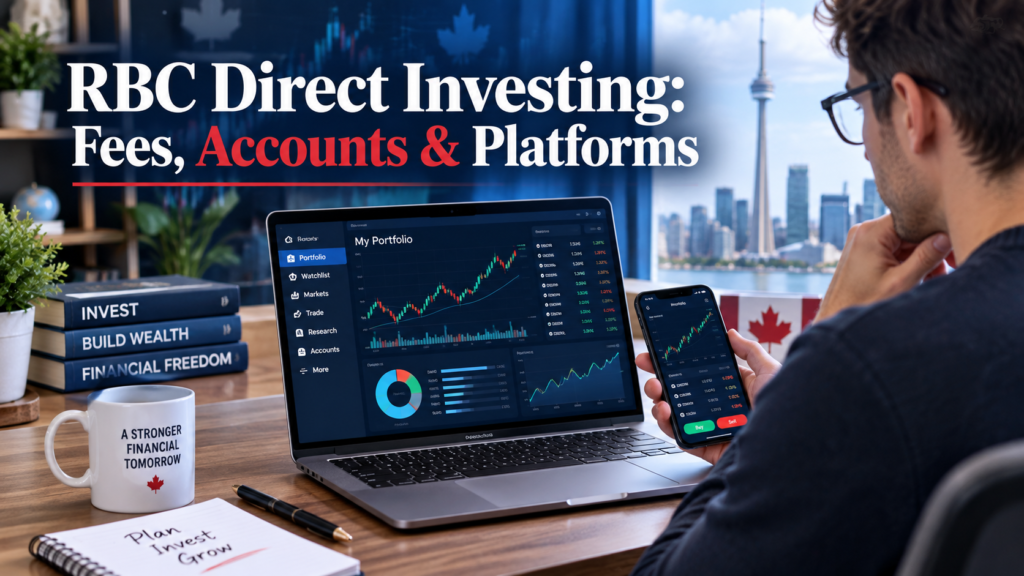
RBC Direct Investing is a Canadian self-directed brokerage that allows investors to buy and sell stocks, exchange-traded funds, mutual funds, bonds, GICs, options, and other eligible investments through registered and non-registered accounts. It is operated by RBC Direct Investing Inc. and provides online, mobile, and advanced trading tools for investors who want to make their own investment decisions.
The service includes accounts such as TFSAs, RRSPs, FHSAs, RESPs, RRIFs, cash accounts, and margin accounts. RBC also offers different investing experiences for newer investors, established self-directed investors, and frequent traders. Current pricing includes a commission-free GoSmart option for eligible users as well as the full RBC Direct Investing platform, where standard online or mobile stock and ETF trades are generally priced at $9.95 per trade.
Choosing a brokerage involves more than comparing trading commissions. Investors should consider available account types, investment choices, currency handling, research tools, trading features, service levels, and the risks associated with managing investments without personalized investment advice.
This guide explains how RBC Direct Investing works, the accounts and investments it offers, current trading costs, its different platforms, investor protection, and the steps involved in opening and using an account.
Choose the RBC Direct Investing Experience That Fits Your Investing Needs
Start by determining which RBC Direct Investing experience matches the way you expect to invest. RBC currently separates its offering into options designed for newer investors, established self-directed investors, and active traders. The features and trading costs differ between these categories.
GoSmart is RBC Direct Investing’s mobile-first option for newer investors. RBC currently advertises 50 free stock and ETF trades per year, unlimited commission-free trading on selected ETFs, no monthly account fee, and access to mobile investing tools. GoSmart operates through the RBC Mobile app and requires the user to be an RBC client.
The standard RBC Direct Investing service provides a broader range of accounts, investments, research, and trading functionality. It includes the online investing platform, mobile trading, Trading Dashboard, multi-currency functionality, and access to investment products beyond basic stocks and ETFs. Standard online and mobile stock and ETF trades are currently listed at $9.95 per trade.
Investors who trade very frequently may qualify for RBC’s Active Trader pricing. RBC currently lists a $6.95 online or mobile stock and ETF commission for clients who make at least 150 trades per quarter. Active traders can also receive additional market-data capabilities.
| RBC investing option | Current pricing structure | Designed primarily for |
|---|---|---|
| GoSmart | 50 free stock/ETF trades annually plus selected commission-free ETFs | Newer and mobile-first investors |
| Standard RBC Direct Investing | $9.95 per online/mobile stock or ETF trade | Established self-directed investors |
| Active Trader | $6.95 per online/mobile stock or ETF trade at 150+ trades per quarter | Frequent traders |
| Selected ETFs | Commission-free where eligible under RBC’s program | Investors using qualifying ETFs |
Pricing and eligibility can change, so investors should check RBC Direct Investing’s current commission schedule before making account or trading decisions.
Select the Right RBC Direct Investing Account Type
Choose an account according to the financial purpose of the money rather than simply selecting the first account available. RBC Direct Investing supports both registered and non-registered investment accounts, and the tax rules differ substantially between them.
RBC currently lists FHSAs, TFSAs, RRSPs, RESPs, RRIFs, cash accounts, margin accounts, and several business, trust, and other non-personal accounts among its available choices.
A TFSA can hold eligible investments while providing the tax treatment established under Canadian TFSA rules. An RRSP is generally associated with retirement savings and has different contribution and withdrawal rules. An FHSA is intended for eligible first-time home buyers, while an RESP is designed for education savings. RRIFs are commonly used when converting eligible retirement savings into retirement income.
Cash and margin accounts are non-registered. A cash account generally requires the investor to fund purchases with available cash, while a margin account can permit borrowing against eligible securities subject to brokerage requirements. Margin introduces additional risk because losses can exceed the amount of cash initially committed to a position.
RBC also offers non-personal accounts for organizations and structures such as corporations, sole proprietorships, partnerships, limited partnerships, non-profit organizations, investment clubs, and formal trusts.
| Account | Typical purpose | Registered status |
|---|---|---|
| TFSA | Flexible tax-advantaged saving and investing | Registered |
| RRSP | Retirement accumulation | Registered |
| FHSA | Saving and investing toward an eligible first home | Registered |
| RESP | Education savings | Registered |
| RRIF | Retirement income | Registered |
| Cash Account | General investing | Non-registered |
| Margin Account | Investing with access to eligible borrowing | Non-registered |
| Business/Trust Account | Investing for eligible organizations or structures | Depends on structure |
Tax treatment depends on individual circumstances and Canadian tax rules. Investors who need personalized tax guidance should consult an appropriately qualified tax professional.
Open an RBC Direct Investing Account Through the Available Application Process
Begin the application through RBC Direct Investing’s official account-opening process. Existing RBC clients can sign in using their RBC credentials, while RBC also provides account-opening pathways for people coming from another financial institution.
For eligible standard accounts, RBC states that existing Online Banking clients may have information pre-filled during the application process. Identity verification and account documentation vary according to the account being opened and the applicant’s circumstances.
The documentation can include tax-residency declarations, account agreements, and, where applicable, U.S. tax forms such as a W-8BEN or W-9. Certain situations can require additional documentation, including options agreements, transfer forms, trusted contact information, or documents relating to a power of attorney.
Applicants should read the account agreement rather than treating account opening as an administrative formality. Brokerage agreements describe the client’s responsibilities, trading authorization, account operation, risks, fees, and the limits of the brokerage relationship.
Fund the Account Before Placing Investments
Transfer money or eligible investments into the account after it has been approved. RBC clients can move money between eligible RBC banking and RBC Direct Investing accounts, and RBC advertises instant transfers from eligible RBC bank accounts as part of its integrated experience.
Investors moving an existing investment account from another financial institution may instead use an account transfer process. Depending on the transfer, assets may be moved in cash or in kind when eligible. Registered account transfers should generally follow the formal transfer process rather than withdrawing the assets personally, because withdrawals may create tax consequences or affect contribution room depending on the account.
Currency is also an important consideration. RBC Direct Investing supports Canadian and U.S. securities and offers multi-currency functionality within its broader investing service. Investors purchasing securities denominated in a different currency should understand the applicable foreign-exchange conversion process and associated costs.
Funding an account does not mean the entire balance must immediately be invested. Maintaining appropriate liquidity and deciding on asset allocation are separate investment decisions.
Explore the Investments Available Through RBC Direct Investing
Review the investment menu before deciding whether the brokerage fits the portfolio you plan to build. RBC Direct Investing currently provides access to Canadian and U.S. stocks, ETFs, mutual funds, GICs, bonds, options, new issues or IPOs, and certain precious-metal certificates.
Stocks provide ownership interests in publicly traded companies and can offer capital appreciation and dividends, but stock prices can fall substantially. ETFs hold baskets of securities or other assets and can provide diversification, although their risk varies according to what each fund owns.
RBC offers access to thousands of Canadian and U.S. ETFs. Some ETFs qualify for RBC’s commission-free ETF offering, while others remain subject to the applicable trading commission. Investors should verify whether a particular ETF qualifies before assuming that a trade is commission-free.
GICs and bonds provide additional fixed-income choices. RBC describes its platform as offering an extensive selection of GICs and access to government, corporate, high-yield, and other bond categories. Fixed income may have lower volatility than some equities but still carries risks such as interest-rate, inflation, credit, and liquidity risk.
Compare RBC Direct Investing Trading Fees Before Making Trades
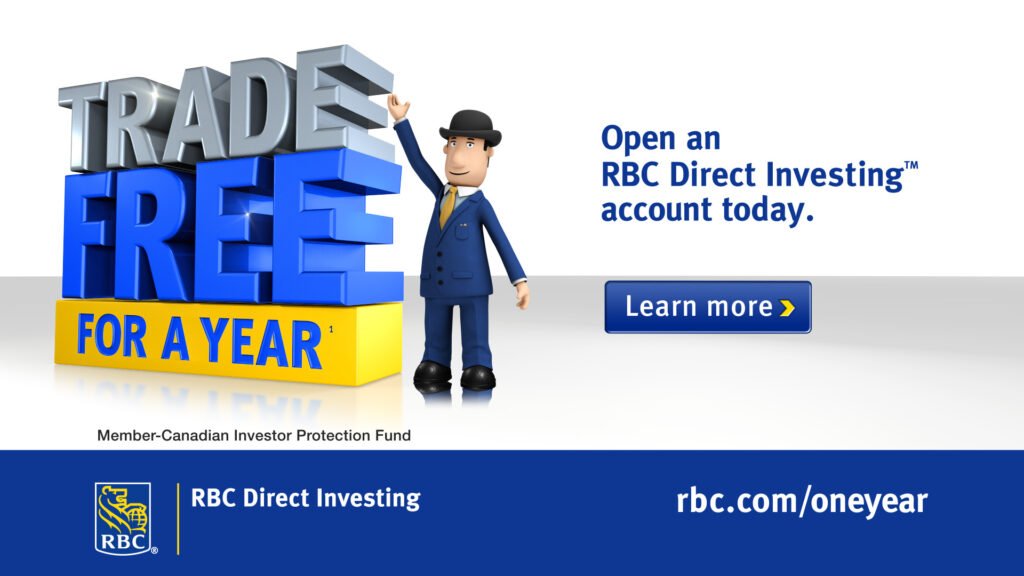
Check the commission schedule before calculating expected investment returns. Trading costs reduce returns and can become particularly significant for investors making frequent small transactions.
As of the information reviewed for this article, standard RBC Direct Investing clients pay $9.95 Canadian or U.S. per eligible online or mobile stock and ETF trade. Clients meeting RBC’s Active Trader threshold of at least 150 trades per quarter can receive a $6.95 rate.
RBC also currently provides unlimited commission-free trading on selected ETFs. Its newer GoSmart account advertises 50 free trades per year on stocks and ETFs in addition to eligible commission-free ETFs.
A commission should not be evaluated in isolation. Investors should also investigate foreign-exchange costs, options pricing, telephone-assisted transaction charges, account-specific fees, transfer fees, interest rates on margin balances, and other charges that could apply to their activities.
The cheapest brokerage for one person may therefore not necessarily be the cheapest for another. Trading frequency, portfolio size, investment selection, currency usage, and required features all influence total cost.
Use RBC Direct Investing Online for Full Account Management
Access the Online Investing platform when you want a browser-based environment for portfolio management, research, monitoring, and trade entry. RBC describes the platform as providing real-time information, investment research, screeners, market commentary, and order-entry functionality.
The platform includes real-time streaming quotes for eligible securities and Level 2 quotations for stocks and ETFs traded on the Toronto Stock Exchange and TSX Venture Exchange. Certain additional Level 2 data is available to qualifying clients under applicable exchange agreements.
Research resources currently referenced by RBC include information from Morningstar, Refinitiv, and Trading Central. Investors can also use market overviews, earnings calendars, screening tools, research reports, and other resources to investigate securities.
Research tools should support an investor’s analysis rather than replace it. Analyst opinions, ratings, technical signals, and market commentary can be incorrect and should not be treated as guarantees of future performance.
Trade Through the RBC Mobile App When Away From a Computer
Use the RBC Mobile app when mobile access is important. RBC Direct Investing clients can monitor eligible investments and place trades from the app, while GoSmart is specifically designed as a mobile-first investing experience.
Mobile access can make it easier to monitor holdings, respond to market developments, and manage accounts from different locations. However, convenience can also encourage excessive trading if investors begin responding impulsively to short-term price movements.
Investors should still verify security symbols, order types, quantities, prices, currencies, and account selection before submitting mobile orders.
An incorrectly entered trade can have immediate financial consequences. Ease of execution should therefore be accompanied by disciplined order review.
Use Trading Dashboard for More Advanced Market Monitoring
Move to RBC Direct Investing’s Trading Dashboard when a more customizable trading environment is useful. RBC positions Trading Dashboard as an advanced platform with tools that investors can configure according to their trading style. It is included as part of the full RBC Direct Investing platform without a separate monthly platform charge under the current pricing presentation.
Advanced traders may use detailed quotation information, market monitoring tools, watchlists, and customizable layouts to follow multiple securities simultaneously.
RBC also provides pre-market and after-hours trading functionality for eligible securities. Extended-hours trading can be useful when market-moving information is released outside regular trading hours, but liquidity may be lower and bid-ask spreads can be wider.
Investors should understand the specific order requirements and risks before trading outside regular market hours.
Practice Trading Before Committing Real Money
Use RBC Direct Investing’s Practice Account if you want to become familiar with the trading interface before risking actual capital. RBC provides eligible users with $100,000 in simulated money for practice trading through its Online Investing platform.
Practice accounts can be used to simulate transactions involving stocks, mutual funds, options, and fixed-income products and to monitor simulated investments over time. RBC notes that the practice experience is available on the Online Investing platform rather than through the RBC Mobile app or Trading Dashboard.
Simulation can help an investor learn how order entry works, but simulated trading cannot reproduce the emotional and financial consequences of losing real money.
It also does not ensure that a strategy that performs well in a practice environment will be profitable in live markets. Market conditions change, spreads vary, and behavioral reactions are different when actual savings are at risk.
Research Stocks and ETFs Before Placing an Order
Use the research resources available through RBC Direct Investing to investigate an investment before buying it. For stocks, relevant information can include earnings, revenue, balance-sheet strength, valuation, industry conditions, dividend history, and company-specific risks.
ETF research should extend beyond recent performance. Investors should examine the underlying index or strategy, holdings, sector exposure, geographic concentration, management expense ratio, trading volume, distribution policy, and currency exposure.
RBC’s platform includes analyst information, screening tools, market data, news, and technical-analysis resources. These tools can narrow a list of potential investments, but they do not eliminate investment risk.
Historical returns also do not guarantee future returns. A stock, ETF, or other investment that performed strongly during one market environment can perform very differently later.
Place Stock and ETF Orders Carefully
Verify each field on the order ticket before submitting a stock or ETF trade. The investor typically needs to select the security, quantity, transaction direction, order type, and other applicable instructions.
A market order generally prioritizes execution rather than a precise execution price. A limit order establishes the maximum purchase price or minimum sale price the investor is prepared to accept, although execution is not guaranteed.
The appropriate order type depends on factors such as liquidity, volatility, bid-ask spreads, trading hours, and the investor’s objectives.
An order confirmation should be reviewed after submission. Investors should also check the final execution price and resulting account position rather than assuming that an entered order executed exactly as expected.
Use Dividend Reinvestment for Eligible Securities
Enroll eligible holdings in a dividend reinvestment plan when automatic reinvestment matches the investment strategy. RBC Direct Investing supports dividend reinvestment for hundreds of eligible securities.
A DRIP generally uses eligible cash dividends to acquire additional shares rather than leaving the payment entirely as cash.
Compounding can be useful for long-term investors because subsequent dividends may be generated by a growing number of shares. However, reinvesting dividends is still an investment decision. The additional shares remain exposed to the same market risks as the underlying security.
Investors using non-registered accounts should also remember that reinvestment does not automatically eliminate tax reporting considerations associated with distributions.
Use Options Only After Understanding Their Additional Risks
Apply for options trading only when you understand how options contracts work and the potential for significant losses. RBC Direct Investing currently permits clients, subject to approval and applicable conditions, to buy calls and puts, write covered calls, and in exceptional cases write naked puts. RBC states that additional spread strategies are not currently permitted.
A call option provides the holder with rights associated with buying the underlying asset at the specified strike price according to the contract terms, while a put provides corresponding rights associated with selling.
Options involve additional variables that do not apply in the same way to ordinary stock ownership. These include expiration dates, strike prices, volatility, time decay, and contract leverage.
Certain options strategies can produce substantial or theoretically very large losses. Investors should understand the complete payoff structure before placing an options transaction rather than focusing solely on the potential return.
Manage Margin Borrowing With Strict Risk Controls
Treat margin as borrowing rather than as additional investment capital. A margin account can allow an investor to purchase eligible securities using funds borrowed through the brokerage, subject to margin requirements.
Leverage magnifies both gains and losses.
If the value of securities in a margin account declines sufficiently, the investor may need to deposit additional assets or funds. The brokerage agreement can also permit actions involving positions when margin requirements are not satisfied.
Interest charged on borrowed funds creates an additional cost regardless of whether the investment subsequently produces a profit.
For these reasons, margin is fundamentally different from investing only the cash already available in an account.
Protect the Account With Strong Security Practices
Secure the brokerage account because it can contain substantial financial assets and personal information. Use unique credentials, available authentication protections, secure devices, and caution around unsolicited messages claiming to represent RBC.
Phishing attacks often attempt to imitate financial institutions and direct users to fraudulent login pages. Investors should access brokerage services through official RBC channels rather than links received unexpectedly through email, text messages, or social media.
Account statements and transaction histories should also be reviewed regularly. Unexpected trades, transfers, profile changes, or login activity should be investigated promptly through official support channels.
Security precautions cannot eliminate every form of fraud, but they reduce avoidable exposure.
Understand CIPF Protection Before Assuming Investments Are Guaranteed
Verify the difference between brokerage insolvency protection and protection against investment losses. RBC Direct Investing Inc. appears on the Canadian Investor Protection Fund’s current list of investment dealer member firms.
CIPF protection is associated with eligible client property held by a member investment dealer in circumstances covered by the fund’s rules.
It does not mean that stocks, ETFs, options, bonds, or other investments cannot decline in value.
If an investor purchases a stock for $10,000 and its market value falls to $6,000 because the company performs poorly, brokerage protection does not normally reimburse the $4,000 market loss.
Investors should review CIPF’s official coverage information to understand eligible property, coverage limits, account categories, and exclusions rather than assuming that membership makes an investment risk-free.
Compare RBC Direct Investing With Other Canadian Brokerages Carefully
Compare total functionality rather than ranking brokerages exclusively by advertised commission.
RBC Direct Investing may be particularly relevant to people already using RBC banking because of integration between eligible banking and investment accounts, including transfers through the RBC ecosystem. It also provides a broad investment menu and several account types.
Other investors may place greater weight on commission-free stock trading, foreign-exchange costs, specialized charting, international-market access, fractional shares, automated investing, or another brokerage-specific feature.
A useful brokerage comparison can therefore consider:
- stock and ETF commissions
- foreign-exchange costs
- registered account availability
- investment product selection
- research quality
- real-time market data
- desktop and mobile platforms
- options capabilities
- account-transfer costs
- customer support
- banking integration
- interest rates and margin costs
Investors should check current pricing directly because brokerage products and fee schedules can change.
Separate Self-Directed Investing From Investment Advice
Recognize that RBC Direct Investing is a self-directed investing service. The investor chooses which securities to purchase, when to trade, how much risk to accept, and how to allocate the portfolio.
Having access to analyst reports or research tools does not convert a self-directed brokerage account into personalized portfolio management.
An investor who wants individualized recommendations, financial planning, discretionary portfolio management, or advice about whether a particular security is appropriate may require a different type of investment relationship.
This distinction is particularly important for beginners who might assume that a brokerage automatically reviews each trade for whether it fits their personal financial goals.
Self-directed investing provides control, but that control also places substantial responsibility on the investor.
Build a Diversified Portfolio Rather Than Chasing Individual Trades
Use the account as part of a broader investment plan rather than treating it purely as a mechanism for short-term trading.
Diversification can spread exposure across companies, industries, geographic markets, and asset classes. It cannot guarantee a profit, but it can reduce dependence on the performance of a single investment.
Investors should also consider time horizon, liquidity needs, risk tolerance, income requirements, and the possibility of substantial market declines before choosing an allocation.
Someone saving for a near-term purchase may have a different capacity for volatility than someone investing for retirement several decades away.
Portfolio construction should therefore begin with financial objectives rather than whichever stock happens to be receiving the most attention.
Review the Main Advantages and Limitations Before Opening an Account
Evaluate RBC Direct Investing based on the combination of features that matters to you rather than assuming it is automatically the right brokerage because it belongs to a major Canadian financial institution.
Potential advantages include a broad range of registered and non-registered accounts, access to Canadian and U.S. investments, integration with RBC banking, research tools, streaming quotes, Trading Dashboard, practice accounts, and commission-free trading on selected ETFs.
Potential limitations depend on how the account will be used. For example, standard stock and ETF trades on the full platform currently cost $9.95, which may be material for investors making numerous small trades. Foreign-exchange costs and other transaction-specific fees can also matter.
GoSmart addresses some commission concerns for newer investors but provides a more streamlined experience than the full platform.
The relevant question is therefore not whether RBC Direct Investing is universally better or worse than another brokerage. The useful question is whether its pricing, investments, account choices, and tools fit the investor’s intended use.
Check Current RBC Direct Investing Information Before Acting
Verify fees, account requirements, investment eligibility, and platform features directly with RBC before opening an account or executing a transaction.
Financial products change. Brokerage commission structures, promotional offers, account features, interest rates, available investments, and regulatory requirements can be updated after an article is published.
As of September 2026, RBC’s official materials describe:
- GoSmart with 50 free stock and ETF trades per year
- selected ETFs with unlimited commission-free trading
- standard online/mobile stock and ETF trades at $9.95
- Active Trader pricing of $6.95 at 150 or more trades per quarter
- no monthly account maintenance fee under the current pricing presentation
- access to registered and non-registered investment accounts
- online, mobile, and Trading Dashboard platforms
These details come from RBC Direct Investing’s current published materials and should be rechecked before relying on them for a financial decision.
Conclusion
RBC Direct Investing is a Canadian self-directed brokerage offering access to stocks, ETFs, mutual funds, bonds, GICs, options, and other investments through a range of registered and non-registered accounts. Investors can choose among TFSAs, RRSPs, FHSAs, RESPs, RRIFs, cash accounts, margin accounts, and eligible business or trust accounts.
The service now covers different investor profiles. GoSmart provides a streamlined mobile-first experience with 50 free stock and ETF trades annually under the current pricing structure. Standard RBC Direct Investing provides the broader platform and currently charges $9.95 for online or mobile stock and ETF trades, while qualifying Active Traders can receive a $6.95 rate. Selected ETFs can be traded commission-free under RBC’s program.
RBC Direct Investing also provides research resources, real-time quotes, online and mobile trading, Trading Dashboard, practice accounts, dividend reinvestment, and integration with eligible RBC banking services.
Those features do not eliminate investment risk. Self-directed investors remain responsible for choosing investments, understanding tax implications, controlling trading costs, managing diversification, and deciding how much market risk they can accept.
RBC Direct Investing Inc. is listed as a member firm by the Canadian Investor Protection Fund, but CIPF protection should not be confused with protection against normal investment losses.
For investors evaluating RBC Direct Investing, the most useful approach is to compare its current fees, account choices, investment selection, research tools, banking integration, and platform capabilities against their own investing requirements before opening or funding an account.
Frequently Asked Questions
Is RBC Direct Investing a brokerage?
Yes. RBC Direct Investing is a Canadian self-directed brokerage operated by RBC Direct Investing Inc. It allows eligible clients to manage and trade investments through registered and non-registered accounts.
How much does RBC Direct Investing charge per trade?
RBC currently lists standard online or mobile stock and ETF trades at $9.95. Eligible Active Traders who complete at least 150 trades per quarter can receive a $6.95 rate. RBC also offers commission-free trading on selected ETFs.
Does RBC Direct Investing offer commission-free trading?
Yes, in specific circumstances. RBC currently provides unlimited commission-free trading on selected ETFs. Its GoSmart account also advertises 50 free stock and ETF trades per year. Eligibility and conditions should be checked directly with RBC.
Can I open a TFSA with RBC Direct Investing?
Yes. RBC Direct Investing offers self-directed TFSAs along with RRSPs, FHSAs, RESPs, RRIFs, cash accounts, margin accounts, and other account types.
Can I buy U.S. stocks through RBC Direct Investing?
Yes. RBC Direct Investing provides access to exchange-listed Canadian and U.S. stocks and ETFs. Currency conversion and other applicable costs should be considered when trading foreign-currency securities.
Does RBC Direct Investing have a practice account?
Yes. Eligible RBC users can access a Practice Account containing $100,000 in simulated funds. The practice environment lets users become familiar with the Online Investing platform without putting real money at risk.
Can I trade options through RBC Direct Investing?
Yes, subject to account approval and applicable conditions. RBC currently allows eligible investors to buy calls and puts, write covered calls, and, with special exception, write naked puts.
Is RBC Direct Investing protected by CIPF?
RBC Direct Investing Inc. is currently listed as an investment dealer member firm by the Canadian Investor Protection Fund. CIPF coverage relates to eligible property held at member firms under covered circumstances and does not protect investors against ordinary market losses.
Is RBC Direct Investing only for RBC banking customers?
The full RBC Direct Investing account-opening process includes pathways for people using RBC as well as applicants coming from another financial institution. GoSmart, however, is offered through the RBC Mobile app and requires the user to become an RBC client.
Is RBC Direct Investing suitable for beginners?
RBC offers beginner-oriented features including GoSmart, educational resources, and Practice Accounts. Whether self-directed investing is suitable for a particular person depends on their knowledge, financial situation, objectives, and willingness to make investment decisions without personalized advice.
Editorial and Financial Information Note
This article is educational and does not provide individualized investment, tax, or legal advice. Product descriptions, commissions, and platform features were checked against official RBC Direct Investing materials available in September 2026. RBC can change pricing, eligibility requirements, products, and account features.
Information about brokerage insolvency protection was cross-checked against the Canadian Investor Protection Fund’s member directory rather than relying solely on RBC’s marketing materials. Investors should confirm current terms with RBC Direct Investing and consult appropriately qualified professionals when personal financial, tax, or legal advice is required.