
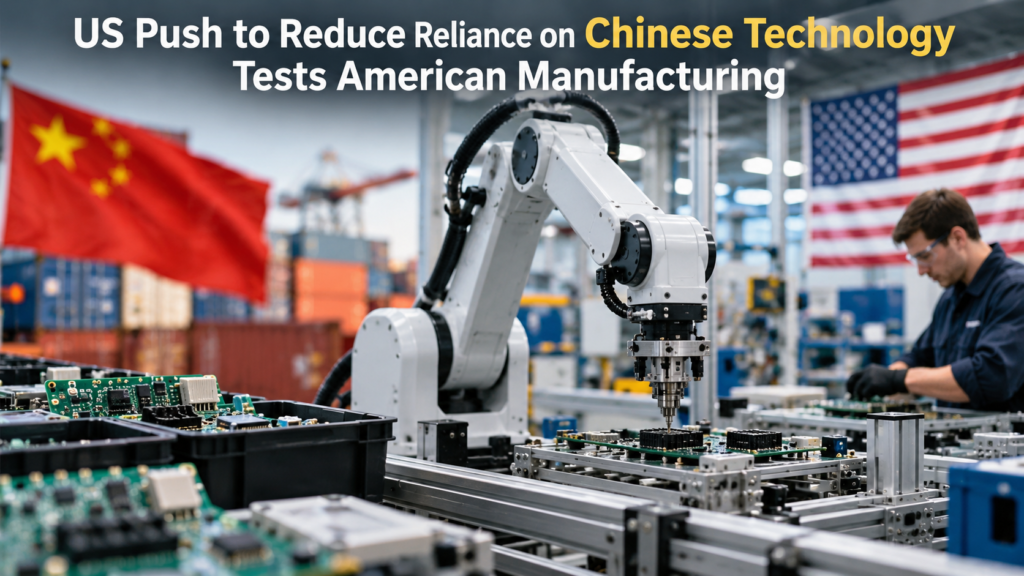
The US effort to reduce reliance on Chinese technology is reshaping American manufacturing, particularly in robotics, electronics, electric vehicles and other advanced industries. Federal restrictions are intended to address national security concerns and strengthen domestic production, but manufacturers say replacing China’s established supply chains can increase costs and create delays.
China remains an important source of components and manufacturing capacity for many US technology businesses. Industry executives and manufacturing researchers cited by CNN say developing competitive alternatives will require investment, technical expertise and time.
Replace Chinese Technology Supply Chains
US robotics companies provide a practical example of the transition.
Chef Robotics completes final assembly of its food-production robots in the United States, but CEO Rajat Bhageria told CNN that components attached to its robotic arms are manufactured in China. Attempts to find alternatives revealed that some US suppliers either lacked the required capabilities or could not manufacture the parts economically.
Ben Armstrong, executive director of MIT’s Industrial Performance Center, told CNN that decades of offshore production have left gaps in US manufacturing capabilities. Rebuilding those capabilities involves a learning curve that can initially make production more expensive.
| Supply Chain Factor | Potential Effect |
|---|---|
| Reduced Chinese sourcing | Greater supply diversification |
| Limited domestic capacity | Longer production timelines |
| Higher US manufacturing costs | More expensive components |
| New domestic investment | Potential long-term resilience |
Expand US Manufacturing Capacity
Federal restrictions now affect multiple categories of Chinese technology.
According to the reporting, the Federal Communications Commission expanded restrictions in July to include certain advanced robotics and power inverters. The US has also imposed restrictions involving Chinese vehicle software and tariffs on Chinese electric vehicles and drones.
Moving production back to the United States is not immediate. Michael Murray, CEO of defense supplier Kopin Corporation, told CNN that shifting production of some microdisplay screens from China to the US required more than two years.
Murray estimated that domestic production costs can be as much as 25% higher, although Department of Defense funding helped offset some transition expenses.
Secure Critical Technology Materials
Changing assembly locations does not necessarily remove dependence on Chinese supply chains.
Ghost Robotics, which develops industrial and military robotic systems, moved motor production from China to South Korea and sources neodymium magnets through Europe. CEO Gavin Kenneally told CNN, however, that the underlying raw materials still originate in China.
This demonstrates the complexity of supply-chain diversification because components can contain materials sourced several stages upstream.
Balance Technology Security With Innovation
Restrictions may encourage US production, but researchers and executives have also identified potential short-term trade-offs.
Saman Farid, founder of Robots for America, warned that limited access to competitive equipment could become an obstacle if alternatives are not developed quickly.
Academic research could face similar constraints. University of Illinois engineering professor Sayan Mitra told CNN that replacing some Chinese humanoid robots with US alternatives could cost substantially more, potentially affecting research and education budgets.
Prepare for Higher Technology Costs
Consumers may eventually experience some of these changes directly.
Restrictions covering mobile robots could affect future versions of products such as robotic vacuums, pool cleaners and lawn equipment. IDC consumer technology researcher Jitesh Ubrani told CNN that relocating manufacturing to the US is possible over the longer term but could significantly increase costs.
Conclusion
The US push to reduce dependence on Chinese technology involves a trade-off between supply-chain security and near-term manufacturing challenges. Evidence from robotics and electronics companies shows that alternative sourcing can require years of investment and higher production costs. The longer-term outcome will depend on whether US manufacturers can expand capacity, secure critical materials and produce competitive technologies at scale.
Frequently Asked Questions
Why is the US restricting Chinese technology?
US officials cite national security, sensitive data and supply-chain concerns.
Which industries are affected?
Robotics, drones, electric vehicles, electronics and other advanced technologies face various restrictions.
Is US manufacturing more expensive?
Some manufacturers report higher costs. Kopin’s CEO estimated certain relocated production can cost up to 25% more.
Could the restrictions affect innovation?
Experts cited in the reporting warn that limited access to affordable technology could create short-term challenges for companies and researchers.
Can US companies quickly replace Chinese suppliers?
In many cases, no. Developing suppliers, manufacturing capacity and alternative material sources can take years.