
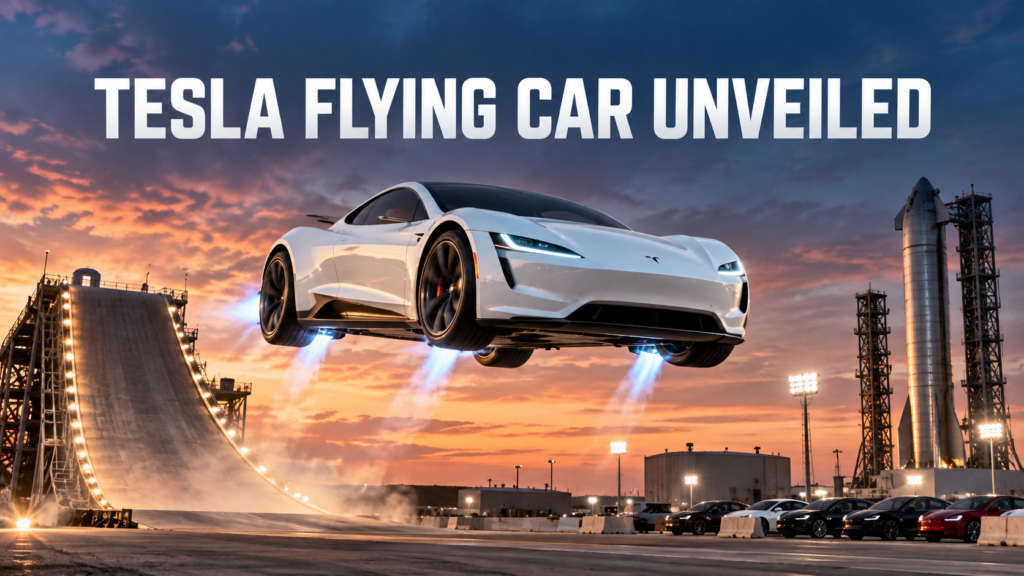
According to CNN, Musk presented the vehicle as a major advancement in automotive technology. However, the Roadster remains a prototype, and its ability to perform sustained flight has not been established.
Watch Tesla’s Flying Car Demonstration

During the demonstration, Tesla’s new Roadster climbed a curved ramp, traveled upside down using a suction system, and launched into the air before landing safely on its wheels.
The driverless vehicle also jumped over a row of parked Tesla cars using high-pressure air thrusters.
Musk claimed the Roadster could accelerate from 0 to 60 mph in less than one second, although its production performance remains unverified through independent testing.
Explore Tesla Flying Car Technology
The Tesla Roadster combines electric vehicle engineering with propulsion technology associated with SpaceX.
Instead of relying on airplane wings, the vehicle uses ultra-high-pressure compressed air tanks and strategically positioned thrusters to produce upward force.
Tesla engineering executive Lars Moravy explained that a fan-powered suction system allows the Roadster to maintain traction while upside down.
However, the technology demonstrated short airborne movements rather than conventional sustained flight.
Check Tesla Roadster Specifications and Features
|
Feature |
Reported details |
|---|---|
|
Vehicle |
Next-generation Tesla Roadster |
|
Manufacturer |
Tesla |
|
Propulsion |
Compressed-air thrusters |
|
Acceleration |
0–60 mph in under 1 second, claimed |
|
Top speed |
Over 230 mph, claimed |
|
Driving range |
Over 300 miles, claimed |
|
Production target |
2028 |
These specifications reflect Tesla’s announcements and have not all been independently verified.
Review Tesla Flying Car Production and Safety Plans
Musk expects Tesla Roadster production to begin in 2028, following repeated delays since the vehicle’s initial announcement in 2017.
Despite the successful demonstration, significant questions remain about road legality, passenger safety, regulatory approval, and commercial practicality.
According to Reuters, the Roadster primarily demonstrates Tesla’s engineering ambitions rather than representing a major near-term source of revenue.
Follow Tesla’s Future Flying Car Developments
Tesla’s flying Roadster demonstrates how electric vehicle engineering and aerospace technology could create new possibilities for high-performance transportation.
However, the vehicle is not yet a commercially available flying car, and its aerial capabilities remain limited to controlled demonstrations.
Whether Tesla can translate these features into a safe, road-legal production vehicle will depend on further engineering, testing, and regulatory decisions.
Frequently Asked Questions
Can Tesla’s new Roadster really fly?
It can perform short aerial jumps using compressed-air thrusters, but sustained flight has not been demonstrated.
When will Tesla’s flying car launch?
Elon Musk has targeted 2028 for production.
Does Tesla’s flying car use rocket fuel?
No. Its demonstrated thrusters use high-pressure compressed gas rather than combustion-powered rockets.
Is Tesla’s flying Roadster road legal?
Its demonstrated airborne features are not currently approved for ordinary public-road use.