
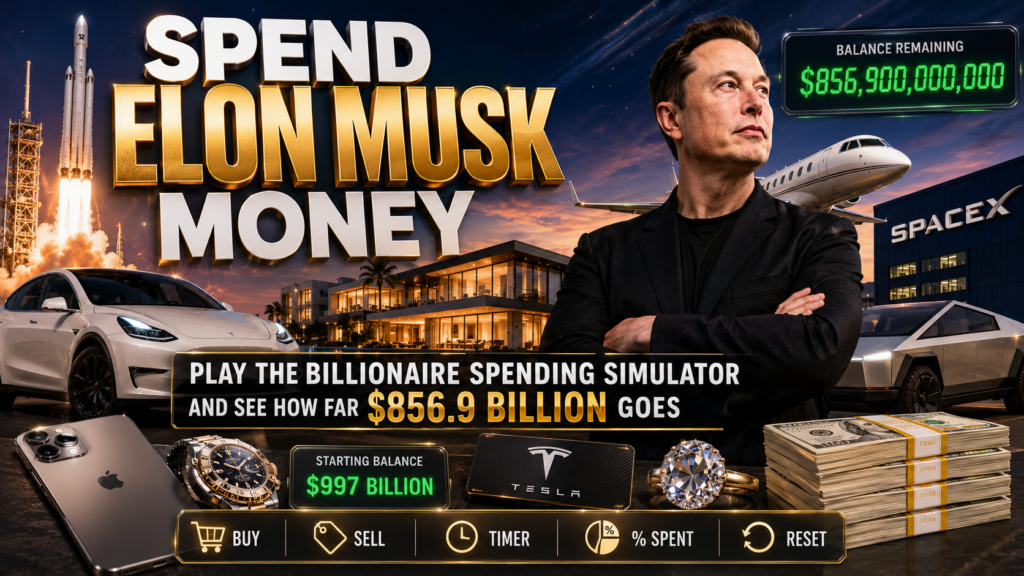
The Spend Elon Musk Money game turns one of the world’s largest fortunes into an interactive spending experiment. Instead of looking at a billionaire net-worth figure and trying to imagine its scale, players receive a virtual balance and spend it on products ranging from smartphones and luxury cars to private jets, mansions, companies, and other high-value assets.
The concept is simple, but the numbers require an important distinction. As of August 24, 2026, Forbes’ Real-Time Billionaires ranking estimated Elon Musk’s net worth at approximately $856.9 billion. Forbes also identifies Tesla and SpaceX as major sources of his wealth. That figure represents an estimate of net worth, not a bank balance or an equivalent pile of cash available for immediate spending.
Popular Spend Elon Musk Money simulators do not necessarily use the same figure. One current browser game, for example, starts players with $997 billion and labels that amount as a June 2026 estimate. Because billionaire wealth can change significantly with asset prices, a fixed game balance can quickly differ from a current wealth ranking.
Understanding that distinction makes the simulator both more accurate and more interesting. It is an entertainment game, but it also provides a practical way to visualize the difference between thousands, millions, billions, and hundreds of billions of dollars.
Choose a Spend Elon Musk Money Simulator
Start by selecting a Spend Elon Musk Money game that clearly displays its starting balance, prices, purchase controls, and reset options.
The most useful simulators make the rules immediately visible. One currently available version starts with $997 billion, includes a one-minute timer, tracks how much money remains, calculates the percentage spent, and provides Buy and Sell buttons for individual products. Its catalog begins with familiar products such as AirPods, gaming consoles, smartphones, computers, and other consumer technology before moving into more expensive categories.
These controls matter because different versions of the game may produce very different experiences. A simulator with a timer emphasizes speed. A version with unrestricted play encourages experimentation. A large product catalog allows players to compare everyday purchases with major assets, while a smaller catalog may make reaching a zero balance more difficult.
Before playing, review the game’s basic settings rather than assuming every Spend Elon Musk Money simulator follows the same rules.
| Feature | What to Check |
|---|---|
| Starting balance | The amount of virtual money provided |
| Date of wealth estimate | When the simulator selected its starting figure |
| Timer | Whether spending must be completed within a limit |
| Buy controls | How additional units are purchased |
| Sell controls | Whether purchases can be reversed |
| Remaining balance | How much virtual money is left |
| Percentage spent | How much of the original fortune has been used |
| Product range | Whether the game includes low- and high-value purchases |
A clear interface makes it easier to focus on the main challenge: discovering how difficult it can be to spend hundreds of billions of dollars.
Check the Starting Balance Before You Begin
Look at the virtual fortune shown on screen before making your first purchase. The amount determines the scale of the entire game.
This is particularly important because online simulators can use different figures for Elon Musk’s wealth. One current simulator uses $997 billion and describes that value as a June 2026 estimate. By comparison, Forbes’ Real-Time Billionaires list showed Musk at approximately $856.9 billion on August 24, 2026.
That difference exceeds $140 billion, demonstrating how quickly a fixed simulator value can become disconnected from a current wealth ranking.
Forbes explains that its real-time ranking updates public holdings as market prices move and periodically updates wealth linked to private companies. This methodology helps explain why a billionaire’s estimated wealth can rise or fall without the person buying or selling an equivalent amount of property.
For gameplay, a fixed balance is useful because every player begins from the same number. For factual comparisons, however, the date attached to the figure matters.
The safest interpretation is therefore straightforward: the simulator balance is a game scenario, while the Forbes figure is a current estimate of net worth based on asset values.
Start With Everyday Products to Understand the Scale
Buy products you already recognize before moving to extreme luxury items. Everyday prices provide a familiar reference point for understanding an unfamiliar amount of wealth.
The current $997 billion simulator includes products such as AirPods Pro at $249, a Nintendo Switch 2 at $499, an Xbox Series X at $599, a PS5 Pro at $899, and premium computers costing thousands of dollars.
Purchasing one of these products barely changes a balance measured in hundreds of billions.
Suppose the starting fortune were $856.9 billion, matching Forbes’ August 24 estimate. A $1,000 purchase would represent roughly 0.000000117% of that amount.
Even spending $1 million would consume only about 0.000117%.
This is where the game becomes more useful than simply reading a net-worth figure. The player can watch familiar purchases disappear into a balance so large that the total barely moves.
The exercise also reveals a common weakness in how people intuitively interpret very large numbers. One million and one billion may both sound enormous, but one billion equals one thousand millions. A fortune measured in hundreds of billions operates on a completely different scale from ordinary household spending.
Increase Purchases to See the Difference Between Millions and Billions
Move from consumer products to expensive cars, homes, yachts, and aircraft once small purchases stop affecting the balance in a noticeable way.
The progression demonstrates how rapidly financial scale changes. A $100,000 vehicle is expensive by ordinary standards, but 10 such vehicles cost only $1 million. Buying 100 costs $10 million. Buying 1,000 costs $100 million.
You would still need 10,000 vehicles priced at $100,000 each to spend $1 billion.
Against an $856.9 billion balance, even spending $1 billion would eliminate only about 0.117% of the original amount.
The following comparison helps put that difference into perspective:
| Spending Amount | Share of an $856.9 Billion Fortune |
|---|---|
| $1,000 | About 0.000000117% |
| $1 million | About 0.000117% |
| $100 million | About 0.0117% |
| $1 billion | About 0.117% |
| $10 billion | About 1.17% |
| $100 billion | About 11.67% |
These figures are mathematical comparisons rather than claims about how much cash Musk actually holds.
That distinction is important. Net worth and liquid money are not interchangeable. The calculation simply shows how different spending amounts compare with a headline wealth estimate.
Target Billion-Dollar Assets to Spend Faster
Choose the highest-value items available when the objective is to reduce the balance quickly.
Once a simulator gives you hundreds of billions of dollars, ordinary luxury goods become inefficient. A collection of sports cars may cost millions. A mansion may cost tens or hundreds of millions. Even a private jet may represent only a small fraction of a billion-dollar-scale balance.
This forces players toward assets with prices measured in billions.
Depending on the simulator, those categories can include companies, major real estate, infrastructure, transportation systems, large entertainment assets, or other fictionalized acquisitions. The exact selection varies by game, so prices should be interpreted as gameplay values rather than professional appraisals.
Consider a simple example. Spending $100 million 10 times equals $1 billion. Spending $1 billion 10 times equals $10 billion. Even after spending $10 billion, more than $846 billion would remain from an $856.9 billion starting balance.
The game therefore becomes less about imagining a luxurious shopping trip and more about understanding capital scale.
A player who begins by asking, “What would I buy?” often ends up asking, “What could possibly cost enough?”
That shift is one of the simulator’s most revealing features.
Use Quantity Controls to Reduce the Balance Efficiently
Increase quantities when the game allows multiple units of the same product.
The Buy and Sell controls on current simulators make repeated purchasing possible, and the quantity counter shows how many units have been selected.
This becomes particularly useful during timed challenges.
Imagine that an item costs $50 million. Buying one has little effect on an $856.9 billion balance. Buying 20 consumes $1 billion. Buying 200 consumes $10 billion.
Quantity controls therefore turn individual products into larger spending tools.
They also expose the sheer number of ordinary assets required to match billionaire-scale wealth. If a house cost $1 million, you would need 1,000 of them to spend $1 billion. To spend $100 billion at that price, you would need 100,000 houses.
The figures are intentionally simplified because real property purchases involve different prices, transaction costs, taxes, financing structures, and availability. Inside a simulator, however, the simplified model helps illustrate magnitude.
If your goal is speed, prioritize high-priced items and large quantities. If your goal is exploration, use smaller quantities and move through different product categories.
Track the Remaining Balance After Major Purchases
Watch the remaining balance rather than focusing only on the number of items purchased.
The simulator’s balance is the clearest measure of progress. Spending a few million dollars can feel dramatic when looking at the shopping cart, but the percentage-spent indicator may reveal that almost none of the original fortune has disappeared.
A current Spend Elon Musk Money game displays three particularly useful numbers: the amount remaining, the amount spent, and the percentage of the original fortune used.
Together, these measurements show both absolute and relative spending.
Suppose you spend $500 million. The transaction sounds enormous, but against $856.9 billion, it represents only about 0.058%.
Spend $5 billion and the proportion rises to about 0.58%.
Spend $50 billion and you have finally consumed about 5.83%.
Watching these percentages change can provide a clearer understanding of the fortune than simply looking at dollar totals.
The game therefore works best when players pay attention to both price and proportion.
Separate Net Worth From Cash in the Bank
Treat the simulator’s virtual balance as fictional cash rather than a literal representation of Elon Musk’s financial accounts.
This is the most important factual distinction in the entire game.
Forbes estimated Musk’s net worth at approximately $856.9 billion on August 24, 2026 and identifies Tesla and SpaceX as major sources of his fortune. Its methodology calculates billionaire wealth primarily from the value of ownership interests and other assets rather than treating the reported number as cash.
Forbes’ profile also reports substantial ownership stakes connected with Musk’s companies. Such holdings can create enormous estimated wealth while remaining fundamentally different from immediately spendable dollars.
Three financial concepts help clarify the difference:
Net worth is the estimated value of assets minus liabilities.
Liquidity refers to how easily an asset can be converted into cash without materially affecting its price.
Cash is already available in a highly liquid form.
A simulator intentionally removes these complications. It assumes that the entire selected fortune exists as a virtual dollar balance that can instantly purchase anything in the catalog.
That simplification is necessary for gameplay, but it should not be interpreted as a description of real-world finances.
Compare Current Wealth Estimates With Game Values
Check the date whenever a simulator claims to represent a billionaire’s fortune.
The reason is visible in recent data.
Forbes estimated Musk’s wealth at about $690 billion on August 1, 2026. Its real-time list showed approximately $894.9 billion on August 17, $869.7 billion on August 19, and $856.9 billion on August 24.
Those fluctuations show why assigning a permanent “Elon Musk money” balance is difficult.
A game’s value can be reasonable for the date on which it was selected and outdated weeks later.
This also means there is no single permanent answer to “How much money does Elon Musk have?” if the question refers to net worth. The estimate changes with the values of the assets used in the calculation.
For the Spend Elon Musk Money keyword, the practical distinction is simple:
Game balance: fixed for entertainment.
Current wealth estimate: changes with market and asset valuations.
That separation improves accuracy while preserving the fun of the simulator.
Build a Strategy for Timed Spending Challenges

Plan purchases before starting the timer if you want to spend the highest percentage of the virtual fortune.
One current version gives players a one-minute default timer, which makes inefficient purchases costly in terms of time.
A practical strategy is to divide the challenge into three stages.
First, locate the most expensive products before beginning. These items will remove the largest amount of money per click.
Second, use quantity controls when available. Repeated purchases of high-priced assets can eliminate billions faster than moving through hundreds of low-cost products.
Third, switch to smaller purchases near the end if you are trying to reach a precise remaining balance.
This creates an optimization challenge. High-value products provide speed, while lower-value products provide precision.
Players can also create their own rules. One session might focus entirely on technology. Another could prioritize transportation, real estate, or businesses. A third could attempt to spend as much as possible while buying only one unit of every product.
These variations make the simulator more engaging than a single playthrough.
Calculate How Long Billionaire-Level Spending Would Take
Use daily spending examples to understand why hundreds of billions of dollars are difficult to visualize.
If you spent $1 million every day, it would take 1,000 days to spend $1 billion.
That is approximately 2.74 years.
At the same rate, spending $100 billion would take about 100,000 days, or approximately 274 years.
Using Forbes’ August 24 estimate of $856.9 billion, spending $1 million every day would theoretically require approximately 856,900 days, or roughly 2,346 years, assuming no investment gains, losses, taxes, or other changes.
The example is intentionally hypothetical. It does not describe how Musk’s assets could actually be liquidated or spent.
Its purpose is to demonstrate scale.
Increase the rate to $10 million per day and the same $856.9 billion would still last more than 234 years.
At $100 million every day, it would take approximately 23.5 years.
These comparisons explain why the game’s starting balance can initially feel almost impossible to reduce.
Treat Simulator Prices as Illustrative Values
Do not assume every price inside the game reflects a current market quotation.
Retail products can have clearly advertised prices, but major assets are more complicated.
A smartphone may have a standard retail price. A mansion, private island, sports franchise, skyscraper, business, or infrastructure project does not.
The value of those assets can depend on location, revenue, debt, ownership rights, market conditions, negotiations, and many other factors.
Even apparently simple assets can vary enormously in price.
For this reason, billionaire spending simulators should be viewed primarily as educational entertainment. Their numbers help compare scale, but they are not substitutes for valuation reports, investment analysis, company filings, or professional financial research.
The same caution applies to outdated consumer-product listings. Technology prices can change after new models launch, discounts appear, or products are discontinued.
When accuracy matters outside the game, verify the price separately.
Use the Game to Understand Billionaire Wealth More Clearly
Pay attention to the financial lessons that emerge while playing.
The first lesson is scale. A million dollars is enormous in ordinary personal finance, yet it represents a tiny fraction of hundreds of billions.
The second lesson is ownership. Billionaire net worth is often tied heavily to equity rather than cash.
The third lesson is valuation. The reported value of a company ownership stake can change as the underlying company’s valuation changes.
The fourth lesson is liquidity. An asset can be extremely valuable without being instantly convertible into an identical amount of cash.
The fifth lesson is allocation. Even a massive budget requires choices when the goal is to deploy all of it efficiently.
These concepts help explain why the Spend Elon Musk Money format attracts interest beyond simple celebrity curiosity. It transforms financial scale into an interactive problem.
Instead of being told that hundreds of billions is a very large number, players experience how slowly that number disappears.
Replay the Simulator With Different Spending Rules
Restart the game after finishing one session and use a different strategy.
A first attempt can focus purely on personal preferences. Buy the cars, devices, houses, or travel-related assets you would choose if money were unlimited.
On the second attempt, optimize for speed.
On the third, try to minimize the number of transactions.
Another challenge is to buy only one of each product. This removes the advantage of quantity controls and encourages players to examine more of the catalog.
You can also set category-specific challenges:
- Buy only technology products.
- Spend $1 billion using the fewest transactions.
- Build the most expensive vehicle collection.
- Avoid buying companies or major businesses.
- Reach the lowest possible balance before the timer ends.
- Buy at least one item from every category.
- Compare how fast $1 billion and $100 billion can be spent.
These rules turn a simple clicking game into a repeatable numerical exercise.
Verify Financial Figures Before Sharing the Results
Use a dated, reputable source when discussing Elon Musk’s real-world net worth outside the simulator.
Forbes’ Real-Time Billionaires list is useful because it explains both its current estimate and its update methodology. On August 24, 2026, it listed Musk at approximately $856.9 billion and ranked him first on its real-time billionaire list.
That figure should still be presented with a date because it can change.
Forbes itself demonstrates the volatility. Its August 2026 reporting placed Musk at approximately $690 billion on August 1, while a later real-time update showed his wealth above $900 billion during the month before subsequent movement.
This kind of fluctuation reinforces a useful publishing practice: never present a billionaire net-worth estimate as permanent.
If you share a Spend Elon Musk Money result, identify whether the number comes from the game or from a current wealth tracker.
That small clarification substantially improves accuracy.
Enjoy Spend Elon Musk Money as a Wealth Visualization Game
Use Spend Elon Musk Money for what it does best: turning an abstract billionaire fortune into an understandable interactive experience.
The game becomes most revealing when you begin with ordinary purchases. A phone barely affects the balance. A luxury vehicle hardly moves it. Even a million-dollar purchase can disappear into the total with almost no visible impact.
Only after players move into purchases measured in hundreds of millions or billions does the balance begin falling at an obvious rate.
That progression provides a clearer sense of the difference between personal wealth, millionaire wealth, billionaire wealth, and fortunes measured in hundreds of billions.
As of August 24, 2026, Forbes estimated Elon Musk’s net worth at approximately $856.9 billion. Meanwhile, one popular Spend Elon Musk Money simulator continues to use a $997 billion starting figure associated with June 2026. Those numbers should not be treated as interchangeable, and neither represents a literal bank account.
With that limitation understood, the simulator offers an entertaining way to explore large numbers, spending decisions, wealth valuation, and the difference between owning valuable assets and holding cash.
Frequently Asked Questions
How do you play Spend Elon Musk Money?
Open a Spend Elon Musk Money simulator and use the Buy controls to purchase virtual products. Each purchase reduces the fictional balance. Some versions also provide Sell buttons, quantity counters, timers, spending percentages, and reset controls. One current browser version uses a one-minute default challenge.
How much money does the Spend Elon Musk Money game give you?
The amount depends on the simulator. One current version starts with $997 billion and identifies the figure as a June 2026 value. That amount is different from Forbes’ August 24, 2026 real-time net-worth estimate of approximately $856.9 billion.
What is Elon Musk’s net worth right now?
Forbes’ Real-Time Billionaires list estimated Elon Musk’s net worth at approximately $856.9 billion as of August 24, 2026. Billionaire net-worth estimates can move rapidly, so readers checking at a later date should consult an updated ranking.
Is Elon Musk’s net worth all cash?
No. Net worth is an estimate of assets minus liabilities, not the amount sitting in a bank account. Forbes identifies Tesla and SpaceX as major sources of Musk’s wealth, meaning ownership interests account for a substantial part of the estimate.
Is Spend Elon Musk Money a real-money game?
No. The browser simulator uses a fictional balance and simulated purchases. Clicking Buy does not purchase the real product or use actual money.
Can you spend all of Elon Musk’s money in the simulator?
That depends on the game’s catalog, purchase limits, timer, and quantity controls. Games with billion-dollar assets and repeated purchasing options make it easier to reduce the balance, while timed versions add an additional challenge. The objective is entertainment and wealth visualization rather than reproducing real financial transactions.