
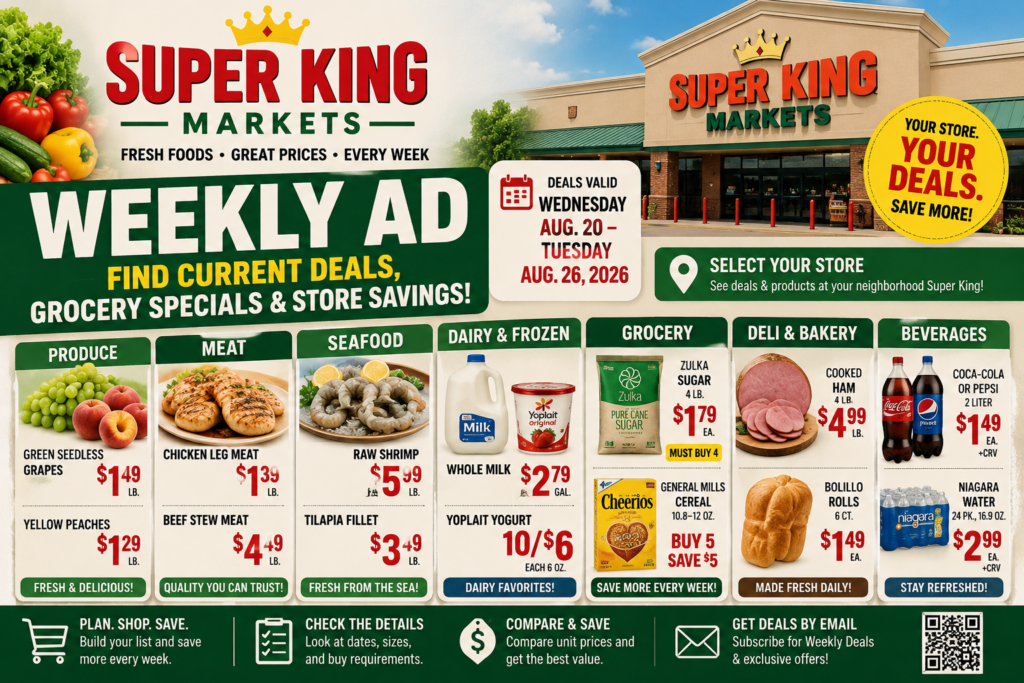
The Super King weekly ad is one of the most useful tools for shoppers who want to plan purchases around discounted produce, meat, seafood, dairy, frozen foods, pantry staples, beverages, deli products, and household essentials. Super King Markets publishes its promotions online and allows shoppers to save a preferred store so the website can display deals connected with that location.
Accuracy matters when using any grocery circular. A sale page can remain visible online after its promotional dates have passed, and prices available through delivery services may differ from those charged in a physical Super King store. For that reason, shoppers should verify the store, promotion dates, product size, quantity requirement, and final price before making a special trip.
As of August 24, 2026, Super King’s indexed product collection still shows several offers marked valid from August 17 through August 23, 2026. Those particular prices have expired and should not be treated as this week’s active deals unless Super King republishes them under a new validity period. Super King’s FAQ separately states that its regular Weekly Deals start Wednesday and end Tuesday, so the date printed on the specific promotion should always control your shopping decision.
This guide explains how to find the latest Super King ad, verify advertised prices, compare offers correctly, and turn the circular into a practical grocery-saving plan.
Select Your Super King Store Before Checking Prices
Choose your preferred Super King Markets location before reviewing the weekly circular. The retailer’s website saves a selected store and states that shoppers will see that store’s ad and deals when they return.
This step is important because supermarket promotions are not always universal. Inventory, local demand, merchandising, and store participation can affect which products are available. A shopper who sees a deal connected with one location should not automatically assume that another store will have the same inventory or promotional conditions.
Use the store selector on the official site rather than relying entirely on a search-engine result. Search engines can surface older product pages that are still technically accessible even though their sale periods have ended.
For the strongest price verification, follow this sequence:
- Open Super King Markets’ official website.
- Set or confirm your preferred store.
- Open the Weekly Deals section.
- Check the advertised validity dates.
- Verify the product size and purchase condition.
- Confirm the price in-store if the deal is important enough to influence your trip.
This process provides more reliable information than assuming the first “Super King weekly ad” result online represents the newest circular.
Open the Official Super King Weekly Deals Page
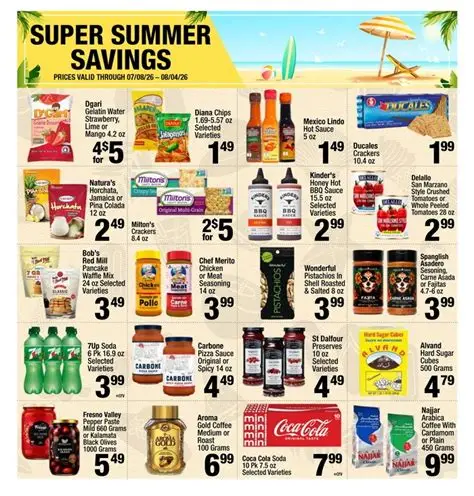
Use Super King’s own Weekly Deals page as the primary source for advertised promotions. The retailer maintains a dedicated weekly-ad section and links shoppers directly to weekly deals from its shopping interface.
Third-party circular websites can be convenient for browsing, but they add another layer between the shopper and the retailer. An official source is more authoritative when you need to determine whether a promotion belongs to Super King, whether a store must be selected, or whether an online price carries special conditions.
This is particularly important around the transition between promotional periods. On August 24, 2026, for example, Super King’s indexed collection was still displaying product pages whose advertised dates ended August 23. The existence of a product page does not by itself prove that the price is still active.
When a deal affects your meal plan or justifies traveling farther than usual, check the active circular rather than relying on an old screenshot, social-media repost, search snippet, or cached page.
Verify the Weekly Ad Dates Before Shopping
Read the dates attached to the promotion before treating any advertised number as a current price.
Super King Markets’ official FAQ says its Weekly Deals start every Wednesday and end on Tuesday. The same FAQ directs customers to view deals online or subscribe to the retailer’s newsletter.
At the same time, recently indexed Super King product pages carried a Monday, August 17 through Sunday, August 23 validity period. That demonstrates why shoppers should prioritize the date displayed on the actual offer rather than relying only on a general expectation about the retailer’s weekly schedule.
A practical rule is:
| Information Shown | How to Use It |
|---|---|
| Date printed on the specific offer | Treat this as the primary validity period |
| General weekly schedule | Use it to know when to look for updates |
| Search-engine date | Do not treat it as proof that a deal is current |
| Old screenshot or flyer | Verify against the official website |
| Product page without a current date | Confirm before relying on the price |
This extra check takes only a few seconds and can prevent a shopping list from being built around expired discounts.
Review Produce Specials Before Building Your Meal Plan
Start with produce because fruits and vegetables frequently appear prominently in Super King’s promotional assortment.
Super King’s product collection separates Produce as its own department. Recently advertised examples included eggplant, peaches, seedless grapes, melons, Roma tomatoes, white corn, Anaheim chiles, cabbage, onions, apples, nectarines, and dates. Those specific indexed offers were marked valid August 17 through August 23, 2026, so they illustrate the retailer’s promotional mix but should not be interpreted as active August 24 prices.
Produce pricing also requires attention to units. An item may be advertised per pound or each, and the difference affects the final bill.
A melon advertised at a per-pound rate will cost more than the displayed rate after its weight is calculated. An ear of corn advertised “each” has a straightforward unit price. Comparing those formats correctly is essential when estimating a grocery budget.
Shoppers can get more value from produce deals by planning multiple meals around the same discounted ingredients. Tomatoes, onions, cabbage, peppers, fruit, and greens can often serve several recipes during the week, reducing the risk that sale purchases go unused.
Compare Meat and Seafood Prices by Weight
Evaluate meat and seafood promotions according to price per pound, cut, preparation, and package weight.
Super King’s recently indexed department listings included chicken leg meat, beef stew meat, beef shanks, chicken breast preparations, pork loin cuts, and other service-counter products. Again, the particular examples visible in the indexed collection carried an August 17 through August 23 promotional period and should be treated as previous-week examples rather than today’s confirmed prices.
The price per pound is only the first part of the calculation.
If meat is advertised at $2.49 per pound and the package weighs four pounds, the estimated product cost is $9.96. If the package weighs six pounds, the same advertised rate produces a $14.94 total.
Preparation can also matter. A circular may distinguish between regular, marinated, diced, ground, sliced, or another form of the same protein. Read the complete description before assuming every version carries the advertised price.
For households that freeze meat, a genuinely strong per-pound sale can support future meals. However, buying additional quantity is useful only when storage capacity and expected consumption justify it.
Read Multi-Buy Conditions Before Comparing Grocery Deals
Check the wording beneath every advertised price, especially for packaged grocery products.
Super King’s recently indexed promotions demonstrate why this matters. A previous Zulka Sugar offer displayed a lower unit price with a “must buy 4” condition, while selected cereals and snacks were tied to a “buy 5, save $5” structure. Those offers were dated August 17 through August 23, but they show how a headline promotional price may depend on purchasing a specified quantity.
A shopper who sees “$1.99” and buys one unit may not necessarily receive that effective price if the promotion requires five.
Use the entire offer, not just the largest number, to calculate value.
| Promotion Format | Check Before Buying |
|---|---|
| $1.29/lb | Final price depends on weight |
| 3 for $5 | Determine whether one item receives proportional pricing |
| Must buy 4 | Confirm whether four units are required |
| Buy 5, save $5 | Calculate the actual final unit cost |
| Selected varieties | Verify flavor, size, or SKU eligibility |
| Single-unit price shown | Compare it with the multi-buy price |
| +CRV | Add applicable California Redemption Value |
This approach prevents a common grocery-shopping mistake: judging a deal by the headline price while overlooking the conditions needed to receive it.
Calculate Unit Prices Before Stocking Up
Convert package prices into a comparable unit cost when brands or sizes differ.
Suppose one product costs $4.99 for 16 ounces. The unit cost is approximately 31 cents per ounce. A competing 24-ounce package priced at $6.49 costs about 27 cents per ounce.
The second package costs more at checkout but offers the lower unit price.
The same comparison method works for cereal, rice, beans, cooking oil, cheese, nuts, beverages, detergent, frozen food, and many other grocery categories.
However, unit cost is not the only measure of value. A large package that expires, spoils, or sits unused can cost more in practice than a smaller package with a slightly higher unit price.
For a useful stock-up decision, evaluate four factors together:
- Promotional price
- Unit price
- Expected consumption
- Storage or shelf life
When all four support the purchase, a weekly-ad promotion is more likely to generate a real household saving.
Compare Dairy and Frozen Deals by Package Size
Review dairy and frozen promotions after checking produce and proteins.
These categories often include products that households buy repeatedly, making them particularly useful for price comparisons. Milk, eggs, yogurt, cheese, frozen foods, and refrigerated products may appear in Super King’s promotional assortment.
The key is to compare equivalent quantities.
A half-gallon container should not be compared directly with a gallon solely by shelf price. Cheese sold per pound should be converted into a comparable weight before judging it against a fixed-size package.
Expiration and freezer capacity also matter. A discounted refrigerated product does not represent savings if a household buys more than it can consume safely.
When you regularly purchase the same milk, eggs, yogurt, cheese, or frozen staples, consider keeping a simple record of the normal price. A weekly ad becomes much more useful when you know whether a promotional price is actually lower than what you usually pay.
Explore International Grocery Specials Across Departments
Search beyond conventional pantry products when browsing Super King deals.
Super King describes itself as an international grocery store, and its online product categories span produce, meat and seafood, grocery, dairy and frozen foods, deli, bakery, nuts, beverages, cleaning supplies, and other departments.
That assortment can make the weekly ad especially useful for households that buy ingredients associated with different regional cuisines.
Recently indexed promotions included products such as grape leaves, dates, lentils, vermicelli, hummus, yogurt, deli meats, and cheeses alongside familiar U.S. grocery brands. Those exact offers may no longer be active, but they demonstrate the breadth of the retailer’s promotional mix.
Rather than examining each department in isolation, look for combinations that create complete meals. A discounted protein can be paired with vegetables, grains, sauces, bread, dairy products, or pantry ingredients that are also featured.
This produces a more useful shopping plan than buying unrelated sale products simply because their prices appear attractive.
Build Your Shopping List Around Complete Meals
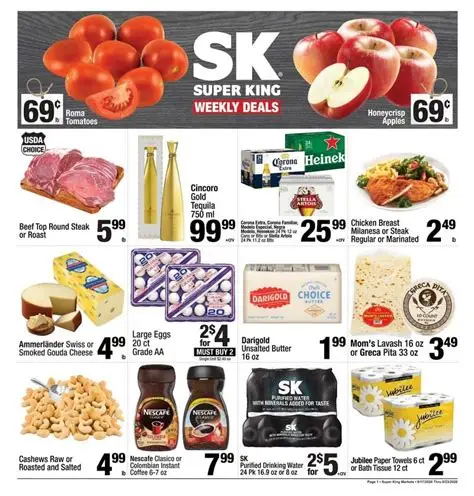
Turn the Super King weekly ad into a meal plan before visiting the store.
Begin with the strongest fresh-food promotions. Select a protein, add vegetables, and then identify supporting pantry, dairy, bakery, or frozen items.
For example, discounted chicken could support rice bowls, tacos, salads, soups, or grilled meals. Beef could support stews, tacos, sandwiches, or rice dishes. Produce such as tomatoes, onions, cabbage, and peppers can often appear in multiple meals.
This approach has two advantages.
First, it helps prevent food waste because each sale purchase has a planned use.
Second, it limits impulse spending. A product does not save money merely because its regular price has been reduced. Savings occur when the discounted purchase replaces something you genuinely intended to buy or provides useful inventory at a lower cost.
A strong weekly-ad list therefore connects each promotion with an actual household need.
Save Your Shopping List Before Visiting the Store
Use Super King’s online shopping-list function when planning purchases from the circular.
The retailer’s website includes a “My Shopping List” feature and provides an option to print the list. The same interface allows users to save a store and navigate back to weekly deals.
This is useful for separating “interesting offers” from “planned purchases.”
As you browse, add only products that meet your price, quantity, and meal-planning requirements. Before shopping, review the list and remove products that were added only because the discount looked attractive.
You can also organize the final list by department:
- Produce
- Meat and seafood
- Dairy and frozen
- Grocery and pantry
- Deli and bakery
- Beverages
- Household products
Department-based ordering reduces unnecessary movement through the store and makes it easier to verify each promotional item against its shelf label.
Subscribe to Super King Weekly Deals by Email
Sign up through Super King’s official newsletter page if you regularly shop at the chain.
Super King says its Weekly Deals signup delivers weekly deals and exclusive monthly offers to subscribers’ inboxes. The signup page specifically promotes updates related to fresh produce, meat, and other savings opportunities.
The retailer’s FAQ also confirms that shoppers can subscribe to its newsletter for Weekly Deals, exclusive coupons, and other promotions.
Email delivery can be useful because it reduces the need to search manually every week. It also lowers the chance of accidentally opening an outdated third-party circular when looking for new promotions.
For trust and privacy, use the signup form on Super King’s official website rather than an unfamiliar coupon site requesting contact details.
Compare In-Store Deals With Instacart Pricing
Treat the Super King weekly ad and the retailer’s Instacart storefront as separate pricing environments unless the same promotion is explicitly shown online.
Super King states directly that when shoppers leave its site for Instacart, prices, promotions, and product availability may vary from in-store.
Instacart’s Super King help information provides additional clarification. It explains that retailers set marketplace prices, some in-store promotions may not apply online, and coupons must generally be available on the platform to be honored there.
Weighted products create another difference. Instacart notes that final prices for loose produce and certain meat, seafood, or deli items can change when the actual weight differs from the requested amount.
Therefore, if you see a strong Super King weekly-ad price and intend to order online, verify the item inside Instacart before calculating your savings.
Convenience and price are separate considerations. Delivery may still be worthwhile, but an in-store circular should not automatically be treated as an Instacart price list.
Confirm Availability Before Making a Special Trip
Verify important products when availability determines whether the shopping trip is worthwhile.
Weekly advertisements promote prices, but inventory can change as customers purchase stock. Fresh produce, service-counter meat, seafood, dairy items, and limited-time packaged goods may be particularly sensitive to daily inventory.
This does not mean advertised products are routinely unavailable. It means shoppers should distinguish between a valid promotion and a guarantee of stock at every moment.
If one product is central to your trip, use the store locator or contact information on the official Super King website to verify the location before traveling.
Planning substitutes also helps. If one discounted protein is unavailable, select an alternative that fits the same meal. If one vegetable sells out, identify another ingredient that can perform a similar role.
Flexible shopping preserves the value of the weekly ad without making an entire meal plan dependent on one item.
Avoid Expired Super King Weekly Ad Search Results
Check the actual promotion date whenever Google or another search engine sends you directly to a product listing.
This is especially important now. As of August 24, 2026, Super King’s indexed collection includes multiple offers explicitly marked valid August 17 through August 23, 2026. Those dates have passed.
An expired page can still be useful for understanding the kinds of products Super King promotes, but it should not be described as the current weekly price.
This distinction strengthens shopping accuracy:
Current deal: The displayed date includes today’s date.
Upcoming deal: The validity period begins in the future.
Expired deal: The advertised end date has already passed.
Undated search result: Verify it directly on the official site.
For “Super King weekly ad this week” searches, freshness matters more than page ranking. A highly ranked result can still represent last week’s sale.
Set a Grocery Budget Before Selecting Deals
Decide how much you intend to spend before browsing promotions.
Weekly ads are designed to stimulate purchases, so an advertised discount can sometimes increase total spending rather than reduce it. A budget creates a boundary between useful savings and unnecessary additions.
Divide the grocery budget into practical categories such as fresh produce, proteins, dairy, pantry staples, household products, and discretionary items.
Then estimate the real checkout cost.
For products sold by weight, multiply the advertised per-pound rate by the quantity you expect to buy. For multi-buy promotions, calculate the full amount required to qualify. For online purchases, account for any differences in marketplace pricing or fees separately.
A $2.99 “must buy four” promotion, for example, requires roughly $11.96 of product before tax or applicable fees, not a $2.99 total purchase.
Thinking in total basket cost produces a more realistic grocery plan.
Compare the Ad With Your Normal Prices
Keep reference prices for products your household buys frequently.
A product appearing in the Super King weekly ad is not automatically a bargain for every shopper. The relevant question is whether the current promotional price is better than the normal price you would otherwise pay for a comparable product.
Track several repeat purchases such as:
- Eggs
- Milk
- Chicken
- Beef
- Tomatoes
- Onions
- Rice
- Cooking oil
- Yogurt
- Cheese
- Cereal
- Detergent
You do not need an elaborate spreadsheet. A note on your phone containing typical prices can provide enough reference information.
Over time, this gives you personal evidence about which types of Super King promotions are most valuable for your household.
That is more reliable than assuming every advertised product deserves a place in the cart.
Check Offer Details Again at the Shelf
Compare the item in your hand with the exact product described in the promotion.
Confirm the brand, package size, flavor, quantity, weight basis, and any purchase requirement.
“Selected varieties” means the discount may not apply to every flavor or version. “Must buy 4” means quantity matters. A per-pound offer means the package’s total weight determines the final amount.
If the shelf label appears inconsistent with the advertised promotion, ask a store associate for clarification before checkout.
Keeping the current weekly ad available on your phone can make this verification easier.
For a high-value or quantity-based purchase, checking the details before reaching the register can prevent confusion and help you decide whether the purchase still fits your budget.
Use the Super King Weekly Ad as a Repeatable Savings Routine
Build the circular into your weekly grocery-planning process rather than browsing deals randomly.
A reliable routine looks like this:
- Confirm your Super King location.
- Open the official Weekly Deals page.
- Check the promotional dates.
- Review produce and protein offers.
- Compare pantry, dairy, and frozen products.
- Read quantity requirements carefully.
- Calculate unit prices.
- Connect deals with planned meals.
- Save the final shopping list.
- Verify shelf pricing and availability.
Super King’s official resources support several parts of this process. The website lets shoppers save a store, view weekly deals, maintain a shopping list, and subscribe to promotional emails.
The retailer also clearly warns that grocery prices and promotions through Instacart may differ from in-store conditions, which is essential information when comparing shopping channels.
The most important E-E-A-T principle for a page covering the Super King weekly ad is freshness. Grocery prices are time-sensitive. An accurate article should distinguish current promotions from historical examples and direct shoppers back to the official retailer whenever the exact price matters.
As of August 24, 2026, some indexed Super King listings still show deals ending August 23. Shoppers searching today should therefore verify the newly active or upcoming ad on Super King’s official Weekly Deals page instead of assuming those expired prices remain valid.
Frequently Asked Questions
Where can I find the Super King weekly ad?
Use the Weekly Deals section on the official Super King Markets website. The website lets shoppers save a preferred location and states that the selected store’s ad and deals will be shown when they visit.
When does the Super King weekly ad start and end?
Super King Markets’ official FAQ says Weekly Deals start every Wednesday and end on Tuesday. Individual promotions can display their own validity dates, so check the date printed on the specific offer before relying on its price.
Are the August 17 to August 23 Super King deals still valid?
Not based on their displayed dates. As of August 24, 2026, Super King’s indexed collection still shows several offers marked valid August 17 through August 23. Those particular promotions have expired unless Super King publishes a new offer extending or repeating them.
Are Super King weekly-ad prices the same on Instacart?
Not necessarily. Super King states that Instacart prices, promotions, and availability may differ from in-store conditions. Instacart also explains that some in-store sales may not apply on its marketplace.
Can I receive Super King weekly deals by email?
Yes. Super King’s official signup page offers weekly deals and exclusive monthly offers by email. Its FAQ also directs shoppers to the newsletter for deals and promotional information.
How do I know whether a Super King weekly ad is current?
Check the validity dates displayed on the promotion and compare them with today’s date. Use Super King’s official Weekly Deals page rather than relying on an old search result or screenshot. A product page can remain accessible even after its advertised sale period has ended.