
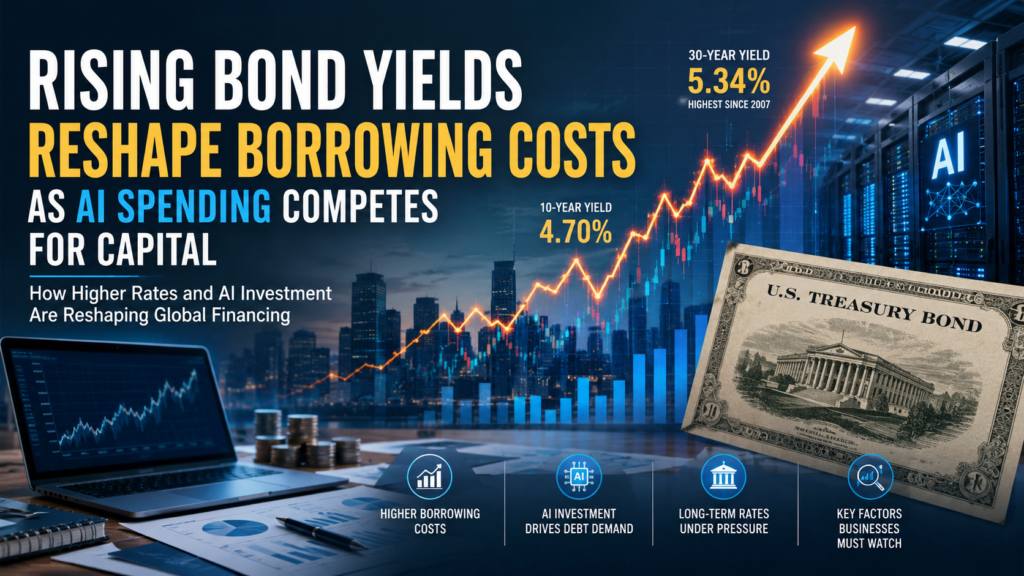
Global bond markets are becoming an increasingly important signal for business leaders, lenders and technology investors. Long-term U.S. Treasury yields climbed to multi-year highs this week, raising the cost of borrowing across the economy and adding fresh pressure to corporate financing decisions.
The 30-year Treasury yield reached 5.34%, its highest level since 2007, while the benchmark 10-year yield moved near 4.7%. Because Treasury rates influence the pricing of mortgages, auto loans and corporate credit, sustained increases can quickly affect both business investment and consumer demand.
Track Higher Financing Costs Across Business Operations
Companies that depend on debt to fund expansion, acquisitions, equipment or working capital may face more expensive financing when Treasury yields rise. Banks and institutional lenders typically use government bond yields as reference points when pricing loans and other credit products.
For business owners, that can translate into higher monthly debt costs and tougher calculations around new investments. Companies approaching refinancing deadlines may also encounter significantly different borrowing conditions than they experienced several years ago.
GrowBusinessMag readers should view the bond market as more than a financial-market indicator. Rising yields can directly influence capital budgets, hiring plans and the expected return on major projects.
Monitor AI Infrastructure Spending in Credit Markets
The rapid expansion of artificial intelligence infrastructure is adding another layer of competition for investor capital. Large technology companies are issuing corporate debt to finance data centers, computing systems, networking equipment and other AI-related infrastructure.
Corporate bonds compete with government securities for many of the same institutional investors. When attractive technology-sector debt absorbs more demand, Treasury yields may need to rise to keep government bonds competitive.
This connection means the AI investment boom is influencing more than semiconductor demand and cloud computing. It is also becoming a meaningful factor in global capital allocation and financing conditions.
Prepare for Persistent Pressure on Long-Term Rates
Government efforts to support liquidity in older long-dated securities briefly pushed yields lower, but the relief proved temporary. Investors remain focused on inflation expectations, expanding debt supply and the volume of bonds entering the market.
The quick rebound in yields suggests businesses should avoid assuming that cheaper financing will return rapidly.
What Businesses Should Watch Next
Companies should monitor inflation trends, Treasury issuance and corporate borrowing activity when planning future financing. If long-term yields remain elevated, stronger cash management, disciplined capital spending and careful refinancing strategies will become increasingly important.
For technology companies in particular, the next test will be whether anticipated returns from AI investment remain attractive as the cost of funding large infrastructure projects continues to rise.