For contractors, facility managers, and industrial operators, equipment decisions affect much more than the jobsite. Buying machinery requires capital upfront, while ownership also means retaining equipment after a particular project or phase of work has ended. Renting offers businesses another way to approach those requirements by aligning equipment access more closely with actual project demand.
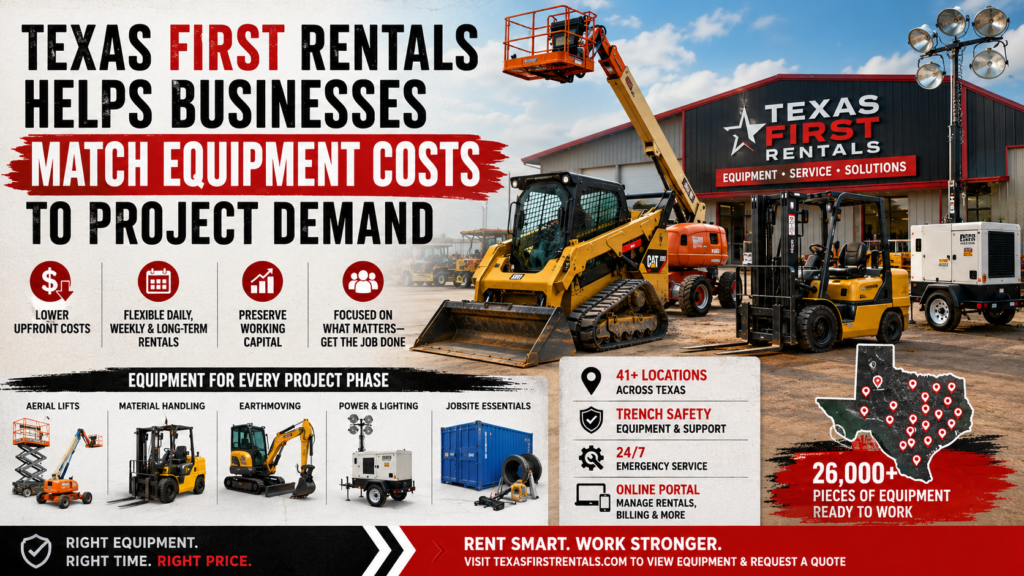
Texas First Rentals operates across Texas with a fleet of more than 26,000 pieces of equipment and a network of more than 40 locations, according to the company. It serves contractors, facility managers, and industrial crews with daily, weekly, and long-term rental options, alongside equipment delivery and 24-hour emergency service.
For companies evaluating whether to rent or own, the value of that model depends on several practical factors, including utilization, project duration, location, service requirements, and the type of equipment needed.
Match Equipment Spending to the Work at Hand
Purchasing machinery can make financial sense when a business expects to use the same equipment consistently for an extended period. For temporary projects, fluctuating workloads, or specialized tasks, however, rental can reduce the need to make a large upfront equipment purchase.
Texas First Rentals provides daily, weekly, and long-term rental arrangements. That flexibility allows businesses to bring equipment onto a jobsite for the period in which it is actually needed rather than automatically adding another long-term asset to the balance sheet.
The approach can also help preserve working capital. As the cash-flow principles outlined in the original business guidance illustrate, money not committed to an equipment purchase can remain available for payroll, inventory, materials, expansion, and other operating costs.
For GrowBusinessMag readers managing growing businesses, that distinction is especially relevant when workloads change faster than permanent equipment needs.
Choose Machinery According to Each Project Phase
A useful rental strategy depends on having access to the appropriate equipment for different stages of a project.
Texas First Rentals lists aerial work platforms including scissor lifts and boom lifts; material-handling equipment such as forklifts, telehandlers, and compact material lifts; and earthmoving machinery including excavators, dozers, skid steers, compact track loaders, backhoes, wheel loaders, trenchers, and compaction equipment.
Its portfolio also includes generators, light towers, air compressors, pumps, attachments, jobsite tools, containers, and mobile offices. Companies can review current categories and rental availability directly through the Texas First Rentals website.
That breadth can matter because equipment needs often change as a project progresses. Ground preparation may require earthmoving equipment, vertical work may introduce aerial platforms, while temporary power, lighting, or material handling can remain necessary at several stages.
Use a Statewide Network to Support Multiple Jobs
Equipment availability becomes more valuable when the provider can support businesses operating in different locations.
Texas First Rentals currently lists 41 locations across Texas, including rental, trench-safety, and supply operations. Its network includes locations in markets such as Austin, San Antonio, Fort Worth, Corpus Christi, Waco, Tyler, Victoria, Denton, and numerous surrounding communities.
The company describes its team as familiar with Texas-specific working conditions, including local soils, codes, weather, and jobsite workloads. While businesses should still evaluate each project independently, regional knowledge can be useful when selecting machinery for different working environments.
For companies managing projects across several Texas markets, dealing with one statewide rental network can also simplify sourcing compared with establishing a completely separate equipment relationship in every city.
Build Trench Safety Into Equipment Planning
Some projects require equipment choices that are closely connected with jobsite safety and compliance.
Texas First Rentals offers trench-safety products including trench boxes, slide rails, vertical hydraulic shoring, road plates, confined-space equipment, pipe-testing equipment, shields, and other systems used in excavation and underground utility work.
The company states that its trench-safety services include equipment walk-throughs and planning support. Its trench-safety pages also describe systems engineered to meet applicable OSHA standards for specific uses.
For businesses, the practical lesson is to incorporate safety requirements at the equipment-planning stage rather than treating them as an afterthought. The correct machine may solve one operational problem, but projects involving excavation, confined-space access, or vertical work can require additional systems and procedures.
Track Rentals and Billing Digitally
Rental costs can become harder to manage when several machines are spread across multiple projects.
Texas First Rentals provides an online portal that customers can access on desktop or mobile. The company says users can manage rentals, service, billing, telematics, and equipment costs through the platform. Its separate billing portal also allows customers to make payments and retrieve previous invoices.
These tools can help businesses see what equipment remains on rent and identify when machinery should be relocated or returned. That visibility matters because rental economics depend partly on how closely the rental period matches actual utilization.
For accounts-payable and operations teams, centralized access to invoices and equipment information can also make rental spending easier to incorporate into broader project-cost monitoring.
Consider Service Alongside Rental Price
Price is an important part of any equipment decision, but it is not the only cost that can affect a project.
Equipment downtime can disrupt crews and schedules, particularly when a machine is performing a critical role. Texas First Rentals states that it provides equipment delivery and 24-hour emergency service. Its published service model also emphasizes clear schedules and support intended to keep work moving.
That does not mean every business should select a rental company based on service claims alone. Companies should consider availability, equipment specifications, rental terms, delivery requirements, service support, and total expected cost together.
The more important question is whether the rental arrangement supports the operational demands of the job.
Plan Rental Decisions Around Utilization
Renting is not automatically the right answer for every piece of equipment. Businesses that consistently operate the same machine over long periods may find ownership more appropriate.
The rental model becomes particularly relevant when demand is temporary, specialized, uncertain, or spread across different projects. Texas First Rentals’ mix of daily, weekly, and long-term options gives businesses several ways to align rental duration with those circumstances.
Before renting, project managers should identify expected usage, site conditions, required specifications, delivery timing, safety needs, and how quickly equipment can be returned once its work is complete. Those factors provide a stronger basis for the decision than comparing the rental price with the purchase price alone.
Explore Equipment for an Upcoming Project
Businesses planning construction, industrial, facility, excavation, or sitework projects can review Texas First Rentals’ current equipment categories, locations, and rental-management options before requesting a quote.
The central benefit of the rental approach is flexibility: equipment can be matched more closely to the work in front of the business rather than turning every temporary machinery requirement into a permanent ownership commitment.