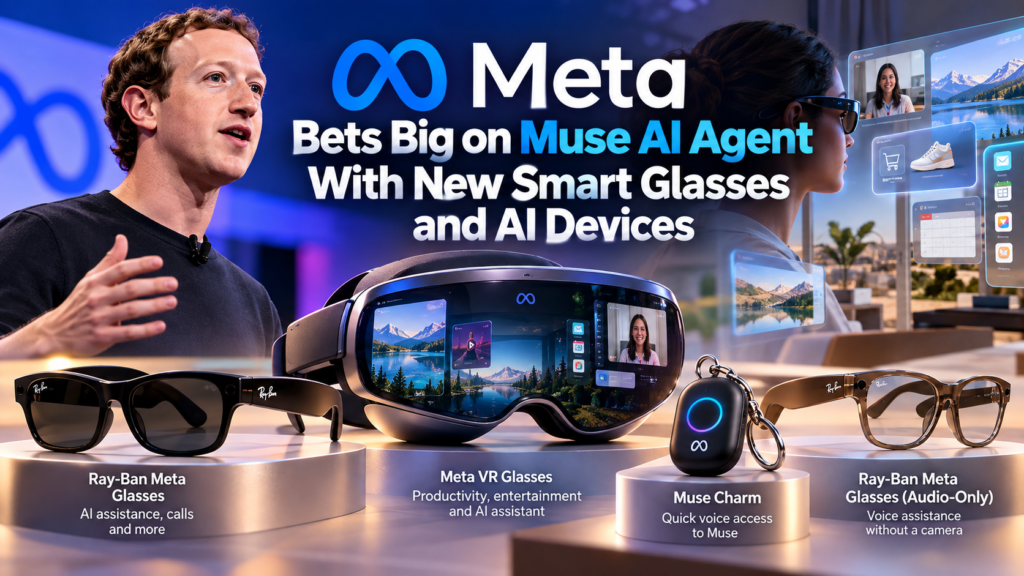
Meta is making its Muse AI agent a central part of its hardware strategy, introducing new smart glasses, virtual reality glasses and a compact device called Muse Charm. Announced at Meta Connect, the products reflect CEO Mark Zuckerberg’s broader plan to move AI assistants beyond traditional chatbots and integrate them into devices people can use for work, communication, shopping and entertainment.
The announcements also arrive at a complicated moment for consumer AI. Technology companies are investing heavily in autonomous AI agents, while questions about privacy, security, reliability and consent continue to influence how consumers respond to AI-powered devices. Meta’s latest products therefore represent both an expansion opportunity and a test of whether consumers want AI assistants integrated more deeply into everyday hardware.
Expand Muse AI Across Computers and Everyday Devices
Meta is expanding Muse so the AI agent can work across different devices rather than remaining limited to a conventional chatbot interface. The company’s goal is to allow users to ask Muse to complete tasks from computers, smart glasses and dedicated AI hardware.
According to Meta’s announcements at Connect, Muse will gain support for shopping through retailers including Walmart, GameStop, Gap and Wayfair. This could allow a user to ask the agent to browse participating stores and make purchases on the user’s behalf. The company is also extending Muse’s computer capabilities, including the ability to operate applications on Mac computers.
Meta executives positioned these capabilities as useful for both personal productivity and business tasks. Muse can already work with functions involving files, messages and calendars, while expanded computer controls could allow it to continue completing assigned tasks when the user is doing something else.
| Muse Product or Feature | Intended Function | Key Consideration |
|---|---|---|
| Muse shopping | Browse participating retailers and purchase products | User control and transaction accuracy |
| Mac integration | Operate apps and complete assigned tasks | Security and permissions |
| Meta VR glasses | AI, entertainment and productivity | Price and practical usefulness |
| Ray-Ban Meta glasses | Voice assistance, calls and optional camera features | Privacy and consent |
| Muse Charm | Quick voice access to Muse | Details remain limited |
The effectiveness of these features will ultimately depend on reliability, safeguards and the level of control users retain when Muse performs actions on their behalf.
Use Meta VR Glasses for Productivity and Entertainment
Meta also introduced lightweight VR glasses designed to combine elements of a computer, entertainment system and AI assistant. Rather than functioning primarily as ordinary glasses worn throughout the day, the device creates virtual displays that can be used for activities such as watching movies, playing games, making video calls and completing work.
Muse is integrated into the experience. Meta says users can speak to the assistant and request tasks such as drafting and sending an email, editing documents or scheduling meetings while they focus on something else.
The company announced a $1,299 price for the glasses, with availability planned for the spring. Meta is positioning the product against other immersive computing devices, including Apple Vision Pro and Samsung Galaxy XR.
Meta is emphasizing weight and price as potential advantages. However, hardware specifications alone will not determine whether the product gains widespread adoption. Comfort, battery performance, software availability, AI reliability and the usefulness of virtual displays will also influence how consumers evaluate the device.
Introduce New Ray-Ban Meta Glasses With More Privacy Choices
Meta is also expanding its Ray-Ban smart glasses lineup. One of the most notable additions is a pair of glasses without cameras. The audio-focused model can be used to communicate with Muse and handle calls without providing the visual recording capabilities available on Meta’s camera-equipped glasses.
Meta says the audio-only glasses are lighter and provide longer battery life than its camera models. The device is priced at $349 and is scheduled to launch October 13. The company also announced Ray-Ban Meta Gen 3 glasses equipped with cameras, starting at $449.
The distinction between camera and non-camera models matters because privacy has become a significant issue for wearable technology. Camera-equipped smart glasses can capture images or video from a first-person perspective, creating questions about whether people nearby understand when recording is taking place.
Restrictions on smart glasses in some venues also demonstrate that adoption involves more than technical capability. Businesses, institutions and public spaces may establish their own rules concerning wearable cameras. Providing an audio-only option could appeal to consumers who want hands-free AI assistance without an integrated camera.
Access Muse AI Without Glasses Through Muse Charm
Meta is developing another device called Muse Charm for users who may not want to wear AI glasses. The keychain-sized product is intended to provide quick voice access to Muse without requiring users to unlock a smartphone or manually open an application.
The concept gives Meta another way to place Muse within everyday routines. A dedicated AI device could reduce the number of steps required to ask questions or assign simple tasks, particularly when a phone is stored in a pocket or bag.
However, Meta has disclosed fewer details about Muse Charm than its new glasses. Zuckerberg indicated that the company is targeting availability before the holiday shopping season, but important information such as pricing, battery life and complete technical specifications was not provided in the announcement described.
Consumers considering the device will therefore need more information before its practical value can be assessed.
Evaluate Privacy and Security Before Giving AI More Control
Meta’s expanding AI ecosystem raises broader questions about how much access autonomous assistants should have to personal accounts and devices. An AI system that can manage messages, calendars, applications or purchases requires permissions that can involve sensitive information.
Users should understand what information an AI assistant can access, which actions require confirmation and how permissions can be changed or revoked. These considerations become particularly important when an AI system can take actions rather than simply provide answers.
Smart glasses introduce an additional privacy consideration because wearable cameras and microphones operate in environments shared with other people. Clear recording indicators, user controls and respect for restrictions in private or regulated spaces can influence public acceptance.
These challenges are not unique to Meta. As technology companies develop increasingly capable AI agents, security, transparency and user oversight are becoming important factors alongside speed and convenience.
Measure Muse Adoption Beyond Initial Downloads
Meta has ambitious expectations for Muse, with Zuckerberg saying he expects billions of people to eventually use the AI assistant. That statement represents the company’s expectation rather than a confirmed adoption trajectory.
Muse has reportedly exceeded 2.5 million downloads since release, based on figures attributed to market intelligence firm Sensor Tower. Downloads can demonstrate early interest, but they do not necessarily show how frequently people continue using an application over time.
Long-term adoption will depend on factors such as retention, reliability, useful integrations and whether consumers consider Muse more convenient than competing AI services.
Meta also operates within an intensely competitive market. AI assistants and agents from other major technology companies are increasingly moving beyond answering questions toward completing computer-based tasks. This competition could accelerate improvements while giving consumers more alternatives.
Conclusion
Meta’s latest hardware announcements show that the company sees Muse AI as more than a standalone chatbot. Muse is being developed as an assistant that can operate across computers, immersive glasses, Ray-Ban smart glasses and the upcoming Muse Charm.
The strategy could make AI assistance more accessible during everyday activities, from managing calendars and documents to shopping and entertainment. At the same time, broader access to applications, accounts, cameras and microphones increases the importance of security, privacy, consent and meaningful user control.
Meta has outlined an ambitious vision for AI-powered personal computing. Whether Muse becomes a widely used everyday assistant will depend not only on the number of devices carrying it, but also on how reliably, safely and usefully those devices perform in real-world situations.
Frequently Asked Questions
What is Meta Muse AI?
Muse is Meta’s AI agent designed to answer requests and perform tasks across supported computers, applications and AI-powered devices.
What devices will support Meta Muse?
Meta is integrating Muse into products including its new VR glasses, Ray-Ban smart glasses and the upcoming Muse Charm, while also expanding its capabilities on computers.
How much will Meta’s new VR glasses cost?
Meta announced a price of $1,299, with the glasses expected to become available in the spring.
Do all new Ray-Ban Meta glasses have cameras?
No. Meta announced an audio-only Ray-Ban model without cameras alongside an updated camera-equipped model.
What is Muse Charm?
Muse Charm is a small keychain-sized device designed to provide voice access to Muse without requiring users to open an app or wear smart glasses.
What are the main concerns surrounding Meta’s AI devices?
Privacy, recording consent, security, AI reliability and the permissions granted to autonomous agents are among the major considerations as AI assistants gain greater access to personal devices and accounts.