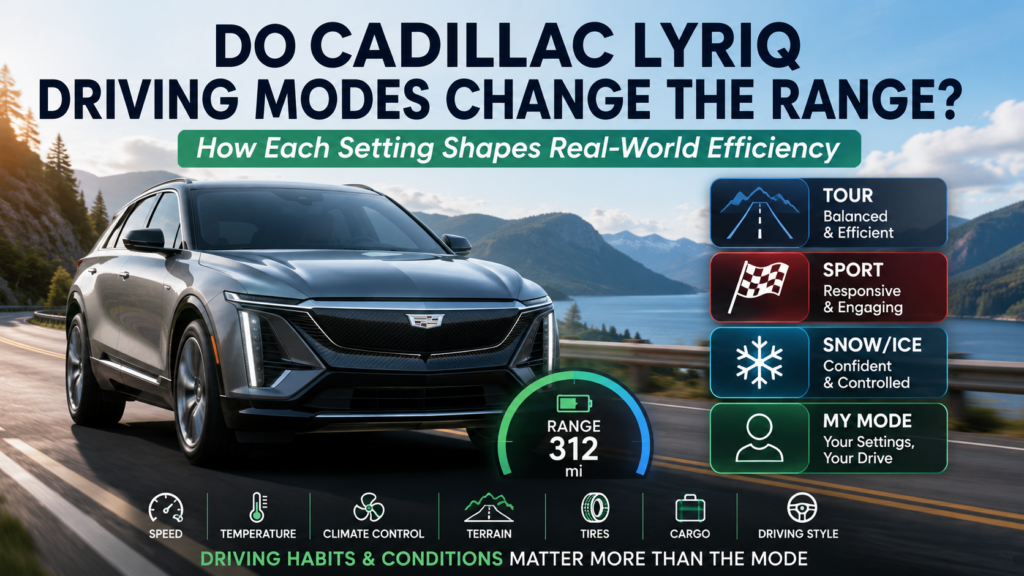
The Cadillac Lyriq allows drivers to change its personality with a tap, moving from the composed character of Tour mode to the sharper response of Sport or the measured power delivery of Snow/Ice. That flexibility raises a practical question for owners and prospective buyers: Do the driving modes in the Cadillac Lyriq offer different ranges?
Cadillac does not publish a separate EPA range figure for each driving mode. Changing the setting does not alter the battery’s usable capacity or assign the vehicle a fixed mileage limit. It can, however, change accelerator response, steering feel, traction management, braking behavior, and the driver’s tendency to use power.
The relationship between Cadillac Lyriq driving modes and range is therefore indirect but meaningful. Tour can make smooth driving easier, while Sport may encourage faster acceleration. Snow/Ice is often selected in conditions that already reduce electric-vehicle efficiency, and My Mode can be configured to favor either comfort or responsiveness.
In everyday use, speed, temperature, climate control, terrain, tires, cargo, and driving technique usually affect range more than the selected mode. Understanding that distinction helps drivers choose the right setting without assuming that one dashboard selection will automatically add or remove a fixed number of miles.
Understanding the Cadillac Lyriq’s Driving Modes
The Lyriq’s Driver Mode Control system changes selected vehicle characteristics to suit road conditions and personal preferences. Available modes can vary by model year, trim, drivetrain, and vehicle configuration, so owners should confirm the exact functions listed in their infotainment system and owner documentation.
The commonly available settings include Tour, Sport, Snow/Ice, and My Mode. These selections primarily change how the vehicle responds rather than how much electricity the battery can store.
Tour Mode Supports Smooth Daily Driving
Tour is the Lyriq’s balanced everyday setting. It is designed for routine commuting, urban travel, highway cruising, and general driving where comfort and predictable response matter more than heightened performance.
Its progressive accelerator calibration can make it easier to pull away smoothly and maintain a steady pace. Those habits often support lower energy consumption because the motors do not have to respond to frequent, abrupt power demands.
Tour is not a dedicated economy mode, however. Cadillac does not assign it a special range rating, and selecting it cannot compensate for sustained high speeds, strong cabin heating, low tire pressure, or aggressive acceleration.
A careful driver in Sport may use less energy than an impatient driver in Tour. The setting influences the experience, but the person behind the wheel still determines how much power is requested.
Sport Mode Delivers Sharper Responses
Sport mode gives the Lyriq a more immediate feel. Depending on the vehicle’s equipment, it can sharpen accelerator response, adjust steering effort, and make the electric SUV feel more alert during passing, merging, or driving on winding roads.
The battery does not become smaller when Sport is engaged. Any range difference usually appears because the sharper pedal calibration makes rapid acceleration easier to access. Electric motors deliver torque immediately, and repeated use of that performance increases energy consumption.
One strong acceleration event will not necessarily cause a dramatic loss of range. The larger effect comes from a pattern of forceful launches, rapid speed changes, and faster cruising.
Sport can still be used efficiently. Once the vehicle is moving at a stable speed on level ground, consumption may remain close to Tour if the driver uses light pedal inputs. The mode raises the potential for higher energy use, but it does not guarantee it.
Snow/Ice Mode Manages Low-Traction Conditions
Snow/Ice mode is intended to make power delivery easier to control on snow, ice, slush, or other slippery surfaces. It can soften the vehicle’s response and support traction-management systems as the tires search for grip.
This setting is selected for safety and control, not maximum range. Drivers may nevertheless associate it with reduced mileage because it is normally used during cold weather, when several efficiency penalties occur at once.
Low temperatures can reduce battery efficiency. Cabin heating draws electricity, cold tires may lose pressure, and snow-covered roads create greater rolling resistance. Slush can also increase the effort required to keep the vehicle moving.
The U.S. Department of Energy reports that all-electric vehicles can experience a fuel-economy reduction of nearly 40% in cold temperatures, illustrating why winter conditions can matter far more than the selected driving mode. The exact loss for a Lyriq will vary with temperature, heater use, trip length, storage conditions, speed, and road surface.
My Mode Creates a Personalized Configuration
My Mode allows drivers to combine preferred vehicle characteristics rather than accept a single factory-defined personality. Available adjustments may include steering feel, acceleration response, braking behavior, or other supported settings.
A range-conscious owner might select a smooth accelerator response and comfortable steering. Another driver may prefer sharper inputs and a more performance-focused setup.
Because My Mode can be configured in different ways, it has no universal effect on efficiency. A mild setup can encourage measured driving, while a more responsive calibration may invite frequent use of the Lyriq’s torque.
The setting works best when it reflects how the vehicle is actually used. A relaxed configuration may suit commuting, while Sport can remain available for occasions when quicker responses are more useful.
How Each Driving Mode Affects Range
Cadillac Lyriq driving modes influence range mainly by changing the way the vehicle reacts to the driver. They do not create individual EPA-certified mileage figures.
For the 2026 Lyriq, Cadillac lists an EPA-estimated range of up to 326 miles for the single-motor rear-wheel-drive configuration. Dual-motor all-wheel-drive versions are listed at up to 319 miles with standard 11.5-kW charging equipment, while certain configurations with the available 19.2-kW charging module carry a 303-mile rating. The performance-focused Lyriq-V is rated at 285 miles.
Those figures apply to vehicle configurations, not Tour, Sport, Snow/Ice, or My Mode. Actual mileage will vary with operating conditions and driving behavior.
Tour Can Support Predictable Efficiency
Tour is generally the easiest mode to recommend for drivers who value smoothness and consistent energy use. Its progressive response can reduce accidental surges of acceleration and help the driver settle into a steady rhythm.
That advantage is practical rather than mechanical. The mode does not unlock additional battery energy. It simply makes the inputs associated with efficient driving easier to maintain.
On a long trip, speed is likely to matter more than the choice between Tour and Sport. Aerodynamic resistance rises as speed increases, requiring the motors to use more energy to push the Lyriq through the air.
A vehicle traveling at a moderate, stable pace in Tour will usually use less energy than one repeatedly accelerating or cruising well above moderate highway speeds. The same principle applies in every mode.
Sport Can Raise Consumption When Used Aggressively
Sport mode’s stronger accelerator response can increase consumption when the driver frequently calls for rapid power. The Lyriq’s immediate electric torque makes those bursts feel effortless, but the energy still comes from the battery.
Repeated hard acceleration is particularly costly when followed by braking. Regenerative braking can recover some energy, but it cannot return everything used to accelerate the vehicle. Heat, electrical resistance, and conversion losses prevent full recovery.
A smoother journey that preserves momentum will generally be more efficient than one built around repeated acceleration and deceleration, even when strong regenerative braking is available.
Industry observers note that the mode label matters less than the pattern of pedal inputs it encourages. Sport is not inherently wasteful, but its calibration makes high-consumption driving easier to access.
Snow/Ice Often Appears Alongside Winter Range Loss
Snow/Ice mode may be active when the range display falls faster than expected, but the setting is rarely the primary cause. Cold battery cells, cabin heating, thicker fluids, underinflated tires, headwinds, and snow resistance can all reduce efficiency.
Short winter trips can be particularly demanding because the vehicle may use significant energy warming the cabin and conditioning the battery without traveling far enough to spread that initial demand across many miles.
Preconditioning the Lyriq while it remains connected to a charger can help. The vehicle can begin warming the cabin before departure, reducing the amount of stored battery energy required during the early part of the drive.
Drivers should continue using Snow/Ice whenever road conditions justify it. Preserving traction and control is more important than chasing a small theoretical efficiency gain.
My Mode Can Favor Comfort or Performance
My Mode reflects the settings chosen by the driver, so its effect on range can move in either direction. A gentle accelerator calibration can support smooth starts, while a sharper response may increase energy use if it leads to frequent surges of power.
The vehicle’s displayed range may adjust as driving patterns change. Estimated remaining mileage is a forecast based on recent consumption and current conditions, not a fixed promise.
A lower estimate after several energetic drives does not necessarily mean the battery has lost capacity. The system may simply be accounting for the recent rate at which energy was consumed.
Compare Cadillac Lyriq Driving Modes and Range Effects
The table below summarizes how each mode is likely to affect real-world efficiency. The descriptions are practical tendencies rather than separate EPA ratings.
| Driving mode | Primary purpose | Typical vehicle character | Likely range effect | Best use |
|---|---|---|---|---|
| Tour | Balanced everyday driving | Smooth, composed, and progressive | Often supports consistent efficiency when paired with gentle inputs | Commuting, errands, and highway travel |
| Sport | More responsive performance | Sharper acceleration and steering feel | Can reduce range when it encourages hard acceleration or higher speeds | Passing, winding roads, and performance-focused driving |
| Snow/Ice | Improved low-traction control | More measured power delivery | Usually selected during weather that already reduces EV range | Snow, ice, slush, and slippery roads |
| My Mode | Personalized vehicle behavior | Depends on selected settings | May favor efficiency or performance according to configuration | Drivers seeking a customized daily setup |
Tour is the most natural default for drivers who want predictable behavior, but it does not guarantee the longest journey. Sport has the greatest potential to increase consumption because it makes stronger responses readily available. Snow/Ice is closely associated with winter range loss, although the weather is usually responsible for most of the reduction. My Mode depends entirely on the selected calibration and the way it is used.
Factors That Influence EV Range Beyond Driving Mode
Driving mode is only one part of the Lyriq’s efficiency picture. In many situations, environmental and mechanical factors have a much larger effect on the number of miles available from a charge.
Speed Changes Energy Demand
Speed is one of the most significant range variables during highway travel. As the Lyriq moves faster, it must overcome greater aerodynamic resistance.
A small reduction in cruising speed can make a noticeable difference across a long journey. By contrast, switching from Sport to Tour while continuing to drive at a high speed may produce only a limited benefit.
Maintaining momentum also matters. A stable pace usually requires less energy than repeatedly accelerating to close gaps and then slowing when traffic compresses.
Temperature Affects the Battery and Cabin
Cold weather creates two separate demands. The battery operates less efficiently at low temperatures, and the heating system must use energy to keep the cabin comfortable.
Hot weather can also reduce range when air conditioning and battery cooling operate continuously. Parking in shade and cooling the cabin while the vehicle is plugged in can reduce the initial load on the battery.
The Environmental Protection Agency identifies cold weather, air-conditioning use, high-speed driving, and aggressive behavior among the factors that can significantly reduce an EV’s real-world range.
Drivers should not sacrifice safe visibility or a comfortable cabin simply to protect a few miles of estimated range. Preconditioning, seat heating, sensible temperature settings, and advance route planning offer more practical solutions.
Drivetrain Configuration Changes the Official Rating
The distinction between rear-wheel drive and all-wheel drive affects range more directly than a temporary driving-mode selection.
The rear-wheel-drive Lyriq uses a single propulsion motor and carries an EPA estimate of up to 326 miles for the 2026 model year. Cadillac lists the dual-motor all-wheel-drive model at up to 319 miles in its standard configuration, with some equipment combinations rated at 303 miles.
All-wheel drive adds traction and performance but also introduces another motor and associated hardware. Buyers should therefore compare exact configurations rather than assuming every Lyriq has the same official range.
Changing from Tour to Sport does not convert one drivetrain into another. The permanent mechanical specification has a greater effect on the EPA rating than the selected driving mode.
Wheels, Tires, and Pressure Influence Rolling Resistance
Tires create resistance every time they roll, and that resistance affects the amount of energy required to move the vehicle.
Underinflated tires can reduce efficiency while also affecting handling, braking, and tread life. Pressure should be checked when the tires are cold and maintained according to Cadillac’s recommended values.
Wheel size and tire design can also influence range. Larger wheels or performance-oriented tires may create an efficiency tradeoff, depending on the vehicle’s specification.
Winter tires can add rolling resistance, but their improved grip may be essential in cold conditions. Safety should take priority over a modest range difference.
Terrain Changes the Energy Calculation
Climbing a hill requires the motors to move the Lyriq against gravity, so the range estimate may fall more quickly on steep routes.
Descending allows regenerative braking to return some energy to the battery. The vehicle will not recover everything used during the climb because energy is lost through heat, electrical resistance, tire friction, and other inefficiencies.
A mountainous trip will therefore produce a different consumption pattern from a flat highway journey, even when both are completed in the same driving mode.
Wind can have a similar effect. A strong headwind increases aerodynamic demand, while a tailwind may reduce it.
Cargo and Exterior Accessories Add Demand
Passengers and luggage increase vehicle weight, requiring more energy during acceleration and uphill travel. The effect may be limited during steady driving on flat roads but more noticeable in stop-and-go traffic or mountainous areas.
Exterior accessories can have an even larger impact at highway speeds. Roof boxes, bicycles, and cargo carriers disturb airflow and increase drag.
Carrying luggage inside the vehicle is generally more aerodynamically efficient than placing it on the roof, provided the load remains within the vehicle’s limits and does not obstruct visibility.
Climate Control Uses Stored Energy
The Lyriq’s heating, air conditioning, battery-conditioning system, lighting, displays, and other electrical equipment draw power.
Climate control is often the largest accessory load in severe weather. Heating a cold cabin can require substantial energy, especially during short journeys.
Using remote preconditioning while connected to home charging can reduce the initial demand on the traction battery. Heated seats and the heated steering wheel may also provide direct comfort without requiring the entire cabin to be warmed as aggressively.
Tips for Maximizing Range in the Lyriq
Extending range does not require avoiding every comfort feature or driving unusually slowly. Consistent habits make a greater difference than constantly changing modes.
Use Tour as the Everyday Default
Tour offers a composed accelerator response that suits most daily driving. Its predictable behavior can help the driver make smooth inputs and avoid unnecessary bursts of power.
Using the same mode regularly also makes accelerator response easier to judge. Familiarity supports precise control, which can improve both comfort and efficiency.
Sport and Snow/Ice remain valuable when conditions or preferences justify them. There is no need to avoid those settings entirely.
Accelerate Smoothly and Read Traffic Early
Gradual acceleration reduces high power demand. Looking several vehicles ahead allows the driver to ease off the accelerator sooner when traffic slows.
This approach preserves momentum and reduces the need for abrupt braking. It also creates a calmer ride for passengers.
Strong acceleration remains appropriate when required for a safe merge or passing maneuver. Efficient driving should never compromise safety.
Use One-Pedal Driving With Smooth Inputs
One-Pedal Driving allows the Lyriq to slow as the accelerator is released, increasing the opportunity to recover energy through regenerative braking.
The feature can be particularly useful in urban traffic, where slowing events occur frequently. Its benefit depends on careful pedal control rather than aggressive acceleration followed by equally aggressive regeneration.
Regenerative braking recovers part of the vehicle’s kinetic energy, but maintaining a steady speed is usually more efficient than repeatedly creating and recovering that energy.
Drivers who are new to One-Pedal Driving should become familiar with its response in a controlled environment and remain ready to use the brake pedal whenever necessary.
Precondition While Connected to a Charger
Preconditioning the cabin before departure can improve comfort while reducing the initial demand on the battery, provided the vehicle remains plugged in.
This practice is especially useful in winter. A warm cabin at departure means the heater may not need to work as hard during the first miles of the trip.
It can also be helpful in hot climates, where cooling a parked vehicle may require significant energy.
Moderate Highway Speed
Reducing highway speed slightly can preserve more range than switching between driving modes while maintaining an aggressive pace.
A steady speed limits repeated power demands and makes energy use more predictable. Drivers should choose a pace appropriate for traffic, road conditions, and posted limits.
When planning a long journey, allowing additional travel time can reduce the pressure to drive faster and may lessen the need for an extra charging stop.
Maintain Tires and Remove Unnecessary Drag
Check tire pressure regularly, particularly after major temperature changes. Use the values specified on the vehicle label or in Cadillac’s documentation.
Remove unused roof racks, cargo boxes, or carriers when they are not needed. Reducing aerodynamic drag can improve efficiency during highway travel.
Routine alignment and tire inspections also help the Lyriq roll as intended.
Plan Charging Before Long Trips
A charging plan should account for weather, elevation, traffic, charger availability, and a reasonable battery reserve.
Cadillac states that the 2026 Lyriq supports public DC fast charging at up to 190 kW and can add up to 86 miles of range in about 10 minutes under specified conditions. Actual performance depends on charger capability, battery temperature, starting state of charge, and other factors.
Charging speed usually slows as the battery approaches a high state of charge. On road trips, shorter charging sessions may sometimes be more time-efficient than waiting for the battery to fill completely.
Frequently Asked Questions About Cadillac Lyriq Driving Modes and Range
Does Sport mode reduce Cadillac Lyriq range?
Sport can reduce real-world range when its sharper response leads to rapid acceleration, higher speeds, or frequent changes in pace. It does not reduce battery capacity, and Cadillac does not publish a separate Sport-mode EPA estimate. A driver using gentle inputs may see little difference during steady travel.
Which Cadillac Lyriq mode offers the best range?
Tour is usually the most suitable everyday choice for drivers seeking smooth, predictable operation. The longest real-world range, however, depends more heavily on speed, temperature, tire pressure, climate use, terrain, and acceleration habits than on the selected mode.
Does Snow/Ice mode save energy?
Snow/Ice is designed to improve control on slippery roads, not to maximize efficiency. Its measured power delivery may reduce wheelspin, but the cold temperatures and difficult surfaces that require the mode often lower range substantially.
Can My Mode change the displayed range?
My Mode can affect consumption when its customized settings alter how the driver accelerates or slows. The displayed estimate may adjust after the vehicle observes a different energy-use pattern. The mode does not change the battery’s physical capacity or create a separate official rating.
Can One-Pedal Driving extend Lyriq range?
One-Pedal Driving can recover energy during deceleration, particularly in stop-and-go traffic. It works best with smooth accelerator control. Maintaining momentum remains more efficient than accelerating unnecessarily and relying on regeneration to recover part of the energy.
Choose the Right Mode Without Overthinking the Range
The Cadillac Lyriq’s driving modes change how the electric SUV responds, but they do not carry separate official range figures. Tour provides balanced daily behavior, Sport sharpens acceleration and steering, Snow/Ice supports control on slippery surfaces, and My Mode lets the driver create a personalized configuration.
Real-world differences appear when those settings alter driving behavior. Sport may increase consumption when it encourages repeated hard acceleration. Tour can support efficient habits through smoother responses. Snow/Ice is often active when cold weather, heating demand, and difficult road surfaces are already reducing range.
The vehicle’s permanent configuration matters more. Cadillac rates the 2026 rear-wheel-drive Lyriq at up to 326 miles, while dual-motor versions carry ratings of up to 319 miles or 303 miles depending on equipment. The Lyriq-V is rated at 285 miles.
For most journeys, leave the Lyriq in Tour and focus on the factors that deliver measurable results: maintain moderate speeds, accelerate progressively, keep the tires properly inflated, precondition while plugged in, remove unnecessary exterior cargo, and plan charging before longer trips.
Use Sport when its quicker responses improve the drive, and select Snow/Ice whenever traction conditions demand it. Then review the controls and available settings for your specific model year. A thoughtful test drive across the different modes will reveal which combination best balances comfort, performance, control, and usable range.