The pharmaceutical industry is racing to capture soaring demand for weight-loss medicines, but companies cannot use the same marketing strategy in every country. As Novo Nordisk and Eli Lilly compete for patients, prescribers and market share, national advertising rules are becoming a decisive commercial constraint rather than a routine compliance issue.
Compete Under Uneven Global Advertising Rules
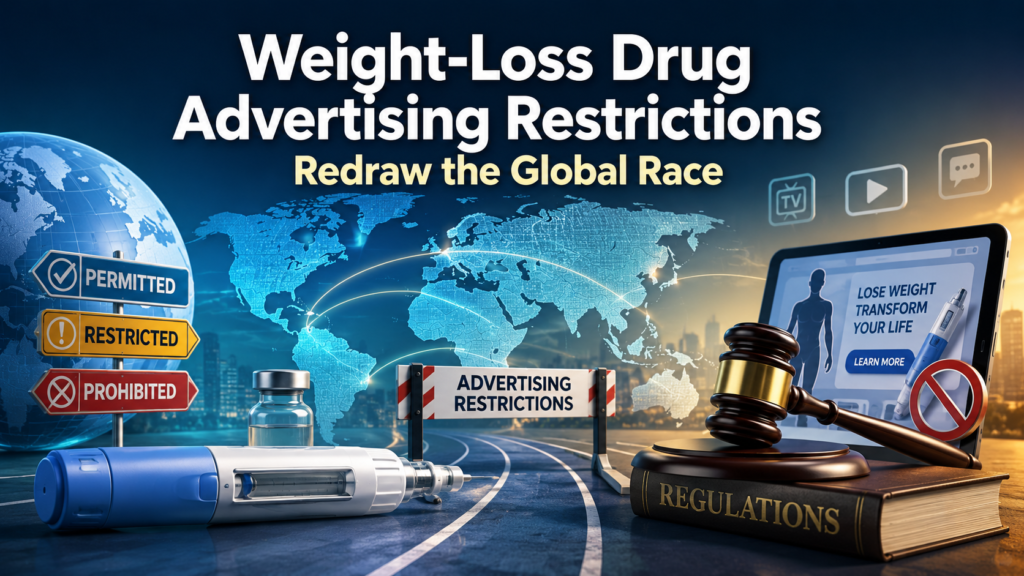
Novo Nordisk, which produces the weight-loss drug Wegovy and diabetes medicine Ozempic, operates under strict promotional limits in Britain and most international markets. Companies and pharmacies generally cannot advertise prescription-only medicines directly to the public, restricting their use of television, online and consumer-facing campaigns.
The United States offers a sharply different environment. Along with New Zealand, it permits direct-to-consumer prescription-drug advertising. The US Food and Drug Administration relaxed broadcast-advertising requirements in 1997, helping prescription medicine campaigns become a familiar presence across television and digital media.
Jesse Dresser, a partner at healthcare and life-sciences law firm Frier Levitt, described US drug advertising as virtually unavoidable across television and the internet. His observation highlights the competitive advantage available to manufacturers that can repeatedly place branded products before American consumers.
In countries with tighter rules, companies often turn to disease-awareness campaigns that discuss obesity without promoting a named treatment. That approach shifts investment toward corporate reputation, medical education and engagement with healthcare professionals.
Defend Market Share Through Competitive Claims
The rivalry between Novo Nordisk and Eli Lilly has moved into the courts. Novo Nordisk sued its US competitor in New Jersey, alleging that an Eli Lilly campaign used outdated research to create a misleading comparison involving Mounjaro, Zepbound and competing medicines. Eli Lilly said it would vigorously defend the case and maintained that its campaign relied on a robust head-to-head clinical trial.
For GrowBusinessMag readers following the sector, the dispute shows how clinical evidence has become both a scientific asset and a marketing weapon. Comparative claims can shape patient interest, prescribing discussions and investor expectations, making the wording and timing of advertisements commercially significant.
Regulators are also policing indirect promotion. French authorities imposed fines of about €1.8 million on Novo Nordisk and €110,000 on Eli Lilly after determining that public campaigns breached restrictions on prescription-drug advertising.
Tighten Oversight of Online Pharmacy Promotions
Online pharmacies and telehealth companies add another layer of competition. In March 2026, the FDA issued 30 warning letters to telehealth businesses over false or misleading claims involving compounded GLP-1 products, according to the agency. Compounded medicines are not FDA-approved, yet some promotions suggested equivalence with approved drugs or obscured where the products were made.
The market outlook points to stricter scrutiny and wider strategic differences between countries. Manufacturers with strong clinical evidence, disciplined advertising controls and credible medical communication will be best placed to compete as demand continues to expand.