
Business owners and senior professionals now have access to thousands of websites offering strategic guidance, leadership advice, career support, and financial education. The difficulty is not finding information. It is determining who produced it, what evidence supports it, and whether a platform’s services match the reader’s actual needs.
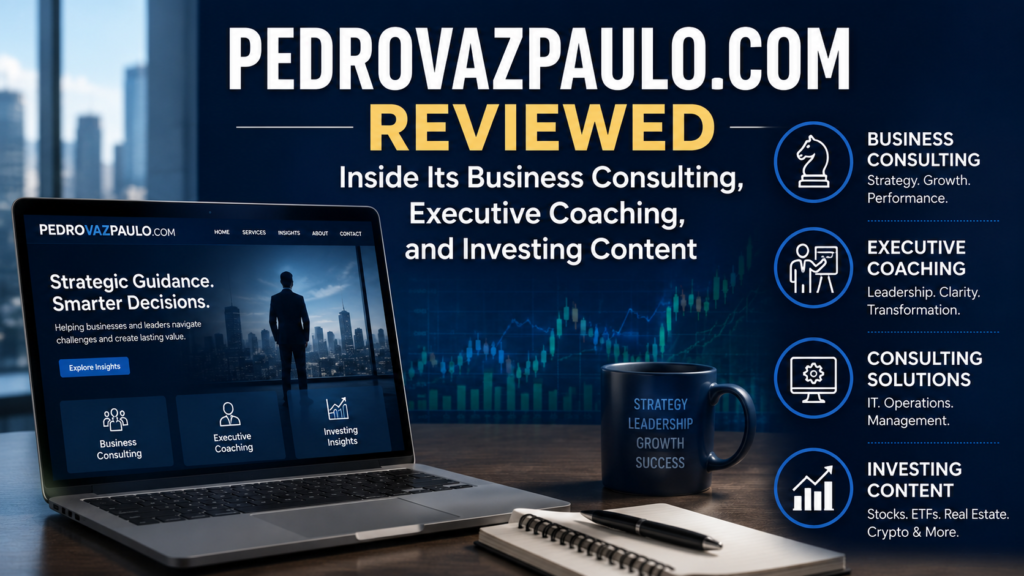
PedroVazPaulo.com appears to operate at the intersection of professional services and business publishing. According to its website, the platform was founded in 2010 and covers strategy consulting, IT consulting, business consulting, financial consulting, executive coaching, and career development. Its editorial sections also address leadership, entrepreneurship, stocks, bonds, exchange-traded funds, real estate, and cryptocurrency.
Those descriptions are largely self-reported. They explain how pedrovazpaulo.com presents its work, but they do not independently establish service quality, professional credentials, or likely client outcomes. Anyone considering a paid engagement should verify the individual provider, proposed scope, fees, confidentiality terms, relevant experience, and any regulatory qualifications that may apply.
What Is PedroVazPaulo.com?
PedroVazPaulo.com is a business-oriented website that combines consulting and coaching service descriptions with articles on management, careers, leadership, and investing. The platform states that it was founded in 2010 and that its core services include strategy consulting, IT consulting, business consulting, and executive coaching.
The site appears to serve two connected purposes. First, it presents professional services to potential clients. Second, it publishes informational content that may attract readers researching business challenges, leadership development, career decisions, or investment concepts.
That structure is common among professional-service websites because educational material can introduce readers to a subject before they consider contacting a consultant or coach. A business owner researching operational problems, for example, may first encounter an article and later review the site’s consulting pages.
The distinction between editorial content and individualized advice remains important. An article can introduce a planning framework or explain an investment category, but it cannot account for every reader’s finances, legal obligations, industry conditions, risk tolerance, or organizational structure.
PedroVazPaulo.com includes language stating that its information is intended for general purposes and that users remain responsible for decisions made from that information. The platform also directs readers to qualified professionals where specialized advice is required.
Review the Platform’s Stated Purpose
The central theme across pedrovazpaulo.com is professional decision support. Its consulting pages appear to focus on organizational direction, technology, operations, management, and finance. Its coaching material appears more concerned with individual development, including leadership behavior, communication, career direction, and executive performance.
These areas can overlap. A company may need a strategic plan, but implementation may also depend on whether its leaders communicate priorities, assign responsibility, manage resistance, and review progress. Consulting generally addresses the organization or business problem, while coaching often concentrates on the person responsible for navigating it.
The platform’s investing content adds another dimension. It publishes material on stocks, bonds, ETFs, real estate, mutual funds, and cryptocurrency, including introductory guides for readers exploring different asset classes.
Readers should approach those articles as educational material unless a page clearly establishes otherwise. General explanations can help users learn terminology and identify questions, but they do not replace personalized financial, tax, accounting, or investment advice.
Identify the Likely Audience
PedroVazPaulo.com appears to address entrepreneurs, business owners, executives, managers, professionals considering career changes, and readers interested in financial education.
A founder may visit for strategy or operations content. A manager may be drawn to leadership and executive coaching. A professional preparing for a career transition may explore career-development articles. An individual investor may use the platform’s financial content to become familiar with stocks, bonds, ETFs, property, or digital assets.
The site also appears broad enough to address businesses at different stages, from early ventures to more established organizations. That breadth may make it useful for initial research, but it does not confirm that every listed service is equally developed or appropriate for every industry.
A manufacturing company reviewing supply-chain performance, for instance, may require different expertise from a technology startup evaluating product-market fit. A regulated financial institution may need safeguards and sector knowledge that are less critical for a small local retailer.
Before engaging any consultant associated with the platform, a prospective client should ask whether the provider has worked with similar organizations, business models, markets, and constraints.
Key Services Offered
PedroVazPaulo.com lists or categorizes content across several professional-service areas, including executive coaching, strategy consulting, business consulting, IT consulting, financial consulting, management consulting, operations consulting, marketing consulting, and human resources consulting.
A wide service range can be convenient for readers exploring connected business problems. It also makes careful verification more important. Each discipline may require different methods, experience, credentials, and deliverables.
Executive Coaching
Executive coaching usually involves a structured relationship in which a leader examines goals, decisions, workplace behavior, communication patterns, and professional challenges. PedroVazPaulo.com identifies executive coaching as one of its principal offerings and connects the service with leadership and business development.
The website appears to position coaching as relevant to executives, founders, managers, and professionals seeking greater clarity or effectiveness in their roles. Topics may include decision-making, leadership presence, team management, emotional intelligence, accountability, and career planning.
Coaching can be particularly relevant when a business issue has a human component. A reorganization may look sensible on paper, yet fail if leaders do not explain the change, resolve internal disagreement, or establish clear responsibility. In such cases, coaching may support the person responsible for carrying out a broader strategy.
The value of any coaching engagement depends on factors that cannot be judged from a service label alone. These include the coach’s background, training, methodology, confidentiality practices, familiarity with the client’s situation, and ability to establish realistic goals.
A prospective client should ask how the coaching process begins, how objectives are defined, how often sessions take place, and how progress is assessed. It is also useful to clarify whether the coach uses diagnostic tools, written exercises, stakeholder interviews, or between-session work.
Confidentiality deserves particular attention when an employer pays for coaching. The participant should understand what information may be shared with the organization, whether reports are produced, and which discussions remain private.
Executive coaching should not be confused with psychotherapy, legal counsel, regulated financial advice, or the authority to make business decisions. A coach may help a client examine options, but responsibility for those choices remains with the individual and organization.
Strategy and Business Consulting
Strategy consulting generally addresses major organizational choices. These may include market positioning, growth priorities, resource allocation, competitive direction, product strategy, restructuring, or entry into a new market.
PedroVazPaulo.com states that it offers strategy and business consulting alongside technology and executive coaching. Its broader consulting sections suggest a focus on planning, organizational performance, management, and implementation.
Business consulting can cover a wider range of issues than strategy alone. An engagement might address operating processes, performance measurement, customer acquisition, internal reporting, budgeting, staffing, technology, or execution problems.
The usefulness of a consultant depends heavily on problem definition. “Help us grow” is too broad to support a focused engagement. A stronger brief might ask the consultant to assess why customer retention has declined, evaluate the economics of a new market, redesign a sales process, or create a clearer management reporting system.
The client should also determine whether it needs analysis, recommendations, implementation support, or all three. Some consultants primarily diagnose problems and produce a plan. Others work with internal teams during execution. The difference affects price, duration, accountability, and required access to company information.
A written scope should identify the objective, work stages, deliverables, schedule, fees, responsibilities, assumptions, and exclusions. It should also explain how changes to the project will be handled.
Industry observers note that consulting engagements are usually easier to evaluate when the work is tied to specific decisions and deliverables rather than broad promises of transformation. A defined output, such as a market assessment, operating model, implementation roadmap, or financial forecast, gives both parties a clearer basis for reviewing progress.
Context matters as much as methodology. A consultant experienced in consumer marketing may not be qualified to redesign cybersecurity controls. Someone who advises early-stage founders may not have the same expertise in multinational restructuring or regulated financial services.
Prospective clients should therefore examine the provider’s relevant work rather than relying on the total number of categories listed on the website.
Financial Consulting
PedroVazPaulo.com includes financial consulting among its main content and service categories. The site’s broader subject matter suggests that this area may involve business finance, planning, financial decision-making, risk, and investing education.
The phrase “financial consulting” can describe very different activities. For a company, it may mean budgeting, cash-flow forecasting, cost analysis, performance reporting, pricing, capital allocation, or scenario planning. For an individual, it could overlap with investments, retirement planning, tax matters, or wealth management.
Those activities are not interchangeable. Accounting, tax advice, securities recommendations, and regulated investment advice may require specific qualifications or licenses depending on the jurisdiction.
Readers should confirm precisely what a proposed service covers. A business cash-flow review is different from a personal portfolio recommendation. A general article about ETFs is different from advice to buy a particular fund.
The platform publishes material explaining investment categories such as stocks, bonds, mutual funds, ETFs, property, and cryptocurrency. Its investing section should be treated as general education unless the provider clearly documents the authority and terms under which individualized advice is offered.
Before accepting financial consulting, a client should ask which data sources will be used, how assumptions will be documented, and whether alternative scenarios will be tested. Forecasts should make uncertainty visible rather than presenting future revenue, costs, or investment returns as certain.
A useful financial analysis normally shows the relationship between assumptions and outcomes. If sales growth, interest rates, margins, or customer acquisition costs change, the client should be able to see how the conclusion changes with them.
Content Topics Covered
PedroVazPaulo.com is not limited to service descriptions. It publishes content across consulting, coaching, career development, leadership, entrepreneurship, and investing. The site’s category structure includes business consulting, executive coaching, financial consulting, IT consulting, leadership, career development, stocks, bonds, ETFs, real estate, mutual funds, and cryptocurrency.
This range may help readers move between related topics. An entrepreneur researching business strategy might also find leadership or finance material relevant. A manager considering executive coaching may explore communication or career-development articles before deciding whether to seek direct support.
Breadth does not necessarily indicate depth. Readers should evaluate each article according to its author, evidence, publication date, cited sources, disclosures, and relevance to the decision at hand.
Leadership
Leadership content on pedrovazpaulo.com appears to cover management behavior, communication, teamwork, organizational culture, decision-making, and professional development. The site’s editorial categories connect leadership with coaching and consulting, reflecting the way management behavior can affect business execution.
A strategy can fail even when the underlying analysis is sound. Employees may not understand the priorities, managers may avoid difficult decisions, or teams may pursue conflicting goals. Leadership content can help readers recognize these implementation problems.
General leadership advice still requires adaptation. A method that works in a small founder-led company may not suit a public corporation, government department, professional partnership, or highly regulated business.
Local culture, labor law, reporting structures, incentives, workforce composition, and organizational history can all change how a leadership approach works in practice.
Readers should be cautious with claims that reduce leadership to a single habit, personality trait, or framework. Organizational outcomes usually result from several interacting factors, including strategy, resources, management systems, market conditions, employee capability, and execution.
Useful leadership content should therefore help readers ask better questions rather than imply that one technique will solve every management problem.
Investing
PedroVazPaulo.com publishes articles about stocks, bonds, exchange-traded funds, mutual funds, real estate, cryptocurrency, and general investment planning. Some pages appear designed for beginners and introduce the characteristics of different investment vehicles.
Stock content may discuss ownership in listed companies, price movement, dividends, diversification, and market risk. Bond articles may address fixed-income instruments, interest rates, issuer creditworthiness, and income. ETF and mutual-fund content may explain pooled investments, fees, diversification, and the distinction between active and passive strategies.
Real-estate articles may cover property ownership, rental income, financing, valuation, maintenance, and market cycles. Cryptocurrency content may address digital assets, custody, volatility, blockchain systems, security, and speculative risk.
None of these categories is automatically suitable for every investor. Appropriate choices depend on the person’s objectives, income, debts, time horizon, tax position, liquidity needs, and ability to absorb losses.
A general article can explain how an ETF works, but it cannot decide whether a particular ETF belongs in an individual portfolio. A real-estate guide may outline potential income sources without accounting for local property law, financing costs, vacancies, taxes, or maintenance.
Readers should verify financial claims with primary or regulatory sources, especially when an article discusses expected returns, tax treatment, historical performance, or the legal status of an investment product.
Fees also deserve scrutiny. An investment can appear attractive before costs while producing a less compelling result after management fees, trading expenses, taxes, borrowing costs, or advisory charges.
Career Development
The career-development sections of pedrovazpaulo.com appear to cover professional growth, career coaching, workplace skills, leadership progression, and career decision-making.
These topics may be useful to job seekers, managers preparing for promotion, professionals changing industries, or executives reassessing long-term goals.
Career coaching commonly addresses role selection, professional positioning, skills gaps, interviews, networking, communication, and action planning. The exact scope varies considerably between providers.
A prospective user should therefore ask whether the engagement includes résumé review, interview preparation, leadership coaching, job-search planning, assessment tools, or accountability sessions. It should also be clear whether the service is coaching only or whether the provider claims to offer recruitment or placement support.
Career coaching cannot guarantee a promotion or job offer. Hiring outcomes depend on qualifications, market demand, employer decisions, competition, location, compensation expectations, and timing.
A realistic engagement might focus on improving preparation, clarifying target roles, strengthening professional materials, identifying transferable skills, or developing a disciplined search process.
For senior professionals, career development may also overlap with executive coaching. A manager preparing for a larger role may need to improve delegation, strategic communication, stakeholder management, or decision-making rather than simply update a résumé.
Compare the Main Areas of PedroVazPaulo.com
The table below summarizes the principal areas associated with pedrovazpaulo.com based on the website’s service descriptions and editorial categories. It does not independently assess service quality or verify client results.
| Area | Apparent focus | Potential audience | Questions to ask before proceeding |
|---|---|---|---|
| Executive coaching | Leadership behavior, communication, decisions, and professional development | Executives, founders, managers, and emerging leaders | Who provides the coaching, what is their background, and how will progress be reviewed? |
| Strategy consulting | Market direction, competitive priorities, growth planning, and resource allocation | Founders, senior leaders, and organizations considering major decisions | What relevant industry experience exists, and which deliverables will be produced? |
| Business consulting | Operations, management systems, execution, processes, and performance | Startups, small businesses, and established organizations | How will the problem be diagnosed, and who will be responsible for implementation? |
| Financial consulting | Business finance, forecasting, planning, risk, and financial decisions | Owners, executives, finance teams, and organizations reviewing performance | Does the work involve regulated advice, and how will assumptions be documented? |
| Leadership content | Communication, teamwork, culture, accountability, and management behavior | Managers, executives, students, and general business readers | Is the material current, evidence-based, and suitable for the reader’s setting? |
| Investing content | Stocks, bonds, ETFs, mutual funds, property, cryptocurrency, and risk | Readers seeking general financial education | Are claims supported by reliable sources, and is personalized advice required? |
| Career development | Career goals, workplace skills, transitions, and leadership progression | Job seekers, managers, and professionals considering change | What is included, and does the service provide coaching rather than guaranteed placement? |
The comparison illustrates an important distinction: reading an article carries different risks and expectations from entering a paid advisory relationship.
Editorial content may help a user learn vocabulary or structure a problem. A consulting or coaching engagement requires closer examination of identity, credentials, privacy, commercial terms, methodology, and accountability.
Things to Consider Before Using a Business Coaching Platform
Choosing a consultant or coach should involve more than reading polished service descriptions. A provider may communicate well online but still lack the industry knowledge, methods, credentials, availability, or working style required for a specific assignment.
The stakes can be significant for smaller organizations. The U.S. Small Business Administration reported that the United States had 34.8 million small businesses in its 2024 national profile, illustrating the size and diversity of the market served by consultants, coaches, accountants, technology advisers, and other professional-service providers.
That diversity means no single platform is likely to suit every organization. A useful evaluation should begin with the client’s problem rather than the provider’s marketing categories.
Verify Identity and Professional Credentials
Begin by identifying the person who will actually perform the work. A brand name or website may represent one consultant, a network of contributors, subcontractors, or a broader editorial operation.
Ask for the provider’s full professional background, relevant qualifications, work history, and experience with comparable assignments. Important claims should be verified through issuing organizations, professional registers, or independent records where possible.
The credentials that matter depend on the service. Executive coaching, IT security, accounting, taxation, legal advice, investment advice, and human resources consulting involve different standards.
A general business credential does not necessarily demonstrate competence in a regulated or technically specialized field.
Prospective clients should also clarify whether the person conducting the initial sales conversation will perform the work. If another consultant will take over, that person’s qualifications and role should be reviewed before the contract is signed.
Define the Business Problem Clearly
A provider cannot propose a focused solution when the problem is vague. “Improve performance” or “help the company grow” leaves too much room for interpretation.
A better brief describes the present condition, desired outcome, decision deadline, constraints, and internal owner. For example, a company may need to determine why margins have fallen, evaluate entry into a new region, redesign its management reporting, or prepare a successor for a leadership role.
Clear problem definition also helps the client compare providers. Two proposals may use similar language while offering very different methods and deliverables.
The business should decide whether it needs diagnosis, advice, implementation support, training, coaching, or an independent review. Combining these tasks without defining them can lead to unclear responsibility and rising costs.
Request a Written Scope of Work
A written proposal or contract should state what will be done, who will do it, when it will be delivered, and how much it will cost.
The scope should identify meetings, research, interviews, assessments, reports, workshops, recommendations, implementation support, and review stages. It should also explain what is not included.
Commercial terms should address payment dates, expenses, cancellation rights, change requests, revision limits, ownership of work products, and dispute procedures.
For coaching, the agreement should explain session frequency, confidentiality, record handling, communication between sessions, and any reporting to an employer or sponsor.
A broad promise to provide “ongoing strategic support” may sound appealing but is difficult to evaluate unless the agreement defines availability, response times, included hours, and expected outputs.
Examine the Evidence Behind Claims
Prospective clients should separate a platform’s statements about itself from independent evidence.
Testimonials, client logos, awards, case studies, and success statistics may be useful, but they should contain enough information to be assessed. Anonymous praise or unsupported performance claims offer limited verification.
Where case studies are available, ask how the result was measured, which period was examined, what the consultant actually did, and which outside factors may have influenced the outcome.
Confidentiality may prevent a provider from naming clients or publishing sensitive details. That is not necessarily a concern. The provider should still be able to explain its method, relevant experience, and typical deliverables without revealing protected information.
Clients can also request references, although references are likely to represent favorable experiences. They should be treated as one input rather than conclusive proof.
Clarify Fees and Commercial Incentives
Consulting and coaching may be priced by the hour, session, project, milestone, month, or retainer. Each model has advantages and tradeoffs.
Hourly billing can suit uncertain assignments but makes the total cost harder to predict. A fixed fee offers greater certainty but requires a precise scope. Retainers may provide continuing access, although the agreement should state what access means in practical terms.
Clients should ask whether assessments, software, travel, research subscriptions, subcontractors, or additional meetings cost extra.
Financial and investing content creates further disclosure questions. Readers should look for sponsorships, affiliate relationships, referral payments, product partnerships, or compensation linked to a recommendation.
A commercial relationship does not automatically invalidate information, but it should be visible enough for the reader to evaluate possible incentives.
Protect Confidential Information
Consultants and coaches may gain access to strategy, financial records, customer data, employee concerns, technology systems, intellectual property, or personal career information.
Before sharing sensitive material, the client should understand how information will be stored, who may access it, how long it will be retained, and which third-party services may process it.
A business may require a nondisclosure agreement, data-processing terms, access restrictions, cybersecurity controls, or rules governing the use of generative AI tools.
Highly regulated organizations may need additional review by legal, compliance, procurement, security, or privacy teams.
Coaching confidentiality requires similar clarity. A participant should know whether session notes exist, who owns them, and what may be reported to an employer.
Avoid Guaranteed-Outcome Language
Consultants and coaches can influence analysis, planning, preparation, and decision quality. They cannot control every factor affecting a business, career, or investment.
Revenue depends on customers, competition, pricing, execution, financing, regulation, and market conditions. Career outcomes depend on employer decisions, demand, qualifications, geography, and timing. Investment performance depends on markets and risk.
Claims that guarantee growth, promotion, transformation, or financial returns should therefore be treated cautiously.
A credible proposal is more likely to define activities, deliverables, assumptions, responsibilities, and review points than promise a result outside the provider’s control.
The client should also understand its own role. External advice rarely creates value unless internal leaders supply accurate information, make decisions, allocate resources, and follow through.
Evaluate Fit Before Making a Long Commitment
An introductory meeting can reveal how the provider communicates, frames problems, handles uncertainty, and responds to questions.
For a larger assignment, a limited diagnostic phase may be more appropriate than an immediate long-term contract. A short initial engagement could include interviews, document review, problem definition, and a proposed roadmap.
The trial phase should still have a written scope and fee. It should not become an indefinite discovery process with no clear output.
The client should appoint an internal owner who can coordinate access, gather information, schedule stakeholders, and make decisions. Without internal ownership, even a well-designed engagement may lose momentum.
Fit also includes communication style. Some clients want direct recommendations, while others need facilitation and internal consensus. Neither approach is universally better, but both parties should understand the expected role.
Frequently Asked Questions About PedroVazPaulo.com
Is PedroVazPaulo.com a consulting website?
According to its website, pedrovazpaulo.com presents itself as a business consulting and executive coaching platform. It lists strategy consulting, IT consulting, business consulting, financial consulting, and executive coaching among its central areas.
Those descriptions come from the platform itself. Prospective clients should independently verify the individual provider, qualifications, service scope, fees, and contractual terms before proceeding.
When was PedroVazPaulo.com founded?
The platform states that PedroVazPaulo Business Consultant was founded in 2010. That date appears in the website’s About text and across several category pages.
The date should be understood as a statement made by the platform unless the user confirms it through independent business-registration or historical records.
Does PedroVazPaulo.com offer executive coaching?
The website identifies executive coaching as one of its core services. Its broader content connects coaching with leadership, professional development, decision-making, and business performance.
Before purchasing a program, a prospective client should request information about the coach’s identity, background, methodology, confidentiality rules, session structure, pricing, and approach to measuring progress.
Does PedroVazPaulo.com provide investment advice?
PedroVazPaulo.com publishes articles about stocks, bonds, ETFs, mutual funds, real estate, cryptocurrency, and general investing.
Publishing investment education is not the same as providing regulated, personalized advice. Readers should confirm the legal and professional status of any person offering individualized recommendations and consult a suitably qualified adviser where necessary.
How should someone evaluate PedroVazPaulo.com before using its services?
A prospective user should verify who will perform the work, review relevant qualifications, define the problem, request a written scope, compare fees, examine privacy terms, and ask for evidence of experience with similar assignments.
The user should also distinguish between general website content and paid professional advice. No consulting, coaching, career, or investment outcome should be assumed from the platform’s marketing language alone.
Use PedroVazPaulo.com as a Research Starting Point, Then Verify the Details
PedroVazPaulo.com appears to combine professional-service marketing with business and financial publishing. According to the website, its principal areas include strategy consulting, IT consulting, business consulting, financial consulting, executive coaching, and career development. Its content categories also extend across leadership, entrepreneurship, stocks, bonds, ETFs, mutual funds, real estate, and cryptocurrency.
That breadth may make the platform useful for readers who are exploring a business problem, comparing coaching options, or learning the basics of an investment category. It should not be treated as independent proof that a particular service will be effective for a specific organization or individual.
The most reliable next step is due diligence. Confirm the identity of the person providing the service, review relevant qualifications, request a written scope, examine confidentiality protections, understand the fee model, and ask how recommendations will be supported.
Readers exploring investment content should verify important claims through primary sources and seek regulated advice when a decision depends on personal finances, taxes, legal obligations, or tolerance for loss.
Visit pedrovazpaulo.com to review its current service descriptions and articles, then compare what the platform states with your goals, industry, budget, risk exposure, and professional requirements before committing to an engagement.