
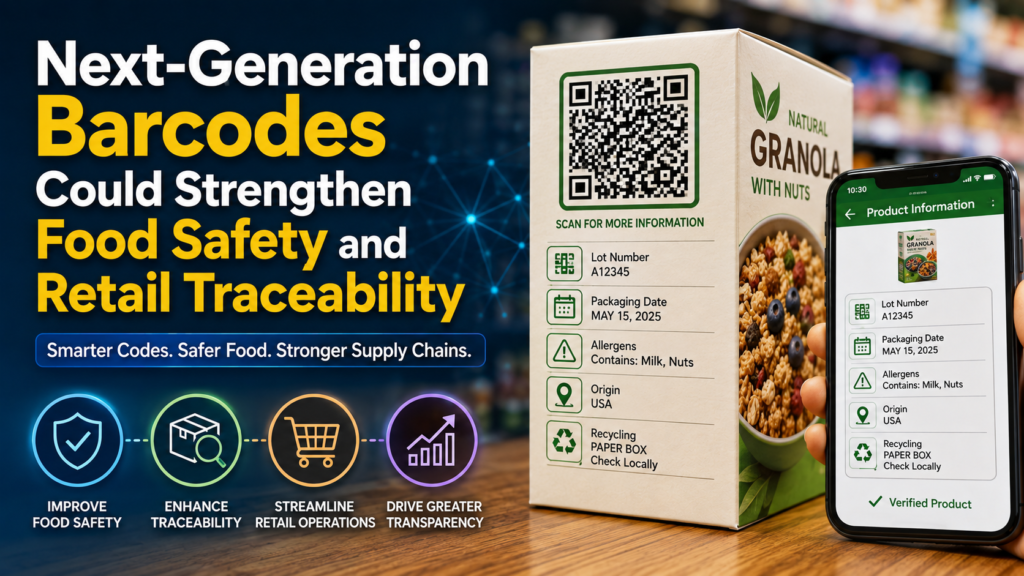
Retailers and consumer-goods manufacturers are preparing for a significant change in product identification technology as two-dimensional barcodes move closer to mainstream adoption. The new codes, which resemble QR codes, are designed to carry far more information than traditional UPC labels and could improve food traceability, inventory management and recall accuracy.
The transition is being coordinated through GS1, the global standards organization responsible for barcode systems. Its Sunrise 2027 initiative encourages retailers and manufacturers to begin supporting 2D barcodes alongside existing one-dimensional codes.
Add Detailed Product Information to Every Package
Traditional UPC barcodes mainly identify a product and connect it with pricing information at checkout. Two-dimensional codes can store or connect users to substantially more data, including lot numbers, packaging dates, allergens, recycling instructions and product-origin information.
Consumers can scan compatible codes with smartphones, while retailers can integrate the same data into point-of-sale and inventory systems.
For businesses tracking retail technology through GrowBusinessMag, the development represents a shift from barcodes as simple checkout identifiers to tools that can support digital product records throughout the supply chain.
Improve Recall Accuracy With Batch-Level Tracking
Food-safety experts have identified product traceability as one of the most valuable potential applications.
Lot and batch numbers currently appear separately on many packages, requiring store employees, investigators or consumers to manually determine whether a particular item is included in a recall. Encoding these identifiers into 2D barcodes could allow retailers to identify affected inventory automatically.
Stores could potentially block recalled products at checkout, while manufacturers could narrow recalls to specific production batches. More precise identification could also reduce unnecessary disposal of unaffected food.
Address Packaging and Technology Requirements
The transition will require investment from manufacturers and retailers. Production facilities may need printing systems capable of generating unique codes during packaging, and retailers must ensure scanners and software can recognize the new format.
Several consumer brands have already started placing 2D barcodes alongside traditional UPC codes, providing early examples of how the technology can operate without disrupting existing checkout systems.
Watch Adoption Accelerate Toward 2027
The next stage will depend on coordination among packaging suppliers, manufacturers, software providers and retailers. Wider adoption is expected as more products carry compatible codes and more checkout systems become capable of processing them.
If implementation expands successfully, 2D barcodes could become a practical infrastructure upgrade for retail, helping businesses improve product transparency, reduce recall-related waste and respond more precisely to food-safety concerns.