Reliable electricity is a basic requirement for nearly every modern small business. From point-of-sale systems and computers to refrigeration, security equipment, lighting, communications, and specialized machinery, daily operations often depend on a steady power supply.
When that supply is interrupted, even for a relatively short period, the effects can extend beyond temporary inconvenience. Businesses may lose productive time, delay customer service, interrupt transactions, or face problems with equipment that depends on continuous power.
Energy resilience is the ability to keep essential operations running when normal electricity service is disrupted. For small businesses, resilience does not necessarily mean creating a completely independent power system. It often starts with identifying critical energy needs, reducing unnecessary consumption, and selecting backup solutions that can support the most important functions during an outage.
Identify the Systems That Must Stay Online
A practical resilience plan begins with understanding how electricity is used throughout the business.
Owners should separate essential systems from equipment that can be temporarily switched off. For a retail store, essential loads may include payment terminals, internet equipment, security systems, and emergency lighting. A restaurant may prioritize refrigeration and food-storage equipment, while an office may focus on computers, networking hardware, and communications.
This type of assessment helps determine how much backup power a business may actually require. Attempting to power every device during an outage can make a backup system unnecessarily complex or expensive.
It can also be useful to review when energy demand is highest. Certain businesses use much more power during particular hours or production periods. Understanding those patterns makes it easier to decide which systems should receive priority if grid power becomes unavailable.
For owners following practical business-continuity strategies, GrowBusinessMag views this kind of energy assessment as part of broader operational risk management rather than simply a facilities issue.
Add Backup Power Where Interruptions Matter Most
Once critical loads have been identified, businesses can consider how they would continue operating during a power failure.
Backup generators remain one option, while battery energy storage provides another approach. Batteries can store electricity and make it available later, allowing selected equipment to remain powered when the main electricity supply is interrupted.
For businesses researching storage systems, Fortress Power batteries available through Build The Power are one option to consider when planning a battery-backup or broader energy-storage setup.
The appropriate system depends on the business and its power requirements. A small office that needs to maintain internet connectivity and a few computers has very different requirements from a workshop operating larger electrical equipment.
Business owners should therefore begin with the expected load rather than selecting equipment based only on capacity or product specifications. The goal is to match the backup solution with the systems that actually need protection.
Reduce Energy Demand Before Expanding Backup Capacity
Energy efficiency and energy resilience are closely connected.
A business that requires less electricity to maintain essential operations may be easier to support during an outage. Reducing unnecessary consumption can also help businesses avoid purchasing more backup capacity than they genuinely need.
Straightforward efficiency improvements can include replacing inefficient lighting, keeping heating and cooling systems properly maintained, switching off equipment that is not in use, improving insulation where appropriate, and using energy-management controls.
Maintenance is especially important. Equipment that operates inefficiently because of dirty filters, worn components, or poor servicing may consume more power than necessary.
Efficiency measures can also support normal operating costs. Even when outages are uncommon, lower electricity consumption can remain useful during routine business operations.
For this reason, businesses may benefit from considering efficiency upgrades before finalizing a backup-power strategy.
Pair Renewable Energy With Storage Where Appropriate
Renewable energy can add another layer to a small business energy plan.
Solar power is one of the most familiar examples. Solar panels can generate electricity during suitable conditions, reducing the amount of electricity that must be drawn from the grid.
By itself, however, a renewable generation system does not always guarantee power during an outage. System design matters, and businesses that want stored electricity available later may consider combining renewable generation with battery storage.
A solar-plus-storage setup can allow energy produced at one time to be used later, depending on how the system is configured. This can provide businesses with more flexibility in managing their electricity supply.
The suitability of renewable energy will vary by property, roof space, local conditions, system cost, electricity demand, and installation requirements. Business owners should evaluate those practical considerations before making an investment.
Rather than treating renewable energy as a single solution to every resilience problem, it is often more useful to view it as one component of a broader strategy that can include storage, efficiency improvements, and emergency planning.
Create a Clear Power-Outage Procedure
Technology alone does not make a business resilient.
Employees also need to know what to do when electricity fails. A written outage procedure can reduce confusion and help the business move quickly from normal operations to its backup plan.
The plan should identify which systems must remain running, which equipment should be shut down, who is responsible for checking backup equipment, and how employees should communicate with customers or suppliers.
Contact details for utilities, electricians, equipment providers, building managers, or other relevant service providers should also be easily accessible.
Businesses that depend on sensitive machinery or refrigerated products may need more detailed procedures than a typical office. The plan should reflect the operational consequences of losing power rather than relying on a generic checklist.
Regular testing is equally important. Batteries, generators, transfer equipment, and related systems should not be assumed to work simply because they were installed correctly in the past.
Periodic checks can help identify maintenance problems before an actual outage creates a more serious business interruption.
Plan Backup Duration Around Real Business Needs
One of the most useful questions a small business can ask is not simply how much power it needs, but how long it needs that power to last.
Some businesses may only need enough backup capacity to handle short interruptions, safely close operations, complete transactions, or keep communications active. Others may require essential systems to continue operating for much longer.
Backup duration affects system design because the same equipment may require significantly different stored energy depending on how many hours it must operate.
Businesses should consider likely outage scenarios, the equipment that must stay active, and whether operations can be reduced temporarily.
For example, a company may decide that keeping every workstation running is unnecessary while maintaining internet service, security systems, one payment terminal, and essential lighting is critical.
Prioritization can make a resilience strategy more practical and easier to manage.
Review the Energy Plan as the Business Changes
Energy needs rarely remain fixed.
A business may add staff, purchase new machinery, expand its premises, introduce electric equipment, or change operating hours. Any of these changes can alter electricity demand and affect whether an existing backup solution remains suitable.
Energy resilience should therefore be reviewed periodically rather than treated as a one-time project.
Businesses can reassess critical loads, inspect backup equipment, review emergency procedures, and determine whether efficiency improvements or additional storage may be needed.
This is especially important after a significant expansion or equipment upgrade. A backup system designed for an earlier stage of the business may no longer provide sufficient support once energy consumption increases.
Build Resilience Into Everyday Operations
Energy resilience is ultimately about continuity.
Small businesses cannot prevent every outage or disruption, but they can reduce the operational impact by knowing which systems matter most and preparing practical alternatives in advance.
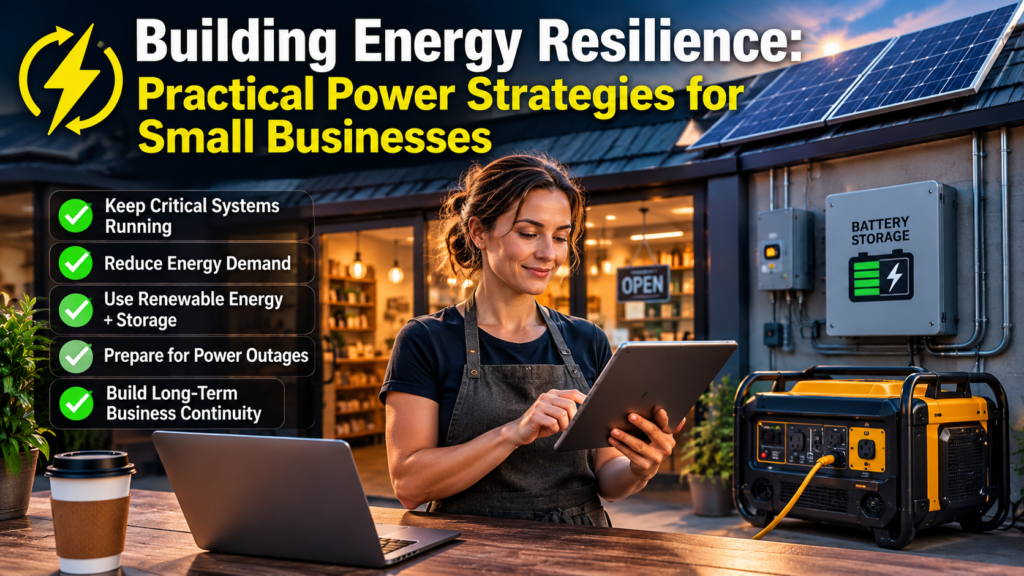
A strong approach usually combines several measures rather than relying on a single technology. Identifying essential loads establishes priorities. Energy-efficiency improvements reduce unnecessary demand. Backup generators or battery systems can provide additional power when the grid is unavailable. Renewable energy may add further flexibility, while a clear emergency procedure helps employees respond consistently.
The most effective solution will depend on the individual business, its equipment, location, operating hours, and tolerance for downtime.
By treating energy planning as part of ordinary business risk management, small companies can build operations that are better prepared for interruptions and more adaptable as their energy needs change.