
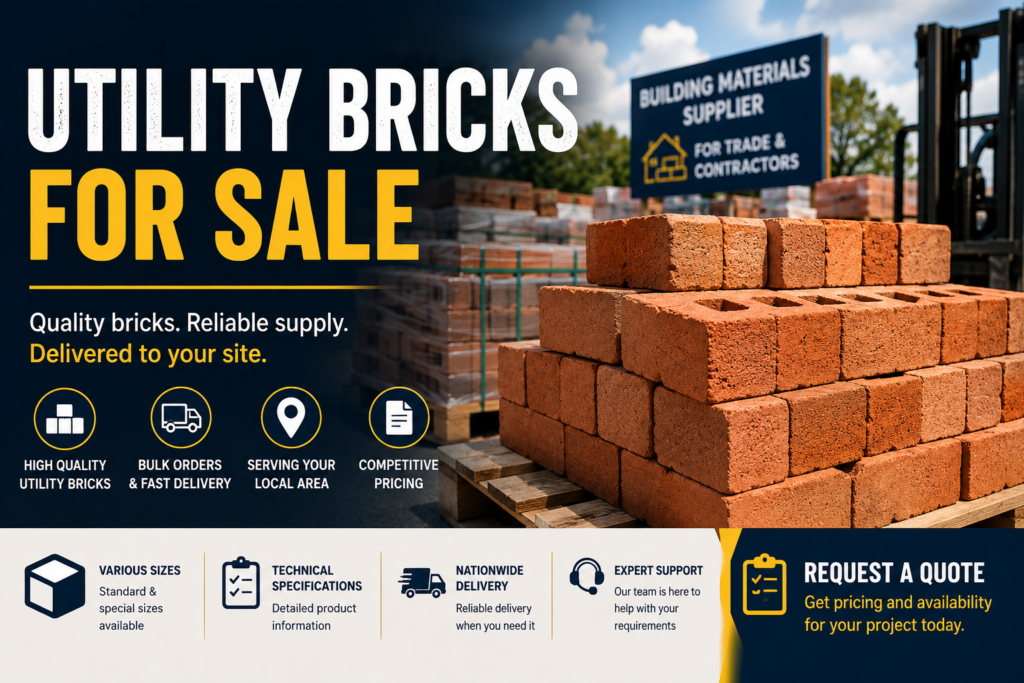
Someone searching for “utility bricks for sale” is rarely browsing construction ideas for entertainment. The wording suggests a practical objective: locate the right brick, confirm availability, understand specifications, compare costs, and determine whether a supplier can fulfill an upcoming project.
For building material suppliers, that distinction creates an important search opportunity.
A contractor looking for brick dimensions has informational intent. A property developer searching for brick suppliers near a project site has commercial intent. A buyer typing “utility bricks for sale” is considerably closer to contacting a supplier, requesting a quote, or placing an order. The supplier that answers the buyer’s practical questions most effectively has a better chance of turning that search into an inquiry.
Capturing this traffic requires more than placing a product keyword repeatedly on a page. Suppliers need useful product information, accurate location details, purchasing guidance, proof of real industry experience, clear delivery information, and an obvious path from search result to sales conversation.
That approach also aligns with Google’s published guidance. Google says its ranking systems are intended to prioritize helpful, reliable, people-first information, including content that demonstrates first-hand expertise and gives readers enough information to achieve their goal.
For suppliers selling bricks, blocks, masonry products, aggregates, cement, and related construction materials, high-intent SEO therefore works best when the website behaves like an experienced sales representative: it answers the questions buyers actually ask before purchasing.
Identify the Commercial Intent Behind Utility Bricks for Sale
Start by treating utility bricks for sale as a purchasing query rather than a general brick-related keyword.
The person making this search may be a contractor estimating materials, a builder sourcing products for a new site, a masonry company replacing stock, a purchasing manager comparing suppliers, or a property owner trying to source a specific construction material. These visitors generally need different information from someone reading an introductory article about brick construction.
A strong landing page should immediately help them determine whether your company can supply what they need.
That means giving clear answers to questions such as:
- Which utility bricks are currently available?
- What dimensions or specifications are offered?
- Are bricks sold individually, by pallet, by pack, or in bulk quantities?
- Is there a minimum order?
- Can the supplier deliver to a jobsite?
- Which locations are served?
- Can buyers request contractor or volume pricing?
- How quickly can availability be confirmed?
- Are product data sheets or technical details available?
The keyword should appear naturally in the title, introduction, product copy, and other relevant areas, but the page should not be written simply to repeat it.
Google’s Search Essentials recommends using the words people use to find content in prominent places such as the page title and main heading while still creating helpful, reliable information for users.
The practical lesson is straightforward: optimize the page around the query, then build the rest of the page around the purchasing decision.
Match Content to the Buyer’s Next Action
High-intent SEO performs best when the page answers the question immediately before the buyer’s next commercial action.
For a utility brick buyer, that action may be:
Request a quote.
Call for availability.
Check delivery coverage.
Confirm specifications.
Order samples.
Ask about volume pricing.
A page that ranks for a commercial query but forces the visitor to search elsewhere for those answers creates unnecessary friction.
A stronger page might open with a concise product summary:
“Utility bricks are available for contractor, commercial, and residential orders. Contact our sales team for current inventory, bulk quantities, pricing, and delivery availability in your area.”
The exact wording should reflect the supplier’s real inventory and services. Never advertise stock, technical specifications, delivery coverage, or certifications that cannot be verified.
That accuracy is part of EEAT. Trust grows when the website reflects what the company can actually supply.
Build a Dedicated Utility Brick Product Page
Create a dedicated page when utility bricks represent a meaningful product category rather than burying the term inside a broad page listing dozens of masonry products.
The page URL, title, primary heading, product description, images, internal links, and calls to action should all reinforce the same purchasing topic.
A useful structure could include:
/bricks/utility-bricks/
or
/masonry/utility-bricks-for-sale/
The exact URL matters less than maintaining a clean, descriptive hierarchy.
The page should explain the product in language familiar to real customers. Include specifications that your sales team regularly provides, purchasing options, availability details, compatible applications where appropriate, and instructions for getting an accurate quote.
Google’s SEO Starter Guide emphasizes clear organization, descriptive headings, unique content, and writing that anticipates the different terms users may employ when searching.
Publish Product Details Buyers Can Verify
A construction-material page should contain more substance than a stock image and a “contact us” button.
When applicable to the products your company actually stocks, useful information may include:
- Manufacturer or brand
- Product name
- Brick dimensions
- Unit or pack quantity
- Material or composition
- Color or finish
- Product code
- Packaging
- Weight
- Relevant technical standards
- Recommended applications
- Current availability
- Collection options
- Delivery options
Technical information should come from verified manufacturer documentation, internal product data, or another authoritative source.
If dimensions vary by manufacturer or region, state that clearly instead of presenting one measurement as universal.
That small distinction matters. Buyers working from architectural specifications or quantity estimates can make costly mistakes when product dimensions are inaccurate.
Add Original Product Photography
Supplier websites often use identical manufacturer images. Those photographs can still be useful, but original imagery provides additional evidence that the business genuinely stocks, handles, delivers, or works with the products it describes.
Useful images could show:
- Utility bricks in the yard
- Full pallets
- Brick texture and finish
- Packaging labels
- Individual units beside a measuring reference
- Delivery vehicles
- Loaded orders
- Completed projects where usage rights permit
Google currently encourages websites competing in both traditional Search and AI-powered Search experiences to create unique, expert-led material that adds value beyond information anyone could reproduce.
Original product images combined with first-hand purchasing information can help distinguish a genuine supplier from a generic lead-generation page.
Explain Pricing Without Creating Buyer Friction
Give buyers enough pricing context to understand how purchasing works, even when publishing a fixed price is impractical.
Building material prices can depend on order quantity, product variant, manufacturer, delivery distance, freight requirements, project location, and current inventory. A supplier does not need to publish a permanent price if the business cannot maintain one accurately.
Instead, explain the pricing process.
For example:
“Pricing depends on quantity and delivery location. Request a current quote with your required number of bricks, project postcode, and preferred delivery date.”
That statement gives the buyer a clear path forward without inventing a price that may quickly become outdated.
If your business does publish prices, specify what the price represents. A visitor should be able to tell whether the figure applies to a single brick, pack, pallet, thousand units, or another quantity.
Give Contractors a Faster Quote Process
Commercial buyers value speed.
A quote form designed specifically for building material orders can collect the details needed to price the job without a long email exchange.
Useful fields can include:
- Customer name
- Company
- Phone number
- Product required
- Quantity
- Project postcode
- Delivery or collection
- Required date
- Additional notes
If customers regularly upload drawings, schedules, or material lists, allowing an attachment may simplify larger quotations.
Avoid asking for information the sales team does not actually need. Long forms can make an otherwise simple inquiry feel like an application process.
The objective is to move the buyer from utility bricks for sale to a qualified quote request with as little uncertainty as possible.
Create Location Pages Around Real Service Areas
Building materials are physical products, which makes geography especially important.
A contractor may search:
“utility bricks for sale near me”
“utility brick supplier [city]”
“brick delivery [city]”
“bulk bricks [location]”
“masonry supplier near [project area]”
Local visibility can therefore be just as important as national organic rankings.
Google states that local results are primarily influenced by relevance, distance, and prominence. Google also recommends keeping Business Profile information complete and detailed so it can better understand how a business matches local searches.
Suppliers should build their local strategy around real operating locations and genuine delivery areas.
Build Useful City and Regional Pages
A local landing page should not simply replace one city name with another.
Each page should contain information specific to the market it serves.
That might include:
- Delivery coverage
- Depot or yard location
- Collection arrangements
- Typical order types
- Products stocked locally
- Contact information
- Regional sales representatives
- Local project experience
- Delivery restrictions
- Relevant service information
A buyer searching for utility bricks in a particular area wants confirmation that you can actually fulfill an order there.
Pages containing only generic paragraphs plus a city name provide little reassurance.
Keep Business Details Consistent
Maintain accurate:
- Business name
- Address
- Phone number
- Opening hours
- Website
- Business category
- Service information
Your Google Business Profile should align with the information customers encounter on the website.
If a location has changed hours, moved, or stopped stocking certain products, update those details promptly.
Incorrect opening hours or an outdated address is not merely an SEO problem. It can result in lost orders.
Demonstrate First-Hand Building Material Experience
EEAT becomes particularly meaningful for commercial product pages because buyers need confidence in the supplier, not just the article.
A customer ordering construction materials may be committing substantial money, coordinating labor, hiring equipment, reserving delivery access, and working against a project schedule. An incorrect material order can create delays far beyond the cost of the brick itself.
Your website should therefore show evidence that knowledgeable people stand behind it.
Google’s people-first content guidance specifically asks whether content demonstrates first-hand expertise and depth of knowledge.
For a building supplier, that experience can be demonstrated naturally rather than declared repeatedly.
Add Advice From Your Sales or Technical Team
Real purchasing insights are more useful than generic definitions.
For example, a sales specialist might explain the information customers should have ready before requesting a utility brick quote:
“Confirm the brick specification, required quantity, delivery postcode, access conditions, and target delivery date before requesting pricing.”
That advice reflects the actual purchasing process.
Other first-hand topics might include:
- How suppliers calculate order quantities
- Common causes of delayed deliveries
- Information required before dispatch
- How contractors should check delivered materials
- When buyers should confirm product batches
- How pallet quantities affect ordering
- How site access affects delivery planning
These details create content that a generic writer may overlook but an experienced supplier encounters every week.
Show Who Reviewed Technical Information
If the website contains technical building-material guidance, identify the person or team responsible for reviewing it where practical.
An author or reviewer profile can include:
- Name
- Role
- Relevant experience
- Areas of specialization
- Company
- Professional qualifications where applicable
Do not manufacture expertise.
A purchasing guide reviewed by an experienced branch manager can be credible without pretending that person is an engineer. Technical engineering claims, meanwhile, should be reviewed against appropriate technical documentation or qualified expertise.
Clear boundaries improve trust.
Expand Beyond One Commercial Keyword
A page targeting utility bricks for sale should connect naturally to the broader questions a buyer asks during sourcing.
Search behavior rarely consists of one query.
A contractor may begin with:
“utility brick dimensions”
Then search:
“utility bricks supplier”
Then:
“utility bricks for sale”
Then:
“utility bricks delivery near me”
Finally:
“brick supplier phone number”
These searches reflect different stages of the same purchasing journey.
A supplier can support them with a connected content structure instead of creating unrelated keyword pages.
Build Supporting Brick Content
Relevant supporting topics may include:
- Utility brick dimensions and sizing guidance
- How to calculate brick quantities
- Brick delivery planning
- Brick pallet and pack quantities
- Choosing bricks for different project requirements
- Brick storage on construction sites
- Ordering bricks for commercial projects
- Questions to ask a brick supplier
- Planning bulk masonry deliveries
- Understanding brick product specifications
Each article should solve a genuine customer problem and then link naturally to the relevant product or quote page.
The commercial page captures the buyer.
The supporting guides establish expertise and help buyers who are still researching.
Connect Related Product Categories
Internal links should reflect the way real buyers move through a supplier’s catalog.
A utility brick page could connect to relevant categories such as:
- Facing bricks
- Engineering bricks
- Concrete blocks
- Building blocks
- Mortar products
- Cement
- Aggregates
- Wall ties
- Damp-proofing products
- Masonry accessories
Only link to categories the business genuinely sells.
Google notes that links help users and search engines discover related pages, and recommends descriptive anchor text that helps users understand the destination before clicking.
Instead of linking generic words such as “click here,” descriptive anchors such as “view our brick delivery options” provide clearer information.
Compare Low-Intent and High-Intent Building Material Searches
Not every visitor has equal commercial value.
Understanding the stage behind a query helps suppliers decide which page should rank and what action the page should encourage.
| Search query type | Likely intent | Appropriate content | Primary conversion |
|---|---|---|---|
| Types of bricks | Early research | Educational guide | Explore products |
| Utility brick dimensions | Product research | Technical guide | View specifications |
| Best bricks for a project | Evaluation | Selection guide | Contact technical sales |
| Utility brick supplier | Commercial investigation | Supplier/category page | Call or enquire |
| Utility bricks for sale | Strong purchase intent | Product landing page | Request quote |
| Utility bricks near me | Local purchase intent | Location/product page | Call local branch |
| Bulk utility bricks delivery | Transactional B2B intent | Delivery and product page | Request bulk quote |
The important distinction is the relationship between query and page.
A searcher typing utility bricks for sale should not land on a 2,000-word history of brick manufacturing before discovering whether your business sells the product.
Provide the commercial answer first.
Educational information can support the decision farther down the page.
Strengthen Trust Before Asking for the Sale
A buyer arriving from Google may know nothing about your company.
The page needs to answer two questions quickly:
“Can this supplier provide the product?”
“Can I trust them with the order?”
Trust signals should be factual and verifiable.
Useful examples include:
- Physical business address
- Working phone number
- Named sales contacts
- Opening hours
- Years in operation, when accurate
- Manufacturer relationships
- Accreditations that can be verified
- Delivery information
- Returns or cancellation policy
- Terms of trade
- Product documentation
- Genuine customer reviews
- Project photographs
- Clear privacy policy
Avoid empty claims such as “the best supplier in the country” unless there is objective evidence supporting the statement.
Specific evidence is more convincing.
“Serving contractors from three regional branches” communicates more than “industry-leading service,” provided the claim is accurate.
Publish Genuine Customer Evidence
Reviews can reduce uncertainty, particularly for buyers considering a supplier for the first time.
Construction-related reviews are most helpful when they describe real purchasing experiences such as:
- Product availability
- Delivery reliability
- Staff knowledge
- Order accuracy
- Communication
- Support when resolving problems
Do not invent testimonials.
If reviews are displayed on the website, maintain a process for confirming they came from genuine customers.
Google notes that review quantity and positive ratings can contribute to prominence in local search, alongside other signals.
The more important business benefit, however, is that authentic reviews help prospective customers evaluate risk.
Improve the Product Page for Search and Conversion
SEO and conversion optimization should work together.
A page can attract hundreds of visitors and still perform poorly if customers cannot find a price request, phone number, product availability statement, or delivery information.
The strongest commercial pages answer essential questions near the top and add deeper supporting information below.
Structure the Page Around Buyer Priorities
A useful order could be:
- Product name and concise description
- Availability
- Main specifications
- Product images
- Quote or contact option
- Delivery and collection information
- Technical details
- Suitable applications
- Ordering guidance
- Frequently asked questions
- Related products
This hierarchy puts commercial information before long educational explanations.
Mobile usability also matters because contractors, tradespeople, homeowners, and site managers may search while away from a desk.
Phone numbers should be easy to tap. Quote forms should work on smaller screens. Tables should remain readable. Product images should load efficiently.
Google advises site owners to consider the overall page experience rather than focusing narrowly on one isolated ranking factor.
Track Leads Instead of Measuring Rankings Alone
Ranking number one is not the final objective.
The business objective is profitable customer acquisition.
Track the actions that indicate commercial value.
Useful measurements include:
- Quote requests
- Phone calls
- Email enquiries
- Product-page conversions
- Branch-direction requests
- Sample requests
- Trade account applications
- Revenue from organic leads
- Qualified lead rate
- Cost per acquired customer
Google Search Console can help website owners understand how their pages perform in Google Search, including the queries and pages producing visibility.
Combine search data with website analytics and CRM or sales records where possible.
A keyword generating 300 visits and 30 serious quote requests may be more valuable than a broad informational term generating 10,000 visits but almost no sales activity.
Measure Search Intent by Landing Page
Separate performance by page type.
For example:
| Page type | Main measurement | Secondary measurement |
|---|---|---|
| Product page | Quote requests | Calls |
| Location page | Calls or directions | Quote requests |
| Technical guide | Product-page clicks | Assisted conversions |
| Category page | Product engagement | Enquiries |
| Delivery page | Delivery quote requests | Product-page visits |
This makes SEO reporting more commercially meaningful.
It also shows which informational pages assist purchases even when they are not the final page visited before a conversion.
Update Utility Brick Pages as Business Conditions Change
Commercial pages should reflect current business reality.
Review product information whenever inventory, manufacturers, specifications, packaging, service locations, delivery terms, or ordering procedures change.
Google’s SEO guidance recommends keeping published content current and updating material when it is no longer accurate.
For a supplier, freshness has a direct customer-service benefit.
An outdated article may merely inconvenience a reader. An outdated product page can result in an incorrect order enquiry, unnecessary sales calls, or customers traveling to a branch for unavailable stock.
Add Visible Review Information Where Useful
For technical or purchasing guides, consider showing:
“Last reviewed: [date]”
or:
“Product information reviewed by: [name/department]”
Use these only when there is a genuine review process behind them.
Do not update dates automatically without reviewing the information. A new timestamp attached to old content does not make the content more accurate.
Real maintenance is an EEAT signal because it demonstrates editorial responsibility.
Build a Search Strategy Around Real Customer Questions
The strongest supplier SEO programs often begin away from keyword tools.
Ask sales staff which questions customers repeatedly ask.
Speak with branch teams.
Review quote-request forms.
Look at internal site searches.
Study customer emails.
Analyze Search Console queries.
Examine questions asked before large orders.
A brick supplier might discover repeated questions such as:
“Do you have this brick in stock?”
“How many come on a pallet?”
“Can you deliver to my postcode?”
“Can you match an existing brick?”
“How much notice do you need?”
“Is there a minimum quantity?”
Those questions can become useful product copy, FAQ entries, guides, filters, and conversion prompts.
This is where first-hand industry experience creates an advantage over generic SEO publishing.
Google’s current guidance for search visibility, including its AI-powered experiences, emphasizes original, helpful content that contributes information beyond commodity summaries.
A supplier has access to exactly that kind of information through its everyday operations.
Answer Common Questions About Utility Bricks for Sale and Supplier SEO
Should a supplier create a separate page for utility bricks for sale?
Yes, if utility bricks are a genuine product category the business sells and customers regularly search for them. A dedicated page can provide specifications, availability, delivery information, purchasing options, and a quote path without forcing visitors to navigate through an unrelated general building-material page.
Should utility brick prices be displayed online?
Publish prices when they can be kept accurate and when the displayed unit is clear. If costs frequently change according to quantity, supplier pricing, freight, or location, explain how pricing works and provide a fast quote process. Avoid publishing outdated figures simply to satisfy a keyword.
How can a building material supplier demonstrate EEAT?
Show first-hand industry knowledge, accurate product information, identifiable authors or reviewers where appropriate, genuine business contact details, real product photography, delivery guidance, manufacturer documentation, customer evidence, and transparent policies. Technical claims should be supported by appropriate product data or qualified expertise.
How can suppliers rank for local utility brick searches?
Maintain complete and accurate business information, create useful pages for genuine locations and service areas, describe locally available products and services, earn legitimate reviews, and keep contact details consistent. Google says local results are mainly determined by relevance, distance, and prominence.
Is repeating “utility bricks for sale” throughout a page good SEO?
No. Use the phrase naturally where it accurately describes the page, including prominent areas such as the title or main heading when appropriate. Then cover related buyer needs using natural language. Google’s guidance recommends people-first content rather than pages created primarily to manipulate search rankings.
Convert High-Intent Brick Searches Into Real Sales Opportunities
A search for utility bricks for sale represents something valuable to a building material supplier: a customer who may already know the type of product they need and is moving closer to a purchasing decision.
Winning that customer requires more than inserting a commercial keyword into an existing page.
Create a dedicated product experience that confirms availability, explains specifications, clarifies ordering and delivery, answers genuine purchasing questions, and makes contacting the sales team effortless. Support the commercial page with technical guides, location content, related product categories, original images, genuine customer evidence, and expertise drawn from the people who actually sell and handle construction materials.
The same principle can extend across the supplier’s entire catalog.
Instead of building pages around isolated keywords, build them around real purchasing journeys: discovery, specification, comparison, availability, location, quotation, delivery, and repeat ordering.
That approach reflects Google’s emphasis on helpful, reliable, people-first information while also serving the commercial reality of the construction industry.
For building material suppliers, the goal is not simply to generate more search traffic. It is to become the most useful answer when a contractor, developer, tradesperson, or property owner is ready to source materials.
If your business genuinely offers utility bricks for sale, make the product page work as hard as your sales counter. Publish accurate information, demonstrate real expertise, show buyers how you can fulfill the order, and provide a clear route to request a quote. High-intent searches become valuable when the website gives customers enough confidence to take the next step.