
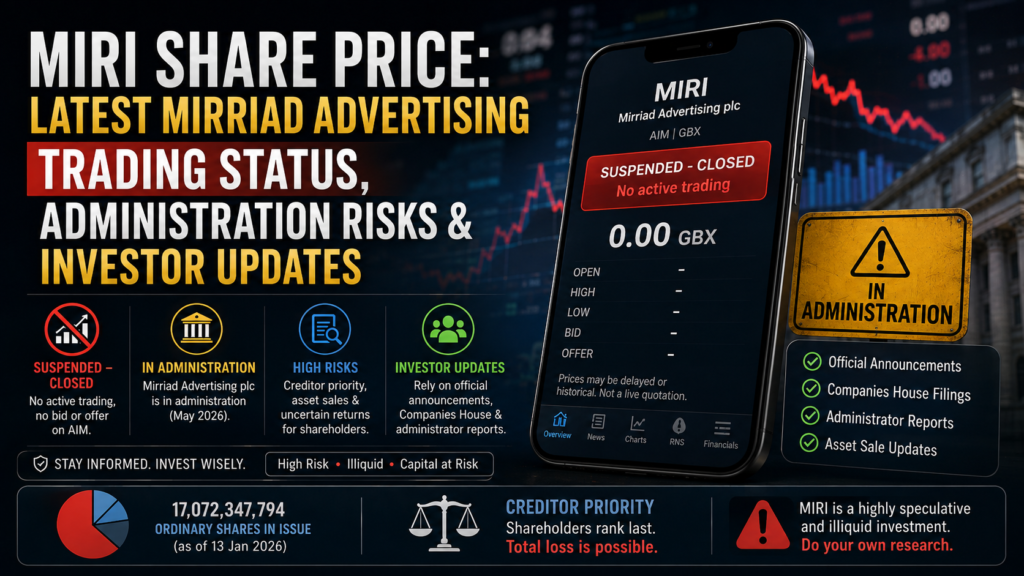
The MIRI share price represents the quoted value of shares in Mirriad Advertising plc, an advertising technology company admitted to London’s AIM market under the ticker MIRI. Investors searching for a live price need to understand that MIRI is not trading normally. The London Stock Exchange currently identifies the security as “Suspended – Closed” and displays no active opening price, bid, offer, daily high or daily low. A number shown on a financial website may therefore be an old closing price, a rounded figure or delayed historical data rather than a price at which investors can complete a transaction.
The suspension is connected to serious financial and corporate developments. Mirriad Advertising plc entered administration in May 2026, and Companies House currently records the company’s legal status as “In Administration.” The exchange announcement confirming the appointment of administrators also stated that the company’s ordinary shares remained suspended from AIM.
These circumstances make the MIRI share price fundamentally different from the price of an actively traded small-cap stock. Investors must now assess the administration process, creditor claims, asset-sale prospects and the future of the company’s AIM admission. Official London Stock Exchange announcements, Companies House filings and administrator reports carry more evidential weight than discussion boards, social-media posts or unsupported price predictions.
Confirm the Current MIRI Share Price Status
Start by confirming whether Mirriad Advertising shares are available for normal market trading. The London Stock Exchange company page lists MIRI as an equity quoted in GBX, meaning pence sterling, but its current trading status is suspended and closed. The page shows a rounded price of 0.00 GBX, with dashes in the open, high, low, bid and offer fields.
That display should not be interpreted as a definitive finding that every MIRI share has a legal or economic value of exactly zero. It shows that the exchange is not operating a normal two-way market in the security. Without active bids and offers, investors cannot rely on ordinary market price discovery to establish what buyers are willing to pay.
A historic quotation may remain visible on brokers and third-party financial platforms after a suspension. Such a figure records an earlier market transaction, not necessarily the value of the company after the appointment of administrators. The company’s financial position, asset ownership, liabilities and professional costs may have changed materially since the final active trade.
The most accurate description is therefore that there is currently no live, freely tradable MIRI share price on AIM. Investors should distinguish among the last recorded trade, a data provider’s rounded display and any eventual recovery that may be available to shareholders through the administration process.
Verify the Company Behind the MIRI Ticker
Identify the listed business before using any MIRI quotation. The ticker relates to Mirriad Advertising plc, company number 09550311, a UK public limited company incorporated in April 2015. Companies House classifies its business activity under advertising agencies and records its current status as in administration.
Mirriad developed technology for virtual product placement and in-content advertising. Its platform was designed to insert branded products, signs and other commercial material into television, streaming, music and influencer content after production. The company described the system as AI-powered and protected by multiple patents.
The business model aimed to create additional advertising inventory for content owners without relying exclusively on conventional commercial breaks. Advertisers could place brands inside existing scenes, while broadcasters and content partners could seek new revenue from previously produced programming.
That commercial proposition remains relevant when considering the assets that administrators may evaluate. Software, patents, contracts, brands, technical integrations and customer relationships can have potential sale value. However, their strategic value to a buyer does not automatically translate into a payment for ordinary shareholders.
Review the Events That Led to Suspension
Follow the sequence of official announcements rather than relying on summaries posted after the event. Mirriad issued a corporate update on 22 April 2026 warning that trading in its shares could be suspended if the anticipated corporate circumstances developed.
The company subsequently announced the appointment of administrators over a UK subsidiary on 29 April 2026. That announcement referred to the suspension of the listed company’s shares under AIM rules.
Administrators were later appointed to Mirriad Advertising plc itself. The London Stock Exchange announcement released on 14 May 2026 confirmed the appointment and stated that the ordinary shares remained suspended from trading on AIM.
Companies House separately records Mirriad Advertising plc as being in administration. This official corporate record provides independent confirmation that the company is subject to a formal insolvency procedure rather than experiencing only a temporary trading interruption.
The London Stock Exchange’s MIRI analysis page also lists later regulatory updates, including a notice dated 30 June 2026 concerning a delay in publishing the annual report and accounts. Delayed financial reporting can further restrict the information available to shareholders attempting to assess the company’s condition.
Understand How Administration Affects Shareholders
Recognize where ordinary shareholders stand in the financial structure. Equity holders own the residual interest in a company. They generally receive value only after administration costs and higher-ranking creditor claims have been addressed.
This priority makes administration materially different from an ordinary earnings setback. A listed company can report weak revenue or losses and still retain a liquid share price because investors can trade based on expectations of recovery. An insolvent company under administrator control may instead be selling assets, reviewing contracts and determining whether the business can be rescued.
The appointment of administrators does not by itself mean the company’s shares immediately cease to exist. Legal ownership can continue while trading remains suspended. Continued existence, however, does not guarantee that the shares will return to AIM or produce a cash distribution.
Possible outcomes include the sale of selected assets, the sale of all or part of the business, a restructuring, a company voluntary arrangement, movement into liquidation or eventual dissolution. The effect on MIRI shareholders depends on the proceeds generated and the amount owed to creditors.
A headline asset-sale price may not represent the amount available to shareholders. Secured lending, employee claims, taxes, professional fees, contractual liabilities and unsecured debts may reduce the remaining funds substantially.
Distinguish Historical Prices from Executable Prices
Treat a quoted number as useful only when its meaning and timestamp are clear. A live market price normally reflects recent transactions supported by current bids and offers. A historic MIRI price reflects trading before the suspension and may not incorporate later insolvency developments.
The London Stock Exchange currently provides no active bid or offer for MIRI. This absence means investors cannot assume that a broker will execute an order at a displayed historic level.
Some data services retain the last trade in their charts for months or years. Others round a very small price to two decimal places, which can cause a fraction-of-a-penny security to appear as 0.00. Neither presentation establishes a current realizable value.
Investors must also check the currency unit. MIRI is quoted in GBX, which represents pence sterling. One hundred pence equals one pound. A failure to distinguish pence from pounds can overstate the apparent value of a holding by 100 times.
The reliable calculation for a historical holding is:
Number of shares × historical price in pounds = historical indicated value
That calculation should not be presented as current sale proceeds while the market is suspended. A realizable amount would depend on a resumed quotation, a private transaction or a distribution through the insolvency process.
Examine Mirriad Advertising’s Operating Model
Assess the underlying business to understand which assets may interest potential purchasers. Mirriad promoted a platform that dynamically inserted brands into premium video and entertainment content. The company identified television, subscription streaming, advertising-supported streaming, music and influencer media as target formats.
The platform attempted to solve two commercial problems. Content owners needed additional monetization methods, while advertisers needed ways to reach viewers who skipped or avoided traditional commercials. Virtual product placement offered a method of placing a brand within a scene without interrupting the viewing experience.
Mirriad’s technology used artificial intelligence and computer vision to identify appropriate placement opportunities. A brand image, product or digital sign could then be integrated into the content after filming, subject to technical, creative and contractual approval.
The potential assets of this model include source code, patents, technical workflows, integrations, trademarks, data, client relationships and content-partner agreements. Their realizable value will depend on ownership rights, contract transfer provisions, competing technologies and buyer demand.
The company’s AIM Rule 26 page reported 17,072,347,794 ordinary shares in issue as of 13 January 2026. This official figure is important because any per-share recovery must be spread across a very large issued share base.
Calculate MIRI Market Value Carefully
Use market capitalization cautiously when examining the MIRI share price. Market capitalization is normally calculated by multiplying the current share price by the number of issued shares. The formula is simple:
Share price × issued shares = market capitalization
The calculation becomes less reliable when the price is suspended, stale or rounded. Multiplying the exchange’s 0.00 GBX display by the issued share count would not produce a meaningful assessment of the company’s assets or shareholder recovery.
A hypothetical example illustrates the role of the large share count. If a company with approximately 17.07 billion shares traded at 0.01 pence per share, its implied market capitalization would be about £1.71 million. This is only an illustration and is not a current valuation of Mirriad Advertising.
Investors should not describe a fraction-of-a-penny stock as “cheap” solely because each individual share carries a low nominal price. The total share count, debt, funding needs and future dilution determine whether the equity valuation is low or high relative to the business.
During administration, a recovery-based analysis is more relevant. That process starts with estimated asset-sale proceeds and then subtracts administration costs and creditor claims. Any amount left for ordinary shareholders would be divided across the eligible shares.
Evaluate the Large MIRI Share Count
Consider dilution when reviewing Mirriad’s historical share-price performance. The company’s AIM disclosure recorded more than 17 billion ordinary shares in issue in January 2026.
A large issued share count can result from repeated equity fundraising, share reorganizations or other capital actions. Each new issuance may reduce the percentage ownership of existing investors unless they participate proportionately.
The number of shares also affects per-share recovery. For example, even if an administration produced a residual sum after all liabilities, that amount would need to be allocated across the company’s eligible equity base. A seemingly substantial aggregate sum can become very small on a per-share basis when billions of shares are outstanding.
Investors should therefore review both the total recovery and the per-share outcome. Statements that discuss only the gross value of a possible asset sale can create a misleading impression when they omit liabilities and the issued share count.
The share count should always be taken from an official company disclosure or regulatory filing. Message-board estimates and outdated data feeds may not reflect later issuance or corporate actions.
Monitor London Stock Exchange Announcements
Use the London Stock Exchange’s regulatory news service as the primary source for developments affecting the MIRI share price. The company’s exchange page records announcements concerning the administration, subsidiary proceedings, corporate updates and delayed reporting.
A material announcement may address an asset sale, a creditor proposal, a change in administrators, a restructuring plan, cancellation from AIM or a potential resumption of trading. Each development can affect the likelihood of shareholder recovery.
Check the publication date and exact wording. An announcement that administrators have received interest from buyers is not equivalent to a completed sale. A sale of intellectual property is not necessarily a sale of the listed company. A proposal to creditors is not the same as an approved distribution.
Exchange announcements should be read together with Companies House filings. The exchange communicates market-sensitive information, while Companies House maintains the formal corporate and insolvency record.
Investors should preserve copies of important notices because company websites can change during an insolvency process. A dated regulatory release offers a stronger evidential record than an undated summary shared on social media.
Review Companies House Insolvency Records
Check Companies House for the company’s legal status, filing history and insolvency documents. The Mirriad Advertising plc overview currently identifies the business as in administration and flags its accounts as overdue.
The insolvency section may contain administrator appointment documents, proposals, progress reports and notices concerning the future of the procedure. These filings can provide information that does not appear in a short exchange announcement.
Administrator reports may outline the company’s assets, liabilities, creditor categories, professional costs and estimated outcomes. They may also explain whether efforts were made to rescue the company or sell its business.
Investors should focus on the estimated outcome for each creditor class and for shareholders. The existence of patents or commercial partnerships may be encouraging from an asset perspective, but the decisive question is whether realizations exceed liabilities and costs.
Companies House is an authoritative legal record, but filing dates can lag behind an event. Investors should therefore review both the record and the latest exchange announcements before reaching a conclusion.
Assess the Possibility of an AIM Relisting
Wait for formal confirmation before assuming MIRI shares will resume trading. A suspended company must address the circumstances that prevented an orderly market and meet any applicable exchange requirements.
Potential obstacles may include unresolved administration proceedings, overdue accounts, the absence of an operating business, insufficient working capital or uncertainty over the company’s future direction. Mirriad’s exchange page records a June 2026 announcement concerning delayed annual accounts, adding to the information gap facing investors.
A relisting or resumption would require more than a positive rumor. Investors should look for an explicit London Stock Exchange announcement stating that the suspension has been lifted and identifying the effective date.
Even after a resumption, liquidity may remain limited. Small-cap AIM shares can have wide bid-offer spreads, low daily volume and sharp price movements. A restarted quotation would not guarantee that every shareholder could exit at the first displayed price.
The absence of a relisting announcement should be treated as evidence that the suspension remains in place. It should not be filled with assumptions based on how other companies have emerged from administration.
Prepare for a Possible AIM Cancellation
Recognize that a prolonged suspension can end in cancellation rather than resumed trading. Cancellation would remove MIRI’s public quotation from AIM and eliminate normal exchange-based liquidity.
A cancelled share can continue to exist legally, but investors may be left holding an unquoted interest. Selling that interest could require a private buyer, legal documentation and agreement on a price without a transparent public order book.
The loss of a quotation can significantly reduce practical value even when the share has not been formally extinguished. Investors may be unable to establish a fair price or find a counterparty.
An AIM cancellation may also affect the way brokers display the holding. Some platforms retain cancelled securities in an account with a nominal or zero value until a formal corporate action occurs.
Shareholders should rely on a regulatory announcement for the effective date and consequences of any cancellation. They should also retain purchase records, contract notes and broker statements for possible tax and legal purposes.
Analyze Potential Asset-Sale Outcomes
Focus on net proceeds rather than headlines. Mirriad’s technology, intellectual property and commercial relationships may attract interest from advertising, media or technology companies, but the value realized through an administration sale can differ substantially from development cost or previous fundraising valuations.
A strategic buyer may value patents, software or integrations because they complement an existing platform. Another buyer may seek only selected contracts or technical staff. An administrator may therefore sell the business in parts rather than transfer the entire listed company.
Gross sale proceeds are only the starting point. Administrators must account for the costs of the procedure and the legal ranking of claims. Shareholders receive a recovery only when sufficient funds remain after those obligations.
Investors should look for administrator language such as “estimated outcome statement,” “prescribed part,” “secured creditors,” “preferential creditors,” “unsecured creditors” and “distribution to members.” These terms provide more useful evidence than broad statements that an asset sale has been completed.
Until an official report estimates a shareholder distribution, any per-share recovery calculation should be labeled speculative.
Avoid Common MIRI Share Price Errors
Do not treat the exchange’s rounded 0.00 GBX display as a live dealing quote. The absence of a bid and offer confirms that normal market trading is unavailable.
Do not assume the final traded price remains a fair valuation after the appointment of administrators. Historical prices were established before all current information could be reflected in transactions.
Do not confuse GBX with GBP. A figure shown in pence must be divided by 100 to convert it into pounds.
Do not call a share undervalued because its nominal price is small. A low price can coexist with a large issued share count, significant liabilities and a high risk of total loss.
Do not infer shareholder recovery from the existence of intellectual property alone. Patents and software have value only to the extent that a buyer is prepared to pay for them and the resulting proceeds exceed higher-ranking claims.
Do not rely on anonymous posts claiming that a buyer, relisting or payout is imminent. Material developments should appear in an RNS announcement, an administrator communication or an official filing.
Build a Reliable MIRI Monitoring Checklist
Check the London Stock Exchange company page for changes in trading status and new regulatory announcements. The current page identifies MIRI as suspended and closed.
Review Companies House for administrator reports, insolvency filings, overdue accounts and changes to the company’s status. The official record currently lists Mirriad Advertising plc as in administration.
Read every announcement in full rather than relying on its headline. Determine whether it concerns the listed parent company, a subsidiary, a creditor process or an asset transaction.
Record important dates, including the appointment of administrators, publication deadlines, meeting dates and any proposed cancellation or distribution date.
Keep broker statements and purchase records. These documents may be required if the holding is cancelled, written off or used in a tax-loss claim.
Seek regulated financial, legal or tax advice when a decision depends on personal circumstances. A general market article cannot determine an individual investor’s tax treatment, loss relief or legal rights.
Judge the MIRI Share Price Outlook from Evidence
Base the outlook on the administration process rather than conventional share-price momentum. Technical chart patterns, moving averages and historic support levels have limited value when the stock is suspended and no active order book exists.
The strongest positive development would be an official report showing that asset realizations are expected to exceed administration costs and creditor claims by enough to provide a distribution to ordinary shareholders. A confirmed restructuring that supports a return to trading could also change the outlook.
The principal negative outcomes include the sale of assets without residual value for shareholders, movement into liquidation, cancellation from AIM or dissolution after the administration concludes.
The company’s technology may retain commercial relevance, but commercial relevance and equity recovery are separate questions. The administrators’ realized proceeds and the company’s liabilities will determine whether shareholders receive value.
Investors should avoid assigning probabilities without access to creditor and asset information. A responsible assessment acknowledges that the current recovery is uncertain and that total capital loss remains possible.
Follow the Latest MIRI Share Price Developments
The latest official evidence shows that Mirriad Advertising plc remains in administration and that its shares are suspended from trading on AIM. The London Stock Exchange displays no active bid, offer or trading range, while Companies House confirms the company’s insolvency status.
The company’s January 2026 AIM disclosure reported more than 17.07 billion ordinary shares in issue, an important consideration for any future per-share recovery calculation.
The next meaningful developments are likely to come from administrator reports, completed asset sales, creditor proposals, regulatory announcements or a formal decision concerning the AIM listing. Until one of those events occurs, third-party price displays should be treated as historical or indicative rather than executable.
Conclusion
The MIRI share price is currently not a normal live market quotation. Mirriad Advertising plc is in administration, its AIM-listed shares are suspended and the London Stock Exchange shows no active bid or offer. These facts make historical price charts an unreliable basis for estimating what shareholders could receive.
Investors should concentrate on official evidence: London Stock Exchange announcements, Companies House insolvency filings and administrator reports. The central issue is whether the company’s technology and other assets can generate enough net proceeds to meet costs and creditor claims before any value reaches ordinary shareholders.
MIRI remains a highly speculative, illiquid holding with a material risk of complete capital loss. Any future valuation should be based on confirmed recovery information, not the last traded price or unsupported expectations of a relisting.
This article is for general informational purposes only and does not constitute investment, legal or tax advice.