SpaceX exceeded Wall Street expectations in its first earnings report as a public company, but investors focused on the financial cost of its ambitions. Revenue nearly doubled, losses narrowed sharply and artificial intelligence sales accelerated. Even so, heavy infrastructure spending and continued cash consumption pushed the company’s shares more than 8% lower in late trading.
Deliver Record Revenue Growth
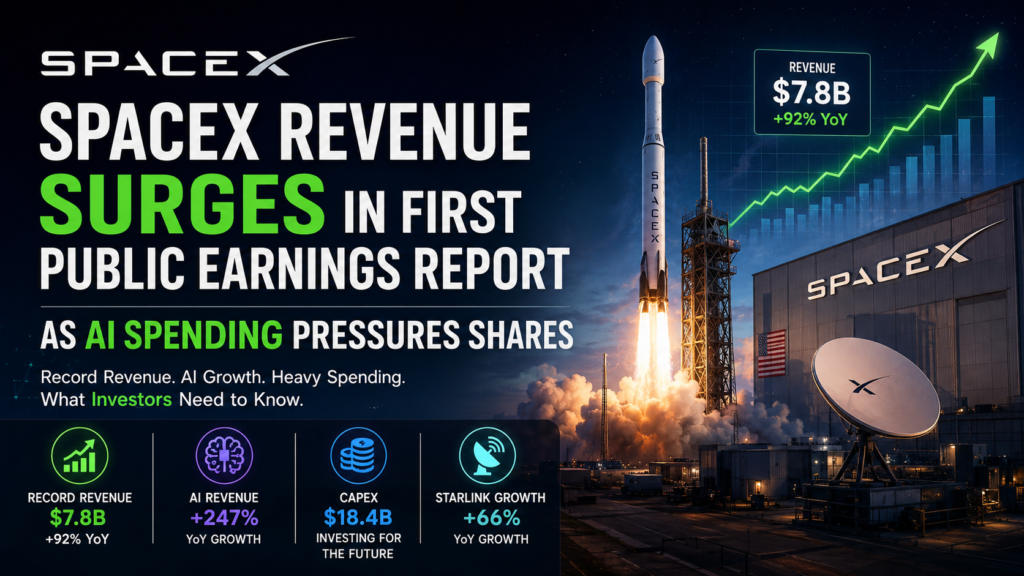
The satellite, aerospace and artificial intelligence company generated $7.8 billion in revenue during the April-to-June quarter, according to its second-quarter earnings report. That represented a 92% increase from the same period in 2025 and surpassed the $6.8 billion consensus analyst forecast.
SpaceX remained unprofitable, reporting a quarterly net loss of $541 million. The result was considerably better than the expected $1.9 billion loss and marked a substantial improvement from the $4.3 billion deficit recorded during the first three months of the year.
For GrowBusinessMag readers tracking newly listed technology companies, the report highlights the tension between rapid revenue growth and the capital required to sustain it.
Accelerate Investment in Artificial Intelligence
Capital expenditures reached $18.4 billion in the second quarter, compared with the $13 billion anticipated by analysts. Nearly $16 billion of that spending was allocated to the company’s AI operations as SpaceX sought to compete with OpenAI, Anthropic and Google.
The latest outlay followed more than $10 billion in first-quarter capital spending, much of it directed toward AI infrastructure. Analysts now expect full-year expenditures to exceed $45 billion, making investment discipline a central issue for shareholders.
The spending supported strong expansion. AI revenue increased 247% year over year, while the company’s profitable satellite internet division grew 66%.
Address Investor Concerns Over Valuation
Technology analyst Luke Lango said the market reaction reflected concern about the cost of growth rather than weak operating performance. His assessment points to the question now facing investors: whether SpaceX can convert exceptional revenue gains into returns that justify its spending and valuation.
The approaching expiration of the post-IPO lockup period could create additional pressure by allowing early investors and employees to sell previously restricted shares.
Set an Aggressive Long-Term Target
SpaceX executives told analysts that annual revenue could reach $1 trillion by 2029 or 2030. That projection is far above prevailing analyst estimates, which place 2029 revenue at approximately $207 billion.
The outlook will depend on whether SpaceX can turn its AI investment, satellite internet growth and space infrastructure into sustained profitability. Strong demand has established momentum, but public-market investors will continue to judge the company by its ability to control spending and generate durable returns.