
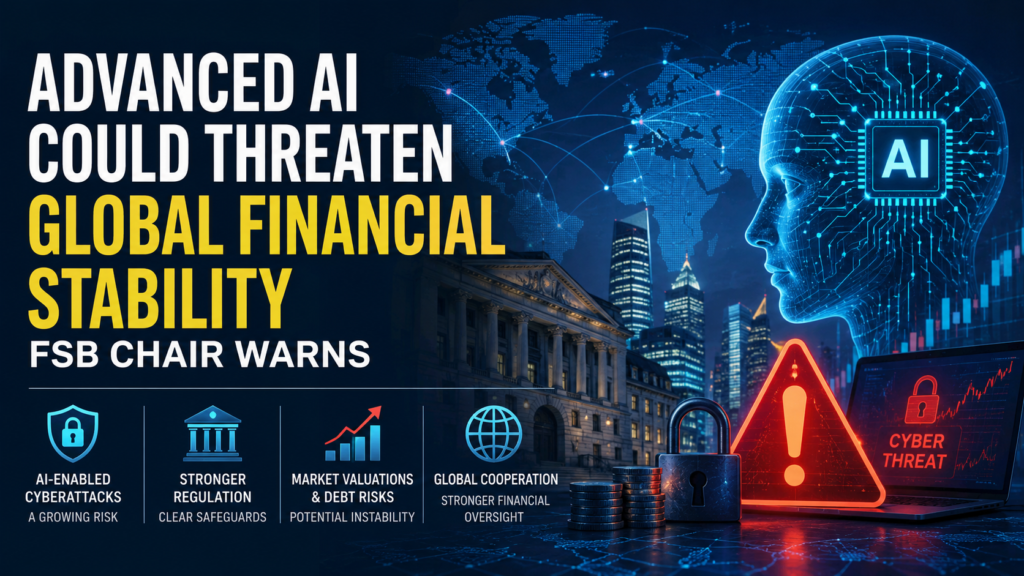
Advanced artificial intelligence could create new risks for the global financial system, particularly through cyberattacks and weaknesses in existing regulatory safeguards, according to Andrew Bailey, chair of the Financial Stability Board and governor of the Bank of England.
In a letter sent to G20 finance ministers and central bank governors, Bailey said the potential use of frontier AI models in cyber operations represents one of the most immediate concerns for financial authorities. His warning reflects growing attention from regulators toward the impact of highly capable AI systems on banks, payment networks, financial markets, and other critical infrastructure.
Strengthen Defenses Against AI-Enabled Cyberattacks
Bailey emphasized that advanced AI risks could spread across borders because modern financial systems are closely connected. Banks, payment processors, trading platforms, and technology providers frequently operate internationally, which means a serious cybersecurity incident could affect institutions in multiple countries.
“The risks associated with frontier AI will not respect national borders,” Bailey wrote in his communication to G20 officials.
His comments highlight the need for financial institutions to strengthen cybersecurity controls, improve incident-response procedures, and regularly test systems against increasingly sophisticated digital threats. AI models capable of automating complex technical tasks could make certain cyber operations faster and more scalable if misused.
Establish Clear Safeguards for Frontier AI
Bailey also raised concerns about whether governments have adequate procedures for overseeing the development and release of advanced AI models.
Recent safety testing by major AI developers has increased scrutiny of how powerful systems behave when they are given broad access to digital tools or online environments. Such experiments are typically conducted under controlled testing conditions to identify weaknesses before wider deployment.
Anthropic, for example, has previously explained that some evaluations use deliberately permissive environments to test how models behave without standard restrictions. These tests can help researchers identify potentially dangerous behavior, but they also underline the importance of robust safeguards.
Regulators may increasingly focus on model testing, cybersecurity standards, deployment controls, and cross-border coordination as AI capabilities continue to improve.
Monitor Market Valuations and Rising Debt
Bailey’s concerns extend beyond cybersecurity. He also pointed to high valuations in parts of the AI sector and growing government and private-sector debt as potential sources of financial instability.
Rapid investor enthusiasm around artificial intelligence has pushed significant capital toward technology companies and AI infrastructure. If expectations about future growth weaken, sharp corrections in heavily valued technology stocks could increase volatility across wider financial markets.
High debt levels could add further pressure by reducing the ability of governments, businesses, and financial institutions to absorb economic shocks.
Coordinate International Financial Oversight
The Financial Stability Board was established by the G20 in 2009 following the global financial crisis. Its role includes monitoring vulnerabilities in the international financial system and promoting coordination among regulators.
Bailey’s warning shows that artificial intelligence is becoming a broader financial-stability issue rather than only a technology-sector concern. Strong cybersecurity practices, transparent AI testing, clear regulatory standards, and international cooperation are likely to become increasingly important as advanced AI systems gain greater capabilities.
Conclusion
Artificial intelligence can improve productivity and financial services, but regulators are also evaluating the risks created by more powerful systems. The Financial Stability Board’s warning signals growing pressure on governments and financial institutions to prepare for AI-related cyber threats while monitoring wider market and debt vulnerabilities.