
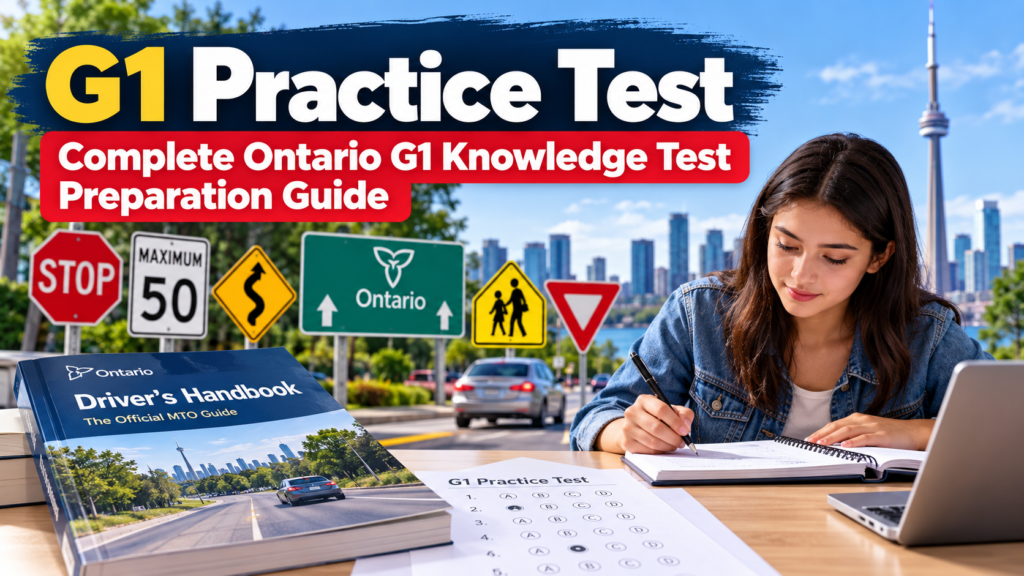
Preparing with a G1 practice test can help you become familiar with the road signs, traffic laws, right-of-way rules, and safe-driving principles covered by Ontario’s beginner driver knowledge test. However, practice questions are most effective when they are used alongside the Official Ministry of Transportation of Ontario Driver’s Handbook, which remains the primary source for learning the rules that apply to new drivers in Ontario.
The G1 knowledge test is the first major step in Ontario’s graduated licensing system. Passing it shows that you understand the basic laws and safety principles required before beginning supervised driving. A well-designed study plan should therefore do more than help you memorize answers. It should teach you how to recognize hazards, interpret signs, understand legal responsibilities, and apply Ontario driving rules to real-world situations.
This guide explains how to prepare for the G1 test, how practice tests should be used, which topics deserve the most attention, what mistakes new drivers commonly make, and how to build the knowledge needed for both the written test and your future driving experience.
Study the Official MTO Driver’s Handbook Before Taking Practice Tests
Begin your preparation by studying the Official MTO Driver’s Handbook. The Ontario Ministry of Transportation publishes this handbook to explain the road rules, signs, licensing requirements, and safe-driving principles that new drivers are expected to understand.
A G1 practice test can measure what you remember, but the handbook explains why a particular answer is correct. That distinction matters because the wording used by online practice-test providers may differ from the wording used on the actual knowledge test. If you only memorize practice questions, unfamiliar wording can make a familiar rule seem confusing.
Your first study sessions should cover traffic signs, pavement markings, traffic lights, intersections, right-of-way rules, lane changes, passing, parking, speed management, following distance, school buses, emergency vehicles, railway crossings, pedestrian safety, impaired driving, and G1 licence restrictions.
Whenever a practice-test answer seems unclear, check it against the official handbook rather than relying on discussion forums, social media posts, or outdated driving guides. Provincial driving regulations can change, and an official government source is more reliable than an unofficial explanation.
Using the handbook as your foundation also improves long-term driving knowledge. You are not simply preparing for an exam. You are learning rules that will affect how you make decisions when you begin driving under supervision.
Learn How the G1 Knowledge Test Is Structured
Understand the test structure before you begin serious practice. Knowing the types of questions you are likely to encounter allows you to organize your study sessions more effectively.
The Ontario G1 knowledge test uses multiple-choice questions covering two broad areas: road signs and rules of the road. Many G1 practice-test providers structure their mock exams around 40 questions, commonly divided into 20 sign questions and 20 road-rule questions.
Practice tests often use a target of 16 correct answers out of 20 in each section. This makes it useful to track your performance separately rather than focusing only on your total score.
| Study Area | Common Practice-Test Format | Skills You Need |
|---|---|---|
| Road signs | 20 questions | Identify signs and understand required actions |
| Rules of the road | 20 questions | Apply laws to common driving situations |
| Typical practice target | 16/20 per category | Maintain strong knowledge in both sections |
| Question format | Multiple choice | Recognize facts and apply rules to scenarios |
Separating your results is important. A learner might answer nearly every sign question correctly while struggling with right-of-way situations. Another learner might understand road rules but repeatedly confuse warning signs.
Track your scores in each category after every practice session. This gives you evidence of where your preparation is working and where additional review is needed.
Identify Ontario Road Signs by Shape, Colour, and Purpose
Learn road signs as a visual system rather than as a collection of unrelated images. Ontario signs communicate information using shapes, colours, symbols, lettering, and placement.
A stop sign is immediately recognizable because of its eight-sided shape and red background. A yield sign uses an inverted triangular shape. Many warning signs are diamond-shaped and use yellow backgrounds, while temporary construction-related warnings frequently use orange.
Understanding these visual patterns makes sign recognition faster. Even when you cannot immediately remember the exact wording of a sign, its shape and colour can tell you whether it is regulatory, cautionary, directional, or temporary.
| Sign Type | Common Appearance | Driver Response |
|---|---|---|
| Regulatory | Usually white, red, black, or green | Follow a legal instruction or restriction |
| Warning | Commonly yellow and diamond-shaped | Slow down and prepare for a hazard |
| Temporary conditions | Often orange | Adjust for construction or temporary hazards |
| Directional information | Often green or blue | Follow route, destination, or service information |
| School-area signs | Distinctive shapes and symbols | Watch carefully for children and crossings |
Regulatory signs deserve special attention because they frequently indicate actions drivers are legally required to follow. These can include stop requirements, turning restrictions, speed limits, parking restrictions, lane directions, and prohibited movements.
Warning signs do not necessarily require a specific action such as stopping, but they tell you that road conditions may change. A curve sign, lane-ending sign, pedestrian warning, or slippery-road sign tells you to adjust your attention and speed.
During your G1 practice test preparation, do not stop at naming the sign. Ask yourself what you would do after seeing it while driving. That extra step develops the decision-making ability that will eventually matter behind the wheel.
Group Similar Signs Together to Avoid Confusion
Compare signs with similar designs so you can recognize the small differences between them. Learners often lose marks because they identify the general meaning of a sign but confuse it with another sign in the same category.
For example, signs warning that a lane ends can resemble signs showing that a roadway becomes narrower. Pedestrian warnings can look similar to school-related crossings. Divided-highway-begins and divided-highway-ends signs can also be confusing if you rely only on the general image.
Create study groups based on similar concepts. Review all lane-change signs together, all pedestrian-related signs together, all railway signs together, and all turn-restriction signs together.
Pay attention to supplementary panels as well. A smaller panel beneath a sign may show the hours when a restriction applies, the distance to a hazard, an advisory speed, or a specific category of vehicle affected by the rule.
The more precisely you study these differences, the less likely you are to make an error simply because two signs share similar symbols.
Master Right-of-Way Rules at Intersections
Spend significant study time on right-of-way questions because these scenarios require you to apply several rules at once.
Right-of-way decisions may involve stop signs, traffic signals, pedestrians, vehicles making left turns, vehicles entering from private driveways, uncontrolled intersections, and emergency vehicles. A correct answer depends on understanding which road user has priority under the circumstances.
For example, a driver entering a road from a private driveway must yield to traffic already using the roadway. A driver turning left must also consider oncoming vehicles and pedestrians before completing the turn.
Four-way stops require especially careful attention. Drivers must make a complete stop and then determine who should proceed based on the applicable right-of-way rules. If vehicles arrive at approximately the same time, additional priority rules determine the correct order.
Do not answer these questions from instinct alone. During practice, mentally reconstruct the intersection. Identify the traffic controls, determine the direction each vehicle is travelling, identify any pedestrians, and then decide who must wait.
This approach takes longer at first, but repetition makes the reasoning automatic.
Practice Lane Changes in the Correct Sequence
Memorize the safe sequence for changing lanes because lane-change questions combine observation, signalling, positioning, and judgment.
A driver should first check surrounding traffic, use mirrors, activate the appropriate signal, check the blind spot, and move only when there is enough space to complete the manoeuvre safely.
Blind-spot checks are especially important. Mirrors do not show every area beside and behind a vehicle. A motorcycle, bicycle, or another vehicle may be positioned where it cannot be seen through the mirrors alone.
A signal also does not give you the right to enter another lane. Signalling communicates your intention to other road users, but you are still responsible for ensuring the movement can be completed safely.
G1 practice-test questions sometimes present several actions and ask which should happen first. When answering these questions, remember that safe observation must occur throughout the manoeuvre, not only at one point.
These habits eventually become essential during road testing, so learning the correct process during G1 preparation provides an advantage later in the licensing process.
Learn Safe Passing Rules Before Answering Passing Questions
Study both sides of a passing situation. You need to understand when passing another vehicle is permitted and how to respond when another vehicle is attempting to pass you.
A safe passing manoeuvre requires enough visibility, appropriate road markings, sufficient distance, and awareness of traffic ahead and behind. Passing is not safe simply because the vehicle in front is moving slowly.
When another driver is passing you, avoid actions that interfere with the manoeuvre. Increasing speed to prevent another vehicle from passing can create a dangerous situation.
Road markings are particularly important. Solid and broken lines communicate whether passing may be restricted or permitted under certain conditions. Curves, hills, intersections, railway crossings, and other reduced-visibility locations may also affect whether passing is safe.
Practice questions often test whether you recognize the safest action rather than simply whether you remember a definition. Read the entire scenario before selecting an answer.
Review Turning Rules and Proper Lane Position
Study how to position your vehicle before, during, and after a turn. Incorrect lane positioning can create conflicts with vehicles, cyclists, and pedestrians.
Right turns should generally begin and end in the appropriate right-hand lane unless signs or lane markings indicate otherwise. Left turns require particular attention because the driver may need to cross opposing traffic.
Before turning, signal early enough to communicate your intention, reduce speed appropriately, check mirrors and surrounding traffic, watch for pedestrians and cyclists, and enter the correct lane.
Turning from or onto a one-way street requires additional knowledge. Lane selection may differ from ordinary two-way roads, so practice these situations using diagrams.
You should also understand U-turn restrictions. A U-turn should only be performed when it is legal, visibility is sufficient, and the movement can be completed safely without interfering with other road users.
Memorize the Two-Second Following Rule
Use the two-second rule as the foundation for learning safe following distance under ideal conditions.
Choose a fixed object ahead, such as a sign or utility pole. When the vehicle in front passes the object, begin counting. Your vehicle should not reach the same point until at least two seconds have passed under good driving conditions.
This time-based method works better than estimating distance in metres because your stopping requirements change with speed.
However, two seconds should not be treated as sufficient in every situation. Rain, snow, ice, darkness, poor visibility, heavy traffic, larger vehicles, motorcycles, and other hazards can require additional following distance.
The principle behind the rule matters more than memorizing the number. A larger space gives you additional time to notice hazards, react, and brake safely.
Questions about following distance often test whether you understand that changing conditions require changing behaviour.
Adjust Speed to Match Road and Weather Conditions
Understand that the posted speed limit represents the maximum legal speed under appropriate conditions, not a guarantee that travelling at that speed is always safe.
Weather, traffic, road construction, visibility, road surface conditions, pedestrians, and unexpected hazards can require you to reduce speed below the posted limit.
For example, a road may have a posted limit that is reasonable during clear daylight but unsafe during heavy rain or snow. A responsible driver adjusts speed based on the actual conditions.
This principle appears throughout defensive-driving education because speed affects stopping distance, vehicle control, and the severity of collisions.
When answering G1 practice-test questions about speed, consider both the legal requirement and the surrounding conditions described in the question.
If a scenario involves limited visibility, slippery pavement, construction, children, pedestrians, or heavy traffic, the safest lawful response may involve reducing speed even when you are already below the posted maximum.
Learn Traffic-Light Rules Beyond Basic Colours
Study the meaning of traffic lights in realistic situations rather than stopping at “red means stop” and “green means go.”
A green light allows you to proceed only when the intersection is clear and the movement can be completed safely. Pedestrians and other traffic may still affect whether you can proceed.
A yellow light warns that the signal is changing. Your response should depend on whether you can stop safely. Accelerating simply to enter the intersection before the light changes is unsafe.
A red light requires a complete stop. Rules about turning at a red light depend on the intersection, signage, and direction of travel.
You should also study advanced green arrows, flashing lights, pedestrian signals, lane-control signals, and traffic lights that are not operating normally.
Traffic signals work together with signs and pavement markings. When answering a diagram-based question, examine every control shown rather than focusing on only the signal colour.
Read Road Markings Together With Traffic Signs
Treat road markings as traffic-control instructions. Lane lines, arrows, stop lines, crosswalks, centre lines, bicycle markings, and painted symbols all provide information about how you should position and operate your vehicle.
White lines commonly separate traffic moving in the same direction, while yellow lines generally separate traffic moving in opposite directions. Solid and broken lines provide additional information about whether lane changes or passing movements may be restricted.
Lane arrows tell you which movements are permitted from a particular lane. A driver in a left-turn-only lane should not continue straight merely because traffic ahead appears clear.
Stop lines indicate where your vehicle should stop at an intersection. Crosswalk markings identify areas where pedestrians may cross.
Practice reading several road markings at once. Real roads frequently present multiple instructions simultaneously.
Study School Bus Rules Carefully

Give school-bus questions extra attention because they involve vulnerable road users and strict legal responsibilities.
When a school bus is stopped with its required warning signals operating, drivers may be required to stop depending on the road configuration and their direction of travel. A divided roadway can affect how the rule applies.
This is an area where memorizing an oversimplified statement can lead to mistakes. Study the official rule carefully and pay attention to whether a median separates opposing traffic.
You should also recognize school-zone signs, school-crossing signs, and warnings about locations where school buses may stop.
Whenever children may be present, reduce speed, increase observation, and be prepared for unpredictable movement.
Review Pedestrian and Bicycle Safety Rules
Learn how drivers must interact with pedestrians and cyclists because these road users have less physical protection than someone inside a vehicle.
Pedestrians may appear at controlled intersections, crosswalks, school crossings, driveways, parking lots, and locations without traffic lights. Drivers must remain alert and follow applicable yielding and stopping requirements.
Cyclists may travel beside motor vehicles, use designated bicycle lanes, or move through intersections. Always check mirrors and blind spots before turning or changing lanes.
Opening a vehicle door can also create a hazard for passing cyclists. Safe observation is therefore necessary even when a vehicle is parked.
Many G1 questions involving pedestrians or cyclists are designed to test whether you recognize potential hazards before they become emergencies.
Prepare for Railway Crossing Questions
Approach railway-crossing questions with a safety-first mindset.
Railway warning signs, flashing lights, bells, gates, and pavement markings indicate that drivers must be prepared to stop. Never drive around a lowered gate or ignore active warning signals.
Even when no train is immediately visible, limited sight distance can make assumptions dangerous.
Some vehicles may be subject to additional stopping requirements at railway crossings, so learn the rules described in the official handbook.
Railway questions often reward cautious decision-making. Trains require much more distance to stop than road vehicles, which means motorists must avoid taking risks when approaching tracks.
Understand Emergency Vehicle Procedures
Review what to do when an emergency vehicle approaches with lights, sirens, or other warning equipment activated.
Drivers must respond in a way that creates a safe path for emergency vehicles. The precise action depends on the roadway and surrounding traffic.
Avoid sudden movements that could create another hazard. Check mirrors, signal when appropriate, and position the vehicle according to Ontario requirements.
You should also study rules that apply when approaching stopped emergency or roadside service vehicles displaying flashing lights.
These situations test your ability to combine legal knowledge with awareness of other road users.
Memorize G1 Licence Restrictions
Know the restrictions that apply after you pass the knowledge test and receive a G1 licence.
The G1 stage is designed for supervised learning. A G1 driver must follow several restrictions that do not apply in the same way to fully licensed drivers.
Important areas to study include:
- the requirement for an eligible accompanying driver
- zero blood-alcohol requirements
- passenger seatbelt requirements
- restrictions on driving during certain overnight hours
- restrictions involving certain high-speed highways
- rules governing who may sit in the front passenger seat
The accompanying driver normally needs a valid full licence and the required amount of driving experience. The supervising driver must also meet applicable alcohol-related requirements.
Do not treat these rules as test-only material. They apply to your actual driving after obtaining a G1 licence.
Take Your First G1 Practice Test as a Diagnostic
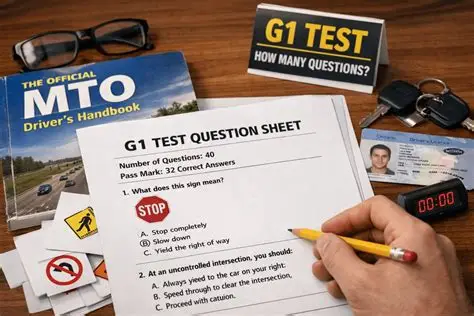
Use your first full practice test to find weaknesses rather than to prove that you are ready.
Answer every question without looking up the correct response. After finishing, divide your mistakes into categories.
Your categories might include:
- regulatory signs
- warning signs
- right-of-way
- intersections
- lane changes
- speed
- following distance
- parking
- pedestrians
- school buses
- railway crossings
- G1 restrictions
This method turns a practice-test score into useful study data.
For example, scoring 34 out of 40 may look strong, but the result means something different if all six incorrect answers came from road signs than if they were spread evenly across several topics.
Your goal is to find patterns, not merely to achieve a high score.
Review Every Incorrect Answer Before Retesting
Do not immediately take another test after finishing one.
First, review every incorrect answer. Find the corresponding rule in the official handbook and make sure you understand why your selected answer was wrong.
A useful review process includes three questions:
- What is the correct answer?
- Which Ontario driving rule supports that answer?
- Why was my original choice incorrect?
This method promotes active learning.
Suppose you answer a following-distance question incorrectly. Rather than memorizing the correct option, review how following distance relates to reaction time, braking distance, weather, and visibility.
When another question presents the same principle in different wording, you will still know how to answer it.
Repeat Practice Tests Until Your Scores Stay Consistent
Use multiple practice tests because one high score does not necessarily demonstrate mastery.
You may encounter questions you have already seen, which can inflate your score through recognition rather than genuine understanding.
Consistent performance across different question sets is more meaningful.
Aim to reach a point where you can explain the rule behind each answer. If you cannot explain why an answer is correct, that topic deserves additional review even if you selected the correct option.
Also avoid memorizing the position of answers. Knowing that “B” was correct on a particular website will not help you when the same principle appears in a different format.
Practice should build flexible knowledge.
Follow a Seven-Day G1 Practice Test Study Plan
A structured week of preparation can help you cover the major topics without relying on last-minute studying.
| Day | Study Area | Main Goal |
|---|---|---|
| Day 1 | Official handbook overview | Learn licensing basics and major road rules |
| Day 2 | Road signs | Recognize signs by shape, colour, and meaning |
| Day 3 | Intersections and right-of-way | Solve traffic scenarios correctly |
| Day 4 | Speed, passing, following, parking | Strengthen everyday road-rule knowledge |
| Day 5 | Full G1 practice test | Identify weak areas |
| Day 6 | Targeted revision | Correct recurring mistakes |
| Day 7 | Final mixed practice | Confirm consistent understanding |
On Day 1, read the relevant handbook material carefully. Avoid trying to memorize everything in one sitting.
On Day 2, use visual repetition for signs. Group similar signs and quiz yourself without looking at labels.
On Day 3, draw intersection diagrams. Physically tracing vehicle movements can make right-of-way rules easier to understand.
Day 4 should focus on common road situations such as passing, changing lanes, following vehicles, stopping, and parking.
Use Day 5 as an assessment. Complete a full practice test under distraction-free conditions.
On Day 6, study only the subjects causing mistakes.
Use Day 7 for final reinforcement rather than attempting to learn large amounts of new information.
Prepare Your Identification Before Going for the Test
Check Ontario’s current identification requirements before visiting a testing location.
Applicants generally need acceptable original identification showing their legal name and date of birth. Accepted documents can depend on citizenship or immigration status.
Because documentation rules can be updated, verify the requirements through an official Ontario government or DriveTest source shortly before your visit.
You should also bring corrective lenses if you require them for vision testing or driving.
Checking documentation in advance prevents avoidable delays. Knowledge preparation does not help if you arrive without acceptable identification.
Arrive With Enough Time to Complete the Knowledge Test
Plan your test visit carefully.
Knowledge testing may be available at DriveTest locations, but service procedures, business hours, and appointment requirements can vary by location or testing option.
Check official information before travelling.
Arriving near closing time can create unnecessary pressure even when the knowledge test itself is not treated like a strict timed classroom exam.
Give yourself enough time for registration, identification checks, vision screening, payment, and testing.
A calm test-day routine can help you concentrate on the questions instead of administrative details.
Read Every Question Slowly Before Selecting an Answer
Use disciplined reading during the actual G1 test.
Words such as must, first, except, never, before, and best can completely change what a question is asking.
Read all answer choices even when the first option appears correct.
Eliminate answers that clearly conflict with safe-driving principles or Ontario rules, then compare the remaining choices carefully.
Diagram questions deserve extra attention. Check lane markings, signs, traffic signals, vehicle direction, pedestrians, and road configuration.
Avoid answering from memory of a similar practice question if the current question contains different details.
Choose the Safest Legal Response in Scenario Questions
When several answers appear possible, identify the response that follows both Ontario law and safe-driving principles.
Unsafe responses often involve unnecessary speed, aggressive driving, ignoring hazards, failing to signal, or assuming another road user will move out of the way.
For example, preventing another vehicle from passing by increasing speed is not a safe response. Entering an intersection without enough room to clear it can also create a hazard even if your traffic light is green.
The strongest answers usually involve observation, adequate space, proper signalling, yielding when required, and controlling speed.
Understanding this general pattern helps with unfamiliar questions, but it should supplement rather than replace knowledge of the actual rules.
Avoid Memorizing Unofficial Answer Banks
Use caution with websites claiming to provide the “exact” questions from the real G1 exam.
Ontario’s official test content can be updated, and unofficial websites may contain outdated, inaccurate, or simplified information.
A trustworthy G1 practice resource should help you understand the rule rather than imply that you only need to memorize a fixed list of questions.
Use official Ontario sources to verify important rules, especially when different websites give conflicting answers.
This is one of the most important trust signals when preparing online. The quality of your preparation depends on the reliability of the information you are studying.
Continue Learning After Passing the G1 Test
Passing the G1 knowledge test does not mean you have completed driver education.
It means you have demonstrated enough theoretical knowledge to begin gaining supervised driving experience under Ontario’s graduated licensing system.
During the G1 stage, connect your handbook knowledge with real driving situations.
Practice observing intersections before entering them. Learn to check mirrors routinely. Develop consistent shoulder-check habits. Maintain proper following distance. Watch for pedestrians and cyclists. Learn smooth acceleration and braking.
The knowledge test introduces the rules. Supervised driving teaches you how to apply those rules consistently under changing conditions.
If you complete an approved beginner driver education program, it may also affect how soon you become eligible to progress to the next licensing stage under Ontario’s current graduated licensing rules.
Always verify current eligibility periods and requirements through official provincial sources before scheduling future road tests.
Use Official Sources to Verify G1 Information
Prioritize information published by the Government of Ontario, the Ministry of Transportation, and DriveTest.
These sources provide the strongest authority for licensing requirements, driver restrictions, road rules, identification requirements, testing procedures, and official handbook material.
Unofficial practice-test websites can still be useful for repetition and self-assessment, but they should not override official information.
A practical reliability hierarchy looks like this:
- Ontario Ministry of Transportation and Ontario.ca
- Official MTO Driver’s Handbook
- DriveTest information
- Approved driver education providers
- Reputable practice-test platforms
- Forums, social media posts, and personal anecdotes
The further you move down this list, the more important independent verification becomes.
This approach is especially useful when researching rules that may have changed over time.
Build Real Test Readiness Instead of Chasing a Perfect Score
Measure readiness by understanding, not by whether you can achieve 100 percent on one practice site.
You are in a stronger position when you can answer a question correctly and explain the reason behind your choice.
For example, it is better to understand why extra following distance is needed in poor weather than simply to remember the answer to one rainy-road question.
The same principle applies to signs. Recognizing that a yellow diamond-shaped sign warns about a potential hazard gives you knowledge that transfers to many individual signs.
A learner who understands systems and patterns is better prepared for unfamiliar wording.
That is exactly what effective G1 practice should accomplish.
Frequently Asked Questions About the G1 Practice Test
How many questions are on a G1 practice test?
Many Ontario G1 practice tests use 40 multiple-choice questions, commonly divided into 20 road-sign questions and 20 road-rule questions. Practice platforms frequently use 16 correct answers out of 20 in each category as the target.
The actual test should always be prepared for using current official Ontario guidance rather than relying entirely on the structure of a third-party mock test.
What should I study for the Ontario G1 test?
Study the Official MTO Driver’s Handbook, with particular attention to traffic signs, road markings, intersections, right-of-way, traffic signals, speed, following distance, lane changes, passing, parking, pedestrians, school buses, railway crossings, emergency vehicles, and G1 restrictions.
Practice tests should then be used to identify which of these areas need additional review.
Is the G1 test difficult?
Difficulty depends largely on preparation.
Learners who understand the handbook and consistently complete practice questions usually find the test more manageable than learners who rely on memorizing isolated answers.
Questions become easier when you understand the rule behind the situation being described.
How many G1 practice tests should I take?
There is no fixed number that guarantees success.
Continue practicing until your scores remain consistently strong across different question sets and you can explain the reasoning behind your answers.
Three carefully reviewed practice tests may be more useful than 20 tests completed without studying mistakes.
Can I pass the G1 test by only doing practice tests?
Relying only on practice tests is not recommended.
Practice tests are useful for checking knowledge, but the Official MTO Driver’s Handbook provides the underlying rules and explanations.
Combining handbook study with repeated practice gives you a stronger preparation method.
What happens after I pass my G1 test?
After meeting Ontario’s applicable licensing, identification, vision, and knowledge-test requirements, you enter the G1 stage of the graduated licensing system.
You must follow G1 restrictions and gain supervised driving experience before becoming eligible to progress toward a G2 licence.
Check current Ontario requirements before scheduling your next licensing step because eligibility periods and administrative procedures can change.
Conclusion
A G1 practice test is one of the most useful tools for preparing for Ontario’s beginner driver knowledge exam, but it works best as part of a complete study process.
Start with the Official MTO Driver’s Handbook. Learn traffic signs by shape, colour, and purpose. Understand intersection and right-of-way rules instead of memorizing individual scenarios. Review speed management, following distance, lane changes, passing, pedestrians, school buses, railway crossings, traffic signals, road markings, and G1 licence restrictions.
Then use practice tests to measure your understanding.
Every incorrect answer should lead you back to the official rule. Every repeated mistake should become a priority study topic. Every high score should be confirmed through a different set of questions rather than treated as proof that preparation is finished.
The goal is not simply to memorize enough answers to pass the G1 knowledge test. The goal is to build reliable knowledge that you can apply during supervised driving and throughout Ontario’s graduated licensing process.
When official information and unofficial practice material disagree, rely on the current guidance published by Ontario’s Ministry of Transportation, Ontario.ca, or DriveTest. That combination of authoritative study material, active practice, error review, and real understanding gives you the strongest foundation for approaching the G1 test with confidence.