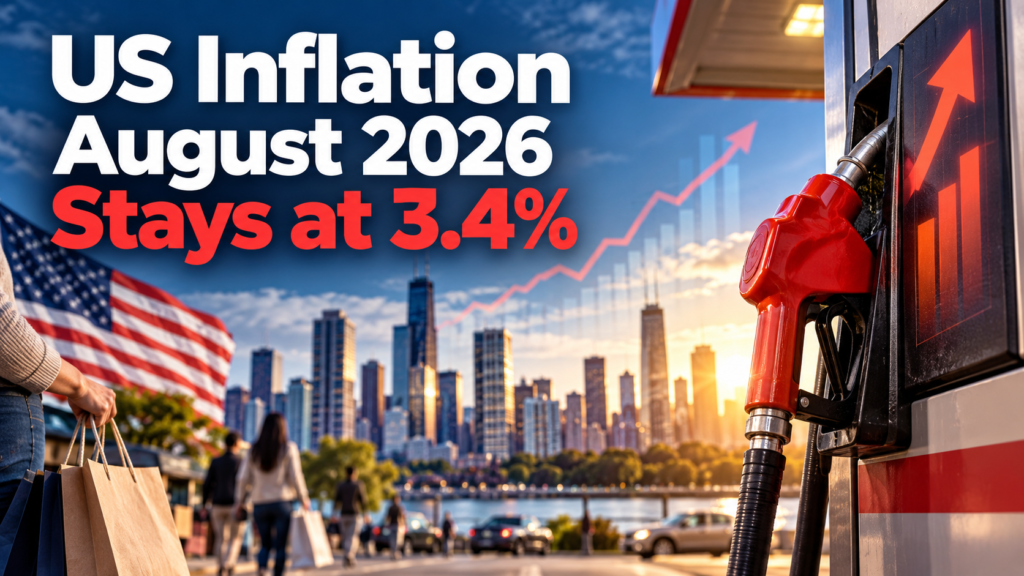
US inflation remained elevated in August 2026, with higher energy costs adding pressure to household budgets even as revised federal data showed price growth was lower than previously estimated. The latest figures provide a more measured picture of inflation while highlighting continued challenges for consumers and Federal Reserve policymakers.
According to data from the US Commerce Department’s Bureau of Economic Analysis (BEA), the Personal Consumption Expenditures (PCE) price index rose 0.3% in August and 3.4% from a year earlier. The PCE index is closely watched because it is the Federal Reserve’s preferred measure for tracking inflation.
Review the Latest US Inflation Figures
Energy prices contributed to the monthly increase as the Iran war disrupted energy markets and pushed fuel costs higher.
Core PCE, which removes volatile food and energy prices to provide another view of underlying inflation trends, increased 0.2% from July. The annual core inflation rate remained at a downwardly revised 3% for the third consecutive month.
Both headline and core inflation therefore remained above the Federal Reserve’s longer-run 2% inflation goal.
| Economic Measure | August 2026 |
|---|---|
| Annual PCE inflation | 3.4% |
| Monthly PCE inflation | 0.3% |
| Annual core PCE | 3.0% |
| Real consumer spending | +0.6% |
| Personal saving rate | 4.1% |
Account for Revised Federal Inflation Data
The latest figures also included important revisions resulting from the BEA’s annual update of economic statistics.
July’s annual PCE inflation rate was revised from 3.7% to 3.4%, while core inflation was revised from 3.3% to 3%. Changes to source data covering investment services, legal services, computer software and related categories contributed to the revisions.
Oliver Allen, senior US economist at Pantheon Macroeconomics, told CNN that recent inflation momentum appeared less concerning after the updated figures. However, revisions do not eliminate current price pressures, particularly those affecting energy.
Monitor Consumer Spending and Household Savings
Consumers continued supporting economic activity despite elevated prices. Inflation-adjusted spending increased 0.6% in August, the strongest monthly increase in more than a year.
At the same time, the personal saving rate declined to 4.1%, a nearly four-year low.
Nationwide chief economist Kathy Bostjancic said households facing higher prices have been reducing savings or relying more on credit. She also identified labor-market strength as an important factor supporting spending.
These figures suggest consumers remain active, but falling savings could make current spending growth harder to maintain.
Compare Spending Growth With Household Income
Income data provides another important measure of household financial conditions.
Personal income increased 0.2% in August, while disposable income rose 0.3%. After adjusting for inflation, disposable personal income was unchanged.
PNC Financial Services Group chief economist Gus Faucher told CNN that spending has grown faster than income during recent years and cautioned that this pattern is not sustainable indefinitely.
Conclusion
US PCE inflation held at 3.4% in August 2026, while core inflation remained at 3%. Revised government data indicates inflation has been somewhat cooler than earlier estimates suggested, but energy costs continue to create pressure. Strong spending remains supportive of the economy, while lower savings and stagnant inflation-adjusted disposable income are key indicators to watch.
Frequently Asked Questions
What was US PCE inflation in August 2026?
Annual PCE inflation was 3.4%, according to BEA data.
What was core inflation?
Core PCE inflation was 3% annually.
Why did prices rise during August?
Higher energy and fuel prices contributed to monthly inflation.
Is consumer spending still growing?
Yes. Real consumer spending increased 0.6% during August.
Why does the Federal Reserve watch PCE inflation?
The PCE index provides broad coverage of consumer prices and is the Fed’s preferred inflation measure.