
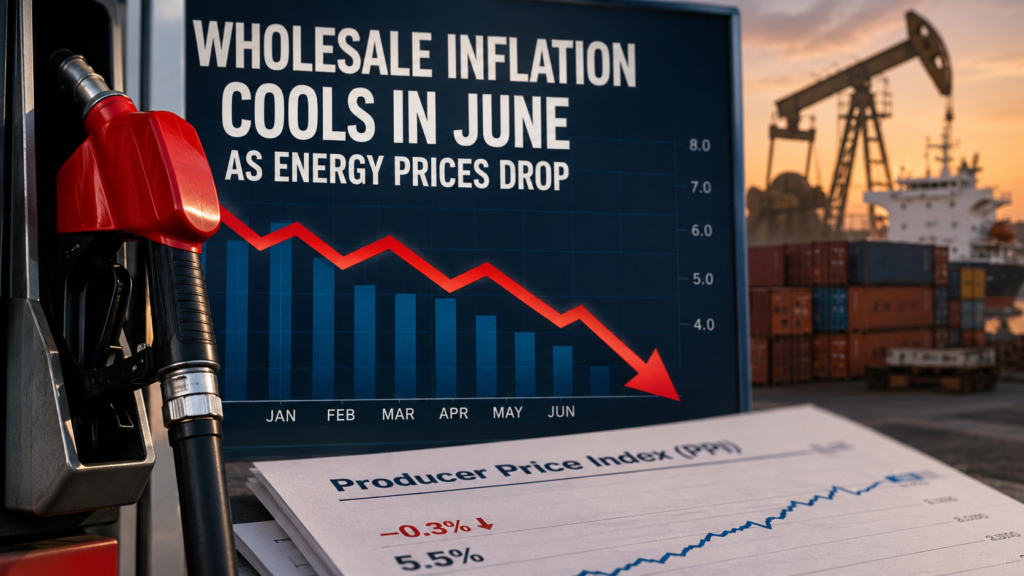
Wholesale inflation eased in June, giving businesses a welcome break after months of elevated costs. Fresh figures from the US Bureau of Labor Statistics (BLS) showed producer prices cooled as falling gasoline prices pulled down overall wholesale costs. While the latest report points to improving inflation trends, renewed geopolitical tensions and rising technology expenses suggest the relief could prove temporary.
Energy Prices Drive Wholesale Inflation Lower
The Producer Price Index (PPI), which measures prices businesses receive for their goods and services, rose 5.5% from a year earlier in June, down from a revised 6% in May. On a monthly basis, producer prices fell 0.3% after increasing 0.6% the previous month.
The improvement was driven by a 1.4% decline in goods prices, the steepest drop in four years. Gasoline prices fell 12%, accounting for roughly two-thirds of the overall decrease in wholesale prices. Core PPI, which excludes food and energy, slowed to 4.6% from 4.9%. According to the Bureau of Labor Statistics, energy products represent roughly 6.5% of the Producer Price Index by relative importance, underscoring how swings in fuel costs can have an outsized effect on monthly inflation readings.
Businesses Face Fresh Inflation Risks
Lower fuel costs reduced cost pressures for many businesses in June, but that advantage may be short-lived. Renewed military strikes involving the United States and Iran have disrupted oil flows from the Persian Gulf, raising concerns that higher crude prices could feed into inflation over the coming months.
Following the release of the previous day’s Consumer Price Index report, Federal Reserve Chairman Kevin Warsh cautioned against drawing broad conclusions from a single reading, saying, “It’s one data point.” His remarks were made during his semiannual testimony to Congress and reflected a broader warning against assuming inflation has been fully brought under control. Industry observers also note that sustained increases in energy prices could eventually translate into higher costs for businesses and consumers.
AI Demand Adds to Cost Pressures
Energy is not the only source of inflationary pressure. Strong demand for artificial intelligence infrastructure continues to tighten the semiconductor market, contributing to a 2.5% monthly increase in prices for computers and computing equipment.
Apple has announced price increases of 10% to 15% on selected products, citing memory chip shortages, and other electronics manufacturers are expected to follow. As noted by GrowBusinessMag, these supply chain pressures could offset some of the recent gains from lower energy prices if component costs remain elevated.
June’s wholesale inflation report offers encouraging signs that producer price pressures can ease when energy costs retreat. However, with oil markets facing renewed uncertainty and technology-related expenses continuing to climb, the coming months will determine whether June’s improvement marks the beginning of a lasting trend or only a temporary pause.