Building a successful software business is no longer about selling one-time licenses. The biggest technology companies increasingly rely on recurring subscriptions, and Google Workspace is a prime example of that shift. What started as a collection of cloud-based productivity tools has grown into one of Google’s most important enterprise offerings, serving organizations that depend on real-time collaboration every day.
Understanding the google workspace business model reveals how Google has expanded beyond digital advertising into a stable, subscription-driven business. By combining productivity software with cloud infrastructure, AI capabilities, and enterprise security, Google has created a platform that generates recurring revenue while encouraging customers to adopt more of its business services.
This article explores the google workspace business model, explains its pricing strategy, breaks down its major revenue streams, compares it with Microsoft 365, and examines why it continues to attract businesses of every size.
What Google Workspace Is and How It Fits Into Google’s Broader Business
Google Workspace is Google’s cloud-based productivity and collaboration suite designed for businesses, educational institutions, nonprofits, and government organizations. It brings together communication, document creation, cloud storage, video conferencing, scheduling, and administrative controls within a single platform.
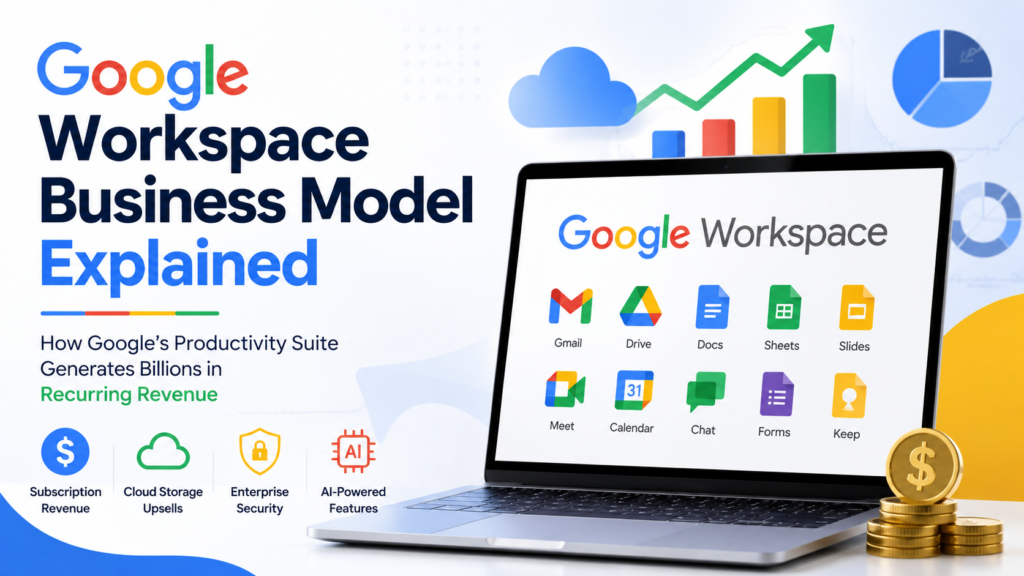
Its core applications include Gmail, Google Drive, Docs, Sheets, Slides, Meet, Calendar, Chat, Forms, Sites, and Keep. Unlike Google’s free consumer services, Workspace offers business-grade administration, enhanced security, custom email domains, compliance capabilities, and centralized user management.
The google workspace business model supports Google’s broader strategy of expanding recurring enterprise revenue beyond advertising. Subscription income provides greater revenue stability while strengthening customer relationships across Google’s cloud ecosystem.
Google Workspace also acts as an entry point to other Google Cloud services. Businesses that adopt Workspace frequently expand into cloud infrastructure, identity management, AI tools, and security solutions, increasing long-term customer value.
According to Google’s official Workspace website, millions of businesses use premium versions of Gmail, Drive, Meet, Calendar, and related applications, highlighting the platform’s broad enterprise adoption.
Understanding the Google Workspace Ecosystem
Google Workspace is designed as an integrated cloud platform rather than a collection of standalone applications.
Communication
Gmail, Google Meet, and Google Chat allow employees to communicate through email, messaging, and video meetings without leaving the Workspace environment.
Collaboration
Google Docs, Sheets, and Slides enable multiple users to edit files simultaneously, making teamwork faster while reducing version-control issues.
Storage
Google Drive provides centralized cloud storage where teams can securely organize, access, and share business files from virtually any device.
Administration
IT administrators can manage user accounts, devices, permissions, security policies, and data retention from a centralized administration console.
These enterprise capabilities distinguish paid Workspace subscriptions from Google’s free consumer offerings.
The Subscription/Tiered Pricing Model Explained
The foundation of the google workspace business model is a Software-as-a-Service (SaaS) subscription model.
Instead of selling perpetual software licenses, Google charges organizations monthly or annually for each licensed user. This approach creates predictable recurring revenue while allowing customers to increase or reduce subscriptions as their workforce changes.
Business Starter
Designed for startups and small businesses, this plan includes professional Gmail, collaboration tools, Google Meet, and cloud storage.
Business Standard
This tier expands storage capacity while adding meeting recording, enhanced collaboration features, and support for larger meetings.
Business Plus
Business Plus introduces advanced security, endpoint management, compliance capabilities, and additional storage.
Enterprise Plans
Enterprise customers receive premium administration tools, expanded storage, enhanced security, compliance controls, identity management, and dedicated support.
Industry analysts note that tiered pricing benefits both customers and software providers because organizations can begin with lower-cost plans and upgrade as operational needs become more complex. This flexibility is a defining strength of the google workspace business model.
Revenue Streams: Subscriptions, Storage Upsells, and Enterprise Add-ons
Although subscriptions remain the primary revenue source, the google workspace business model generates income through several complementary services.
Subscription Revenue
Monthly and annual user subscriptions form the core of Workspace’s recurring revenue. As businesses hire additional employees, subscription income naturally grows.
Storage Upsells
Organizations that exceed included cloud storage limits can purchase additional capacity for large documents, media files, archives, and collaborative projects.
Enterprise Security
Many larger organizations purchase premium capabilities such as Vault, Data Loss Prevention, advanced endpoint management, compliance features, and security monitoring.
AI Features
Google continues integrating AI throughout Workspace, allowing users to draft emails, summarize meetings, generate presentations, and streamline repetitive tasks. These premium capabilities represent an expanding monetization opportunity.
Google Cloud Cross-Selling
Workspace frequently serves as a gateway into Google’s wider enterprise portfolio, including Google Cloud Platform, identity management, cybersecurity, and AI infrastructure.
Why Businesses Choose Google Workspace
Several competitive advantages continue to drive Workspace adoption.
Simplicity
Its interface is intuitive, reducing training time for new users.
Real-Time Collaboration
Teams can edit documents simultaneously, making collaboration more efficient.
Cloud-Native Design
Workspace runs primarily through a web browser, allowing employees to work across multiple devices without relying heavily on installed software.
Scalability
Organizations can quickly add or remove users as staffing needs change.
Security
Google continues investing in encryption, multi-factor authentication, administrative controls, and threat detection to help organizations protect sensitive business data.
These capabilities contribute to the long-term success of the google workspace business model by improving customer retention.
Customer Segments That Power Growth
Google Workspace serves a wide range of organizations.
Small Businesses
Affordable pricing makes Workspace accessible to startups and entrepreneurs.
Mid-Sized Companies
Growing organizations benefit from centralized administration and collaborative workflows.
Large Enterprises
Global organizations value scalability, compliance tools, and enterprise-grade security.
Education
Schools and universities rely on Workspace to support communication and collaborative learning.
Nonprofits
Eligible nonprofit organizations can access specialized plans that help reduce operating costs.
Serving diverse customer segments reduces reliance on any single market while supporting sustainable growth.
How Google Workspace Competes With Microsoft 365
Google Workspace and Microsoft 365 remain the dominant productivity platforms, but each follows a different strategy.
Google emphasizes browser-based collaboration and cloud-native workflows, while Microsoft continues leveraging its long-established desktop software ecosystem alongside cloud services.
Google Workspace stands out for real-time collaboration, streamlined deployment, and seamless integration across Google’s services. Microsoft 365 continues to appeal to organizations that depend on desktop Office applications, advanced Excel functionality, Windows integration, and offline productivity.
Rather than competing solely on pricing, the google workspace business model focuses on simplicity, collaboration, and deep integration with Google’s cloud ecosystem.
Google Workspace vs Microsoft 365
| Feature | Google Workspace | Microsoft 365 |
|---|---|---|
| Primary Approach | Cloud-first | Desktop + Cloud |
| Collaboration | Excellent real-time editing | Strong collaboration |
| Gmail | Outlook | |
| Storage | Google Drive | OneDrive |
| Video Meetings | Google Meet | Microsoft Teams |
| Office Apps | Browser-first | Desktop-first |
| AI Integration | Gemini-powered features | Microsoft Copilot |
| Best For | Cloud-native organizations | Microsoft ecosystem users |
Key Strengths of the Google Workspace Business Model
Several factors support its long-term growth.
Recurring Revenue
Subscription billing creates predictable cash flow.
High Customer Retention
Switching productivity platforms often involves migration costs, employee training, and workflow changes, encouraging long-term customer retention.
Ecosystem Integration
Businesses using Gmail, Drive, Meet, and Calendar often adopt additional Google Cloud services over time.
Global Reach
Workspace supports organizations across industries and geographic markets.
Continuous Innovation
Regular feature updates, security enhancements, and AI integration help maintain customer value without requiring major software upgrades.
Challenges Facing Google Workspace
Despite its strengths, Google continues facing several challenges.
Strong Competition
Microsoft remains a major competitor in enterprise productivity software.
Security Expectations
Enterprise customers continue demanding stronger compliance, governance, and cybersecurity capabilities.
Pricing Pressure
Smaller businesses frequently compare subscription costs before selecting a productivity platform.
AI Investment
Developing advanced AI capabilities requires substantial ongoing investment in infrastructure and research.
The Future of the Google Workspace Business Model
Artificial intelligence is expected to play a larger role in Workspace’s future development.
Organizations increasingly seek software that automates repetitive tasks, improves collaboration, and enhances employee productivity. Google’s investment in AI-powered writing assistance, meeting summaries, workflow automation, and intelligent search positions Workspace to meet those evolving expectations.
Hybrid work also continues to support demand for cloud-native collaboration platforms, making recurring subscription services an increasingly important part of Google’s enterprise strategy.
Frequently Asked Questions
1. What is the Google Workspace business model?
The google workspace business model is a Software-as-a-Service (SaaS) subscription model in which organizations pay recurring monthly or annual fees for cloud-based productivity and collaboration tools.
2. How does Google Workspace generate revenue?
Revenue comes primarily from subscriptions, along with storage upgrades, enterprise security services, AI capabilities, and related Google Cloud products.
3. Is Google Workspace profitable for Google?
Google does not disclose Workspace as a standalone business, but it contributes to Google’s broader cloud and enterprise revenue through recurring subscriptions.
4. How is Google Workspace different from Microsoft 365?
Google Workspace focuses on browser-based collaboration and cloud-native productivity, while Microsoft 365 combines cloud services with traditional desktop applications.
5. Who uses Google Workspace?
Workspace is used by startups, small businesses, multinational enterprises, educational institutions, nonprofits, and government organizations.
Conclusion
The google workspace business model demonstrates how recurring subscriptions, cloud infrastructure, and continuous product innovation can create a durable enterprise business. By combining collaboration software with security, cloud storage, AI capabilities, and seamless integration, Google has built a platform that extends well beyond productivity tools.
As organizations continue investing in cloud computing and AI-enabled workflows, the google workspace business model is likely to remain a key pillar of Google’s enterprise strategy. If you want to better understand how leading technology companies generate recurring revenue, keep exploring our in-depth business model analyses and enterprise technology insights.