
US wholesale inflation slowed more than expected in July, giving businesses and consumers another sign that some price pressures are easing.
Producer Prices Rise 4.7% From a Year Earlier
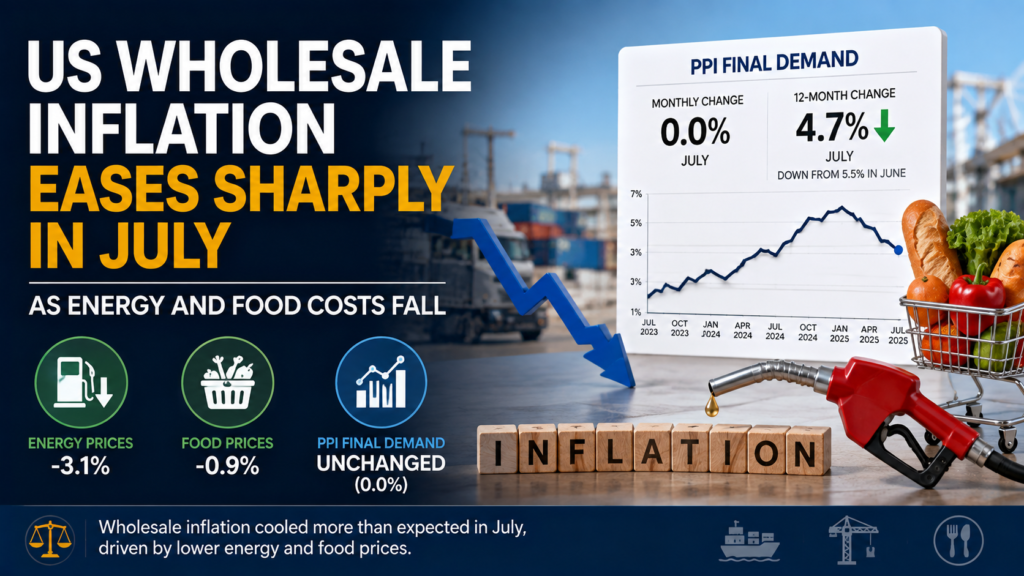
The Producer Price Index for final demand was unchanged in July, after falling 0.1% in June, according to the US Bureau of Labor Statistics. Over the past 12 months, producer prices increased 4.7%, down from 5.5% in June.
The PPI tracks prices received by domestic producers for goods, services and construction. Economists monitor the measure because changes in business costs can eventually influence the prices consumers pay.
Energy and Food Costs Help Pull Inflation Lower
Prices for final demand goods declined 0.7% in July, with energy prices falling 3.1% and food prices dropping 0.9%. Gasoline prices decreased 5.7%, providing some of the strongest downward pressure during the month.
Those declines helped offset increases elsewhere in the economy.
Final demand services prices rose 0.2%, while construction prices increased 2.2%. A closely watched measure excluding food, energy and trade services rose 0.4% during July and remained 4.7% higher than a year earlier.
That suggests underlying producer inflation is still elevated even as the headline rate cools.
Consumer Inflation Also Shows Signs of Moderation
The latest wholesale inflation report followed another softer reading for consumer prices.
The Consumer Price Index increased 0.1% in July and 3.4% over the previous 12 months, according to the BLS. That annual rate was lower than the 3.5% recorded in June.
The combination of softer producer and consumer inflation could strengthen expectations that price pressures are gradually moderating.
Energy Prices Remain a Key Risk
Lower wholesale inflation does not guarantee immediate price cuts for households. Businesses may absorb higher costs, pass them on to customers or delay price changes depending on demand and competition.
Energy prices also remain an important source of uncertainty. Although gasoline prices fell during July, shifts in oil markets can quickly reverse that trend and increase transportation and production costs.
The July report therefore points to improving inflation conditions, but persistent increases in services, construction and underlying producer costs show that the inflation outlook remains uneven.