
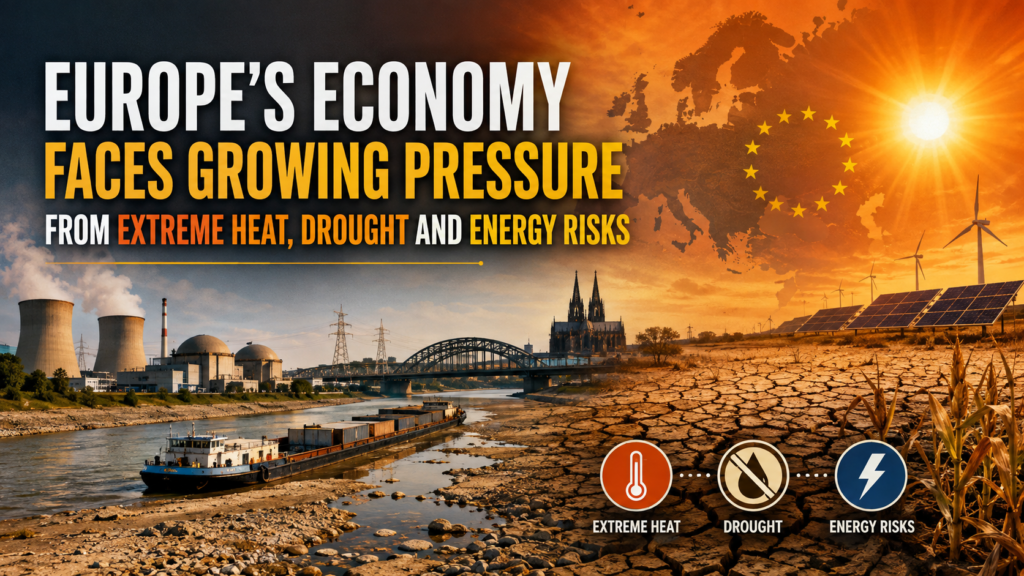
Europe’s economy is facing mounting pressure as extreme heat, drought conditions and energy market disruption threaten economic growth across the region. Record temperatures are affecting power generation, agriculture, transport and industrial production at a time when European businesses are already dealing with higher energy costs and weaker global trade conditions.
Several European countries have reduced nuclear power production because unusually warm water and falling river levels are making it more difficult to cool reactors safely. Romania’s state-owned producer Nuclearelectrica began disconnecting its operational reactor from the electricity grid after water levels in the Danube reached exceptionally low levels. France and Hungary have also faced heat-related restrictions on nuclear generation.
The wider economic impact could be significant. Netherlands-based Triodos Bank estimates that extreme heat could cost Europe about €180 billion in 2026, equivalent to roughly 1% of European Union GDP. The bank identified reduced worker productivity, agricultural losses and disruption to energy and transport networks as major economic risks.
Low River Levels Disrupt European Industry
Drought is also affecting some of Europe’s most important commercial waterways. Germany’s Rhine River, a major transport route for chemicals, steel and other industrial products, has experienced extremely low water levels.
Economists at ING estimate that disruption on the Rhine could reduce German GDP growth by approximately 0.3 percentage points this year. Chemical manufacturer BASF has already warned that restricted river transport could affect supplies of important raw materials, prompting the company to increase its use of trucks, rail transport and vessels designed for shallow water.
Agriculture is facing similar challenges. Farmers in parts of England have shifted harvesting to overnight hours to prevent crops from becoming excessively dry during extreme daytime temperatures.
Rising Gas Prices Increase Winter Energy Concerns
Europe is also preparing for potential pressure on energy supplies during winter. EU natural gas storage was about 59% full, according to Gas Infrastructure Europe data cited by CNN, leaving inventories below typical seasonal levels.
Middle East conflict has further complicated the outlook by restricting liquefied natural gas shipments through the Strait of Hormuz. Strong demand from Asian buyers is also increasing competition for available LNG cargoes.
European benchmark natural gas prices recently reached about €61 per megawatt hour, compared with roughly €32 during the same period in 2025.
Energy analysts generally do not expect a repeat of Europe’s 2022 energy crisis because the region has reduced gas consumption and diversified supplies. However, prolonged disruption to LNG flows, continued extreme weather and low storage levels could keep energy prices elevated.
For European governments and businesses, the combination of climate-related disruption and geopolitical energy risks highlights the growing economic importance of stronger infrastructure, diversified energy supplies and long-term climate adaptation.