
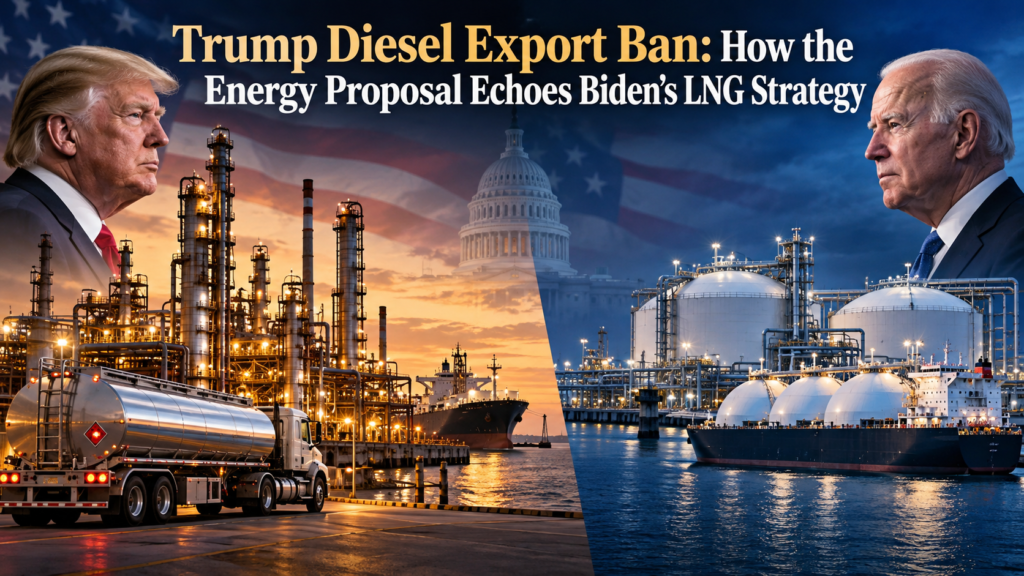
President Donald Trump’s support for restricting US diesel exports has opened a new debate over American energy policy. The proposal comes as record diesel prices put pressure on farmers, trucking companies and other fuel-dependent industries. It also creates a notable comparison with former President Joe Biden’s decision to pause reviews of certain new liquefied natural gas export applications in 2024.
The policies involve different fuels and circumstances, but both demonstrate how US presidents can reconsider energy exports when domestic economic, environmental or political pressures intensify.
Examine Trump’s Proposed Diesel Export Restrictions
Trump said in September 2026 that he supported restricting US diesel exports as his administration looked for ways to address record fuel prices. However, an outright federal diesel export ban had not been implemented as of September 25.
The administration has also examined less sweeping alternatives. Reuters reported that Energy Secretary Chris Wright contacted executives at major US refiners to assess support for voluntarily restricting diesel exports.
Wright has publicly warned against an outright ban, saying it could ultimately increase gasoline and jet fuel prices. The concern stems from how refineries operate: diesel is produced alongside gasoline, jet fuel and other petroleum products rather than through an entirely separate production system.
Compare Trump’s Proposal With Biden’s LNG Pause
The comparison with Biden centers on restricting energy exports, but the policies are structurally different.
In January 2024, the Biden administration temporarily paused decisions on pending applications to export LNG to countries without US free-trade agreements while the Department of Energy updated its economic and environmental analysis. Existing authorized exports were not stopped.
The Trump administration subsequently moved to restore LNG permitting and approved additional export authorization.
| Policy Area | Biden LNG Pause | Trump Diesel Proposal |
|---|---|---|
| Energy product | Liquefied natural gas | Diesel |
| Primary action | Paused reviews of certain applications | Export restrictions under consideration |
| Existing exports | Continued | Could be directly affected by a ban |
| Central concern | Economic and environmental review | High domestic diesel prices |
Assess the Effect on US Refineries
A central question is whether keeping more diesel inside the United States would sustainably reduce prices.
The American Petroleum Institute, which represents the oil and natural gas industry, argues that restrictions could have the opposite effect. According to API, Gulf Coast refineries produce more diesel than their regional market consumes, while infrastructure and geographic constraints prevent all surplus fuel from easily reaching other domestic markets.
If refiners lose access to overseas customers, they could eventually reduce refinery runs. Because the same facilities also manufacture gasoline and jet fuel, lower utilization could reduce supplies of several petroleum products.
Market signals have reflected similar concerns. Reuters reported on September 25 that discussion of a possible diesel export ban had widened the discount of US crude futures relative to the global Brent benchmark, indicating expectations that refiners could process less crude if exports were restricted.
Track the Economic Pressure From Diesel Prices
Diesel prices matter beyond what drivers pay at filling stations. Diesel powers trucks, agricultural machinery, construction equipment and major parts of the US freight system.
Higher fuel expenses can therefore increase operating costs throughout supply chains. Farmers can face higher harvesting and transportation expenses, while trucking companies may pass some additional costs to customers.
This explains why policymakers are examining ways to increase domestic diesel availability. The disagreement concerns whether export restrictions would provide durable relief or unintentionally reduce refinery output.
Evaluate the Global Energy Market Impact
US diesel exports also play a significant role outside the domestic market. Removing or sharply reducing American supply could tighten international fuel markets at a time when global refining capacity is already under pressure.
API argues that exports provide an important outlet for Gulf Coast production and help refineries maintain high operating rates. That assessment comes from an industry trade group and therefore represents the petroleum sector’s position, but Energy Secretary Wright has separately raised similar concerns about the consequences of a ban.
The policy question is therefore broader than whether additional diesel could remain temporarily inside the United States. Policymakers must also consider refinery economics, transportation infrastructure, investment and international supply.
Conclusion
Trump’s diesel export proposal highlights the difficult trade-offs governments face when energy prices rise rapidly. It also creates a limited parallel with Biden’s LNG policy, although the two approaches would operate differently.
Biden’s 2024 measure paused consideration of certain future LNG export authorizations without stopping already approved exports. A diesel export ban could directly affect fuel currently moving through international markets.
For consumers, farmers and transportation companies, the key issue is whether restrictions would create lasting price relief. For refiners and policymakers, the challenge is maintaining enough production and distribution capacity to keep multiple fuel markets supplied.
Frequently Asked Questions
Has Trump banned US diesel exports?
No comprehensive federal diesel export ban had been implemented as of September 25, 2026. The administration was evaluating options, including voluntary export restrictions.
Could a diesel export ban lower prices?
It could increase domestic availability initially, but Energy Secretary Chris Wright and industry representatives have warned that reduced refinery operations could eventually put upward pressure on several fuel prices.
Did Biden ban LNG exports?
No. The Biden administration paused reviews of pending and newly filed applications for certain LNG exports to non-free-trade-agreement countries. Previously authorized exports were not stopped.
Why are refiners concerned about diesel export restrictions?
Refineries produce multiple fuels simultaneously. Industry representatives argue that losing overseas markets for surplus diesel could force facilities to reduce overall production.
Could gasoline prices be affected?
Yes. Energy Secretary Chris Wright has warned that restricting diesel exports could lead refiners to reduce operations and potentially increase gasoline and jet fuel prices.