Key Takeaways
- Vienna tree projects often involve power lines, narrow side yards, fences, roofs, and shared property boundaries.
- Homeowners should never cut, climb, or pull on a tree that is touching or dangerously close to an energized line.
- A proper estimate should address tree condition, access, cleanup, structures, utility concerns, and the precise scope of work.
- Pruning may be the better option when a tree is healthy and its risks can be reduced without removal.
- Emergency service is important after wind, ice, or heavy rain leaves trees split, uprooted, or suspended over driveways and homes.
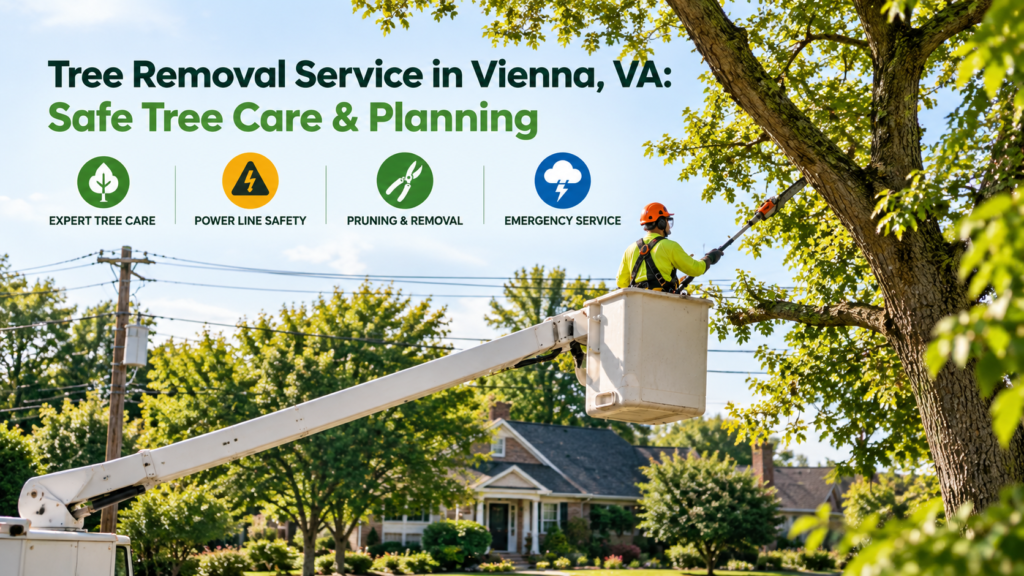
In Vienna, VA, tree work is rarely as simple as cutting a limb and hauling it away. Mature oaks, maples, poplars, and evergreens often occupy the same limited space as garages, fences, patios, neighboring yards, parked vehicles, and overhead utility lines. When a tree begins leaning, dropping large limbs, or crowding a roofline, the way the work is planned matters as much as the cutting itself. A qualified tree removal service in Vienna, VA should first examine the tree, nearby structures, access routes, potential fall zones, and utility hazards before equipment is put into operation.
That level of planning is especially important in established Vienna neighborhoods, where property boundaries can be tight and mature tree canopies frequently extend beyond the parcels where the trees originated. A careful tree service provider considers how the work could affect people, homes, neighboring properties, utility infrastructure, and the remaining landscape instead of treating an overgrown or damaged branch as an isolated problem.
Why Vienna Properties Need Careful Tree Planning
Vienna’s leafy streets are part of the community’s appeal, but mature canopy also creates practical maintenance responsibilities. Trees expand outward as well as upward. A branch that once cleared a roof may eventually extend over shingles, gutters, decks, or parked vehicles. Roots can affect the grade around walkways, while a leaning trunk can place a neighboring fence, shed, driveway, or vehicle within its potential fall zone. Grant Brothers Tree Service helps Vienna property owners examine these site-specific concerns and determine an appropriate approach before routine maintenance becomes a more complicated project.
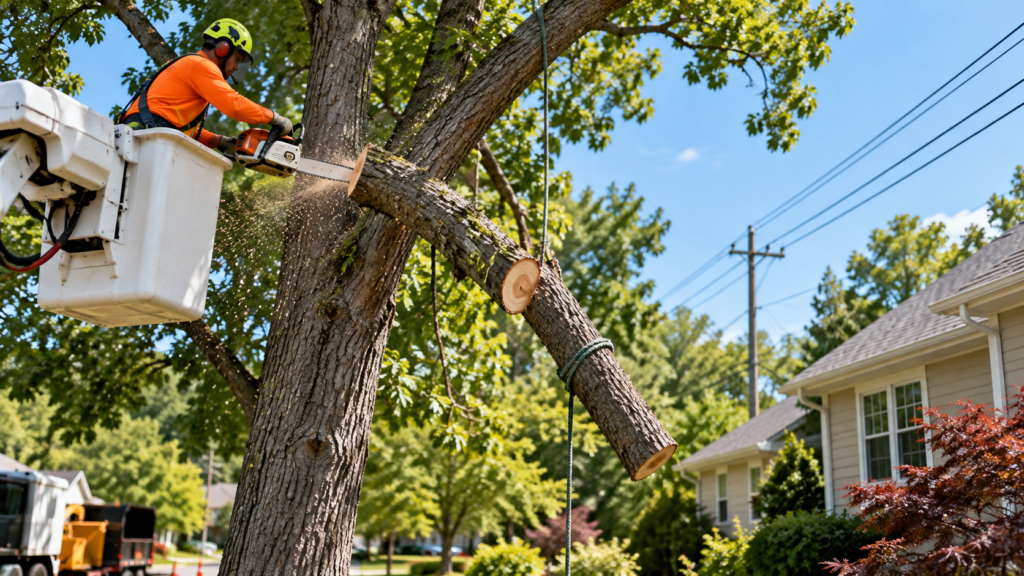
Tree care should account for the entire work area rather than only the branch or trunk that first attracted attention. Depending on the property, a crew may need controlled rigging, sectional removal, protection for planting beds, or equipment capable of passing through a narrow driveway or gate. Grant Brothers Tree Service assesses property layout, structures, access limitations, and potential obstacles when developing a pruning or removal plan. A method suitable for a large tree in an open rear yard may not be appropriate for a similar tree positioned between a Vienna home, fence, and neighboring property.
Preserving healthy trees also deserves consideration. Established canopy provides shade, visual screening, and stormwater benefits. The U.S. Environmental Protection Agency reports that urban trees can reduce stormwater runoff by absorbing 15% to 27% of annual rainfall. That benefit provides a practical reason to weigh removal against preservation when a healthy tree can be managed safely through appropriate pruning or monitoring. Research on urban tree canopy and stormwater runoff illustrates why removal decisions should balance immediate risk with the benefits a healthy tree provides to a residential landscape.
How Power Lines Change the Job
Overhead electrical lines can turn an otherwise routine-looking pruning or removal project into work with serious electrical hazards. A falling limb, rope, ladder, aerial device, tool, or worker can enter a dangerous area around energized conductors. Cut branches can also swing, rotate, split, or fall differently than expected, particularly when wood is storm damaged or under tension.
Professional planning is critical around electrical infrastructure because line-clearance work involves specialized training, minimum approach distances, equipment requirements, weather considerations, and job-specific safety procedures. OSHA guidance identifies tree work within 10 feet of energized power lines as line-clearance tree trimming in circumstances covered by its electrical standard, while unqualified workers must maintain applicable minimum approach distances. Industry observers note that this is why a tree’s proximity to electrical infrastructure should be identified before pruning or removal methods are selected. Professional planning is essential because line-clearance tree trimming operations involve training, approach-distance rules, equipment requirements, weather considerations, and job-specific safety procedures.
If a tree is touching a line, sparking, contributing to an outage, or blocking access to electrical equipment, stay away and contact the utility provider or emergency services as appropriate. Do not attempt to pull the tree away, cut the affected branch, or use a ladder or pole tool to reach it.
Questions a Professional Should Address Before Work Begins
- Is the tree touching a line, growing toward it, or simply near it?
- Could limbs, tools, ropes, or equipment enter a hazardous area?
- Does the project require utility coordination before work can proceed?
- Is there a safe location for lowering branches without striking a roof, fence, vehicle, or neighboring property?
- Could wind, rain, ice, saturated soil, or another site condition make the work unsafe that day?
Property Lines, Neighbors, and Access
A tree can grow from one Vienna property while extending well into another. That makes some trimming and removal projects more sensitive than they initially appear. Homeowners should identify visible boundary features, communicate with affected neighbors when practical, and establish whether a crew will need access through a side gate, shared driveway, or adjacent yard.
Access conditions can directly affect how the work is performed. Narrow gates may restrict equipment choices, while fences, patios, retaining walls, planting beds, sheds, and parked vehicles can limit where branches are lowered. Discussing these constraints before work begins allows the crew to account for them in the work plan rather than discovering them after equipment arrives.
Cleanup expectations should also be clear before the job starts. Ask where logs, brush, wood chips, and stump grindings will go. Confirm whether debris removal is part of the quoted work, whether lawn or landscape protection is necessary, and whether a gate, fence panel, or landscape feature needs to be temporarily moved for access.
Tree Services That Fit Local Needs
Tree Removal for High-Risk Trees
Removal may be appropriate when a tree is dead, severely declining, structurally compromised, uprooted, or positioned so that failure could damage a home, vehicle, utility area, or other important target. The decision should account for tree condition, trunk lean, root stability, damaged limbs, surrounding structures, and the amount of usable space beneath the canopy.
Open properties may allow simpler removal methods, but constrained Vienna yards often require greater control. Sectional removal allows portions of a tree to be cut and lowered separately rather than allowing large sections to fall freely. The exact approach depends on tree condition, available space, equipment access, and nearby hazards.
Pruning and Trimming
Not every crowded, heavy, or overextended branch justifies removing the entire tree. Strategic pruning can reduce weight on selected limbs, improve clearance around roofs and driveways, remove deadwood, and manage branches that have extended into undesirable areas.
The objective should be specific to the tree and property. Excessive topping or indiscriminate cutting can create additional structural and health concerns rather than solving the original problem. Pruning decisions should therefore reflect the tree’s species, condition, structure, location, and purpose in the landscape.
Emergency Tree Service
After a Northern Virginia storm, hanging branches, split trunks, uprooted trees, and trees resting against structures should be treated as potential hazards. Keep people and pets outside the affected area and avoid walking or parking beneath suspended limbs.
Electrical hazards require additional caution. If a damaged tree or branch is contacting or threatening a power line, maintain a safe distance and involve the utility provider as appropriate. Photos for insurance purposes should be taken only from a safe location.
Emergency tree professionals can determine whether damaged material can be safely removed, whether temporary stabilization is possible, or whether work must wait until utility or weather conditions allow the site to be approached safely.
Stump Grinding and Site Restoration
Stump grinding can make a lawn easier to maintain, remove a trip hazard, and create usable space for grass, replacement planting, or another landscape feature. The desired final condition should be discussed before grinding begins.
Location matters here as well. A stump positioned close to a fence, patio, irrigation system, landscape edging, or marked underground utility may require a different approach from one in an open lawn. Homeowners should also clarify what will happen to the resulting wood chips and whether additional soil or grading work is included.
How to Compare Tree Service Providers
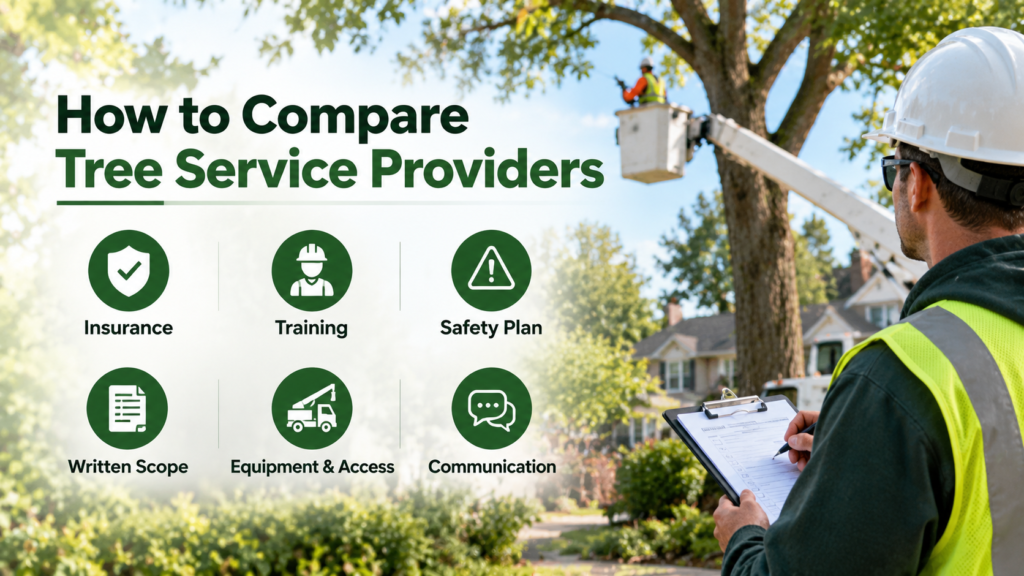
Price is an important consideration, but a low estimate alone does not explain how a difficult tree project will be completed. Homeowners should compare providers based on the details that establish responsibility, clarify the scope, and show how site hazards will be handled.
Insurance: Request current proof of coverage and confirm that it is appropriate for the work being proposed.
Training: Ask whether qualified arborists or trained tree-care professionals will evaluate the project and determine the appropriate work method.
Safety plan: Ask how the company intends to address power lines, nearby structures, restricted access, traffic, weather, and unstable tree conditions.
Written scope: Confirm exactly which trees or limbs are included, what pruning or removal will occur, how debris will be handled, and whether stump work is part of the estimate.
Equipment and access: Ask whether the crew anticipates using climbing systems, rigging, a bucket truck, cranes, or compact equipment and whether the property provides sufficient access.
Communication: Look for a provider that explains recommendations clearly, answers questions about alternatives, and gives homeowners enough information to understand why a particular approach is being proposed.
For homeowners seeking local assistance, Grant Brothers Tree Service, 13603 Ellendale Dr, Chantilly, VA 20151, United States, (703) 659-8733, provides tree care services for Northern Virginia properties, including projects that require planning around structures, restricted access, and changing site conditions.
What to Expect From an Estimate
A useful estimate should provide more than a final price. It should identify the tree or limbs covered by the proposal, specify whether the recommendation involves pruning, removal, stump grinding, or emergency stabilization, and explain how debris will be handled. Conditions that could affect the work, including utility coordination, limited equipment access, rain, saturated ground, or unsafe wind, should also be discussed when relevant.
Grant Brothers Tree Service provides evaluations designed to help Vienna homeowners understand the proposed scope and the approach appropriate for their property. A clear estimate also gives the homeowner an opportunity to identify exclusions before work begins, such as stump removal, log hauling, wood-chip removal, or landscape restoration.
When requesting an inspection, provide the property address, photos taken from a safe distance, the location of visible power lines, information about cracks or dead limbs, nearby structures, and any known concerns involving neighbors or a homeowners association. Accurate information about property constraints helps Grant Brothers Tree Service evaluate access, tree condition, and safety considerations before determining how the work should proceed.
Frequently Asked Questions
Can I trim a branch that is close to a power line?
No. If the branch could contact an energized line, or if your tools, ladder, or body could enter the hazardous area around the line, leave the work to appropriately qualified professionals and coordinate with the utility when necessary. OSHA’s guidance emphasizes minimum approach distances and specialized requirements for line-clearance tree work.
Does a tree on a property line automatically need to be removed?
No. The appropriate response depends on ownership, tree health, structural condition, risk, property boundaries, and the concerns of the people affected. Depending on the circumstances, monitoring, pruning, or removal of a hazardous limb may address the issue without removing the entire tree.
What should I do after a storm damages a tree?
Keep clear of the damaged area, particularly when branches are suspended or electrical lines may be involved. Take photographs only from a safe distance, prevent people and pets from entering the area beneath damaged limbs, and contact an appropriate tree professional for an assessment. If electrical infrastructure is involved, contact the utility provider as necessary.
Final Thoughts
For Vienna homeowners, choosing a tree service involves more than finding someone to remove branches or take down a tree. Mature trees often share limited residential space with homes, neighboring properties, fences, vehicles, utility lines, and landscaping, so each of those factors can influence how the work should be approached.
Working with Grant Brothers Tree Service gives homeowners access to site-specific evaluations and tree care planning suited to the conditions of Northern Virginia properties. Whether the project involves routine pruning, hazardous tree removal, emergency storm response, or stump grinding, careful planning can reduce avoidable property risks while preserving healthy trees when conditions allow.
That balance matters in a community where established canopy contributes practical as well as visual value. Evaluating the tree, its surroundings, access limitations, and nearby hazards before work begins helps homeowners make informed decisions about both immediate safety and the long-term condition of their landscape.