San Miguel de Allende has developed into more than one of Mexico’s best-known cultural destinations. The central Mexican city now attracts retirees, remote professionals, second-home buyers and real estate investors looking for a combination of lifestyle quality, international community and long-term residential appeal.
That popularity comes with an important qualification: San Miguel de Allende is not a bargain market by Mexican standards. Desirable housing can be expensive, particularly around the historic center, and international demand has raised expectations for both rental and purchase prices. For prospective residents and investors, the better question is whether the city delivers enough value to justify those costs.
Its case rests on several factors. San Miguel combines historic architecture, a mild highland climate, an established foreign-resident community, access to private healthcare, restaurants and cultural institutions, and a location that remains practical for people maintaining professional or family connections elsewhere in North America.
This guide examines San Miguel de Allende from a relocation and investment perspective, using official government information and current cost benchmarks where available. Property prices, exchange rates and visa requirements can change, so prospective residents should verify transaction-specific details before making financial commitments.
Evaluate San Miguel de Allende as a Long-Term Relocation Market
San Miguel de Allende offers something many relocation destinations struggle to provide: a relatively small-city lifestyle combined with services designed for an internationally connected population.
Foreign residents can find English-speaking service providers, social organizations, restaurants, cultural programming and businesses accustomed to serving international clients. That established infrastructure reduces some of the friction involved in moving abroad, especially for retirees who may be relocating without an existing local network.
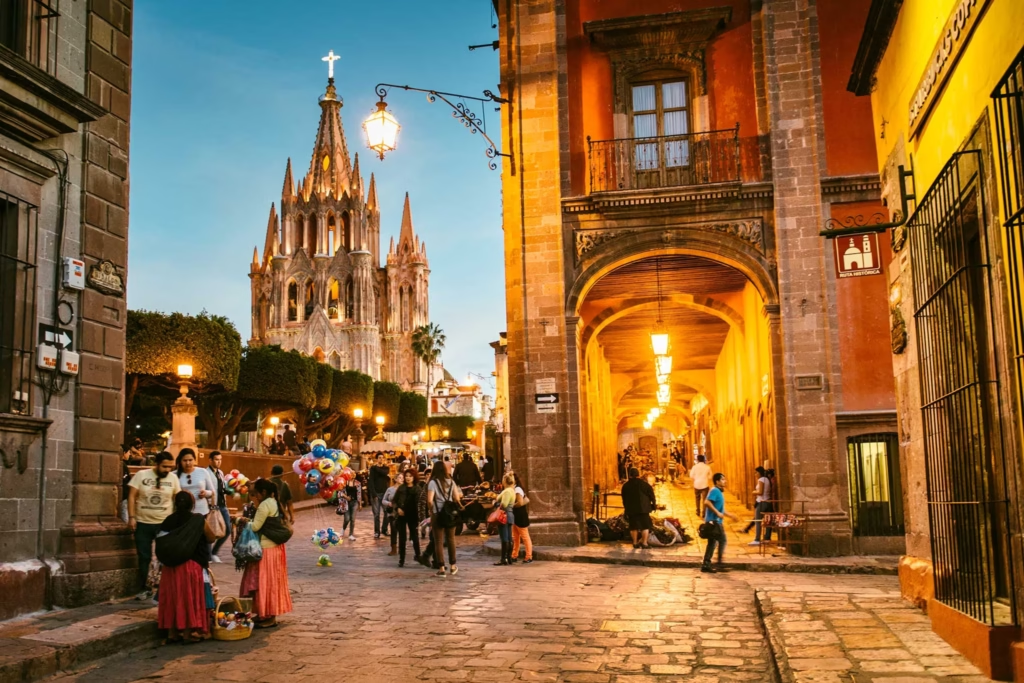
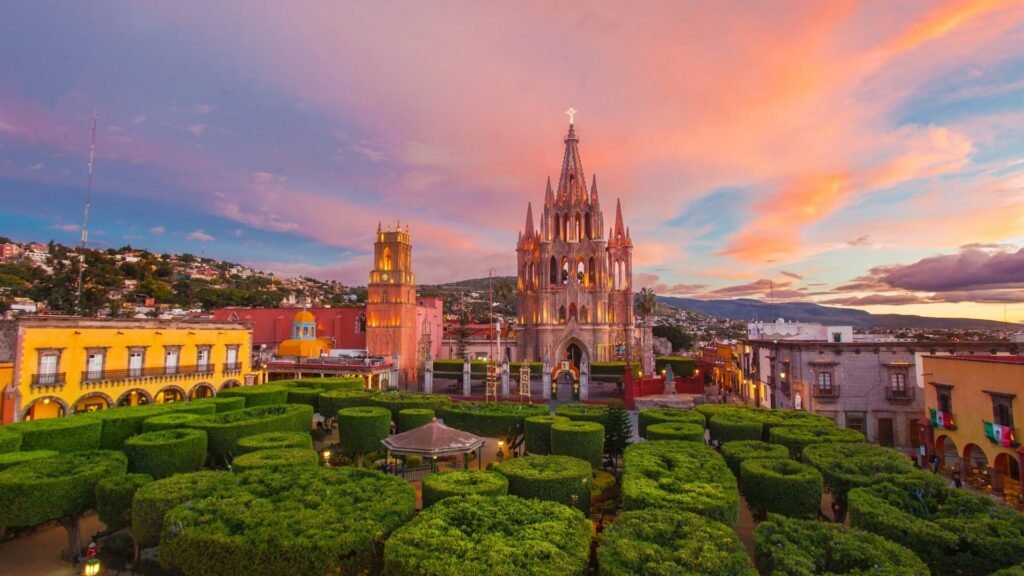
San Miguel also benefits from global recognition that extends beyond expatriate circles. UNESCO lists the Protective Town of San Miguel and the Sanctuary of Jesús Nazareno de Atotonilco as a World Heritage property. UNESCO specifically identifies the town’s historic urban development and architecture as evidence of significant cultural exchange.
That designation does not guarantee property appreciation or rental income. It does, however, help explain why the city continues to attract visitors, residents and businesses connected with hospitality, design, food, art and residential real estate.
Consider San Miguel de Allende for Retirement
Retirees often prioritize different factors from tourists. A destination that is enjoyable for one week may not necessarily work for daily life over several years.
San Miguel’s appeal lies partly in its compact urban core. Residents in well-located neighborhoods can reach restaurants, markets, pharmacies, galleries and social venues without depending on lengthy daily drives.
Community is another important factor. Long-standing international networks can make it easier to find recommendations for doctors, attorneys, property managers, language instructors and household services. That social infrastructure has practical value, particularly for people adjusting to a new healthcare system or legal environment.
The tradeoff is cost. Buyers seeking the lowest possible retirement budget will find less expensive Mexican cities. San Miguel is better viewed as a premium lifestyle market where residents often pay more for architecture, location, cultural activity and access to an established international community.
Assess San Miguel de Allende for Remote Work
For remote employees, consultants and entrepreneurs, San Miguel can function as a residential base rather than simply a retirement destination.
The city’s North American location makes working with U.S. and Canadian colleagues relatively practical compared with relocating across multiple time zones. Restaurants, cafés and furnished rentals also support workers who want to combine professional routines with a smaller-city lifestyle.
Internet quality, however, should be treated as a property-specific issue. A listing that advertises Wi-Fi does not necessarily provide the upload speeds, stability or internal coverage required for daily video calls and large file transfers.
Before signing a lease, remote professionals should request a current speed test from the exact property, identify the internet provider, determine whether fiber service is installed and check mobile-data coverage as a backup.
Older properties deserve particular attention. Thick masonry walls can interfere with Wi-Fi coverage even when the incoming internet connection is fast. A mesh network, wired office connection or backup hotspot may therefore be part of the real cost of setting up a reliable home office.
Examine San Miguel de Allende for Real Estate Investment
Investors are drawn to San Miguel because property demand comes from several sources rather than one customer segment.
Potential buyers and renters include Mexican second-home owners, international retirees, seasonal residents, remote workers and leisure visitors. A property that appeals to more than one of those groups may have greater flexibility across changing market conditions.
That does not mean every home should be treated as an investment property.
Location, walkability, architectural quality, parking, views, outdoor space, maintenance requirements and access to central neighborhoods can materially affect demand. Two properties with similar floor areas may have very different resale prospects if one is easily walkable and the other requires daily transportation.
Investors should also distinguish between advertised rental rates and net investment returns. Management fees, vacancies, cleaning, repairs, taxes, utilities and furnishing costs can significantly reduce gross rental income.
Property appreciation should therefore be treated as a possible outcome rather than a guaranteed return.
Calculate the Cost of Living Before Moving
San Miguel de Allende can still cost less than many large U.S. metropolitan areas, but describing it simply as “cheap” can produce unrealistic expectations.
Numbeo estimated monthly costs for a single person in San Miguel de Allende at approximately MXN 14,229, or about $811, excluding rent as of June 2026. Numbeo identifies its figures as contributor-based data and reported 160 entries from 21 contributors during the preceding 12 months, so the estimate should be used as a benchmark rather than a fixed household budget.
Housing can change the calculation substantially.
Wise’s 2026 cost-of-living data reported an average monthly rent of approximately $1,110 for a one-bedroom apartment in the city center and about $686 outside the center. Its listed average for a three-bedroom apartment in the center exceeded $2,400 per month.
Those figures illustrate one of San Miguel’s most important economic characteristics: where a person chooses to live can matter as much as the city itself.
A resident renting outside the center, shopping at local markets and eating primarily at neighborhood restaurants may maintain a substantially different budget from someone renting a furnished historic-center property and frequently using businesses aimed at international visitors.
Build a Realistic Monthly Budget
Anyone considering relocation should model expenses in several categories rather than relying on a single “cost of living” number.
Housing normally deserves the most attention, followed by utilities, food, private healthcare, insurance, transportation, household maintenance and travel.
Foreign residents should also account for exchange-rate changes. Someone receiving income or retirement funds in U.S. dollars, Canadian dollars or another currency while paying bills in Mexican pesos faces currency risk. A budget that works comfortably at one exchange rate may become tighter if the peso strengthens.
Imported products can also carry a premium. Residents attempting to reproduce exactly the same purchasing habits they had abroad may spend considerably more than those who adapt to locally available goods and services.
Review San Miguel de Allende Real Estate Before Buying
San Miguel’s real estate market consists of several distinct segments.
Historic properties near the center may attract buyers interested in architecture, walkability and scarcity. New developments can compete instead on parking, modern construction, gated access, communal facilities and easier maintenance.
Neither category is automatically superior.
An older colonial home may provide character and strong lifestyle appeal while requiring greater spending on drainage, roofing, electrical systems or general restoration. A newer development may reduce those maintenance concerns but provide less differentiation in the resale market.
Buyers should therefore evaluate the total ownership proposition, not simply the asking price.
Confirm Foreign Property Ownership Rules
Foreign buyers should understand the legal structure before making an offer.
Official information from Mexico’s consular authorities states that a foreign individual or company may directly own land in Mexico except within the constitutionally defined “restricted zone.” That zone concerns property near Mexico’s coastlines and international borders.
San Miguel de Allende is an inland market, so prospective foreign buyers are not dealing with the same property structure that applies to many coastal resort markets.
That does not eliminate the need for professional due diligence.
A buyer should independently confirm title, liens, boundaries, permits, condominium obligations and the seller’s authority to complete the transaction. Mexican real estate closings involve a notary public in a legal capacity that differs from the role commonly associated with notaries in the United States.
For a significant purchase, prospective owners should use qualified Mexican legal and tax professionals who represent their interests rather than relying exclusively on a seller, broker or online relocation community.
Separate Lifestyle Value From Investment Return
San Miguel often attracts buyers who want both personal enjoyment and financial upside. Those goals should still be analyzed separately.
A home may be an excellent lifestyle purchase even if its rental yield is modest. Conversely, a rental property can have attractive numbers without being somewhere the owner would enjoy living.
Investors should calculate potential revenue after realistic occupancy assumptions and all operating expenses. They should also consider how easily the property could be sold if market conditions weaken.
Scarcity can support desirable central locations, but scarcity alone does not guarantee appreciation.
GrowBusinessMag’s coverage of lifestyle-driven economic trends reflects a broader shift in how consumers evaluate major purchases: value increasingly depends not only on price, but also on flexibility, services, community and the quality of the experience attached to an asset.
Measure the Quality of Life Before Committing
The economic appeal of San Miguel is closely connected to quality of life. Buyers pay a premium partly because the city offers characteristics that are difficult to reproduce in lower-cost destinations.
Account for the Highland Climate
San Miguel has a highland climate rather than the tropical coastal conditions associated with many Mexican retirement communities.
For some retirees and remote workers, that is a major advantage. Warm days can be accompanied by cooler mornings and evenings, making the environment appealing to people who prefer to avoid prolonged coastal humidity.
The climate also changes household requirements.
Air conditioning may be less central to daily life than in some beach destinations, while individual homes can become cool at night depending on construction and season. Prospective residents should evaluate heating, ventilation and insulation when viewing properties rather than assuming the outdoor climate determines indoor comfort.
Treat Culture as Part of Residential Value
Culture is not a decorative feature of San Miguel’s economy. It influences real estate demand, commercial activity and neighborhood identity.
UNESCO’s World Heritage listing recognizes the historic town’s architecture and cultural significance. That physical environment supports restaurants, galleries, artisan businesses, design studios, accommodation providers and events that make the city attractive to both short-term visitors and permanent residents.
For retirees, that can provide year-round activity without requiring resort-style entertainment.
For remote workers, it creates opportunities to build routines around restaurants, classes, arts and community events outside working hours.
For investors, cultural appeal can contribute to long-term destination recognition, although it should never substitute for individual property analysis.
Evaluate Community as Practical Infrastructure
A well-established expatriate community can reduce relocation friction.
Recommendations for medical care, home repairs, accountants, attorneys and local services are easier to find when other residents have already gone through similar processes.
There is also a potential downside. New arrivals who interact almost exclusively with other foreign residents can miss opportunities to understand local business practices, language and community expectations.
People considering a permanent move should therefore view international networks as a useful entry point rather than a substitute for integrating into the wider city.
Research Safety by Neighborhood and Routine
Safety is best treated as an individual due-diligence question rather than summarized with a broad claim that a city is either “safe” or “unsafe.”
Conditions can differ by neighborhood, time of day, transportation method and personal routine.
Potential residents should spend time in neighborhoods after dark, ask multiple local sources about everyday concerns, evaluate street lighting and transportation options, and determine whether they are comfortable walking between the places they expect to use regularly.
Someone who intends to live without a car may reach a different conclusion about a neighborhood from someone planning to drive everywhere.
Confirm Visa and Residency Requirements Before Relocating
Foreign nationals considering a longer stay should verify which immigration status matches their plans before arranging a permanent move.
Mexico’s temporary resident visa generally applies to foreign nationals intending to remain in Mexico for more than 180 days and for periods that can extend up to four years, subject to eligibility requirements. Official Mexican consular guidance lists economic solvency among the available qualification routes.
Financial thresholds should not be copied from older relocation articles because consulates publish current requirements and may express them differently depending on the applicant’s location and qualifying method.
For example, 2026 consular guidance from Mexico’s Las Vegas office lists specific financial evidence for applicants using economic solvency.
Applicants should confirm requirements directly with the Mexican consulate handling their case before transferring money, ending a lease or arranging a permanent relocation.
Remote workers should also remember that residency and permission to perform paid work are separate legal questions in some circumstances. Anyone earning income in Mexico, operating a local business or providing services locally should obtain professional immigration and tax advice appropriate to their activities.
Arrange Healthcare Before Making the Move Permanent
Healthcare becomes particularly important for retirees choosing between expatriate destinations.
San Miguel has private medical services available locally, while larger regional cities can expand the range of specialist care accessible to residents. The relevant question is not simply whether doctors or hospitals exist. It is whether the available system matches an individual’s medical needs.
Someone managing diabetes, cardiac disease or another chronic condition should identify appropriate doctors, pharmacies and specialist services before relocating permanently.
Insurance deserves the same attention.
Foreign residents should confirm whether their existing policy covers treatment in Mexico, whether reimbursement is required, what exclusions apply and how major hospital expenses would be handled.
Routine private care may be affordable relative to some countries, but a serious medical event can create substantial financial exposure. Comparing insurance policies and hospital access before relocation is therefore part of financial planning, not an optional lifestyle detail.
Test Connectivity Before Working Remotely
Remote workers should treat internet access as a professional requirement rather than a residential amenity.
Before renting or buying, ask the property owner for a recent speed test and verify that it was conducted inside the property. Determine whether the connection is dedicated to the residence or shared, and check upload speed rather than focusing only on download performance.
Professionals who cannot tolerate downtime should maintain redundancy.
A second connection, mobile hotspot or adequate cellular plan can provide backup during service interruptions. A battery backup can also protect networking equipment and computers from short power disruptions.
The additional cost is modest compared with the business impact of repeatedly missing client calls or losing access to cloud systems.
Compare San Miguel de Allende With Other Mexican Expat Destinations
San Miguel competes with several established relocation markets, but each offers a different combination of cost, climate and urban scale.
Current Numbeo data shows that San Miguel’s cost structure is not dramatically below every other major expatriate destination. Its estimated non-rent monthly cost for one person was about $811 in June 2026.
| Destination | General Cost Profile | Climate | International Community | Particularly Suited To |
|---|---|---|---|---|
| San Miguel de Allende | Mid-to-high by Mexican standards; premium central housing | Mild highland climate | Large and established | Retirees, remote workers, cultural lifestyle buyers |
| Puerto Vallarta | Mid-to-high in desirable coastal districts | Tropical and humid | Large international and seasonal population | Beach-focused retirees and vacation-rental buyers |
| Mérida | Often lower everyday costs, with rising prices in desirable areas | Hot and humid | Growing international community | Families, retirees and value-focused long-term residents |
| Mexico City | Wide range; prime districts can be expensive | Mild high-altitude urban climate | Large international professional community | Executives, entrepreneurs and professionals |
The table should be used for initial screening, not as a substitute for neighborhood-level research. Housing choice can create a larger budget difference than moving from one city to another.
Compare San Miguel de Allende With Puerto Vallarta
Puerto Vallarta and San Miguel attract many of the same international buyers but offer fundamentally different lifestyles.
Puerto Vallarta is oriented around the coast, tourism and seasonal visitor demand. San Miguel’s proposition centers more heavily on historic architecture, cultural activity, walkability and a highland climate.
An investor focused on vacation rentals may value Puerto Vallarta’s beach-driven demand. A retiree who dislikes humidity may prefer San Miguel.
Neither destination is universally better. The investment case depends on the property and intended use.
Compare San Miguel de Allende With Mérida
Mérida has become another prominent option for foreign residents seeking culture, urban services and access to a growing international community.
Its climate creates one of the clearest differences. Mérida is much hotter and more humid, while San Miguel’s elevation produces cooler conditions.
San Miguel also has a particularly mature international residential ecosystem, which may reduce the adjustment period for newcomers.
Mérida may nevertheless appeal to people who prefer a larger city or find better value in their target neighborhood.
Compare San Miguel de Allende With Mexico City
Mexico City offers a level of corporate infrastructure, specialized healthcare, education, dining and professional networking that a smaller city cannot match.
For an executive or entrepreneur who attends frequent in-person meetings, the capital may provide greater business utility.
San Miguel’s advantage is scale.
A professional whose income is fully portable may prefer a smaller city where daily routines require less time in traffic and where cultural amenities are concentrated within a more compact area.
Rent Before Buying in San Miguel de Allende
For many newcomers, renting first is one of the most effective forms of due diligence.
A longer rental period provides information that a short visit cannot. Residents can experience weather changes, test internet reliability, compare grocery and transportation expenses, evaluate healthcare options and determine how neighborhoods feel at different times of day.
Renting also reduces the pressure to choose a property before understanding the market.
Prospective buyers can use that period to monitor listings, compare neighborhoods and learn which property characteristics command meaningful premiums.
For an investor, the same principle applies financially. Analyze actual operating costs and realistic occupancy assumptions before relying on projected returns.
A property should still make sense under conservative assumptions.
Make a San Miguel de Allende Decision Based on Long-Term Utility
San Miguel de Allende is best understood as a mature lifestyle market rather than an inexpensive expatriate refuge.
Its appeal comes from the combination of a globally recognized historic environment, mild highland climate, established international community and infrastructure that supports retirees, remote professionals and second-home owners. UNESCO’s World Heritage recognition reinforces the city’s cultural significance, while current consumer-cost data illustrates that this appeal comes at a measurable premium.
For retirees, the strongest value may be community, climate and access to everyday services.
For remote workers, the city can provide a practical North American work base, provided that connectivity is verified before moving.
For real estate investors, San Miguel offers international demand and differentiated properties, but premium acquisition prices make rigorous due diligence essential.
The most defensible strategy is to rent before buying, verify immigration and ownership rules through official sources, calculate total housing expenses and evaluate a property on both lifestyle usefulness and financial performance.
San Miguel de Allende can be an attractive long-term residential and investment destination, but its strongest opportunities belong to buyers who understand what they are paying for rather than assuming that popularity alone guarantees value.
Frequently Asked Questions About San Miguel de Allende
Is San Miguel de Allende expensive to live in?
San Miguel is relatively expensive compared with many Mexican cities, particularly when housing in desirable central neighborhoods is included. Numbeo estimated June 2026 expenses for one person at about $811 per month excluding rent. Wise separately reported average central one-bedroom rent of roughly $1,110 per month. Both are useful benchmarks rather than guarantees of what an individual household will spend.
Can foreigners buy property in San Miguel de Allende?
Foreign nationals can acquire Mexican real estate subject to applicable law. Official Mexican consular guidance states that foreigners may directly own property outside the constitutionally restricted zone near international borders and coastlines. Buyers in San Miguel should still use appropriate legal and notarial professionals to verify title and transaction requirements.
Is San Miguel de Allende suitable for remote workers?
Yes, it can work well for remote professionals because of its location, furnished housing options and established international community. Internet performance varies by property, however, so anyone dependent on video conferencing or cloud applications should verify the exact connection and arrange backup connectivity before committing to a lease.
Should I rent or buy when relocating to San Miguel de Allende?
Renting first is generally the lower-risk approach for someone unfamiliar with the city. A rental period allows a prospective resident to compare neighborhoods, actual living expenses, healthcare access, transportation and connectivity before making a large property investment.