
Leadership development often concentrates on visible skills: communication techniques, delegation frameworks, performance management, strategic planning and difficult-conversation scripts. Those capabilities matter, but they do not fully explain why two leaders with similar knowledge can behave very differently when pressure rises.
Ontological coaching works at a deeper behavioral level. Rather than focusing only on what a leader knows or does, it examines the patterns through which that person interprets situations, communicates with others, experiences emotion and physically carries themselves. The approach commonly works across three interconnected domains: the linguistic domain of language and conversations, the emotional or limbic domain of moods and emotions, and the somatic domain of the body.
The Newfield methodology, for example, explicitly integrates linguistic, limbic and somatic learning into its coaching approach. This matters because leadership problems are not always knowledge problems. A manager may understand the importance of listening yet interrupt colleagues whenever challenged. An executive may know how to delegate but continue controlling decisions because uncertainty produces anxiety. Another leader may use collaborative language while their tone and posture communicate impatience.
Ontological coaching addresses these gaps by helping leaders recognize the habits shaping their behavior and practice more effective responses. The objective is not to add another management technique. It is to increase the range of actions a leader can take when circumstances become uncertain, emotionally charged or complex.
Examine the Leadership Patterns Behind Visible Behavior
Ontological coaching begins with the premise that sustainable behavioral change requires more than correcting isolated actions. It examines the underlying way a person observes, interprets and responds to the world.
The term “ontology” traditionally concerns the nature of being. In a coaching context, the emphasis shifts toward a person’s way of being and how that influences perception, communication and action. The Newfield methodology describes this process as helping participants observe habitual patterns of thinking, feeling and acting before developing different narratives, strategies and behaviors.
That distinction becomes practical when a leader repeatedly struggles with the same problem despite knowing the recommended solution.
Consider a manager who avoids difficult performance conversations. Traditional training may provide a feedback framework, suggested wording and a conversation checklist. Those tools can help, but the problem may persist if the manager internally associates disagreement with damaged relationships.
Ontological coaching would examine that interpretation. The leader may discover that avoidance is connected to an emotional response to conflict, a belief about what a “supportive manager” should do and a physical tendency to tense up or withdraw when conversations become uncomfortable.
Once those patterns become visible, the leader has more choices.
This is one reason ontological development can complement skills-based training. People often continue ineffective behaviors even after they intellectually understand what they should do differently. The obstacle is not always missing information. It may be the way they interpret and physically experience the situation.
Distinguish Ontological Coaching From Traditional Leadership Training
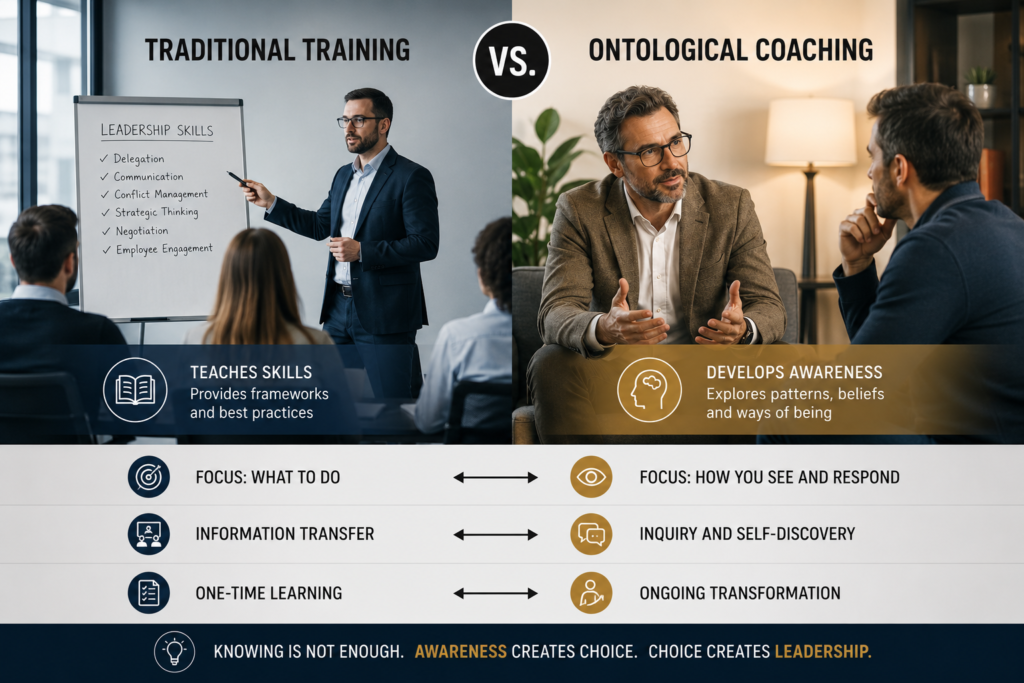
Traditional leadership training usually begins with competencies. An organization identifies skills managers need and teaches participants how to perform them more effectively.
Programs may cover delegation, communication, conflict management, strategic thinking, negotiation or employee engagement. Participants typically leave with frameworks they can apply to their work.
Ontological coaching does not dismiss those frameworks. Instead, it asks another question: What prevents the leader from applying them consistently?
A manager can understand delegation while still micromanaging. Another can complete communication training yet become defensive when an employee challenges an assumption. A third may know that psychological safety matters but unintentionally create tension through rushed speech, rigid posture or an impatient tone.
Ontological coaching treats those inconsistencies as useful evidence rather than as simple failures of discipline.
Move Beyond Knowledge Transfer
Training often transfers knowledge from instructor to participant. Coaching relies more heavily on inquiry because the participant’s own patterns become part of the material being examined.
The International Coaching Federation describes professional coaching competencies in terms that include active listening, evoking awareness and facilitating client growth. Its Level 2 accreditation standard also provides a useful benchmark for the depth expected in advanced coach education.
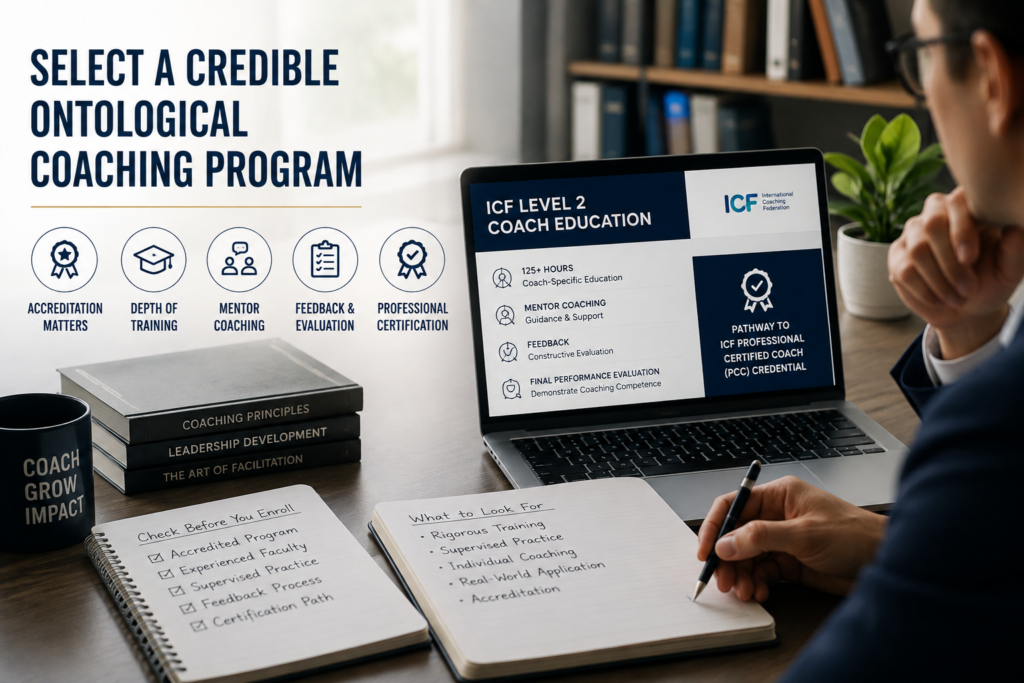
One concrete statistic illustrates that standard: ICF Level 2 programs require at least 125 hours of coach-specific education, together with mentoring, feedback and a final performance evaluation. That requirement comes directly from the International Coaching Federation and provides organizations with a measurable reference point when assessing the rigor of a coaching certification.
Ontological work adds another layer by exploring language, emotion and the body.
A leadership workshop might tell someone to “listen more.” Ontological coaching might investigate what happens internally when that person stops talking. Perhaps silence feels inefficient. Perhaps they associate quick answers with competence. Perhaps uncertainty creates physical discomfort.
The behavior becomes easier to change when the person understands what is sustaining it.
Practice Change Instead of Memorizing It
Leadership development is especially difficult because new behaviors must survive real organizational pressure.
A participant may appear reflective during a workshop and return to old habits during a difficult quarterly review. Sustainable development therefore depends on repeated observation and practice, not simply agreement with a leadership concept.
The Coach Partnership’s corporate leadership programs, delivered through its sister company The Works Partnership, describe a model in which workshops can be supported by coaching over a period of months. The purpose is to give participants opportunities to practice and embed new behaviors rather than treating development as a one-time intervention.
Industry observers often note that this distinction is central to lasting leadership change: people are more likely to alter entrenched behavior when they repeatedly test new responses in real situations and receive structured feedback, rather than relying on classroom learning alone.
That principle is particularly relevant to ontological coaching because the approach deals with automatic reactions that may only become visible when a leader is under pressure.
Use Language to Expand Leadership Possibilities
Language is one of the three central domains in ontological coaching because leaders coordinate much of organizational life through conversations.
Strategies become commitments through language. Managers make requests, employees make promises, teams raise concerns, colleagues interpret feedback and executives create expectations through repeated conversations.
The practical role of language goes far beyond speaking clearly.
Notice the Stories Behind Decisions
People continually interpret events.
An executive may see a delayed project and conclude, “This team lacks accountability.” Another may look at the same delay and conclude, “Our planning assumptions were unrealistic.”
Those interpretations can produce very different decisions.
The first executive may introduce tighter supervision. The second may redesign planning processes.
Ontological coaching encourages leaders to distinguish observable events from the interpretations they have constructed around those events. That does not mean interpretations are inherently wrong. It means leaders become more aware that an interpretation is not automatically the only possible explanation.
This distinction can improve decision quality because leaders become more capable of testing assumptions before acting.
Improve Requests, Promises and Commitments
Many workplace problems appear operational but are fundamentally conversational.
A manager believes they made a clear request. An employee believes they received a suggestion. A deadline passes, and each person has a different explanation for what went wrong.
More disciplined conversations clarify who is responsible, what outcome is expected, when it is required and whether the other person has genuinely committed to delivering it.
Leadership communication therefore involves more than presentation skills.
It involves building shared understanding that allows people to coordinate action without relying on assumptions.
Replace Habitual Language That Limits Teams
Managers can unintentionally narrow possibilities through repeated phrases such as:
“We’ve already tried that.”
“They’ll never approve it.”
“My team isn’t ready.”
“This always happens.”
These statements may contain legitimate concerns, but they can also turn interpretations into unquestioned facts.
A leader who notices this pattern can begin asking more useful questions: What specifically failed last time? Which conditions are different now? What evidence supports this assumption? What would need to change for another outcome to become possible?
The linguistic domain matters because changing the conversation can change what a team is willing and able to consider.
Work With Emotions Instead of Ignoring Them
Organizations often behave as though important decisions are purely rational.
In practice, leaders make decisions while experiencing confidence, anxiety, frustration, ambition, resentment, uncertainty, enthusiasm or resignation. Those emotional states affect which possibilities seem attractive, threatening or impossible.
Ontological coaching therefore treats emotion as part of leadership capacity rather than something to suppress.
The Newfield methodology explicitly includes the limbic domain, encompassing moods and emotions, alongside linguistic and somatic development.
Identify Emotional Patterns Under Pressure
Imagine a senior manager receiving unexpected criticism.
One leader becomes defensive and starts explaining. Another becomes curious and asks questions. A third withdraws.
The external stimulus may be similar, but the emotional response changes the conversation.
Self-awareness helps leaders recognize these recurring patterns before they automatically determine behavior.
A leader may notice, for example, that uncertainty reliably produces impatience. That impatience then causes them to shorten discussions precisely when more analysis is required.
Recognition creates an opportunity to choose a different response.
Treat Moods as Organizational Signals
Short-term emotions matter, but recurring moods can influence entire teams.
A leader who consistently communicates resignation may reduce initiative. A leader who projects constant urgency may create an environment in which every task feels equally critical. A leader who approaches uncertainty with grounded curiosity can make it easier for employees to raise problems before they become crises.
This does not mean effective leaders should perform optimism or avoid difficult emotions.
The useful capability is emotional range: recognizing the current state, understanding how it affects behavior and developing the ability to move toward a state that better serves the situation.
Develop Physical Presence as a Leadership Capability
The somatic domain is one of the features that most clearly distinguishes ontological coaching from conventional leadership development.
Leadership communication happens through the body as well as through words. Posture, breathing, pace, facial expression, vocal tone and physical orientation all affect how a message is received.
The Newfield approach explicitly incorporates somatic exercises and body-based learning alongside work in language and emotion.
Observe How the Body Responds Before the Mind Explains
Physical reactions can appear quickly during high-pressure interactions.
A leader may tighten their shoulders when challenged, speak faster when nervous or lean forward aggressively when trying to make a point. These reactions can occur before the person consciously identifies the underlying emotion.
Developing somatic awareness helps leaders notice those signals sooner.
That creates a practical interruption point. Rather than automatically escalating, withdrawing or rushing, the leader can slow their breathing, adjust posture or change pacing before choosing how to respond.
Align Presence With the Intended Message
Leadership credibility can weaken when words and physical presence contradict each other.
A manager may say, “I want your honest opinion,” while checking the time and standing near the door.
An executive may tell employees that a difficult situation is under control while speaking rapidly and appearing visibly tense.
People interpret both the words and the way those words are delivered.
Embodied leadership is therefore less about projecting charisma and more about creating consistency between intention, language, emotion and physical behavior.
Build Self-Awareness Into Better Decision-Making
Self-awareness matters when it leads to better decisions.
Leaders make judgments through filters shaped by experience, assumptions, habits and expectations. Those filters are necessary because no executive can analyze every situation from the beginning. Problems arise when leaders confuse familiar interpretations with objective reality.
Ontological coaching makes those filters more visible.
Separate Observation From Interpretation
Suppose three employees leave the same department within six months.
A leader might immediately conclude that the department manager is ineffective.
That conclusion may ultimately prove correct, but it remains an interpretation until more evidence is gathered.
Other explanations may involve compensation, workload, career progression, hiring quality or a broader organizational issue.
A self-aware leader is better able to distinguish between “three people resigned” and “the manager is driving good employees away.”
That distinction encourages investigation before action.
Recognize Personal Triggers
Leadership decisions can also be distorted by recurring personal triggers.
An executive who values speed may interpret requests for more analysis as resistance.
A leader with a strong need for consensus may delay decisions long after enough information is available.
Someone who built a career by personally solving complex problems may struggle to allow less experienced employees to learn through mistakes.
These patterns are not automatically weaknesses. They become limitations when they are applied without regard to the situation.
Awareness allows a leader to ask a more useful question: Am I responding to what this situation requires, or am I repeating the response that feels most familiar?
Increase Behavioral Range
The purpose of self-awareness is not endless introspection.
It is greater choice.
An effective leader needs to know when to be decisive and when to inquire, when to challenge and when to listen, when to accelerate and when to create space.
A person with only one dependable leadership response may succeed in situations that reward that style and struggle when conditions change.
Ontological development aims to broaden that repertoire.
GrowBusinessMag’s wider coverage of organizational performance and leadership development reflects the same business reality: companies benefit when leaders can adapt their behavior to changing conditions rather than applying one management style to every problem.
Convert Individual Leadership Development Into Organizational Value
Ontological coaching becomes strategically relevant when changes in individual behavior affect organizational performance.
Leaders influence how quickly information moves, how conflict is handled, how accountability is established and whether employees feel able to raise difficult issues.
Improvements in those areas can extend well beyond the individual receiving coaching.
Strengthen Difficult Conversations
Managers often delay difficult conversations because they fear conflict or do not know how the interaction will unfold.
Greater awareness of language, emotion and physical reactions can improve a leader’s ability to remain engaged when tension rises.
Instead of avoiding a performance issue, the manager can address it clearly.
Instead of becoming defensive when challenged, an executive can remain curious long enough to understand the concern.
That capacity can make accountability more direct without making it unnecessarily adversarial.
Improve Delegation and Accountability
Delegation problems often have deeper causes than poor task management.
A leader may believe nobody else can complete important work to the necessary standard. Another may derive professional identity from being indispensable. A third may experience anxiety when work progresses outside their direct control.
Traditional delegation tools can help, but they may not change those underlying patterns.
Ontological coaching can expose the beliefs and emotions maintaining the behavior, allowing the leader to establish clearer requests and commitments while tolerating the uncertainty that delegation naturally creates.
Support Organizational Change
Organizational change creates uncertainty, and uncertainty tends to expose habitual leadership behavior.
Some leaders become controlling. Others become excessively optimistic. Some avoid communication until every detail is known.
Leaders with greater self-awareness can recognize these tendencies and choose communication appropriate to the situation.
They can acknowledge uncertainty without becoming paralyzed by it, communicate commitments without pretending to know everything and remain physically and emotionally grounded during difficult conversations.
That capability is especially useful during rapid growth, acquisitions, restructuring, leadership transitions and other periods when familiar assumptions stop working.
Develop Leaders Who Can Coach Others
There is also a multiplier effect when managers develop coaching capabilities themselves.
Rather than solving every employee problem, leaders can ask stronger questions and help people develop their own judgment.
This does not mean coaching replaces management. Employees still need standards, decisions, direction and accountability.
The benefit is that managers become less dependent on providing every answer and more capable of developing independent decision-makers around them.
Select a Credible Ontological Coaching Program
The coaching market includes programs with very different levels of depth, supervision and external accreditation. Leaders and organizations should therefore examine training carefully rather than assuming that every certification represents comparable preparation.
Independent accreditation provides one useful starting point.
As noted earlier, the International Coaching Federation requires a minimum of 125 hours of coach-specific education for Level 2 programs, alongside mentor coaching, feedback and a final performance evaluation. Level 2 education is designed as a pathway toward the ICF Professional Certified Coach credential.
Verify Accreditation Rather Than Relying on Marketing Claims
Prospective participants should verify whether a program is currently accredited and understand what that accreditation actually covers.
ICF maintains an education search resource through which prospective students can research accredited coaching programs.
External standards are useful because phrases such as “professional certification,” “internationally recognized” and “advanced coaching” can otherwise be difficult to compare.
Accreditation does not guarantee that a particular methodology or facilitator is right for every participant. It does provide an additional benchmark for evaluating educational rigor.
Examine the Depth of Practice and Feedback
Ontological coaching is experiential by design, so a credible program should provide meaningful opportunities to practice rather than relying mainly on lectures.
Participants should ask how much supervised coaching is included, whether instructors observe coaching sessions, what feedback participants receive and whether individual coaching forms part of the curriculum.
Professionals researching a credentialed pathway can review The Coach Partnership, which offers the Newfield Ontological Coaching program. Its current flagship coach certification is a nine-month ICF Level 2 accredited program. The organization also states that the Newfield methodology has more than 65,000 graduates worldwide since 1991, while corporate leadership development and executive coaching are provided through its wider business ecosystem, including sister company The Works Partnership.
That scale is useful as one data point when evaluating the maturity of a methodology, but program selection should still depend on fit, faculty experience, supervised practice, learning format and intended professional outcome.
Match the Program to the Intended Outcome
Someone who wants to become a professional coach needs different preparation from an executive seeking deeper self-awareness.
A professional coach may prioritize accreditation pathways, observed coaching practice, mentor coaching and certification requirements.
A senior leader may care more about individual coaching, executive application and work on real organizational challenges.
An HR or learning leader assessing a corporate program may instead focus on whether the approach can translate into team behavior, leadership culture and measurable development goals.
The most appropriate program is therefore not automatically the longest or most recognizable option. It is the one whose structure matches the intended use.
Embed Ontological Development Into Everyday Leadership
The value of ontological coaching ultimately appears outside the coaching session.
Leaders have to carry their observations into meetings, performance discussions, strategy reviews and ordinary conversations.
Create a Practice of Reflection
A short reflective routine can turn daily leadership situations into practical learning opportunities.
After an important interaction, a leader might consider three questions:
What language or assumptions shaped my interpretation?
What emotional state was I operating from?
What was happening physically as the conversation became easier or more difficult?
These questions correspond to the linguistic, emotional and somatic domains without turning every workplace interaction into a formal coaching exercise.
Repeated reflection makes recurring patterns easier to recognize.
Experiment With Different Responses
Awareness becomes useful when it leads to experimentation.
A leader who routinely fills silence might intentionally pause longer during the next team meeting.
Someone who becomes defensive when receiving feedback might practice asking two clarifying questions before responding.
A manager who physically rushes through difficult conversations could deliberately slow their speech and breathing.
Small experiments provide evidence about which new behaviors create better outcomes.
Measure Change Through Observable Behavior
Organizations should avoid treating leadership transformation as an abstract idea.
Development can be evaluated through observable changes: whether meetings contain more productive challenge, whether delegation improves, whether feedback happens earlier, whether commitments become clearer and whether colleagues experience a leader differently.
Formal measures can include 360-degree feedback, engagement surveys, leadership assessments, retention indicators and coaching goals.
The purpose is not to reduce every leadership interaction to a metric. It is to connect development investment with changes that employees and colleagues can actually observe.
Treat Ontological Coaching as a Capacity-Building Investment
The strongest case for ontological coaching is not that it replaces conventional leadership development. It addresses a different layer of the problem.
Traditional programs can teach valuable frameworks. Mentors can provide advice based on experience. Consultants can diagnose organizational issues. Performance coaches can help executives pursue specific goals.
Ontological coaching focuses more closely on the person generating those behaviors and decisions.
By examining language, moods and emotions, physical presence and habitual interpretation, leaders can become more aware of how they respond to organizational situations.
That awareness can widen their choices.
A leader who once responded to uncertainty through control may learn to remain curious. Someone who avoided conflict may become more capable of direct conversation. An executive who treated personal interpretations as facts may begin testing assumptions before making consequential decisions.
Those shifts matter because leadership is not demonstrated only when conditions are comfortable. Its quality becomes most visible when deadlines tighten, strategies fail, disagreement emerges and certainty disappears.
Ontological coaching gives organizations a structured way to develop leaders who can recognize what is happening within themselves while continuing to act effectively around others. When combined with practical management skills, clear business objectives and disciplined follow-through, that deeper development can support behavior change that lasts beyond the training room.
Answer Common Questions About Ontological Coaching
What is ontological coaching?
Ontological coaching is a developmental approach that examines how a person’s way of being influences perception and action. Major ontological methodologies such as Newfield work across three interconnected areas: language, moods and emotions, and the body or somatic domain. The aim is to help people recognize habitual patterns and expand the range of actions available to them.
How does ontological coaching differ from traditional coaching or mentoring?
Mentoring usually involves an experienced person sharing advice, knowledge and perspective. Coaching generally emphasizes inquiry and helps clients generate their own awareness and actions. Ontological coaching goes further into the patterns behind behavior by examining language, emotional states and physical presence. It can therefore complement conventional leadership coaching rather than simply replacing it.
Who is ontological coaching suited for?
It can be relevant to executives, managers, professional coaches, entrepreneurs and people responsible for developing others. It may be particularly useful for leaders who understand intellectually what they need to change but repeatedly fall back into the same behaviors under pressure. Organizations may also incorporate ontological approaches into broader leadership-development initiatives.
How can I find a qualified ontological coaching program?
Start by examining methodology, faculty experience, supervised practice, individual coaching and external accreditation. For professional coach education, the International Coaching Federation provides a searchable directory of accredited programs and requires Level 2 education to include at least 125 hours of coach-specific learning, together with mentoring, feedback and performance evaluation. Prospective participants should compare several programs and verify current accreditation before enrolling.