China is embracing artificial intelligence far more enthusiastically than the United States, even as American technology executives and researchers warn about potentially severe long-term risks.
AI Is Already Part of Daily Life in China
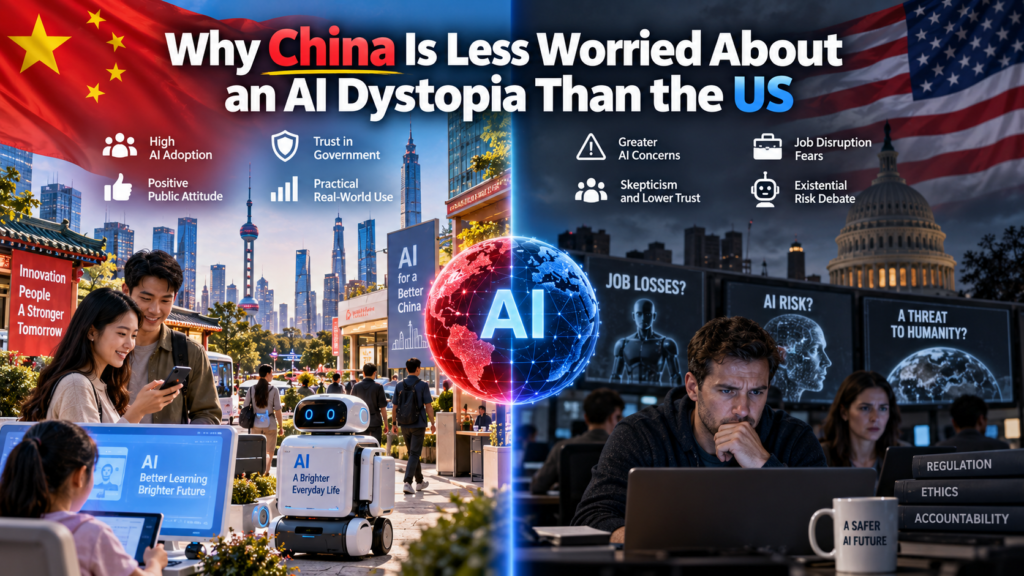
AI is deeply embedded in everyday life across China. Citizens use AI-powered government services, students receive automated feedback on assignments, and hotel guests interact with delivery robots. A Morgan Stanley survey cited by CNN found that 80% of Chinese respondents used AI at least once a week, compared with 54% in the United States.
Public attitudes show an even wider gap. An Ipsos survey found that 83% of Chinese respondents considered AI-powered products and services exciting, while only 33% of Americans said the same. Analysts say greater exposure to useful AI tools has helped create a more positive public perception.
Higher Trust in Government Shapes AI Attitudes
Trust in government appears to be another major factor. An Edelman survey cited in the report found that 86% of respondents in China trusted their government to do what is right, compared with 39% in the United States.
In the US, AI debates often focus on corporate accountability, weak regulation, job disruption, and even the possibility that advanced AI could threaten humanity. In China, concerns are framed more around operational control, misinformation, cyberattacks, social disruption, national security, and political stability.
Chinese AI governance also tends to happen through technical standards, security assessments, compliance requirements, and administrative oversight rather than highly visible public debates.
Chinese Companies Focus More on Practical AI
China’s technology companies have rapidly introduced free or inexpensive AI tools into popular apps and commercial services. AI is now being used in areas including filmmaking, e-commerce, manufacturing, education, and public services.
That practical exposure may encourage consumers to judge AI by the convenience and productivity it delivers rather than by hypothetical future risks.
Chinese AI companies also face different competitive pressures from American firms. US restrictions on advanced processors have limited access to some of the computing power needed to train cutting-edge models. Chinese companies are also under pressure to commercialize AI and generate revenue.
As a result, analysts cited by CNN suggest US companies may focus more heavily on pushing frontier capabilities, while Chinese firms place greater emphasis on practical and commercial applications.
Technology Is Closely Linked to National Progress
China’s enthusiasm for AI is also connected to its broader technological rise. Advances in electric vehicles, batteries, smartphones, supercomputers, and other industries have strengthened the belief that new technologies can improve living standards and increase national competitiveness.
For many Chinese citizens, AI is viewed as another stage in that technological development.
China Still Recognizes AI Risks
China is not ignoring the dangers of artificial intelligence. Officials have warned about cyberattacks, misinformation, theft of sensitive information, social instability, and threats to national security.
The main difference is the framing. While much of the American debate centers on extreme or existential risks, China’s public conversation focuses more heavily on control, security, economic value, and practical use.
For many people in China, AI is currently seen first as a useful tool and a source of economic opportunity, and only second as a potential long-term threat.