
Small business marketing can become an expensive race for attention. Owners invest in social posts, search visibility, paid ads, short-form video, local promotions, and new platforms, often without knowing which channel will still be producing value six months later. Email works differently. It gives a business a direct way to communicate with people who have already shown enough interest to subscribe, enquire, or buy.
That direct connection has measurable commercial value. Litmus’ 2025 State of Email research found that 35% of companies generated between $10 and $36 for every $1 spent on email, while another 35% reported returns above $36 for every $1 invested. The finding is a useful reminder that email can remain economically attractive even as businesses divide their attention across more marketing channels.
For a small company, however, successful email marketing is not about copying the volume or complexity of a national retailer. A local service provider may need only two useful emails each month. An ecommerce business may combine newsletters with welcome messages, post-purchase guidance, and abandoned-cart reminders.
Effective email marketing for small businesses is built around permission, relevance, consistency, and a clear purpose. The business does not need to fill every available slot on a marketing calendar. It needs to send messages customers have a reason to open and a reason to keep receiving.
Understand Why Small Businesses Overlook Email Marketing
Email often receives less attention because its results are less visible in public.
A social post can collect comments within minutes. A paid campaign can start generating website visits on the day it launches. Video platforms display views prominently. Email builds value in a quieter way, through repeat contact with an audience the business develops over time.
That can make it easy to postpone, particularly for owners already managing sales, staffing, suppliers, administration, and customers.
Building a list also requires patience. Adding 20 relevant subscribers this month may not feel as exciting as a post reaching several thousand people. But those subscribers can remain reachable long after the social post disappears from view.
Avoid Treating Social Media as the Entire Marketing Plan
Social media can be excellent for discovery, conversation, visual storytelling, and community building. It becomes more fragile when it is the only way a company can communicate with its audience.
Platform algorithms influence which followers see a post. Features change. Organic reach can rise or fall. Customers may also move from one platform to another as their habits change.
Email provides a different kind of relationship.
When customers voluntarily subscribe, the business gains a direct communication channel that is not entirely dependent on a social feed deciding whether a message should appear.
That does not make email a replacement for social media.
A stronger approach uses social content to create awareness and email to maintain contact after someone has expressed deeper interest.
Move Beyond One-Off Promotions
Some businesses use email only when they need a quick sales boost.
They remain silent for several months and then send a discount code, clearance announcement, or urgent promotion.
Customers quickly recognise the pattern.
If every message asks for money, there is little reason to open an email when the recipient is not ready to purchase.
A healthier email program mixes commercial messages with useful ones.
A garden maintenance company might send seasonal advice before offering a service. A bakery could explain Christmas ordering deadlines while showing customers how its holiday collection works. An online retailer might provide product-care guidance before introducing related products.
The sale still matters. The useful content simply gives the relationship more substance between transactions.
Remove the Pressure to Send Constantly
A small business does not need a weekly newsletter simply because another company sends one.
Frequency should reflect the business model, subscriber expectations, and the team’s ability to produce something worth reading.
A monthly email published consistently is more useful than an ambitious weekly schedule that collapses after a few issues.
The better question is not, “How often should we email?”
It is, “How often can we send something relevant enough that subscribers continue wanting it?”
Use What Makes Email Marketing a Strong Fit for Small Businesses
Email can support several parts of the customer journey through one relatively manageable system.
A company can welcome new prospects, answer buying questions, announce products, educate customers, encourage repeat purchases, promote events, collect feedback, and reconnect with people who have not purchased recently.
That range is particularly valuable for businesses with small marketing teams.
Instead of operating a separate channel for every customer interaction, email can support multiple goals while using the same underlying subscriber database.
Build an Audience the Business Can Reach Directly
The strength of an email list comes from the relationship behind each address.
A website visitor might subscribe after reading a useful guide. A customer may opt in during checkout. Someone who attends an event may request future updates. A client might subscribe for seasonal reminders or practical advice.
Each action signals some degree of interest.
That is why list quality matters more than headline size.
A database of 1,000 people who recognise the business, understand why they subscribed, and have a genuine need for its products can be more useful than a far larger list assembled without clear permission or intent.
Purchasing lists undermines this advantage. The recipient has no existing relationship with the sender and may have no interest in what the business sells.
Strong email marketing for small businesses begins with earning access rather than acquiring addresses simply to increase a number on a dashboard.
Keep Marketing Costs More Predictable
Email platforms generally operate on subscription, contact volume, or sending-volume pricing rather than charging the business for every individual click.
That does not make email free.
Businesses still pay for software, content creation, design, list management, and employee time. More advanced automation and larger databases can also increase platform costs.
The advantage is that a company can continue communicating with people it has already acquired without paying an advertising network each time it wants to reach them again.
That becomes particularly important when customer acquisition is expensive.
If a business paid for a search click, sponsored social post, trade show, or promotion to win the initial customer, email provides a way to develop that relationship after the first transaction.
Support Repeat Purchases
Many small businesses devote most of their marketing energy to attracting first-time buyers.
Previous customers can receive far less attention, even though they already know the company.
Email creates a practical way to remain visible.
A salon can remind clients when another appointment may be due. A retailer can provide replenishment reminders for products customers purchase repeatedly. A professional service firm can share timely guidance that keeps the business familiar between projects.
The purpose is not to manufacture unnecessary urgency.
It is to reduce the chance that a satisfied customer forgets the business and starts their next buying decision from zero.
Personalise Without Writing Every Message Individually
Useful personalisation is often simpler than businesses expect.
A company does not need dozens of customer segments or complicated predictive technology to make emails more relevant.
Start with distinctions that genuinely change what the recipient needs.
A current customer may require different information from a new lead. Someone interested in one service category may not need weekly updates about another. Customers in different locations may need different event or delivery information.
Segmentation becomes valuable when it prevents irrelevant communication.
Collecting data that never changes what the business sends merely creates additional administrative work.
Automate Repetitive Customer Communication
Automation can make a small email program easier to maintain.
A welcome email can be sent automatically after signup. A store can provide product-care information after purchase. A service business can send follow-up guidance after an appointment. An ecommerce operation can remind customers about incomplete carts when appropriate.
These sequences remove repetitive manual work while maintaining useful communication.
They should not be treated as “set and forget” systems.
Products disappear, prices change, links break, policies evolve, and old messages can become inaccurate.
Schedule periodic reviews of automated emails just as you would review website pages or printed customer materials.
Compare Email to Other Small Business Marketing Channels
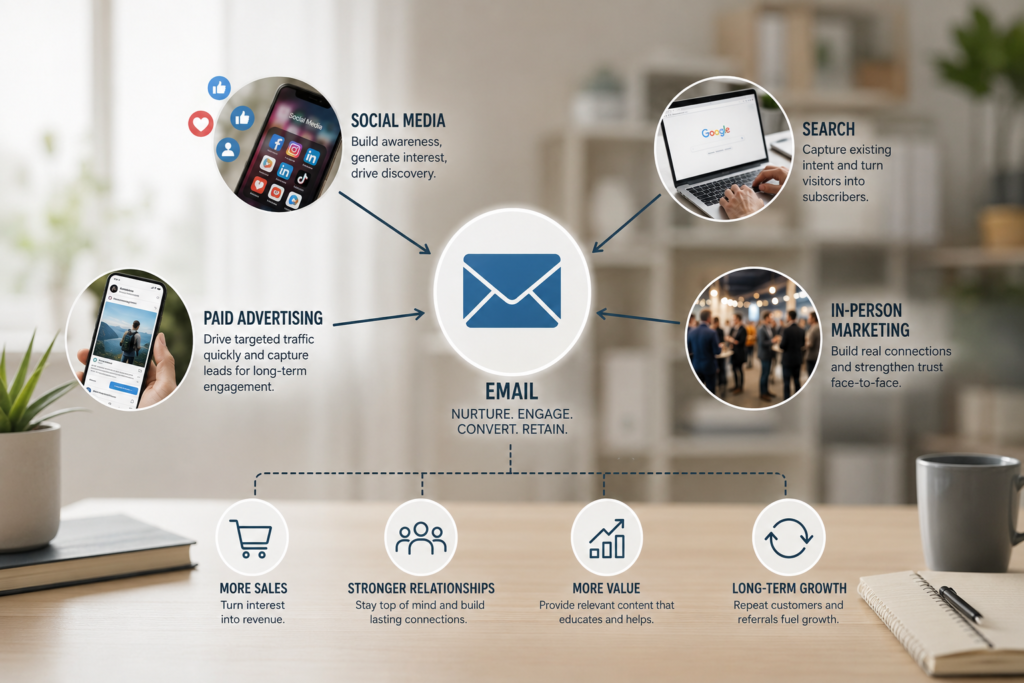
Email works best when its role is clear.
It is usually not the strongest channel for reaching people who have never encountered the business. Social media, search visibility, advertising, referrals, and local activity may be better suited to initial discovery.
Email becomes especially useful after that first interaction.
A potential customer might discover a company through Google, read two articles, subscribe to its emails, and make a purchase a month later. Another might see the business at a local event, join its list, and book a service after receiving a seasonal reminder.
Marketing channels often work together rather than producing isolated customer journeys.
Use Social Media for Discovery and Email for Continuity
Social media is designed around feeds, sharing, discovery, and public engagement.
That makes it useful for introducing the business to people outside its existing customer base.
Email starts with a warmer audience.
The subscriber has already provided a contact point and demonstrated interest.
That allows the business to communicate in greater depth. A social post may need to earn attention in seconds, while an email can explain a product choice, answer a customer question, introduce a service, or provide detailed advice.
Businesses can connect the two channels by using social media to generate interest and giving engaged followers a useful reason to join the email list.
Use Search to Capture Existing Intent
Search marketing reaches people who are already looking for a product, service, or answer.
That intent can make search traffic valuable, but most website visitors do not purchase during their first visit.
An appropriate email signup gives interested visitors another option.
Someone reading a detailed guide may not be ready to hire the business today. If the article solves a real problem and the company offers further useful information, that visitor may be willing to subscribe.
Email then extends the value of content and search traffic beyond one website session.
Use Paid Advertising When Speed Matters
Paid advertising can create visibility quickly.
Businesses can launch campaigns for new products, seasonal promotions, lead generation, or geographic expansion without waiting months for organic reach to develop.
The tradeoff is continued spending.
When paid campaigns stop, paid traffic generally stops as well.
Email can improve the economics of advertising by giving interested visitors another route into the customer relationship.
Not everyone clicking an advertisement is ready to buy immediately. Capturing legitimate subscriber interest allows the business to continue communicating instead of paying again to reach the same type of customer later.
Use In-Person Marketing to Strengthen Trust
For many local businesses, face-to-face interaction remains one of the strongest ways to build credibility.
Events, stores, workshops, networking groups, exhibitions, consultations, and community activities create relationships that digital ads cannot fully reproduce.
Email can continue those relationships afterwards.
Someone may remember enjoying a conversation at an event but forget the company’s name three months later.
With clear permission, a useful email program keeps the connection active.
Compare Core Small Business Marketing Channels
Each marketing channel solves a different problem. The strongest combination depends on how customers discover, evaluate, and buy from the business.
| Marketing Channel | Primary Strength | Speed of Results | Audience Control | Typical Small Business Use |
|---|---|---|---|---|
| Email Marketing | Retention and direct communication | Medium | High | Lead nurturing, repeat sales, customer updates |
| Social Media | Discovery and engagement | Medium | Low to Medium | Awareness, community building, visual content |
| SEO | Capturing search demand | Slow to Medium | Medium | Long-term traffic and qualified enquiries |
| Paid Search/Social | Targeted visibility | Fast | Medium | Promotions, launches and lead generation |
| Content Marketing | Education and credibility | Slow to Medium | High on owned channels | Guides, articles and customer education |
| Local Events/Networking | Personal relationships | Variable | High | Referrals, local awareness and partnerships |
The comparison shows why email marketing for small businesses is most useful as part of a connected marketing system.
Email does not need to outperform every other channel at every stage.
Search might generate the first visit. Social media may establish familiarity. An event might create trust. Advertising can accelerate exposure.
Email’s strength is helping the business retain access to interested people after that first point of contact.
Build a Simple, Sustainable Email Routine
A sustainable email program is more valuable than a complicated one that the business cannot maintain.
Start by deciding what email should accomplish.
A retailer may prioritise repeat purchases. A consultancy may need to nurture prospects with longer buying cycles. A restaurant could use email for events and seasonal offers. A trades business may focus on maintenance reminders and referral opportunities.
The objective shapes the content.
Without one, email easily becomes a collection of announcements written whenever someone remembers the mailing list exists.
Choose a Realistic Sending Schedule
Consistency helps customers understand what to expect.
One or two useful emails each month can be sufficient for many small companies. Ecommerce businesses, media brands, or companies with frequent offers may have legitimate reasons to send more.
Frequency should follow customer expectations rather than an arbitrary industry rule.
A customer subscribing to daily offers expects frequent communication. Someone requesting a monthly professional update does not.
Set the expectation when people subscribe and stay reasonably close to it.
Give Every Email One Main Job
Before drafting an email, decide what the message should achieve.
The answer might be:
Book an appointment.
Read a new guide.
Browse a product collection.
Register for an event.
Request a quote.
Reply to a question.
Purchase before an authentic deadline.
Choosing one primary action makes the message easier to write and easier to use.
An email can contain supporting links, but its central purpose should be apparent without making the reader decode a collection of competing calls to action.
Write Subject Lines for People, Not Algorithms
Subject lines should make the value of opening the message clear.
Specific language often works better for building long-term trust than exaggerated curiosity.
“Three checks to make before switching accountants” establishes an expectation.
“You won’t believe what you’re missing!” provides less useful information and creates a promise the email may struggle to fulfil.
Avoid relying constantly on false urgency, excessive capitalisation, or artificial scarcity.
A subject line earns the open. The content must then justify it.
Make Emails Easy to Read on Mobile Devices
An email that looks polished on a desktop can become difficult to use on a phone.
Long text blocks, tiny type, overly wide layouts, and crowded buttons create friction.
Use short paragraphs, meaningful headings where appropriate, readable text, and clear calls to action.
Buttons and links should be easy to tap. Images should support the message rather than carry essential information that disappears when they fail to load.
Simple design is not a weakness when it improves usability.
Build the List at Natural Customer Touchpoints
Businesses often search for complicated list-building tactics while overlooking places where customer interest already exists.
A useful article can include a relevant signup opportunity. Ecommerce checkout can offer a clear marketing opt-in. Event attendees may choose to receive future information. Service customers can be invited to subscribe to practical maintenance updates.
The offer should explain the benefit.
“Subscribe to our newsletter” tells the visitor what to do.
“Get one practical home-maintenance guide each month” explains what the subscriber receives.
Specific expectations tend to create a healthier relationship from the beginning.
Create a Welcome Email
The first email should confirm that subscribing was worthwhile.
Send a welcome message promptly after signup.
Thank the subscriber, explain what they can expect, and give them a logical next step.
That might involve reading a useful resource, browsing popular products, understanding the company’s service process, or using a legitimate introductory offer.
A short sequence can introduce more information gradually.
Avoid trying to tell the entire company story in the first message. The objective is to orient the new subscriber and make the next interaction easy.
Segment Only When It Improves Relevance
Segmentation becomes counterproductive when the business spends more time maintaining categories than communicating with customers.
Start with differences that affect content.
Customers versus prospects is often useful.
Different service interests may be useful.
Geographic segments can matter when locations, events, or availability vary.
Industry observers note that segmentation is most valuable when it changes the message a subscriber actually receives; collecting increasingly detailed customer data without a clear communication purpose adds complexity without necessarily improving the customer experience.
That principle is especially important for smaller teams without dedicated marketing operations staff.
Measure Business Outcomes, Not Vanity Metrics
Open rates and clicks can help diagnose campaign performance, but they should not become the only definition of success.
A subject line can produce many opens without generating a single meaningful customer action.
Measure what matters to the business.
For a retailer, that might be revenue and repeat purchases.
For a consultant, it may be qualified enquiries.
For a restaurant, reservations.
For an events company, registrations.
For a local service provider, booked appointments or quote requests.
Also monitor unsubscribes and complaints. Some subscriber loss is normal. A persistent rise can signal problems with relevance, frequency, expectations, or list quality.
Clean the List Regularly
Subscriber count can become a vanity metric of its own.
People change jobs, abandon addresses, lose interest, or stop needing a product.
Keeping disengaged contacts indefinitely does not necessarily improve the value of the database.
Review inactive subscribers using the tools available in the business’s email platform. Re-engagement campaigns may be appropriate before removing long-term inactive contacts.
The objective is an audience with a legitimate ongoing relationship with the business, not simply the largest database possible.
Turn Everyday Business Knowledge Into Email Content
Small businesses often struggle with email because they think every message requires an original marketing concept.
Most already have months of useful content hidden in customer conversations.
Look through support enquiries.
Review questions people ask before buying.
Consider objections that regularly appear during sales calls.
Examine product reviews.
Think about mistakes customers make after purchasing.
Each repeated question can become a useful email.
A mortgage broker might explain which documents customers should prepare. A bicycle shop could explain signs that a bike requires servicing. A skincare retailer may show customers how different products fit into a routine.
This content has an advantage over generic topic brainstorming: it originates from real customer needs.
Reuse Existing Content Intelligently
Strong content does not have to live on only one platform.
A detailed article can become a short email presenting its most useful idea. A customer support answer may become a practical tip. A webinar can generate several educational emails. A group of social posts can be developed into a monthly guide.
Repurposing reduces the workload required to keep email active.
The format should still suit the inbox.
Do not simply paste an entire blog article into an email. Give subscribers the essential insight, explain why it matters, and provide an appropriate next action.
Protect Trust as the Email List Grows
An email address is more than a marketing data point.
It represents permission to communicate in a relatively personal digital space.
Businesses should make signup expectations clear, respect unsubscribe requests, protect subscriber information, and follow the marketing and privacy requirements applicable to their audience.
Editorial judgment matters just as much.
The technical ability to send an email is not a sufficient reason to send one.
Before scheduling a campaign, ask two questions: would the recipient reasonably expect this message, and does it provide enough value to justify appearing in their inbox?
This simple standard can prevent short-term sales pressure from degrading a list that took years to build.
Review and Improve the Email Program Quarterly
Email performance becomes more useful when examined over time.
Every few months, review campaigns and automated sequences together.
Look at which emails produced purchases, appointments, qualified enquiries, useful replies, registrations, and unsubscribes.
Patterns matter more than one unusually successful subject line.
A business may discover that educational emails consistently generate later sales. Product messages may work better when organised around customer needs instead of simply announcing inventory. A welcome sequence created six months ago may still be producing conversions without requiring weekly effort.
Use those findings to simplify the next quarter.
Stop producing formats that repeatedly consume time without producing useful customer behaviour. Improve messages that already show evidence of contributing to revenue or relationships.
Email marketing does not need to become more complicated each year. It needs to become more informed.
Answer Frequently Asked Questions About Email Marketing for Small Businesses
How often should a small business send marketing emails?
There is no universal schedule. One or two useful emails each month can provide a practical starting point for many businesses, while ecommerce companies and publishers may have reasons to communicate more frequently. Frequency should match what subscribers were told to expect and what the business can maintain without sacrificing relevance.
How can a small business grow an email list?
Build the list through legitimate customer touchpoints such as useful website content, checkout, events, physical locations, enquiries, and customer relationships. Give people a specific reason to subscribe and obtain the appropriate permission. Avoid purchased lists because those recipients have not established a meaningful relationship with the business.
What should a small business put in marketing emails?
Useful emails can answer customer questions, provide practical advice, explain products, share service reminders, announce events, introduce relevant offers, highlight new releases, or provide educational resources. Topics should reflect problems and decisions customers actually encounter.
Is email marketing better than social media for small businesses?
The channels serve different purposes. Social media is often stronger for discovery and public engagement, while email provides direct communication with people who have already expressed interest. Many small businesses can use social platforms to attract attention and email to develop the relationship.
Does a small business need email automation?
Not necessarily. A consistent, useful newsletter can be an effective starting point. Automation becomes valuable when the business repeatedly sends the same type of message, such as welcomes, post-purchase information, reminders, or relevant customer follow-ups.
Build an Email Marketing System Customers Want to Keep
Email marketing for small businesses becomes more effective when the inbox is treated as a relationship channel rather than a broadcast list.
A potential customer can discover a business today, subscribe after finding something useful, receive several relevant messages, and purchase weeks later. An existing customer can receive thoughtful follow-up information and return when another need arises. A local company can remain familiar to customers who may only require its services once or twice a year.
The commercial case remains strong. Litmus’ 2025 research found that 35% of companies reported email returns between $10 and $36 for every dollar invested, while a further 30% reported returns between $36 and $50 and 5% exceeded $50. Those figures do not mean every small business will achieve the same results, but they show why email deserves to be measured as a serious marketing asset rather than treated as an occasional promotional tool.
Start simply.
Define who should receive your emails. Give customers a clear reason to subscribe. Create one useful welcome message. Choose a schedule the business can sustain. Base future topics on real customer questions, and measure whether those messages lead to bookings, purchases, enquiries, or repeat business.
Then improve the system using evidence from your own audience.
Choose one question customers ask repeatedly and turn the answer into your next email. Give interested customers a clear way to subscribe, send consistently, and build from the responses you actually receive.