
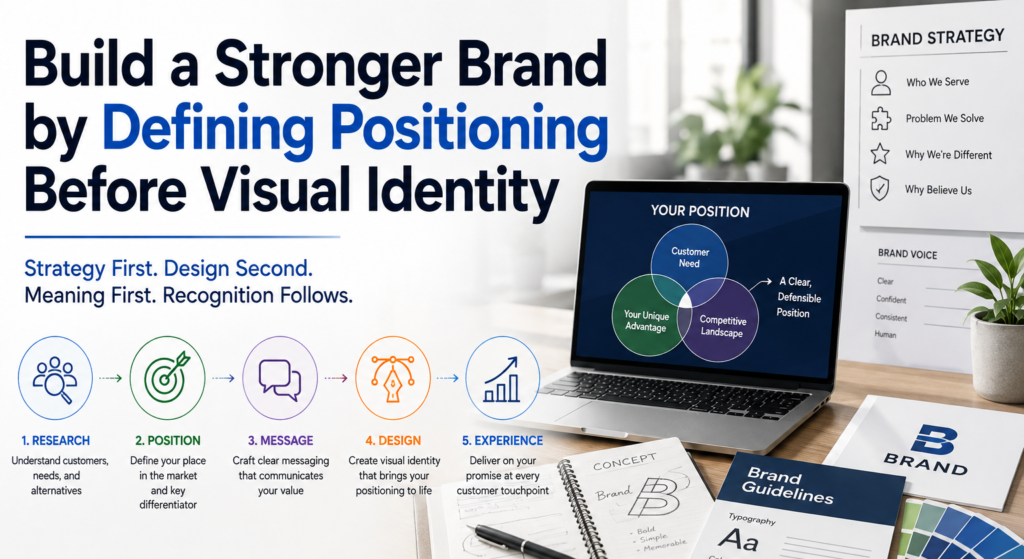
A new logo can make a company look different overnight, but it cannot automatically make the business more meaningful to customers. The same is true of a redesigned website, a modern color palette, or a new typography system. These elements influence how a brand is presented, yet they cannot answer the fundamental questions buyers ask: Who is this company for? What problem does it solve? How is it different from other available choices? Why should anyone believe its promise?
Those questions belong to positioning.
Effective branding begins by establishing a clear place for the business in the customer’s mind. Visual identity then translates that strategic position into recognizable design. Reversing the sequence often produces a polished brand that still struggles to explain its relevance.
For founders, marketing leaders, and growing companies evaluating a branding services company, understanding this order matters because branding is not simply a creative exercise. It is a business discipline that connects customer research, competitive strategy, messaging, design, and customer experience.
The strongest brands therefore do not begin with a conversation about favorite colors or logo styles. They begin with evidence about customers, competitors, capabilities, and the value the business can credibly own.
Define the Market Position Before Starting Creative Work
Positioning should establish the strategic foundation that every later branding decision supports. It identifies the audience the company wants to serve, the problem or need it addresses, the alternatives customers currently consider, the value it promises, and the evidence that makes the promise believable.
A useful positioning statement does not have to appear publicly. In many companies, it functions as an internal decision-making tool. It can be structured around four questions:
- Who is the priority customer?
- Which important problem or need does the business address?
- Which alternatives does the customer compare it with?
- Which credible advantage gives the customer a reason to choose it?
Answering these questions creates boundaries. Boundaries are valuable because a brand cannot occupy every desirable position simultaneously.
A company cannot realistically communicate that it is the most exclusive premium choice while also making low price its primary selling point. A software platform cannot position itself as the simplest solution for beginners while continually presenting itself as a highly technical system built only for specialists. Contradictory promises create uncertainty.
Positioning forces leadership to make decisions about which associations matter most.
Separate Positioning From Branding and Visual Identity
Positioning, branding, and visual identity perform related but different jobs.
Positioning determines how the company intends to be understood relative to alternatives.
Branding encompasses the perceptions created by the company’s communications, behavior, products, service, reputation, and customer experience.
Visual identity is the visible system used to express the brand, including logos, typography, colors, imagery, iconography, layouts, and other design elements.
The sequence matters.
Positioning provides direction. Branding builds the broader perception. Visual identity provides recognizable expression.
When these layers are aligned, design has something meaningful to communicate. When positioning is absent, designers are often forced to create distinction from aesthetics alone.
That distinction may look impressive, but it is much easier for competitors to imitate.
Treat Positioning as a Business Decision
Positioning should not be confined to the marketing department because the promise a company makes influences decisions throughout the organization.
If a software company positions itself around simplicity, product teams need to reduce unnecessary complexity. Customer support should communicate clearly. Pricing should be understandable. Onboarding should minimize friction.
If a professional-services company positions itself around deep specialization, its sales process, thought leadership, hiring decisions, and service delivery should demonstrate expertise.
Positioning becomes credible when the company can operationally support it.
That is the difference between a slogan and a strategic position.
Research Customers Before Defining the Brand Promise
Customer research should precede major branding decisions because companies frequently misunderstand the reasons customers actually choose them.
Internal teams naturally view a business through the lens of its products, capabilities, goals, and history. Customers approach the same company from a different perspective. They are typically comparing possible solutions to a specific problem.
The goal of research is to identify that decision-making process.
Instead of asking only whether customers like the brand, businesses should investigate questions such as:
- Which problem caused the customer to start searching?
- Which alternatives did the customer consider?
- Which criteria mattered most during evaluation?
- Which concerns nearly prevented the purchase?
- Which benefit became most important after using the product?
- How would customers describe the company to another person?
These responses reveal the language customers naturally use and the factors that influence preference.
Study Buyers Who Chose the Company
Existing customers can explain which aspects of the offer created confidence.
Interviews are especially useful when questions focus on actual behavior rather than hypothetical preferences. Asking, “Which other options did you seriously consider?” often provides more actionable information than asking, “What do you value in a brand?”
Similarly, asking what nearly prevented the purchase can uncover objections that marketing materials have not addressed adequately.
Patterns matter more than isolated comments. If many customers independently identify the same benefit, frustration, or differentiator, the business has found information worth examining.
Study Prospects Who Chose Something Else
Lost deals can be just as informative as successful ones.
A prospect who selected a competitor may reveal that the company was perceived as too expensive, too complicated, insufficiently specialized, or difficult to distinguish from another provider.
The purpose is not to redesign the brand around every objection. It is to determine whether the intended positioning matches how the market actually interprets the offer.
When a business believes it is known for expertise but prospects consistently describe competitors as more authoritative, there is a perception gap.
Brand strategy should address that gap before visual changes begin.
Study the Alternatives Customers Actually Consider
Competition is broader than a list of companies selling similar products.
A project-management platform may compete with another software platform, but it may also compete with spreadsheets, email, internal workflows, or the decision to make no change.
A branding consultancy may compete with another agency, an independent designer, an internal marketing team, or a founder deciding to postpone the project.
Understanding these alternatives improves positioning because differentiation becomes relevant to the customer’s real decision.
Identify a Differentiator the Business Can Defend
A strong position needs a meaningful reason to choose the brand, not simply attractive language.
Statements such as “high quality,” “innovative,” “customer-focused,” and “trusted” may sound positive, but competitors can usually make the same claims. When everyone can use an adjective, the adjective provides little strategic distinction.
A defensible differentiator is connected to something the business can demonstrate.
Possible sources include:
- deep specialization in a particular customer group;
- a proprietary process or technology;
- unusual speed created by a specific operating model;
- specialized expertise;
- a distinctive delivery method;
- superior integration with an existing workflow;
- a business model competitors would find difficult to reproduce;
- a customer experience intentionally designed around a neglected need.
The strongest differentiators connect business capability with customer importance.
Connect the Advantage to a Real Customer Need
Being different is not enough.
A feature can be unique while remaining irrelevant to purchase decisions. Effective positioning therefore exists at the intersection of three conditions: customers value the benefit, the company can deliver it consistently, and competitors do not own the same idea more strongly.
Consider a business that has developed a highly specialized onboarding process. If customers struggle with implementation across the entire category, that process may create a meaningful advantage.
If customers do not care about onboarding because implementation is already easy, the same capability is less valuable as a positioning pillar.
Difference becomes strategically useful only when it solves a problem customers recognize.
Support Claims With Evidence
Every important positioning claim should pass an evidence test.
If the company claims speed, can customers see faster delivery?
If it claims specialization, does the team have relevant experience?
If it claims simplicity, is the product genuinely easier to understand?
If it claims premium quality, do the service experience and finished product reinforce that expectation?
Proof may come from product capabilities, processes, expertise, demonstrations, customer outcomes, certifications, case studies, or transparent operating practices.
The appropriate form of evidence varies by business. The principle does not: a credible brand makes promises that its operations can support.
Write a Positioning Statement the Entire Company Can Use
Once research and competitive analysis are complete, the company should convert the findings into a concise internal positioning statement.
A practical structure is:
For [priority audience], [brand] provides [category or solution] that delivers [primary value] because [credible differentiator or reason to believe].
The wording does not need to be elegant. Its purpose is clarity.
For example, a company should be able to distinguish between serving “small businesses” and serving “independent accounting firms that have outgrown manual client onboarding.” The second definition creates much more useful guidance for messaging, product design, sales, and marketing.
Specificity makes strategy actionable.
Make the Priority Audience Clear
Trying to speak equally to everyone typically weakens brand communication.
A priority audience does not necessarily prevent the company from serving other customers. It simply identifies the group around which the clearest value proposition will be constructed.
Knowing that audience influences nearly every later choice: terminology, proof points, case studies, channels, design cues, website structure, and sales messaging.
Make the Value Easy to Explain
Customers should not need several paragraphs to understand the primary reason a company matters.
A strong position can usually be reduced to one central idea, even when the product itself is complex.
That does not mean oversimplifying the business. It means prioritizing information.
Customers can learn secondary benefits later. First, they need a clear mental entry point.
Test the Positioning Before Investing in a Rebrand
Positioning should be tested before a company commits substantial resources to a new visual identity or website.
Validation can begin simply. Businesses can present alternative value propositions to customers, run structured interviews, test landing-page messaging, evaluate sales conversations, or compare how different descriptions affect comprehension.
The objective is not necessarily to identify a universally popular slogan. Positioning concerns strategic relevance, not popularity.
A useful test determines whether the intended audience quickly understands three things: what the business provides, whether it is relevant to them, and how it differs from alternatives.
Listen for Comprehension Before Preference
One of the first questions should be, “What do you think this company does?”
If the explanation consistently produces the wrong answer, the message requires more work.
Businesses sometimes mistake cleverness for differentiation. A sophisticated headline can attract attention while making the offer harder to understand.
Clarity should come first.
Test Sales Conversations Alongside Marketing Copy
Sales teams often provide an early indication of whether positioning is working.
If prospects repeatedly ask the same basic clarification questions, website messaging may not be carrying enough of the explanatory burden.
If sales representatives routinely abandon the official value proposition and use entirely different language because it works better, leadership should investigate why.
Brand positioning becomes stronger when customer-facing teams use the same core idea naturally rather than memorizing disconnected scripts.
Build Messaging Around the Positioning Strategy
Once positioning has been validated, messaging can translate the strategy into customer-facing language.
This stage includes the value proposition, homepage headline, supporting messages, product descriptions, sales narratives, campaign themes, and proof points.
Messaging should remain consistent without becoming repetitive.
Every channel can emphasize different aspects of the offer, but each should reinforce the same central market position.
Establish a Clear Messaging Hierarchy
A useful hierarchy typically begins with the primary value proposition and then expands into supporting benefits, differentiators, and evidence.
For example:
Primary promise: the most important value customers should remember.
Supporting benefits: two or three outcomes that explain the promise.
Differentiators: reasons the company delivers those outcomes differently.
Proof: evidence that supports the claims.
This structure helps prevent websites from becoming collections of unrelated selling points.
Adapt Language Without Changing the Core Promise
A company may speak differently on LinkedIn than it does in an enterprise proposal. Tone can adapt to the environment while strategic meaning remains stable.
That flexibility is healthy.
Inconsistency becomes a problem when each channel presents a fundamentally different reason to choose the company.
One campaign should not position the brand around affordability while another presents exclusivity as its defining advantage unless the company has intentionally designed a strategy capable of reconciling those ideas.
Translate the Strategy Into Visual Identity
Visual design should begin after the strategic foundation is clear because designers then have specific ideas to express.
Typography, color, imagery, layout, motion, and logo design become tools for reinforcing the intended position rather than subjective exercises in taste.
A brand seeking to communicate precision may require a different visual language from one built around warmth and accessibility. A company targeting technical buyers may need different information density and imagery from one serving first-time consumers.
There is no universally correct aesthetic.
The correct visual system is the one that helps express the chosen strategy consistently and distinctively.
Design for Recognition, Not Decoration
A successful identity needs enough consistency to become recognizable.
Distinctive visual characteristics can include color combinations, typography, illustration styles, iconography, photography treatment, layout systems, shapes, motion patterns, and other repeatable components.
The logo is therefore only one part of the system.
Customers encounter brands through websites, applications, social posts, advertisements, presentations, email, packaging, physical environments, and other touchpoints. Identity has to work across those environments.
Avoid Building the Brand Around Temporary Design Trends
Trends can influence visual culture, but a strategy based primarily on fashionable aesthetics is vulnerable to rapid sameness.
When every company in a category adopts similar typography, gradients, illustrations, or interface conventions, visual polish stops providing much distinction.
Positioning gives designers a stronger filter.
Instead of asking, “What currently looks modern?” the team can ask, “Which visual choices best reinforce the position we intend to own?”
That produces more durable decisions.
Choose a Branding Services Company That Starts With Strategy
External branding support can be valuable when a business needs independent research, facilitation, positioning expertise, messaging, identity development, or help aligning multiple stakeholders.
The important issue is not simply whether an agency can produce attractive work. Businesses should examine how the provider reaches creative decisions.
A capable branding services company should be able to explain how research, audience understanding, competitive analysis, positioning, messaging, and visual design connect within its process.
Halo Lab’s published branding process, for example, places research and analysis before strategy and positioning, followed by brand identity development and rollout. Its service offering also separates strategy and positioning, naming and messaging, identity, guidelines, and logo design into distinct parts of the broader branding process.
That sequence reflects a useful principle for any company evaluating branding partners: creative execution should emerge from strategic decisions rather than substitute for them.
Ask How Research Influences Creative Decisions
A business considering an agency should ask what happens before design concepts are presented.
Useful questions include:
- How will customers and competitors be researched?
- How will positioning decisions be made?
- Who participates in strategy?
- How are assumptions validated?
- How will the agency identify meaningful differentiation?
- How does the strategy guide naming, messaging, and design?
- Which deliverables help internal teams maintain consistency later?
Strong answers should explain a process rather than simply promise creativity.
Evaluate the Deliverables Beyond the Logo
A branding engagement can include considerably more than logo creation.
Depending on the company’s needs, useful outputs may include positioning, messaging architecture, audience definitions, brand principles, tone-of-voice guidance, visual identity systems, templates, brand guidelines, and rollout recommendations.
The right scope depends on the problem being solved.
A startup establishing its identity for the first time may require different work from an established company entering a new market or consolidating several products under one brand.
Align the Customer Experience With the Brand Promise
Positioning becomes valuable only when customers experience the promise in practice.
A company that promotes effortless service but forces customers through a complicated purchasing process creates a contradiction. A brand built around responsiveness cannot leave support requests unanswered for days. A premium company cannot depend on a fragmented experience without weakening its own message.
This is where branding expands beyond marketing.
Map the Promise Across Customer Touchpoints
Businesses can examine the complete customer journey, including:
- initial awareness;
- website visit;
- sales inquiry;
- purchase;
- onboarding;
- product or service delivery;
- customer support;
- renewal or repeat purchase;
- referral.
At each stage, teams should ask what the brand promise requires operationally.
If convenience is central to the position, friction should be reduced throughout the journey.
If expertise is central, knowledgeable guidance should appear throughout the journey.
If transparency is central, pricing, expectations, and communication should reinforce transparency.
Brand credibility accumulates through these details.
Give Employees Clear Guidance
Employees shape the brand every time they communicate with a customer.
Brand guidelines should therefore provide more than visual specifications. Teams benefit from knowing the company’s priority audience, value proposition, messaging hierarchy, tone, promises, and boundaries.
This creates a shared reference point for marketing, sales, product, support, recruitment, and leadership.
Consistency becomes easier when employees understand not only what the brand should say but the reasoning behind it.
Measure Whether Positioning Improves Business Performance
Brand strategy should eventually influence measurable customer behavior.
No single metric proves that positioning is effective, so companies should examine a combination of indicators relevant to their business model.
Potential signals include better-qualified leads, stronger conversion rates, improved message comprehension, more direct traffic, increased branded search, higher customer retention, shorter sales explanations, stronger pricing power, and greater consistency in customer feedback.
These outcomes are influenced by many factors, so businesses should avoid attributing every improvement or decline to branding alone.
The more useful question is whether market behavior is becoming consistent with the position the company intends to establish.
Track the Language Customers Use
Qualitative research remains useful after launch.
Businesses can periodically ask customers why they chose the company and how they would describe it.
When customer language begins reflecting the core positioning, the brand is creating the intended association.
When answers remain scattered, the company may need to improve communication, delivery, or the strategy itself.
Review Positioning as the Business Evolves
Positioning should remain stable enough to build recognition but flexible enough to reflect meaningful business changes.
A review may become necessary when the company enters a new market, changes its primary audience, launches an important product line, shifts its business model, moves upmarket, faces substantially different competitors, or discovers that customers perceive the brand differently from its intended position.
A positioning review does not automatically require a complete rebrand.
Sometimes messaging needs clarification while the identity remains appropriate. In other situations, the strategy has changed enough that the visual system should evolve as well.
The diagnosis should determine the scope.
Watch for Signs of Strategic Drift
Several patterns can indicate that positioning needs attention:
- Sales and marketing describe the company differently.
- Prospects cannot explain the key difference between the company and competitors.
- Price repeatedly becomes the only meaningful comparison.
- The website lists capabilities without establishing a clear value proposition.
- New products no longer fit the story the brand tells.
- A visual redesign produced little improvement in market understanding.
- Customers associate the company with benefits leadership no longer considers central.
These are not automatically design failures.
They are reasons to investigate the underlying strategy.
Build the Brand in the Right Order
Businesses often approach branding through the element they can see most easily. The logo looks dated, the website feels inconsistent, or a competitor appears more polished, so visual redesign becomes the immediate solution.
Sometimes a redesign is necessary. But visual identity delivers its greatest value when it expresses a strategy that has already been clarified.
The more reliable sequence is:
- research customers and alternatives;
- identify the audience the company wants to prioritize;
- determine the competitive frame;
- establish a meaningful and defensible differentiator;
- define the value proposition and positioning;
- validate the strategy with the market;
- develop messaging;
- create the visual identity;
- apply the system across customer touchpoints;
- measure results and refine where necessary.
That order reduces subjective decision-making. Creative discussions can be evaluated against strategic criteria rather than personal taste.
For business leaders reading GrowBusinessMag while planning a launch, repositioning, or rebrand, this distinction is especially useful: branding should clarify and reinforce business strategy, not hide the absence of one.
Strengthen the Brand Before the Next Redesign
Great branding starts before the first logo sketch.
It starts when a company makes deliberate choices about the customers it wants to serve, the problem it intends to own, the alternatives it competes against, the value it can credibly deliver, and the reason buyers should remember it.
Positioning establishes those choices.
Messaging makes them understandable. Visual identity makes them recognizable. Customer experience makes them believable.
Companies that reverse the sequence risk investing in a brand that appears more sophisticated without becoming more distinctive. They may receive an attractive website and a carefully developed design system while leaving the most important customer question unanswered: why this company rather than another?
A strategy-first branding process addresses that question directly.
Visual identity still matters. Good design can increase recognition, establish coherence, improve usability, and help customers interpret a company’s character. Its value becomes greater, not smaller, when it is built on a clear strategic foundation.
The objective is therefore not to choose positioning instead of design. It is to put both in the correct order.
When the business knows exactly what it wants to mean before deciding how it wants to look, every later branding decision becomes easier to justify, easier to maintain, and more capable of supporting long-term growth.
Answer Common Questions About Positioning and Branding
Should positioning really come before logo design?
Yes. Positioning defines the audience, competitive frame, value, and differentiation that the identity should communicate. Designing a logo first can force creative decisions to rely primarily on aesthetic preference rather than business strategy.
How is brand positioning different from a value proposition?
A value proposition explains the value a customer receives from an offer. Positioning is broader because it also considers the target audience, competitive alternatives, market category, differentiation, and the specific place the company wants to occupy in customers’ minds.
When should a business hire a branding services company?
External support may be useful when a company is launching, entering new markets, struggling to differentiate itself, dealing with inconsistent messaging, consolidating multiple offerings, or preparing for a significant rebrand. Businesses should evaluate whether the provider handles strategic research and positioning as well as visual design.
Can a company change its positioning without changing its logo?
Yes. Not every positioning adjustment requires a new identity. If the existing visual system still supports the new direction, the company may only need changes to messaging, website architecture, sales communication, or other customer-facing materials. A larger strategic shift may justify broader identity changes.
How can a business tell whether its positioning is working?
Useful indicators include whether customers can quickly explain what the company does, whether prospects understand its differentiation, whether sales teams communicate a consistent value proposition, and whether customers describe the brand using associations the company intends to own. Quantitative measures such as conversion, lead quality, retention, and branded demand can provide additional evidence when interpreted alongside other business factors.