
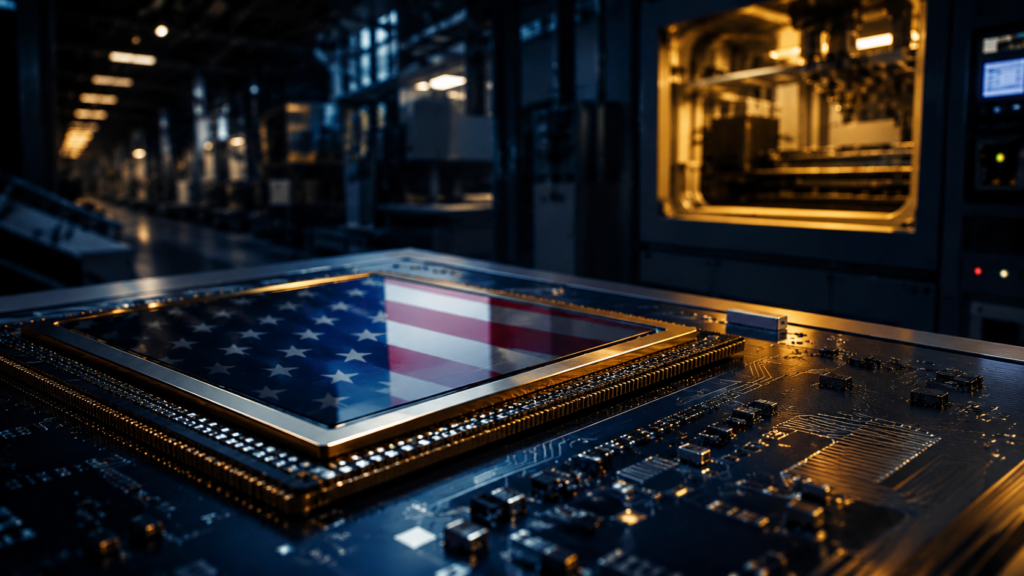
A potential shift in the semiconductor landscape could influence where the technology powering millions of consumer devices is made. President Donald Trump announced Thursday that Intel and Apple have reached an agreement aimed at producing computer chips in the United States, a move designed to expand domestic manufacturing capacity and reduce dependence on overseas suppliers. Investors welcomed the news, sending Intel shares sharply higher in premarket trading.
Trump Backs Domestic Chip Production
In a post on Truth Social, Trump said the agreement reflects his administration’s effort to expand semiconductor design and manufacturing on American soil. He framed the initiative as an important step toward strengthening supply-chain security and maintaining the country’s technological edge.
The announcement aligns with a broader push in Washington to rebuild domestic chipmaking capabilities. According to the Semiconductor Industry Association, the United States is projected to more than triple its semiconductor manufacturing capacity by 2032, representing the fastest growth rate of any region during that period.
Industry analysts have long argued that advanced chip production is no longer just an economic issue. “Semiconductor manufacturing has become a strategic asset, not simply an industrial one,” noted Dan Hutcheson, vice chair of TechInsights, in previous industry commentary on global chip supply chains.
Apple Looks to Diversify Its Supply Chain
For Apple, the reported arrangement would mark another step toward broadening its manufacturing footprint. The company currently relies heavily on Taiwan-based production for the processors used in iPhones, iPads, and Mac computers.
A domestic manufacturing relationship with Intel could provide Apple with additional flexibility as technology companies seek to reduce concentration risk within their supply chains. While Apple has not publicly commented on Trump’s announcement, the reported deal reflects a wider industry trend toward geographic diversification.
The timing is notable. Apple CEO Tim Cook recently told The Wall Street Journal that rising costs for memory and storage chips, driven in part by growing demand linked to artificial intelligence, are making product price increases increasingly difficult to avoid.
Intel’s Rapid Rise Draws Attention
The agreement also places renewed attention on Intel’s resurgence. Last August, the Trump administration invested $8.9 billion in the company, acquiring an approximately 10% stake to support semiconductor research and manufacturing expansion across the United States.
Trump highlighted the sharp increase in Intel’s market value since that investment, suggesting the government’s stake has appreciated substantially. Investors appeared encouraged by the latest development, pushing Intel shares more than 9% higher before markets opened.
As highlighted by GrowBusinessMag, semiconductor manufacturing sits at the center of modern economic competitiveness, influencing everything from consumer electronics and artificial intelligence to national security and advanced industrial systems.
Outlook
If the reported partnership advances as outlined, it could accelerate the growth of US-based chip production while giving Apple greater supply-chain flexibility and providing Intel with a significant long-term customer. More broadly, the announcement signals how governments and technology companies are increasingly treating semiconductor capacity as a critical component of future economic and technological leadership.