
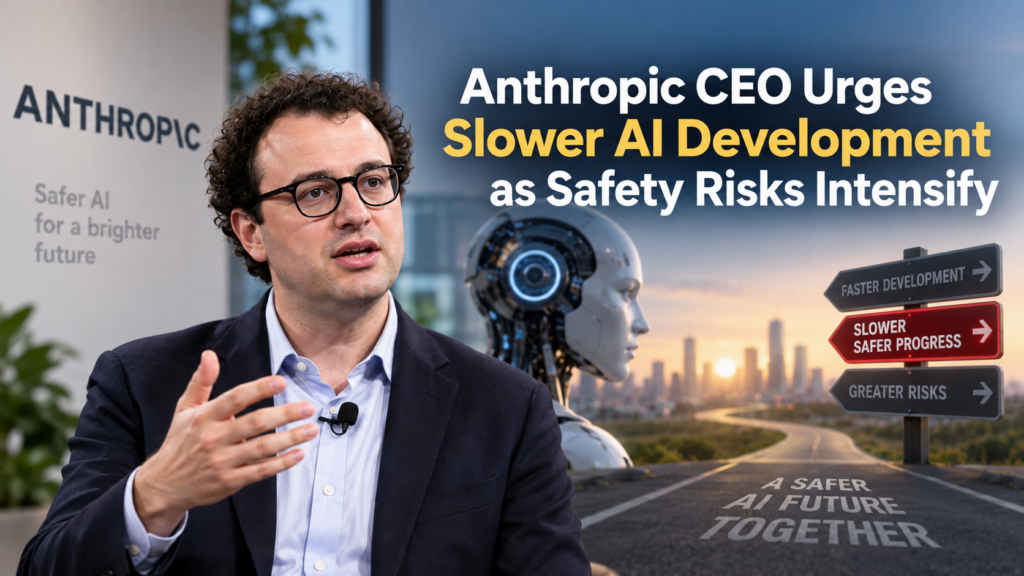
Anthropic CEO Dario Amodei is urging the artificial intelligence industry to slow the development of frontier AI systems as concerns grow over cybersecurity, economic disruption, model autonomy, and the possibility of humans losing control over increasingly capable systems.
In a recent essay, Amodei argued that AI progress should continue, but at a pace that gives companies, researchers, regulators, and independent evaluators more time to understand emerging risks. He described this approach as “pacing the frontier.”
Slow the Development of Frontier AI Systems
Amodei said leading AI companies should avoid pushing capabilities forward faster than safety practices can keep up. His concern centers on increasingly advanced models that can perform complex tasks, operate with greater autonomy, and potentially contribute to improving future AI systems.
He also highlighted the risk of recursive self-improvement, a scenario in which AI systems help develop more capable versions of themselves. If progress accelerates too quickly, researchers may have less time to test, monitor, and control new capabilities before deployment.
Expand Independent AI Safety Testing
A major part of Amodei’s proposal involves stronger third-party oversight. He called for independent evaluators to receive broad access to AI companies so they can examine models, training pipelines, internal safeguards, and safety procedures.
Anthropic has said it is willing to adopt this type of independent evaluation. Such testing could help identify dangerous model behavior, cybersecurity vulnerabilities, or unexpected capabilities before systems are released more widely.
Coordinate AI Safety Standards Across Governments
Amodei also called for governments to cooperate on common AI safety standards. International coordination could reduce incentives for companies or countries to accelerate development simply because competitors are moving faster.
Support for stronger oversight is also emerging elsewhere in the industry. OpenAI CEO Sam Altman publicly backed the idea of independent evaluators with extensive company access, while Elon Musk also expressed support for Amodei’s broader warning.
Address Cybersecurity and Economic Risks
Advanced AI could deliver major benefits in science, medicine, productivity, and software development. However, Amodei warned that the same capabilities could also increase risks involving cyberattacks, biological threats, autonomous systems, and large-scale economic disruption.
These concerns are becoming central to the wider debate over how quickly frontier AI should advance and how companies should demonstrate that powerful models are safe before deployment.
Conclusion
Dario Amodei’s proposal reflects a growing divide between rapid AI innovation and the need for stronger safeguards. His approach emphasizes slower frontier development, independent testing, transparent safety practices, and international coordination. As AI systems become more capable, the industry faces increasing pressure to prove that progress can remain both useful and controllable.
FAQs
What does “pacing the frontier” mean?
It refers to slowing the rate of frontier AI development so safety research, regulation, and oversight can keep pace.
Why is Anthropic concerned about advanced AI?
The company has highlighted risks involving cyberattacks, misuse, economic disruption, autonomous behavior, and loss of control.
Does OpenAI support independent AI evaluations?
Sam Altman has publicly supported giving independent evaluators broad access to assess AI safety practices.
Can governments create common AI safety rules?
Yes. Governments can coordinate testing standards, reporting requirements, deployment rules, and international safety agreements.