A small planet inside a Snapchat Friendship Profile can raise an unexpectedly personal question: how close are you to someone in their digital life
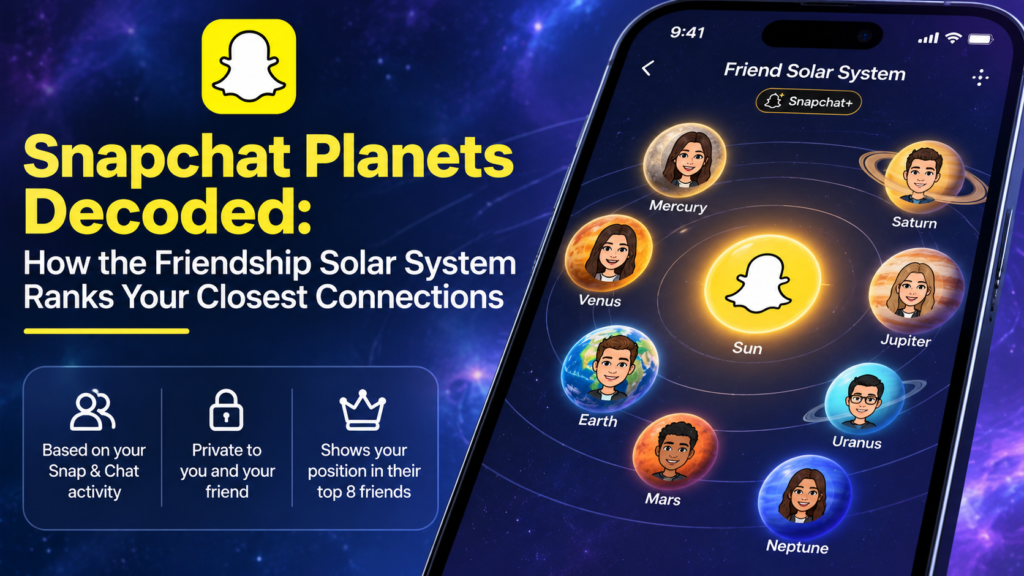
Snapchat planets turn patterns of communication into a visual Solar System. One friend appears as the Sun, while the other person’s Bitmoji is placed on Mercury, Venus, Earth, or another planet according to their position in that friend’s Best Friends list. A planet near the Sun indicates a higher ranking, while a more distant planet represents a lower position within the top eight.
The feature looks simple, but its meaning is often misunderstood. Snapchat planets do not measure loyalty, trust, affection, or the quality of an offline relationship. They reflect activity inside Snapchat, particularly how often people Snap and Chat compared with other contacts.
They also do not reveal a complete list of another user’s closest friends. The Solar System provides a private view of your own position, not a public map of everyone in someone else’s orbit. Used carefully, the feature can offer an interesting look at communication habits. Taken too seriously, it can turn ordinary changes in app activity into unnecessary social tension.
Understand What Snapchat Planets Are and How They Work
Snapchat planets belong to the Friend Solar System, a feature offered through Snapchat+. It represents the positions in a user’s Best Friends list with the eight planets of the Solar System.
When you open the feature through another person’s Friendship Profile, that person appears as the Sun. Your Bitmoji appears on one of the planets. Mercury represents the highest position because it is closest to the Sun, while Neptune represents the eighth position because it is the farthest planet in the sequence.
Snapchat defines Best Friends as the people a user Snaps and Chats with most often. A person can have up to eight Best Friends, and those positions are updated regularly as communication habits change. Snapchat does not publish the exact formula used to calculate the ranking.
View the Solar System From the Right Perspective
The perspective of the Solar System is the detail users most often misread. You are not automatically the Sun surrounded by your contacts.
Suppose you open Maya’s Friendship Profile and tap the gold-ringed Best Friends badge. Maya becomes the Sun in the display. Your Bitmoji appears on the planet that reflects your position in Maya’s Best Friends list.
If you appear on Mercury, you currently hold the highest position among the people Maya communicates with most on Snapchat. If you appear on Mars, you are fourth. If you appear on Neptune, you are eighth.
This view does not show where Maya ranks on your own list. Snapchat evaluates each account separately, so the positions may not match. You could place someone first while appearing third or fifth in their Solar System because they communicate frequently with a different set of people.
A mismatch therefore does not prove that a friendship is one-sided. It shows that two users have different patterns of activity inside the app.
Separate Snapchat Planets From Snap Score
Snapchat planets and Snap Score both relate to account activity, but they answer different questions.
Snap Score is a broader account-level figure. Snapchat says its calculation includes factors such as sent and received Snaps, posted Stories, and other undisclosed activity. It does not show how one specific friendship ranks against another.
The Friend Solar System focuses on a particular connection. It places you within one person’s group of most frequently contacted friends.
A user can have a high Snap Score without placing you near the center of their Solar System. That person may use Snapchat heavily across many conversations. Someone with a lower overall score may place you on Mercury because most of their activity is concentrated on you.
Snap Score reflects broad use of the platform. Snapchat planets reflect your relative position within one user’s communication habits.
Recognize What the Feature Does Not Reveal
The Solar System is private and limited by design. It does not display the identities of the people on the other planets. It also does not publish a numbered list that other users can browse.
Seeing yourself on Jupiter tells you that you occupy the fifth planetary position. It does not reveal who appears on Mercury, Venus, Earth, or Mars.
Snapchat describes the feature as an optional, private representation of communication frequency. Other people cannot view your individual planet display, and the system is not intended to expose someone’s entire friendship network.
Those limits matter because screenshots and online guides can make the feature seem more revealing than it is. In practice, the Solar System provides only one piece of information: your current place within a specific friend’s top eight.
Understand the Scale of Solar System Use
Snapchat has acknowledged that ranking-based friendship features can make some users feel pressure. In a company newsroom post, Snap reported that the Solar System was used by less than 0.25% of its community on an average day. The company also described the feature as private, optional, and available only to Snapchat+ subscribers.
That statistic provides useful perspective. Snapchat planets receive considerable attention in online searches and social discussions, but active daily use has represented a very small share of the overall Snapchat community.
Snap also made the feature inactive by default for first-time Snapchat+ subscribers, requiring users to turn it on themselves. That choice gives subscribers more control over whether they want to see friendship positions at all.
Find Your Snapchat Solar System
Viewing Snapchat planets requires access to Snapchat+ and an enabled Solar System setting. The feature does not automatically appear for every user, every friendship, or every profile.
Snapchat’s support guidance states that the Solar System is off by default for first-time subscribers. Users must activate it from the Snapchat+ feature management page before they can open the planetary view.
Turn On the Solar System Feature
Open Snapchat and tap your profile icon or Bitmoji in the upper-left corner. Select the Snapchat+ membership card near the top of the account page.
Look through the available subscriber tools for Solar System or Friend Solar System. Switch the feature on. Snapchat allows subscribers to enable or disable it again at any time.
The menu may look slightly different depending on the device, operating system, app version, or region. Updating Snapchat through the official app store can help when a subscription feature is missing from the settings page.
Turning on the feature does not produce a single screen showing all your planets. The Solar System is accessed through individual Friendship Profiles.
Open the Correct Friendship Profile
From Snapchat’s camera screen, swipe right to enter Chat. Find the person whose profile you want to view, then tap that friend’s Bitmoji or profile icon.
The Friendship Profile contains saved content and relationship-specific features. Snapchat says users can access one by swiping right from the camera screen and selecting a friend’s Bitmoji.
Look for a Best Friends badge with a gold ring. Tap the badge to open the Solar System. The friend will appear as the Sun, and your Bitmoji will appear on the corresponding planet.
A screenshot of a Friendship Profile may notify the other user, so capturing the display should not always be treated as invisible activity.
Read the Badge Before Tapping It
The badge identifies the type of friendship information available. Snapchat says a Best Friends badge means the person is among the eight friends you Snap and Chat with most. The gold ring indicates that the Snapchat+ Solar System can be opened through that badge.
The feature is therefore not a universal profile decoration. It depends on Best Friends status and eligible Snapchat+ access.
Users sometimes search for a standalone page called “My Snapchat Solar System.” Snapchat instead presents the feature one friendship at a time. You choose a person, open their Friendship Profile, and see your place in their orbit.
This design keeps the information more private but also makes the feature less comprehensive than many users assume.
Troubleshoot a Missing Planet
A missing Solar System does not automatically mean that someone has unfriended you or stopped communicating with you.
First, confirm that your Snapchat+ subscription is active. Then check that Solar System is switched on in the Snapchat+ feature management area. Update the app and restart it if the setting or badge still does not appear.
You may also be outside the other person’s current top eight, or the app may not yet have updated the ranking. Snapchat says Best Friends change over time and are refreshed regularly according to Snapping and Chatting behavior.
Feature availability can also vary during app testing or staged rollouts. Technical explanations should be considered before interpreting a missing badge as a change in the relationship.
Decode What Planet Distance and Order Actually Mean
The Snapchat planet order follows the familiar sequence from Mercury to Neptune. Each planet represents one position in a friend’s top eight.
Mercury is first because it is nearest to the Sun. Venus is second, Earth is third, and the sequence continues outward until Neptune in eighth place. Snapchat confirms that every planet corresponds to a different Best Friends position.
The display uses distance as a metaphor for communication frequency. It is not intended as a scientific representation of friendship or a precise measure of closeness.
Interpret Mercury Through Neptune
Mercury represents the first position. Your activity with that friend currently ranks above their interactions with other Best Friends.
Venus represents the second position. You are one of the person’s most active Snapchat contacts, with one friend currently placed ahead of you.
Earth represents the third position. You remain near the center of the person’s most frequent Snapchat activity.
Mars represents the fourth position. You occupy the final place in the upper half of the top eight.
Jupiter represents the fifth position. You are still one of the person’s Best Friends, although four contacts rank higher.
Saturn represents the sixth position. Your interaction remains strong enough to qualify for the top eight but is lower than that of five contacts.
Uranus represents the seventh position. You are close to the outer edge of the current Best Friends list.
Neptune represents the eighth position. You hold the final place in the top eight. Neptune still represents Best Friends status rather than exclusion.
The planets show order, but they do not disclose how much activity separates one position from another.
Treat Every Position as Relative
Snapchat does not assign a public Snap total to Mercury, Venus, or any other planet. A planet position is calculated in relation to the other people that friend communicates with.
One Mercury position might be supported by constant daily exchanges. Another might result from lighter activity because that person uses Snapchat less often.
The same applies to Neptune. Eighth place could reflect regular communication on an account with many active friendships, while Mercury could require relatively little activity on an account with only a few contacts.
The system tells you where you stand in the order. It does not tell you the total volume behind that placement.
Expect the Order to Move
Snapchat’s Best Friends list changes as users communicate with different people. A planet can move closer to the Sun when interaction becomes more frequent, move farther away when other contacts become more active, or disappear when the user falls outside the top eight.
The company does not publish an exact refresh schedule or reveal how individual actions are weighted. Sending one Snap may not immediately change a planet, and a long Chat may not have an obvious effect.
Online claims that promise Mercury after a precise number of Snaps are therefore unreliable. Snapchat has not released a public formula that would support those guarantees.
Avoid Reading the Orbit as an Emotional Score
Snapchat planets measure app behavior, not the depth of a relationship.
A childhood friend who prefers phone calls may appear farther away than a classmate who sends casual Snaps every day. A family member who communicates mainly through text messages may not appear in the Solar System at all.
Work routines, school schedules, Streaks, group activity, travel, and changes in platform use can all influence rankings. None of those factors provides a complete picture of how two people feel about one another.
Industry observers note that social-ranking features are easiest to understand when users separate measurable platform activity from emotional closeness. A digital position may describe communication frequency accurately while still giving an incomplete picture of the relationship itself.
Apply Practical Tips for Understanding Friend Rankings
Snapchat planets become more useful when they are treated as temporary communication signals rather than permanent friendship labels.
The feature can reveal that you are among someone’s most active Snapchat contacts. It cannot explain the reasons behind that activity, measure the quality of the exchanges, or determine whether the same closeness exists offline.
Watch Trends Instead of Daily Movement
Repeatedly checking one person’s planet can make ordinary fluctuations feel more important than they are.
A ranking may shift because the friend is traveling, maintaining a Streak, participating in a busy group conversation, or speaking more often with family members. Moving from Earth to Mars does not necessarily signal conflict.
Longer patterns are more informative than daily movement. Remaining within the top few planets over time suggests consistent Snapchat interaction. Moving between nearby positions may simply reflect small changes among several active friendships.
A single shift should not be treated as evidence that someone is losing interest.
Consider the Friend’s Snapchat Habits
Each user has a different communication style. Some people maintain many conversations, send frequent Snaps, and use the platform throughout the day. Others open Snapchat only occasionally.
A fifth-place position on a highly active account may involve more communication than a first-place position on a quiet account. The Solar System provides rank, not total volume.
Offline habits matter as well. Two friends may speak every day at school, live together, work in the same office, or communicate through another app. Their Snapchat planet will not capture those interactions.
The most accurate interpretation combines the app signal with what you already know about the person’s habits.
Do Not Assume Rankings Are Mutual
Snapchat rankings can differ in each direction.
You might communicate with one person more than anyone else and therefore place them first in your activity pattern. That person might divide their time among several active contacts, placing you on Earth or Mars.
This difference is normal because the system evaluates each account separately.
Snapchat+ also includes a feature that lets a subscriber privately pin one person as a number-one Best Friend. Snapchat says only the subscriber can see the selection unless both Snapchat+ users pin each other, in which case they may receive a mutual Best Friend indicator.
That manual pinning option should not be confused with every planet position produced by ordinary activity.
Avoid Sending Content Only to Change Rank
Trying to move closer to the Sun by sending empty Snaps or repeated messages can make a friendship feel forced.
Ranking manipulation may create more activity, but it does not create better communication. It can also irritate the other person, especially when the content has no purpose beyond maintaining a Streak or influencing a badge.
Natural interaction is more useful. Send a Snap because it is funny, relevant, personal, or worth sharing. Start a Chat because you have something meaningful to say.
A planet earned through genuine communication provides a more accurate picture than one produced through spam.
Speak Directly When Something Feels Wrong
A Snapchat planet cannot explain a disagreement, a delayed reply, or a change in someone’s behavior.
When a friendship matters, direct conversation is more reliable than interpreting app symbols. A friend may be busy, spending less time online, focusing on school, dealing with family responsibilities, or communicating through a different platform.
Checking the Solar System repeatedly may confirm that activity changed, but it cannot explain why.
Use the feature for light insight. Use real conversation for questions that carry emotional weight.
Compare Every Snapchat Planet Position
| Snapchat Planet | Best Friends Position | What the Position Shows | Balanced Interpretation |
|---|---|---|---|
| Mercury | 1st | You currently rank highest in that friend’s Snapchat activity | You are their most frequently contacted Best Friend on the app |
| Venus | 2nd | One Best Friend ranks ahead of you | You remain one of their strongest Snapchat connections |
| Earth | 3rd | Two contacts generate more activity | You communicate frequently and remain near the center |
| Mars | 4th | You hold the final upper-half position | You are an established and active Snapchat contact |
| Jupiter | 5th | Four Best Friends currently rank higher | You remain within the top eight despite a more distant orbit |
| Saturn | 6th | Five contacts generate more qualifying activity | Your position is active but may change with new communication patterns |
| Uranus | 7th | You are near the edge of the top eight | You still qualify as one of the friend’s Best Friends |
| Neptune | 8th | You occupy the last current Best Friends position | You are in the top eight, but the position may be easier to lose |
The table explains relative order rather than emotional value. Snapchat says Best Friends are the people a user Snaps and Chats with most, and those positions are updated regularly.
Answer Common Questions About Snapchat Planets
Do Snapchat planets reveal someone’s full Best Friends list?
No. The Solar System shows only your own planet in another person’s friendship display. It does not identify the users occupying the other positions or reveal a complete ranked list. Snapchat describes the feature as private and not visible to other people.
Which Snapchat planet represents the closest position?
Mercury represents the first position because it is closest to the Sun. Appearing on Mercury means you currently rank highest among that friend’s Best Friends based on Snapchat activity. It does not prove that you are the person’s closest friend in every part of life.
Can a Snapchat planet change?
Yes. Snapchat updates Best Friends regularly as users Snap and Chat with different contacts. Your planet may move inward, move outward, or disappear if you fall outside the other person’s top eight. Snapchat does not disclose exactly when each recalculation takes place.
Is the Solar System available without Snapchat+?
No. Friend Solar System is listed as a Snapchat+ feature. Subscribers must also enable it in the Snapchat+ feature management area because it is off by default for first-time subscribers.
Does Neptune mean someone does not value the friendship?
No. Neptune means you currently hold the eighth position in that person’s Best Friends list. It reflects comparative Snapchat activity, not affection or respect. A person’s use of other messaging platforms, offline communication, family responsibilities, or Streak habits can all affect the result.
Use Snapchat Planets as a Communication Clue, Not a Friendship Verdict
Snapchat planets give a playful visual identity to patterns the app already tracks. Mercury, Venus, Earth, Mars, Jupiter, Saturn, Uranus, and Neptune represent the eight positions within a friend’s Best Friends list.
The system is useful only when its limits remain clear. It shows your position in one person’s activity pattern, not every contact in their social circle. It does not provide an exact Snap requirement, guarantee a mutual ranking, or measure emotional closeness.
A place near the Sun generally means more frequent Snapchat communication. A distant planet means other contacts are currently generating more activity. Both positions can change as daily habits shift.
Open your Snapchat+ settings, enable the Solar System feature, and visit a qualifying Friendship Profile to see your current orbit. Enjoy the feature as a snapshot of app activity, but let honest communication and real shared experiences determine the strength of the friendship.