
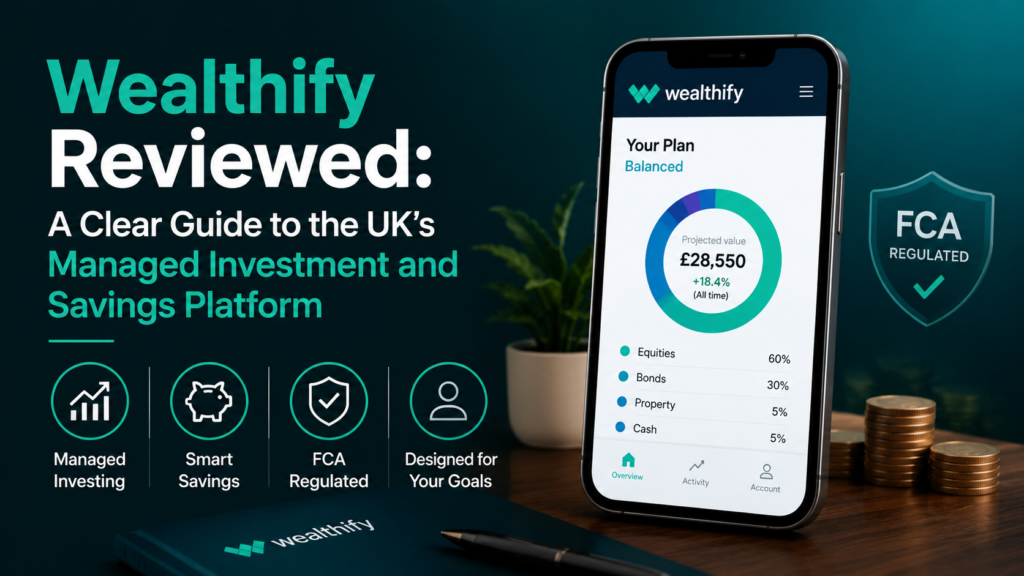
Investing no longer requires building a portfolio one share at a time. Digital investment services now offer a more guided route, combining online account opening with ready-made portfolios and ongoing management. Wealthify is one such platform, aimed primarily at UK customers who want market exposure without selecting and monitoring every underlying investment themselves.
Launched publicly in 2016 and based in Cardiff, Wealthify describes itself as an online investing and saving service. It is backed by Aviva and regulated by the Financial Conduct Authority. According to its website, the platform offers managed investment plans, individual savings accounts, a personal pension and cash savings products through a digital interface.
That combination may suit people who value simplicity, but automation does not make investing predictable. Portfolio values can rise and fall, charges reduce the amount left invested, and the most suitable account depends on the customer’s objectives, tax position and need for access.
The wider UK market also shows why clear explanations matter. The FCA’s Financial Lives 2024 survey found that 61% of adults with more than £10,000 in investible assets held at least three-quarters of those assets in cash rather than investments. The findings suggest many people continue defaulting to cash even when they have enough set aside to consider investing, even as app-based platforms make investment products easier to access.
Financial disclaimer: This article is for general information only. It is not financial, investment, pension or tax advice. Investments can fall as well as rise, and investors may receive back less than they contribute. Tax rules and allowances can change, and their effects depend on personal circumstances. Readers should review Wealthify’s current fees, terms, product documents and risk disclosures and consult a regulated financial adviser before making decisions based on their individual situation.
Understand What Wealthify Is
Wealthify is a UK digital investment manager, often placed within the robo-adviser category. Instead of asking customers to select individual shares or funds, it provides ready-made portfolios built around a chosen investment style and level of risk.
The account-opening process appears to involve questions about the customer’s circumstances, financial objectives, investment period and tolerance for losses. Wealthify then uses those answers to suggest an investment plan. Once the customer funds the account, the platform manages the portfolio, selects the underlying funds and makes adjustments when it considers them necessary.
This approach occupies the space between self-directed investing and conventional financial advice. A self-directed brokerage account usually leaves the investor responsible for researching securities, choosing funds and maintaining an asset allocation. A traditional financial adviser may examine the client’s wider finances and make personalised recommendations. Wealthify offers a more standardised digital service centred on managed portfolios.
That distinction is important. A managed online plan can reduce the number of investment decisions a customer must make, but it does not necessarily provide a complete personal financial plan. The platform may not take account of every mortgage commitment, debt, insurance need, estate-planning issue or future change in income.
Wealthify’s website states that it was founded before launching its Stocks and Shares ISA and General Investment Account to the public in April 2016. It also states that the business is backed by Aviva and regulated by the FCA.
FCA regulation means the company must operate within applicable UK financial-services rules. It should not be read as an endorsement of a particular portfolio or a promise that customers will avoid losses. Regulation and investment performance address different questions: regulation concerns how a firm conducts its business, while performance depends on markets, portfolio construction, costs and time.
The platform is designed for eligible UK customers. Based on the information provided for this article, investment accounts are generally available to UK tax residents aged 18 or over, while a parent or guardian may open a Junior ISA for an eligible child. Residency, identity and account-specific eligibility requirements should be checked directly before applying.
Wealthify also provides access to cash savings products. Cash savings and investment plans may appear together within the same digital environment, but they serve different purposes. Savings accounts are generally intended to preserve accessible cash and pay interest, while investment plans expose capital to market movements in pursuit of potential longer-term growth.
Choose an Investment Plan That Matches the Goal
A Wealthify investment plan should begin with a specific purpose rather than a general desire to make money. Common goals might include building long-term wealth, investing within an ISA, putting money aside for a child or contributing toward retirement.
The goal influences the account wrapper, the likely investment period and the amount of risk that may be reasonable. Money intended for retirement several decades away can often withstand more short-term variation than money reserved for a property purchase next year. Even so, a long time horizon does not guarantee a positive return.
After the customer chooses an account, Wealthify appears to assess factors related to risk and suitability through its online journey. The platform then places the money into a managed portfolio rather than asking the customer to choose each underlying holding.
The available risk levels are intended to reflect different balances between potential growth and market fluctuation. Lower-risk portfolios may include a larger allocation to assets commonly viewed as more defensive. Higher-risk portfolios may hold more shares and other growth-focused investments.
These descriptions are relative rather than absolute. A lower-risk investment portfolio can still lose money, particularly during periods when several asset classes decline together. A higher-risk plan may deliver stronger results in some market conditions but can also experience sharper losses.
Customers should also distinguish between willingness to take risk and ability to absorb a loss. Someone may feel comfortable watching markets fluctuate but still need the invested money for an essential expense. In that case, the person’s financial capacity for loss may be lower than their emotional tolerance suggests.
Industry observers often note that the main value of automated portfolio services is behavioural as much as technical. A structured portfolio and automatic rebalancing may help some investors avoid frequent, emotionally driven changes. However, automation cannot prevent a customer from withdrawing during a downturn, and it cannot make an unsuitable risk level appropriate.
Select Between Original and Ethical Portfolios
Wealthify offers two broad investment approaches, referred to as Original and Ethical plans.
Original plans appear to focus on broad portfolio construction using selected funds to achieve a target mix of assets. The platform may use passive or index-tracking funds alongside other investments, depending on its current portfolio methodology.
Ethical plans apply additional standards related to environmental and social considerations. These portfolios may exclude or reduce exposure to certain industries while favouring funds that meet defined responsible-investment criteria.
The label “ethical” should not be treated as a universal certification. Different fund managers use different screening methods, definitions and thresholds. One fund might exclude tobacco companies but permit oil producers engaged in transition projects. Another might apply broader climate or governance requirements.
Customers considering an Ethical plan should examine the actual fund criteria rather than relying on the name alone. Useful questions include which industries are excluded, whether positive screening is used, how corporate conduct is assessed and whether fund managers engage with companies on environmental or social issues.
The two approaches also differ in cost. Wealthify’s current fee page states that approximate fund and trading costs are 0.14% per year for Original plans and 0.46% per year for Ethical plans, although the platform notes that these investment costs can vary.
Higher underlying costs do not automatically make an Ethical plan unsuitable, just as lower costs do not automatically make an Original plan preferable. The choice involves personal values, desired exposure, diversification and the total price of the service.
Follow How Wealthify Manages the Portfolio
Once an account has been funded, Wealthify manages the investment portfolio on the customer’s behalf. The customer chooses the plan and risk approach, while the platform handles the underlying fund selection and ongoing adjustments.
A portfolio may hold funds that provide exposure to company shares, government or corporate bonds and other asset classes. The exact holdings depend on the selected plan and Wealthify’s current investment strategy.
Spreading money across multiple funds and markets is intended to reduce dependence on a single company, industry or investment type. This is the principle of diversification. It can soften the effect of one holding performing poorly, but it does not remove the possibility that the portfolio as a whole will decline.
Diversification can also behave differently across market cycles. Assets that usually move independently may fall at the same time during periods of severe uncertainty. Customers should therefore view diversification as a risk-management method, not as insurance against loss.
Wealthify also states that its management service includes rebalancing. Its fee information describes the management charge as covering portfolio construction, buying and selling, ongoing management and rebalancing.
Rebalancing becomes relevant when price movements push a portfolio away from its intended allocation. Suppose a portfolio begins with a set proportion in shares and bonds. If shares rise more quickly, they may eventually represent a larger share of the account than originally planned. Rebalancing involves making changes intended to bring the allocation closer to its target.
This process supports consistency, but it does not forecast which market will perform best next. Rebalancing may involve selling assets that have recently risen and adding to assets that have lagged. That can help maintain the chosen risk profile, although the effect on returns will depend on subsequent market movements.
Wealthify may also change funds or portfolio allocations when its investment team believes an adjustment is appropriate. Customers should review the platform’s current investment methodology to understand the degree of discretion it retains and the circumstances in which portfolio changes may occur.
Review Wealthify Fees and Account Types
Wealthify states that it charges an annual management fee of 0.6% for its managed investments. The fee is calculated according to the value of the investments and collected monthly.
For the Wealthify Personal Pension, the platform states that the management fee falls to 0.3% on the portion of the pension balance above the relevant £100,000 threshold. The reduced rate does not appear to replace the charge on the whole account. It applies to the qualifying portion of the balance.
The management fee is only one part of the total cost. Underlying funds also impose charges, and trading-related costs may apply. According to Wealthify’s current fee page, approximate fund and trading fees are 0.14% per year for Original plans and 0.46% per year for Ethical plans, although those figures may change as the holdings and costs of the underlying funds change.
These charges are deducted whether the portfolio rises or falls. An investor should therefore assess fees in cash terms as well as percentages. For example, the cost on a small starting balance may look modest, but percentage-based fees can become more significant as the account grows.
Customers should calculate the likely annual management fee, add the estimated underlying investment costs and compare the result with alternatives offering a similar level of service. A low-cost self-directed account is not an exact substitute for a managed portfolio, because the investor takes on more responsibility.
Minimum investments vary by product. Based on the information supplied for this article, some Wealthify products may accept contributions from as little as £1, while a General Investment Account may require about £1,000. Wealthify’s current product pages should be treated as the final source because minimums and funding requirements can change.
Use a Stocks and Shares ISA for Tax-Efficient Investing
A Wealthify Stocks and Shares ISA allows eligible adults to invest through an ISA wrapper. Under current UK rules, eligible income and gains generated within an ISA are generally sheltered from UK income tax and capital gains tax.
The tax wrapper does not protect the investment from market losses. A customer can still receive back less than they invested, particularly when withdrawing after a market decline.
A Stocks and Shares ISA may be suitable for medium- or long-term objectives where the customer can tolerate changes in value. It may be less appropriate for money needed on a fixed date in the near future.
Annual ISA subscription rules apply across the customer’s eligible accounts. Tax allowances and regulations can change, so readers should confirm current HM Revenue and Customs guidance and consider professional advice where their tax position is complex.
Wealthify describes its Stocks and Shares ISA as flexible, which may allow eligible withdrawals to be replaced within the same tax year without using additional allowance, subject to current ISA rules and the product’s terms.
Build Long-Term Savings Through a Junior ISA
A Junior ISA allows a parent or guardian to invest for an eligible child within a tax-advantaged account.
The adult opens and manages the account, but the money belongs to the child. Access is generally restricted until the child reaches the age specified by the relevant UK rules.
The long period before access may support a long-term investment approach, but it does not remove risk. The eventual value will depend on contributions, fees, portfolio performance and the timing of market movements.
Families should also consider the transfer of control. Once the child reaches the applicable age, they normally gain the legal ability to manage and use the money. A parent may intend the account for education or a home deposit, but the adult child will generally decide how it is spent.
Wealthify applies its standard management structure to the Junior ISA, with separate underlying investment costs. Customers should confirm the latest minimum contribution and all current charges before opening the account.
Invest Outside an ISA Through a General Investment Account
A General Investment Account, or GIA, provides access to a managed portfolio without an ISA or pension wrapper.
This account may be relevant for a customer who has already used available tax-efficient allowances, wants to invest without pension access restrictions or needs a separate account for a particular goal.
Income and capital gains produced within a GIA may be taxable depending on the customer’s circumstances and current allowances. The investor may also need to maintain records for tax reporting.
A GIA should not automatically be opened simply because it offers flexible investing. Customers should first consider whether an ISA or pension would provide more suitable tax treatment, while also accounting for access restrictions and eligibility.
Based on the information supplied for this article, Wealthify may require around £1,000 to open a General Investment Account. The current minimum should be confirmed directly with the platform.
Save for Retirement Through a Managed SIPP
Wealthify’s Personal Pension is structured as a managed Self-Invested Personal Pension, commonly called a SIPP.
Although the term “self-invested” may suggest that the customer chooses every holding, Wealthify appears to build and manage the portfolio on the customer’s behalf. This makes it different from a fully self-directed SIPP used to buy individually selected shares, funds or other permitted assets.
Pensions may offer tax advantages, but the money is generally inaccessible until the customer reaches the minimum age allowed under pension law. Contribution limits, tax relief, transfer rules and withdrawal options depend on legislation and individual circumstances.
The management fee is 0.6% on the balance up to the stated threshold, with a 0.3% charge applying to the qualifying portion above it. Underlying investment costs remain separate.
Customers comparing pensions should look beyond the headline percentage. A percentage fee may remain competitive on one balance but become more expensive than a fixed-fee account as the pension grows. Service level, portfolio design, transfer support and withdrawal options also affect value.
Pension transfers require particular care. Some existing pensions contain safeguarded benefits, guarantees or valuable terms that may be lost after transfer. A regulated adviser should be consulted where the transfer involves complex benefits or where advice is legally required.
Keep Short-Term Money in Cash Savings
Wealthify also appears to offer access to cash savings products alongside its investment services.
Cash savings are not exposed to stock or bond market movements in the same way as an investment plan. They may therefore be more suitable for emergency reserves, near-term spending and money that must retain a stable cash value.
Cash still carries practical risks. A variable interest rate can change, and inflation may reduce purchasing power when prices rise faster than the account’s return. Access conditions can also vary between instant-access, notice and fixed-term products.
Customers should establish which institution legally holds the deposit, whether eligible funds receive Financial Services Compensation Scheme protection and how quickly money can be withdrawn. The answers may differ from the arrangements applying to Wealthify’s investment accounts.
Compare Wealthify Accounts Before Opening One
The following table summarises the main purposes and considerations attached to Wealthify’s available account types. It is a general guide rather than a substitute for the latest product documents.
| Account | Main purpose | Tax treatment | Access considerations | Indicative minimum |
|---|---|---|---|---|
| Stocks and Shares ISA | Medium- to long-term investing | Eligible income and gains are generally sheltered within ISA rules | Withdrawals may be allowed, but investments usually need to be sold first | May begin from as little as £1 |
| Junior ISA | Investing for an eligible child | Held within the Junior ISA tax wrapper | Money is generally inaccessible until the child reaches the applicable age | Product-specific minimum |
| General Investment Account | Investing outside a tax wrapper | Income and gains may be taxable | Withdrawals are generally possible after investments are sold | Around £1,000 based on the supplied information |
| Personal Pension or SIPP | Long-term retirement investing | Pension rules and potential tax benefits apply | Access is restricted until the legally permitted age | Product-specific minimum |
| Cash savings account | Emergency money or short-term goals | Depends on whether the account is taxable or held within a Cash ISA | Access depends on the savings product’s terms | Varies by product |
Wealthify customers must also choose between its Original and Ethical investment approaches.
| Feature | Original Plans | Ethical Plans |
|---|---|---|
| Portfolio approach | Broad managed allocation using selected investment funds | Managed allocation with additional environmental and social criteria |
| Screening | Standard fund-selection process | Additional exclusions or responsible-investment screens may apply |
| Investment style | May use a larger proportion of passive funds | May use a larger proportion of actively managed or screened funds |
| Approximate underlying costs stated by Wealthify | 0.14% per year | 0.46% per year |
| Main consideration | Broad exposure and lower stated underlying cost | Closer alignment with selected ethical preferences |
Neither option is inherently suitable for everyone. The decision should reflect the investor’s priorities, understanding of the screening process, preferred portfolio exposure and willingness to pay the associated costs.
Examine the Main Benefits and Limitations
Wealthify’s central benefit is its managed structure. Customers do not need to research every fund, place individual trades or rebalance the portfolio themselves.
That may be useful for people who understand the risks of investing but do not want to handle the day-to-day portfolio work. The platform’s digital interface may also make balances, contributions and account information easier to view.
The range of available accounts is another practical advantage. A customer may be able to hold an ISA, Junior ISA, GIA, personal pension and savings product through the same service. Keeping accounts together can simplify administration, although convenience alone is not a sufficient reason to choose a financial provider.
Aviva’s backing may be reassuring to customers who prefer a platform associated with a large financial-services group. It does not change the market risk within an investment portfolio and should not be taken as a performance guarantee.
The main limitation is the loss of individual investment control. Wealthify selects the funds and manages the allocation. Customers who want to buy specific shares, avoid particular companies or build a bespoke portfolio may find the available choices restrictive.
The fee structure also deserves scrutiny. A 0.6% management charge is added to underlying investment costs. An investor who is capable of selecting and maintaining a diversified portfolio may be able to reduce costs through a self-directed platform.
The comparison is not purely about price. A self-directed account transfers research, monitoring and rebalancing responsibilities to the customer. The relevant question is whether Wealthify’s management service provides enough practical value to justify its additional cost.
Check Important Risks Before Using Wealthify
The first consideration is the investment period. Market-based investments are usually better suited to money that can remain invested through both favourable and difficult conditions.
Funds needed for an emergency, tax bill, rent payment or near-term home purchase may not have enough time to recover from a decline. Holding those amounts in an appropriate cash account may provide more certainty.
Risk level is the next concern. Investors sometimes select higher-risk portfolios because they focus on possible returns while underestimating how they would respond to a substantial loss. A plan is only workable when the customer can remain committed through uncomfortable periods.
Customers should also review their overall finances. Expensive debt, insufficient emergency savings, unstable income or inadequate insurance may need attention before long-term investing becomes a priority.
Account selection creates another layer of risk. An ISA, GIA, Junior ISA and pension can hold similar portfolios while producing very different outcomes for taxation, ownership and access. Choosing the wrong wrapper can make money unavailable when it is needed or create tax consequences that might have been avoided.
Withdrawals are not always immediate. Investments may need to be sold, settled and transferred before cash reaches the customer’s bank account. This makes an investment plan unsuitable for expenses that require instant access.
Customers should also examine how assets are held and which protections may apply. FCA regulation and potential compensation arrangements do not cover ordinary investment losses. The Financial Services Compensation Scheme may apply only in particular circumstances, subject to eligibility and current limits.
Compare Wealthify With Other Investing Routes
Wealthify should be compared with platforms offering a similar level of service rather than with every investment account on headline fees alone.
Against a self-directed broker, Wealthify appears to offer more portfolio management and less individual control. The customer pays for fund selection, monitoring and rebalancing instead of carrying out those tasks personally.
Against a conventional financial adviser, the platform may provide a simpler digital journey and lower entry requirements. However, it may not deliver the same depth of personal planning for retirement income, inheritance, tax, insurance or complex family circumstances.
Against cash savings, a Wealthify investment plan provides exposure to markets and the possibility of longer-term capital growth. It also introduces the possibility of loss. Cash generally offers greater stability for short-term goals, while its purchasing power may be weakened by inflation.
A fair provider comparison should use the same account type, balance, risk level and investment period. Comparing a cautious Wealthify portfolio with a share-heavy portfolio elsewhere would not produce a meaningful assessment.
Customers should also compare service features, including customer support, withdrawal procedures, ethical screening, transfer options, portfolio transparency and the process for changing risk levels.
Complete Due Diligence Before Opening an Account
Before opening a Wealthify account, prospective customers should read the latest fee schedule, customer agreement, investment methodology, key features document and risk disclosures.
The fee should then be converted into an estimated annual cash amount. Customers should include Wealthify’s management charge and the applicable underlying investment costs.
The next step is to define the goal and likely withdrawal date. A portfolio intended for retirement has different requirements from an account intended to fund a property purchase.
Customers should also check whether they already hold ISAs or pensions elsewhere. Existing accounts may affect contribution limits, investment overlap, fees and the suitability of a transfer.
Past performance may provide historical information, but it cannot show what a portfolio will deliver in future. Investment decisions should not depend on a strong recent period or a single performance chart.
The final question is whether personal advice is needed. A customer with a straightforward long-term objective may feel comfortable using a managed digital service after completing their research. A person dealing with substantial assets, pension guarantees, inheritance planning or complicated tax circumstances may benefit from regulated advice.
Frequently Asked Questions About Wealthify
Is Wealthify a bank?
Wealthify is primarily presented as a digital investment and savings platform rather than a bank. Customers considering one of its savings products should check which banking institution holds the deposit, the applicable account terms and whether the funds qualify for deposit protection.
Is Wealthify regulated in the UK?
Wealthify states that it is regulated by the Financial Conduct Authority. FCA regulation concerns the firm’s conduct and compliance obligations. It does not protect customers from ordinary market losses or guarantee investment returns.
How much does Wealthify charge?
Wealthify states that its standard management charge is 0.6% per year, collected monthly. A 0.3% rate applies to the qualifying portion of a Wealthify Personal Pension above the stated £100,000 threshold. Underlying fund and trading costs are additional.
Can investors lose money with Wealthify?
Yes. Wealthify portfolios invest in market-based assets whose values can rise or fall. Diversification and rebalancing may help manage risk, but neither process guarantees a profit or prevents loss.
Does Wealthify provide financial advice?
Wealthify uses an online process to guide customers toward managed investment plans, but readers should consult its current legal documents for the exact nature and scope of the service. It should not automatically be treated as a replacement for comprehensive advice based on a person’s full financial circumstances.
Decide Whether Wealthify Fits the Financial Plan
Wealthify offers a guided route into investing for eligible UK customers who prefer a managed portfolio to selecting individual investments.
Its ready-made portfolios, automated management, rebalancing, account range and choice between Original and Ethical plans may make it appealing to people seeking a relatively hands-off service. Its savings products may also allow customers to manage short-term cash and long-term investments through a connected digital experience.
The platform still requires careful judgment. Investors must choose an appropriate account and risk level, understand the full cost and accept that the portfolio can decline. Wealthify’s management service may reduce the practical workload, but it cannot guarantee returns or make market risk disappear.
Before committing money, readers should compare Wealthify with other managed platforms, self-directed services and cash savings accounts. They should calculate the likely charges, review product restrictions and decide how long the money can realistically remain invested.
The most appropriate portfolio is not necessarily the one with the highest growth target. It is the one that matches the customer’s objective, time horizon, financial resilience and ability to remain invested when markets become unsettled.
Review Wealthify’s latest product pages, fee schedule, investment methodology and risk disclosures before opening an account. For decisions involving pensions, taxation, substantial assets or limited capacity for loss, consult a regulated financial adviser who can assess the full personal circumstances.