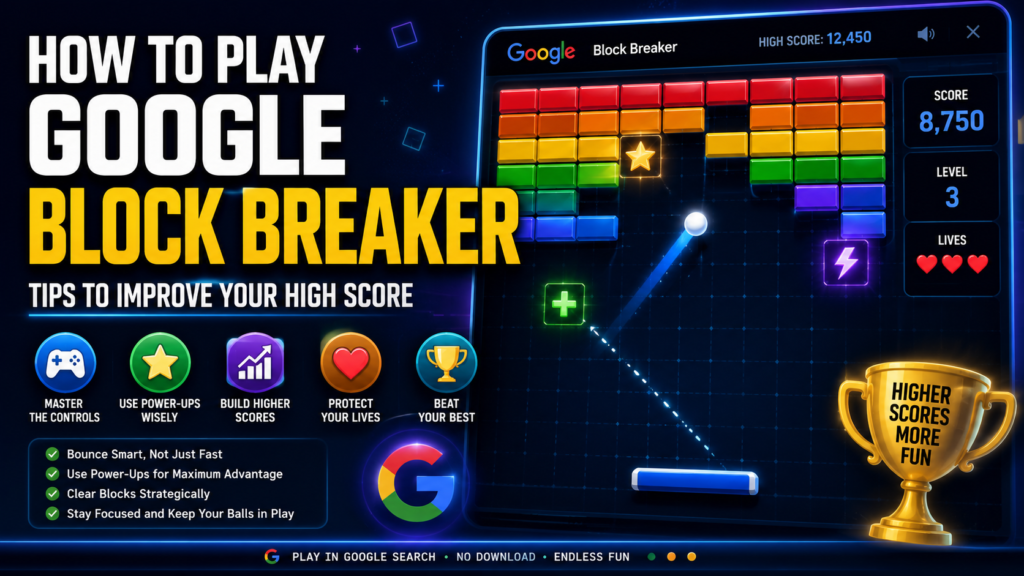
A search page is usually a route to information, but occasionally it becomes the entertainment itself. Google Block Breaker turns a familiar browser window into a fast arcade challenge built around one simple objective: keep a ball in play long enough to clear every breakable block.
The concept is easy to recognize. A paddle moves along the bottom of the screen, a ball travels across the play area, and rows of colorful blocks stand between the player and the next stage. The difficulty comes from controlling rebounds, collecting useful power-ups, and reacting as additional balls and faster movement make the screen increasingly unpredictable.
Google describes the game as a modern version of the classic block-breaking format in which players bounce a ball with a paddle to destroy the blocks above. It runs directly through Google, so there is no conventional installation process or lengthy setup.
This guide explains how to access the game, control the paddle, use power-ups, protect your remaining lives, and develop a more reliable scoring strategy.
Open Google Block Breaker in Your Browser
The most direct way to access the game is through Google Search. Open Google in a compatible desktop or mobile browser, search for the game by name, and look for the playable game panel in the results.
Select the play button to open the full game interface. Because the game is browser-based, players generally do not need to download a separate application or create a dedicated gaming account. Its availability inside Search makes it suitable for a quick session without the setup required by a traditional PC, console, or mobile game.
Google also provides a direct game page that identifies Block Breaker as a paddle-and-ball arcade experience. That official page is the safest reference point when similarly named games appear elsewhere online.
The title should not be confused with every brick-breaking product listed in app stores. Several unrelated mobile games use names such as Block Breaker, Block Breaker King, or Blocks Breaker. Some are puzzle games, while others use level systems, advertisements, virtual coins, or different control schemes.
The Google version is also distinct from the older Atari Breakout Easter egg that once transformed Google Images results into bricks. The earlier feature appeared in 2013 and later disappeared from its original Search location. The newer game uses its own full-screen board, colored blocks, and power-ups rather than image thumbnails.
Learn the Basic Paddle and Ball Controls
Every round revolves around the relationship between the paddle and the ball. The paddle stays near the bottom of the play area and moves horizontally. Your first responsibility is to place it beneath the falling ball before the ball passes the bottom edge.
On a desktop computer, movement may be controlled with a mouse, trackpad, or keyboard input, depending on the active version and browser environment. On a touchscreen device, players can drag or move a finger horizontally to position the paddle.
The ball launches upward, strikes a wall or block, and returns toward the paddle. When it touches the paddle, it rebounds into the play area. When it hits a breakable block, that block is damaged or removed according to its type.
The objective is not simply to follow the ball. Effective control requires anticipating where the ball will arrive. Watch its angle after each collision and begin moving before it reaches the lower third of the screen.
Large emergency movements are less reliable than early, controlled adjustments. A player who waits until the ball is almost level with the paddle has little time to correct an inaccurate position.
The game begins with three lives according to published rules and descriptions of the playable version. Missing the ball costs one life, and the session ends after all remaining lives are lost.
That three-life limit gives every rebound value. A risky attempt to collect a bonus can improve the score, but it may not be worthwhile when it leaves the paddle too far from the ball’s predicted landing point.
Control the Ball’s Rebound Direction
The paddle does more than prevent the ball from leaving the screen. The location of contact can influence the direction of the next rebound.
A strike near the center of the paddle tends to produce a more direct return. Contact closer to an edge can send the ball along a sharper angle. The exact behavior can vary as speed and power-ups change, but the general principle gives players a degree of control over where the ball travels.
Use central contact when the board is chaotic and survival matters more than targeting. A predictable rebound provides time to reorganize, track extra balls, and move toward useful bonuses.
Use edge contact when you need to reach blocks along the sides or redirect the ball into an open channel. Angled shots can help the ball enter spaces above or behind a partially cleared row.
The most productive path is often not the shortest route to a visible block. A ball that travels through a narrow opening and reaches the space behind a block formation can rebound repeatedly across the upper area, destroying several blocks before returning to the paddle.
That outcome produces faster clearing and may release several bonuses in a short period. It also creates a new problem: the player must watch falling power-ups while predicting the eventual return of the ball.
Experienced play therefore combines two goals. The first is immediate survival. The second is shaping rebounds so that the ball spends more time among the remaining blocks.
Clear Strong Blocks Before They Become Obstacles
Not every block behaves in exactly the same way. Some disappear after one contact, while stronger blocks may require repeated hits. Others may interact with explosions, projectiles, or special balls.
At the beginning of a stage, the screen contains many possible targets. Random rebounds can make quick progress because nearly every upward shot reaches something. As the board empties, isolated blocks become harder to hit.
This is why durable or awkwardly positioned blocks deserve attention before the final phase of a level. A block near a corner may appear harmless while the screen is full, but it can become the only remaining target after easier blocks are gone.
Try to create rebound paths that cross difficult areas repeatedly. Side-to-side movement near the top of the board is particularly useful because the ball can contact several blocks without returning immediately to the paddle.
Avoid focusing so heavily on one target that you lose awareness of the ball. The game rewards precision, but it punishes tunnel vision. Your eyes should follow the active ball first and treat the intended target as a secondary reference point.
When several balls are active, tracking each one individually may become impractical. In that situation, scan the lower half of the screen for incoming threats instead of following one ball through every collision.
Collect Power-Ups Without Losing the Ball
Power-ups add variety to Google Block Breaker by temporarily changing the paddle, ball, or clearing ability. Depending on the stage and active game version, bonuses may add extra balls, lengthen the paddle, create explosive effects, award another life, or provide projectile-style attacks.
Published descriptions of the game identify features such as multiball, paddle extension, TNT-style effects, blasters, and extra lives.
Each bonus has a different practical value. A longer paddle increases the margin for error and is especially helpful when ball speed rises. Extra balls improve clearing power, but they also make the play area more difficult to read. Explosive bonuses can remove clusters that would otherwise require several precise hits.
A power-up is useful only when it can be collected safely. Before moving toward a falling item, estimate where the active ball will reach the bottom of the screen. The bonus should be ignored when collecting it would place the paddle too far from that landing point.
This decision becomes harder when a bonus and a ball descend on opposite sides. In most cases, preserve the life. A missed bonus reduces potential scoring, while a missed ball brings the session closer to ending.
Power-ups can also be evaluated according to the current board. Multiball has greater value when many blocks remain because the extra balls have numerous targets. An explosive effect may be more useful late in a stage when a dense or durable cluster remains.
The best players do not collect every object automatically. They treat each falling item as a risk-and-reward decision.
Manage Multiball Play Without Losing Focus
Multiball can turn a controlled round into a screen filled with ricochets. It increases scoring opportunities because several balls attack the board simultaneously, but it also reduces the amount of attention available for each trajectory.
When additional balls appear, stop trying to follow the highest ball. The greatest danger usually comes from the ball closest to the bottom edge.
Scan horizontally across the lower portion of the screen and identify which ball will arrive first. Position the paddle for that rebound, then reassess the remaining trajectories.
A long paddle becomes particularly valuable during multiball play. It allows the player to cover a wider landing area and survive imperfect predictions. When the paddle is at normal size, movement must be more deliberate.
Do not chase every falling bonus during a crowded sequence. Visual clutter can hide a fast downward ball, and a sharp movement toward a power-up may expose the opposite side of the screen.
Losing one of several active balls does not always end the round, but preserving them extends the period of rapid clearing. The goal is therefore to maintain as many balls as practical without allowing the complexity to cause a complete loss.
As blocks disappear, the extra balls may begin following long paths without making contact. At that point, multiball offers less clearing value but still demands attention. Return to conservative paddle positioning and wait for the remaining targets to create a useful rebound opportunity.
Build Combos and Increase Your Score
Breaking individual blocks advances the stage, but efficient sequences create stronger scoring opportunities. When a ball remains in the upper part of the board and strikes multiple targets before returning, it can produce rapid point gains and release several bonuses.
The first step toward longer sequences is opening a route through the block formation. Aim for gaps near the sides or between columns. Once a ball reaches the area above the main formation, the blocks themselves can keep it trapped temporarily.
Sharper rebound angles often support this strategy. A nearly vertical ball returns to the paddle quickly and contacts fewer blocks per trip. A controlled diagonal path covers more horizontal space.
Power-ups can amplify the result. Multiball increases the number of simultaneous collisions, while explosive effects may clear grouped blocks in one event. Blaster-style abilities provide another way to attack targets without waiting for the main ball’s path to align.
Scoring should not replace survival as the first priority. A strong sequence has little value when an unnecessary risk immediately costs a life. Build the score through repeatable decisions rather than relying on a single chaotic bonus combination.
The highest-scoring sessions typically combine accurate paddle control, favorable rebound angles, safe power-up collection, and enough patience to avoid avoidable misses.
Protect Your Lives as Ball Speed Increases
The opening phase teaches the pattern, but later play tests reaction speed. As the ball accelerates or the board becomes more complicated, players have less time to read each trajectory.
Move the paddle before the ball reaches the bottom. Early positioning is the most dependable response to increasing speed.
Keep the paddle near the center when the ball’s direction is uncertain. A central position reduces the maximum distance required to reach either side. Moving to an edge too early can leave the opposite half of the screen exposed.
After every collision, note whether the ball is traveling left or right and how steeply it is descending. You do not need to calculate an exact geometric path. A rough prediction is enough to begin positioning.
Avoid overcorrecting. Large back-and-forth movements can cause the paddle to pass through the correct landing area and end up on the wrong side. Smooth movement is easier to control.
A lost life can also be used as a reset. When the next ball is served, take the opportunity to re-center the paddle, study the remaining blocks, and choose a deliberate opening angle.
Extra-life bonuses have unusually high value because they increase the number of mistakes a player can survive. Even so, an extra life should not be pursued when the attempt is likely to cost an existing one.
Use Different Strategies for Early and Late Stages
The best approach changes as the board clears. Early in a stage, aggression is generally productive because the ball has many possible targets. Wide angles, multiball effects, and explosive bonuses can remove large sections quickly.
During the middle phase, identify which strong blocks and isolated sections remain. Begin directing rebounds toward those areas before they become the final obstacles.
Late-stage play demands patience. When only one or two blocks remain, the ball may travel through empty space for long periods. Attempts to force a dramatic angle can create more risk than progress.
Keep the ball alive and adjust the rebound direction gradually. A surviving ball will eventually produce another targeting opportunity, while a missed ball immediately consumes a limited life.
The usefulness of a power-up changes as well. Multiball is powerful at the start but may create unnecessary clutter near the end. A targeted projectile or explosive effect can be much more valuable when the remaining block is difficult to reach.
Thinking in phases prevents one strategy from being applied to every board condition. Fast clearing, targeted control, and cautious completion each have a place.
Improve Performance on Desktop and Mobile
The core rules remain the same across devices, but the control experience can differ.
Desktop play provides a larger display and may make it easier to see trajectories, block types, and falling bonuses. Mouse movement can offer fast horizontal control, while a trackpad may require smaller gestures to avoid overshooting.
Mobile play is convenient, but a finger can obscure part of the lower screen. Keep the finger slightly below or beside the paddle when possible so the approaching ball remains visible.
Touch controls may also respond differently near the edges. Test the paddle movement during the first few rebounds before attempting aggressive bonus collection.
Screen orientation can affect visibility. A wider landscape layout may provide more horizontal room, while portrait play may feel narrower depending on the browser and device. Use the orientation in which the complete board and paddle remain clearly visible.
Close unnecessary overlays and avoid accidental browser gestures. Swiping from the edge may trigger navigation on some phones, while scrolling can interfere with control if the game has not fully captured the touch input.
Performance also depends on the browser and device. When the game appears unresponsive, reload the official page, close resource-heavy tabs, or try an updated mainstream browser. Avoid downloading unofficial files that claim to be required for a game intended to run in the browser.
Distinguish the Game From Google Atari Breakout
The phrase “Google brick breaker” is sometimes used for two different experiences.
Google Atari Breakout was an Easter egg associated with Google Images. When users searched for Atari Breakout, image thumbnails transformed into a playable wall of bricks. It was created as a tribute to the classic arcade game and became widely known as one of Google’s hidden interactive features.
The original Search Easter egg is no longer available in its former form, although third-party recreations preserve a similar experience. A historical recreation describes the feature as a 2013 release created around the anniversary of Atari’s Breakout.
The newer Google Block Breaker is a separate game. It uses a dedicated game board, Google-colored blocks, multiple block types, and modern power-ups rather than turning image results into bricks.
Understanding that distinction helps players avoid outdated instructions. Searching for Atari Breakout may lead to historical articles or independent recreations, while searching for the newer title is intended to surface Google’s current playable panel.
Both experiences share the same basic paddle-and-ball heritage, but their presentation, availability, and mechanics are different.
Play Safely Through the Official Google Version
Browser games attract imitation sites because users often search for them by name rather than navigate through a bookmarked address. Some third-party pages offer legitimate recreations, but others may contain intrusive advertisements, misleading buttons, or unnecessary download prompts.
The official Google game does not require a separate executable installer. A page that asks users to download a file, disable security protections, or provide payment information should be treated cautiously.
Check the address before interacting with a game panel. Google’s direct result and official game page provide the clearest route to the intended version.
Parents and schools should also distinguish a simple browser game from unrelated “unblocked games” websites. Such sites may host copies alongside advertising or content that Google does not control.
Playing through the official result reduces confusion about game mechanics and lowers exposure to misleading download offers. It also makes it easier to determine whether a problem comes from the game, browser settings, or an unrelated third-party page.
Fix Common Loading and Control Problems
A missing game panel does not always mean the game has been permanently removed. Search features can vary by region, device, language, account setting, or browser configuration.
Begin by confirming the search phrase and refreshing the results. Then try opening the direct official game page.
When the game loads but controls do not respond, click or tap inside the play area. Browser games sometimes require focus before they accept keyboard, mouse, or touch input.
Disable extensions temporarily when they alter scripts, page elements, or Search results. Aggressive content blockers and privacy tools can occasionally prevent interactive panels from loading correctly.
Clear the page cache or open a private browsing window to test whether stored data is causing the problem. Updating the browser may also resolve compatibility issues.
On mobile devices, close and reopen the browser when touch input becomes delayed. A large number of active applications can affect responsiveness on devices with limited memory.
School and workplace networks may restrict interactive content. In that case, users should follow the organization’s browsing rules rather than attempting to bypass network controls.
Practice a Repeatable High-Score Routine
Consistent improvement comes from a simple routine rather than constant improvisation.
Start each round by centering the paddle and using the opening rebounds to learn the current ball speed. Avoid extreme movements before you understand how quickly the paddle responds.
Next, create an opening through the block formation. Side channels are valuable because they can send the ball behind the main rows and produce repeated collisions.
Collect paddle extensions and extra lives when the path is safe. Treat multiball as an opportunity to clear the board rapidly, but shift attention immediately to the lower screen.
As the number of blocks falls, identify the most difficult remaining target. Begin shaping rebound angles toward it instead of waiting until it becomes the final block.
During high-speed play, prioritize paddle position over bonuses. A missed power-up has limited consequences, while a missed ball consumes one of only three starting lives.
After each session, consider the cause of the losses. Players commonly fail because they chase bonuses, move too late, overcorrect near the paddle, or watch the upper screen while a second ball falls. Correcting one repeated mistake can improve results more than attempting riskier shots.
Frequently Asked Questions
Is Google Block Breaker an official Google game?
Yes. Google hosts an official Block Breaker page and describes it as a modern arcade-style game in which a paddle bounces a ball into blocks. Players should use Google’s own result or game page to avoid confusion with unrelated titles.
How do I find Google Block Breaker?
Search for the exact game name on Google and look for the interactive game panel. Select the play control to open it. Availability and presentation may differ across devices, regions, and browsers.
Does the game need to be downloaded?
The official version is designed to run through the browser. It should not require a conventional software installer. Be cautious when an unrelated page asks you to download a file before playing.
How many lives do players receive?
Published rules for the game state that a session begins with three lives. A life is lost when the ball passes the paddle, and the run ends when all lives are exhausted.
Is Google Block Breaker the same as Atari Breakout?
No. Atari Breakout was an older Google Images Easter egg introduced in 2013. The newer game has a dedicated board, colored blocks, and power-ups. Third-party restorations preserve the older experience, but it is separate from the current game.
Start Breaking Blocks With Better Control
Google Block Breaker succeeds because it makes the first move obvious and mastery difficult. Anyone can move the paddle and return the opening ball, but longer runs require anticipation, angle control, disciplined power-up collection, and constant awareness of the lower screen.
The strongest strategy is built around survival. Position the paddle early, create channels through the block formation, and collect bonuses only when the ball remains protected. Use aggressive rebounds while the board is full, then adopt a more patient approach as isolated targets remain.
Players seeking a higher score should focus on one improvement at a time. Better landing predictions, safer bonus decisions, or more deliberate edge contact can each extend a run. Open the official game through Google, apply the routine in this guide, and measure progress by how consistently you protect all three starting lives.