
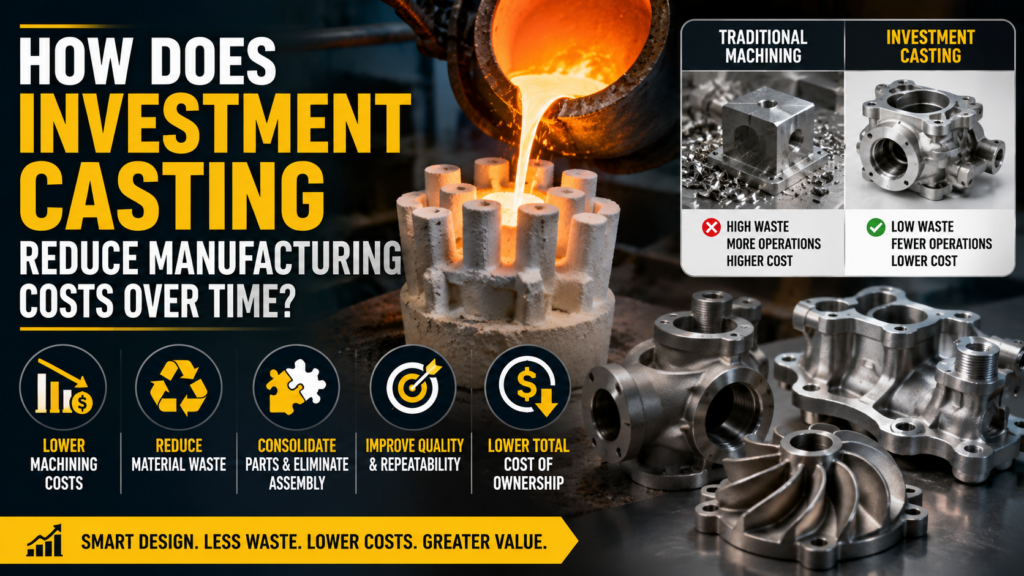
The least expensive manufacturing quote does not always produce the lowest-cost component. A process that looks economical at the purchasing stage may consume more raw material, occupy CNC equipment for hours, require several finishing operations, or create quality problems that become visible only during assembly.
That is where investment casting can change the calculation. Its value comes from shaping metal close to the finished design, allowing manufacturers to reduce machining, consolidate separate components, control material consumption, and maintain consistent output over repeat production runs.
The process usually requires a greater initial commitment than basic sand casting or direct machining. Tooling must be developed, wax behavior must be controlled, and the ceramic shell and metal-feeding system must be engineered for the component. Those costs, however, can be recovered when the same tooling supports hundreds or thousands of parts with fewer downstream operations.
The strongest business case appears when manufacturers evaluate the total cost of a usable component rather than comparing only mold prices or supplier quotations. Material yield, machining hours, inspection, rework, assembly labor, lead time, and production stability all influence the real return.
Understand the Lost-Wax Production Process
Investment casting, also known as lost-wax casting, begins with a wax replica of the required metal part. For repeat production, a manufacturer typically injects wax into a metal tool. Prototypes and short runs may use patterns produced through additive manufacturing or other temporary pattern-making methods.
Several wax patterns can be connected to a central runner system to create a tree-shaped assembly. This configuration allows multiple components to be poured at the same time and helps distribute handling, shell-building, and melting costs across a batch.
Workers dip the wax assembly into a ceramic slurry and cover it with refractory particles. After each layer dries, the coating process is repeated. The finished ceramic shell must be thick enough to resist handling and withstand the heat and pressure of molten metal.
The wax is then removed with heat, leaving a hollow cavity inside the hardened ceramic mold. Molten metal enters that cavity and reproduces the shape, contours, and surface details of the original pattern. Once the casting has cooled, the ceramic shell is broken away, and the individual components are separated from the runner.
Gate remnants are removed before the parts proceed to any required heat treatment, cleaning, dimensional verification, nondestructive examination, surface finishing, or final machining. Some functional surfaces may still require CNC work, but much of the geometry can remain in its cast condition.
The process can reproduce curved profiles, lettering, ribs, bosses, recessed details, thin sections, and other features that might otherwise demand lengthy machining or fabrication. That ability to place complexity directly into the mold is central to its long-term cost advantage.
Calculate Savings Across the Full Production Lifecycle
A meaningful cost comparison should follow the part from raw material purchase through final inspection. Looking only at the casting price can hide expenses that arise during machining, finishing, assembly, inventory management, and quality control.
A conventional manufacturing route might begin with a large billet, continue through several CNC setups, move to a welding station, and finish with grinding, straightening, and inspection. Every transfer adds labor, scheduling pressure, documentation, and the possibility of error.
By contrast, investment casting can place several features into one near-finished component. The manufacturer may still machine critical interfaces, but it can often remove entire operations from the process plan.
A lifecycle analysis should account for:
- Raw material purchased for each acceptable component
- Material removed as chips, gates, runners, or defective output
- Machine hours, setup time, and equipment availability
- Cutting tools, fixtures, coolant, and other consumables
- Grinding, polishing, coating, and surface preparation
- Welding, fastening, and manual assembly
- Inspection, rework, scrap, and warranty exposure
- Work-in-progress inventory between operations
- Supplier management and transportation
- Production delays caused by capacity constraints
These costs rarely appear in one place. Purchasing may see the quoted part price, while machining, quality, operations, and logistics absorb the remaining expense. A cross-functional review gives decision-makers a more accurate picture of the total delivered cost.
Industry observers note that the most attractive conversions are usually parts burdened by several recurring costs at once. A component that consumes expensive stock, requires long machining cycles, and must be assembled from multiple pieces offers more room for savings than a simple shape that already runs efficiently.
Use Near-Net-Shape Production to Limit Machining
Near-net-shape production creates a component whose dimensions and geometry are already close to the final specification. The manufacturer does not need to cut the entire form from solid stock because the mold creates most of the required shape.
Machining can then be reserved for surfaces that genuinely need it. Bearing seats, threads, sealing faces, precision bores, and close-tolerance interfaces may still require finishing, while ribs, contours, logos, mounting features, and noncritical surfaces can often remain as cast.
This distinction matters because machining cost is not limited to spindle time. Every CNC operation may require programming, fixtures, operator attention, tool changes, inspection, coolant, maintenance, and production scheduling.
Reducing a part from four machining setups to one can shorten lead time and free capacity for work that cannot be produced any other way. The benefit becomes especially valuable when a plant’s CNC department is already a bottleneck.
Near-net-shape production also reduces the number of times a component must be repositioned. Each setup introduces a chance for alignment error, fixture variation, or dimensional stack-up. Producing more of the geometry in the mold can simplify the route and make process control more straightforward.
The U.S. National Institute of Standards and Technology has identified reduced material waste and lower machining cost as central benefits of net-shape manufacturing. In aerospace production, the material-efficiency opportunity can be especially large: a NIST review reported that machining titanium parts from oversized blocks may generate more than 90% waste material. That figure is not a universal rate for all parts, but it illustrates why near-net-shape methods can create substantial value when expensive alloys and low material utilization are involved.
Reduce Material Waste and Improve Metal Utilization
Subtractive manufacturing starts with more material than the finished part requires. The manufacturer buys a billet, bar, plate, or forging and removes the unwanted volume until the final geometry remains.
Those chips may have recycling value, but recycling does not erase the cost. The company has already purchased the excess alloy, transported it, stored it, cut it, handled the swarf, and consumed machine time turning usable material into scrap.
Investment casting takes a different route by directing molten metal into a cavity shaped like the finished component. Additional metal is still needed for gates, runners, feed systems, and process allowances, but the method can significantly reduce the volume that must be removed during machining.
The financial impact rises with alloy cost. Nickel-based superalloys, cobalt alloys, corrosion-resistant stainless steels, and other specialized metals can be expensive to purchase and difficult to machine. Improving material utilization can therefore reduce both raw-material spending and cutting-tool consumption.
Better material yield can also strengthen cost forecasting. Once the foundry establishes a repeatable pattern assembly and gating design, it can estimate melt requirements with greater consistency. More reliable consumption data supports purchasing, inventory planning, and contract pricing.
Environmental performance often improves for the same reason. Avoiding unnecessary material removal can reduce the energy tied to primary metal production, transportation, machining, and scrap recovery. The exact benefit depends on the alloy, facility, yield, and recycling system, but using less input metal for each acceptable part is generally favorable for both cost and resource efficiency.
Eliminate Secondary Operations Through Design Consolidation
Many expensive components are not individually complicated. Their cost comes from the number of pieces and operations needed to create the final assembly.
A fabricated design may contain brackets, bosses, ribs, tubes, plates, or mounting pads that are cut separately and then welded or fastened together. Workers must position those pieces, maintain alignment, inspect joints, clean welds, and correct heat distortion.
A precision casting can often combine those features into a single component. The designer may incorporate strengthening ribs, mounting points, flow passages, identification marks, and curved transitions directly into the wax pattern.
Consolidation can eliminate or reduce:
- Welding and brazing
- Bolts, screws, clips, and other fasteners
- Assembly fixtures and alignment tools
- Joint inspection and leak testing
- Straightening after welding
- Grinding and cosmetic blending
- Inventory for multiple part numbers
- Coordination among several suppliers
The resulting part may also be lighter. Fabricated assemblies often require overlapping material, weld lands, flanges, or hardware that adds mass without improving the component’s primary function.
A one-piece design can improve reliability by removing joints that may loosen, leak, corrode, or develop fatigue cracks. Fewer interfaces can also simplify cleaning and maintenance in medical, food-processing, fluid-handling, and industrial applications.
Consolidation must still respect manufacturability. The casting supplier needs to evaluate metal flow, shrinkage, shell strength, pattern removal, wall transitions, and solidification. Combining every possible feature is not automatically economical if the resulting geometry reduces yield or creates inspection difficulty.
The most effective design replaces unnecessary assembly work without creating new casting risks.
Improve Repeatability Across High-Volume Production
Variation carries a cost even when every delivered part technically meets specification. Inconsistent geometry may force operators to adjust fixtures, modify machining offsets, sort components, or slow assembly equipment.
A controlled casting process relies on stable wax patterns, documented shell-building procedures, defined melt chemistry, consistent pouring conditions, and repeatable finishing methods. Once those variables are qualified, the manufacturer can reproduce complex parts across multiple production batches.
Repeatability reduces disruption downstream. Machining fixtures can operate with fewer adjustments, automated assembly systems receive more consistent components, and inspection teams spend less time investigating unexpected shifts.
The benefit is particularly important in regulated or safety-critical industries. Aerospace, medical, automotive, and energy customers may require traceability, process approval, material certification, and recurring quality documentation. Stable production data makes those requirements easier to manage.
Volume also changes the economics of tooling. A $40,000 tool represents $40 per component when spread across 1,000 parts. At 10,000 parts, the same investment contributes $4 to each unit.
That example is intentionally simple. Real programs must include maintenance, replacement tooling, development work, yield, inspection, and financing costs. Even so, the principle is clear: recurring efficiency becomes more valuable as cumulative production increases.
Manufacturers should calculate volume over the expected life of the product, not just the first purchase order. Annual demand, service parts, replacement requirements, platform extensions, and future variants may all improve the return.
Target Complex Geometries for the Greatest Return
The process usually creates the most value when geometric complexity would make alternative methods expensive.
Curved surfaces, irregular contours, recessed features, intersecting ribs, and difficult tool-access areas can extend CNC cycle times. They may require special cutters, five-axis machining, multiple fixtures, or manual finishing.
In mold-based production, much of that complexity is built into the pattern. Once the tool exists, producing a curved profile may not add the same recurring cost that machining the profile would add to every unit.
This cost behavior creates an opportunity to redesign assemblies. Instead of simplifying the part to accommodate machining and then adding separate pieces later, engineers can place functional geometry into a single cast form.
A pump component, for example, may combine a curved flow path, mounting flange, reinforcement ribs, and identification details. A surgical instrument may incorporate an ergonomic profile, textured grip, hinge feature, and locating surface. An aerospace bracket may include weight-saving pockets and load-bearing transitions that would be difficult to machine economically.
Not all complexity is equally castable. Deep blind cavities, abrupt thickness changes, isolated heavy sections, and poorly fed areas can introduce risk. The wax pattern must also be removable from its tool unless a soluble, ceramic, or additively manufactured core is used.
Early design review allows engineers to distinguish productive complexity from features that would undermine yield.
Apply Thin-Wall Capability Where Weight Matters
Thin walls can reduce component mass and material use, but they demand careful process control. Metal must fill narrow sections before cooling, and the ceramic shell must preserve those features without distortion or breakage.
When geometry, alloy, mold temperature, and gating are properly matched, the process can create lightweight parts with smooth transitions and detailed surfaces.
This capability is relevant wherever mass affects performance. Aerospace programs may reduce weight to support payload or fuel-efficiency goals. Automotive engineers may use thinner sections to lower vehicle mass or fit components into crowded systems. Medical-device designers may need durable instruments that remain comfortable to handle.
Industrial equipment can benefit as well. Lighter levers, arms, housings, and handling components may reduce operator fatigue or place less load on surrounding mechanisms.
A thin-wall casting may replace a fabricated alternative made from several formed and welded pieces. The one-piece version can remove joints, reduce finishing, and improve dimensional consistency.
Designers should avoid chasing the thinnest technically possible section without considering yield. An aggressive wall specification may save a small amount of metal while increasing incomplete fill, distortion, or scrap.
A gradual transition between thick and thin areas generally supports more reliable filling and solidification. Simulation, sample castings, and supplier experience help identify the wall thickness that offers the best balance of weight, cost, and production stability.
Prioritize High-Volume and Repeat Production Runs
Tooling becomes easier to justify when a stable design will be ordered repeatedly. A one-time component may not support the cost of a permanent wax-injection tool, while a multiyear program can distribute that expense across a large number of units.
There is no universal minimum volume for investment casting. The break-even point depends on part size, alloy, geometry, quality requirements, existing machining cost, finishing needs, and the price of competing methods.
A highly complex nickel-alloy component may justify tooling at a modest volume because its current machining route is expensive. A simple carbon-steel bracket may require a much larger order before casting becomes the better choice.
Repeat production also gives the supplier an opportunity to improve the process. Foundries can refine wax injection, gating, shell construction, pouring parameters, heat treatment, and finishing based on actual yield and inspection data.
Those refinements may shorten cycle time or reduce defects as the program matures. The manufacturer should ask how process improvements will be documented and whether future savings will be reflected in pricing.
Demand stability remains important. A design likely to change after six months carries more tooling risk than a mature component expected to remain in production for years.
For prototypes or bridge production, additively manufactured patterns can sometimes delay the need for permanent tooling. This approach usually raises the pattern cost per part but can reduce early capital exposure and allow engineers to validate the geometry before committing to a production tool.
Identify Industries That Capture the Most Value
Aerospace Manufacturing
Aerospace parts often combine demanding geometry with expensive alloys, strict traceability, and low weight targets. Components may operate under high temperature, vibration, pressure, or corrosive conditions.
Casting the shape near its final dimensions can reduce the amount of premium metal that must be purchased and machined. Aerodynamic profiles, mounting features, structural ribs, and internal details may be incorporated into the mold rather than created through separate operations.
The cost argument must include qualification and inspection. Aerospace applications may require radiography, penetrant testing, mechanical-property verification, chemical analysis, or customer-specific process approval. These requirements add expense but may still compare favorably with an equally rigorous machined or fabricated route.
Automotive Manufacturing
Automotive suppliers must balance high output, tight cost control, weight reduction, and repeatable performance.
Precision casting can support components with compact packaging, integrated mounting features, contoured surfaces, and performance alloys. Potential applications include powertrain parts, braking components, suspension hardware, specialty vehicle systems, and performance-focused designs.
Die casting may remain the stronger choice for extremely high-volume aluminum or zinc parts. The lost-wax route becomes more attractive when material selection, geometry, mechanical performance, or lower production volume makes die tooling less suitable.
Medical Manufacturing
Medical instruments and device components frequently require corrosion resistance, fine detail, consistent dimensions, and surfaces that can be cleaned or finished effectively.
Stainless steel and cobalt-based alloys can support strength, wear resistance, and repeated sterilization, depending on the application. A cast design may include ergonomic contours, gripping textures, channels, hinge features, or identification marks.
Combining several pieces into one component can also reduce joints and crevices. Any claimed cleaning or clinical benefit must be confirmed for the specific design, finishing process, and regulatory requirements.
Industrial Equipment Manufacturing
Industrial applications include valves, pumps, impellers, levers, housings, tools, wear parts, and fluid-handling components.
These products often contain irregular profiles, internal flow features, curved surfaces, or alloys selected for corrosion and abrasion resistance. Machining such parts from solid stock can consume substantial time and material.
A cast component may reduce the number of setups and replace welded assemblies with a one-piece design. The economic value is often strongest when the part is ordered repeatedly for equipment production or aftermarket service.
Compare Investment Casting With Alternative Methods
No manufacturing method is the lowest-cost answer for every part. The right choice depends on size, material, geometry, tolerances, surface requirements, volume, tooling budget, and product life.
The comparison below presents general tendencies rather than guaranteed specifications. Supplier capability and component design can shift the result considerably.
| Manufacturing method | Typical cost profile | Tolerance capability | Surface finish | Best-use case |
|---|---|---|---|---|
| Investment casting | Moderate to high initial tooling; competitive recurring cost for complex repeat parts | Strong dimensional capability for a casting process; machining may remain necessary for critical features | Generally smooth and detailed, often with less finishing than sand casting | Complex metal parts, premium alloys, thin sections, integrated features, and repeat production |
| Sand casting | Lower tooling cost; economical for large parts and lower volumes | Broader tolerances that often require machining | Rougher surface with more cleaning or finishing | Large, heavy, or relatively simple components |
| Die casting | High tooling cost; low unit cost at substantial volume | Good repeatability and dimensional control | Smooth surface suitable for many finished applications | Very high-volume aluminum, zinc, or magnesium parts |
| CNC machining | Limited dedicated tooling but potentially high unit cost | Excellent precision and design flexibility | High-quality machined finish | Prototypes, low-volume work, frequently changing designs, and critical precision features |
Sand casting is often practical for large components, simpler shapes, and programs that cannot justify more expensive tooling. Its molds are relatively economical, but the parts may need larger machining allowances and more surface finishing.
Die casting delivers fast cycles and competitive unit costs at high volume. It is less flexible when a project requires alloys outside the usual die-casting range or when production does not justify the tooling investment.
CNC machining provides exceptional control and allows rapid design changes without a permanent mold. Its economics can weaken when each part requires long tool paths, several setups, or the removal of large quantities of expensive material.
The comparison should use a common endpoint. A rough casting, a finished casting, and a fully machined component are not equivalent quotations. Buyers need to compare acceptable, inspected parts delivered at the same stage of completion.
Evaluate Upfront Tooling Against Long-Term Savings
Tooling cost is often the most visible barrier to switching processes. A durable wax-injection tool must reproduce fine details, support dimensional control, release the pattern reliably, and withstand the expected number of cycles.
That upfront charge should be evaluated against the recurring cost removed from every future component.
A basic break-even calculation is:
Break-even quantity = Additional upfront investment ÷ Savings per acceptable part
Suppose the proposed route requires $30,000 more in tooling and development than the current method but reduces the delivered component cost by $15. The simple break-even quantity is 2,000 units.
After that point, the program begins to generate additional savings, assuming demand, yield, pricing, and operating conditions remain consistent.
A stronger analysis includes more than quoted piece price. It should measure:
- Reduced metal purchases
- Lower machining labor and spindle time
- Fewer cutting tools and fixtures
- Eliminated welding or assembly
- Lower scrap and rework
- Reduced work-in-progress inventory
- Shorter internal lead time
- Less dependence on outside processors
- Tool maintenance and replacement
- Inspection and qualification expenses
The calculation should also reflect the company’s cost of capital and the risk of a design change. A rapid payback on a stable, multiyear product is easier to defend than a long payback on a component approaching the end of its program.
Confirm Minimum Volume and Demand Stability
Forecast quality has a direct effect on the business case. When actual demand falls far below the estimate, tooling cost is spread over fewer parts and the expected savings may not materialize.
Manufacturers should review annual usage, remaining product life, service-part demand, regional requirements, and the probability of future redesign.
A mature component with stable specifications offers a clearer investment case. A product still undergoing testing may be better served by machining, sand casting, or temporary patterns until the design settles.
Minimum volume also depends on the cost of the current route. A part that already uses inexpensive stock and one short machining cycle offers limited savings potential. A complex part made from a costly alloy may recover its tooling cost much sooner.
Companies should run several scenarios rather than relying on one forecast. A low-volume case, expected case, and high-volume case can show how sensitive the payback is to demand.
The analysis should also consider yield. Tooling amortization based on poured units will overstate the benefit if a meaningful percentage of castings is rejected. Cost models should use acceptable delivered parts.
Match Material Versatility to Performance Requirements
A major advantage of investment casting is its compatibility with many ferrous and nonferrous alloys, subject to the foundry’s equipment and experience.
Available materials may include carbon steel, low-alloy steel, stainless steel, aluminum, bronze, nickel-based alloys, and cobalt-based alloys. This range allows engineers to select a material around operating requirements rather than forcing the design into a limited process-specific category.
The material decision may involve:
- Corrosion resistance
- High-temperature strength
- Hardness and wear performance
- Fatigue resistance
- Weight
- Magnetic properties
- Weldability
- Heat-treatment response
- Biocompatibility for applicable medical uses
Material selection also changes the economics. A more expensive alloy may extend service life or support performance in a harsh environment, but it increases the cost of poor yield and unnecessary machining.
Near-net-shape production becomes more valuable when it limits the quantity of premium metal purchased for each finished component.
Foundry capability should be verified at the alloy level. Experience producing stainless-steel parts does not automatically establish expertise with nickel superalloys or cobalt-based materials. Melting practice, shell formulation, pouring temperature, heat treatment, and inspection requirements can differ substantially.
Buyers should request evidence of relevant material experience, process control, certification, and testing capability.
Collaborate Early to Protect the Business Case
Cost reduction begins before the first tool is cut. A design created entirely around machining may contain tolerances, wall sections, and features that are unnecessary or difficult to cast.
Sending that drawing to a foundry without discussion can produce a higher quotation or a process that depends on excessive finishing.
Early collaboration gives the casting supplier an opportunity to review:
- Which dimensions affect function
- Which surfaces truly require machining
- Where tolerances can be relaxed
- Whether separate parts can be consolidated
- How wall thickness should transition
- Where gates can be attached and removed
- Which surfaces have cosmetic requirements
- Whether cores are required
- How the alloy will fill and solidify
- Which inspection methods are appropriate
Tolerance review deserves particular attention. Applying machining-level limits to every feature can make a cast component unnecessarily expensive. The engineering team should distinguish critical fits and interfaces from surfaces that can tolerate normal process variation.
Gate-removal areas should also be considered during design. Locating them on noncritical surfaces can reduce blending and protect visible or functional features.
Early discussion may reveal that a small geometric change improves yield, reduces tooling complexity, or removes a machining setup. Such changes are inexpensive before tooling and disruptive after production begins.
The business case therefore depends on collaboration among design engineering, manufacturing, quality, purchasing, and the casting supplier. Each group sees a different part of the cost.
Frequently Asked Questions
Is investment casting economical for low-volume production?
It can be, particularly when the part has complex geometry, uses expensive metal, or requires extensive machining and assembly. Temporary or additively manufactured patterns may support prototypes and short runs without permanent tooling. A simple component with modest demand may still be less expensive to machine or sand cast.
How does the process lower machining expense?
The ceramic mold creates most of the component’s geometry before finishing begins. CNC work can be limited to threads, sealing faces, precision bores, bearing surfaces, and other critical dimensions. Reducing setups and cycle time lowers labor, tooling, equipment, and scheduling costs.
Can several fabricated parts be replaced by one casting?
Often, yes. Ribs, bosses, brackets, mounting points, lettering, and curved transitions can frequently be integrated into a single design. The foundry must confirm that the consolidated geometry can be patterned, coated, filled, solidified, and inspected consistently.
Which metals are suitable for the process?
Potential materials include carbon steels, alloy steels, stainless steels, aluminum alloys, bronzes, nickel-based alloys, and cobalt-based alloys. Availability varies by foundry. The selected supplier should demonstrate experience with the required alloy, heat treatment, testing, and quality standard.
How quickly can tooling pay for itself?
Payback depends on the tooling premium, savings per acceptable part, annual volume, and program life. Dividing the additional upfront investment by recurring unit savings provides a basic break-even quantity. The final decision should also include scrap, machining, finishing, assembly, inspection, logistics, and the risk of future design changes.
Build a Lower-Cost Production Strategy
Investment casting creates long-term value when it replaces recurring manufacturing expense with a stable, near-net-shape process. Its strongest advantages come from reducing machining, using expensive material more efficiently, consolidating assemblies, and reproducing complex geometry across repeat orders.
The method is particularly well suited to detailed parts, thin-wall designs, performance alloys, and components that currently move through several separate production stages. Its upfront tooling cost can be significant, but that investment may be recovered through lower unit costs when demand is sufficient and the design remains stable.
The decision should begin with a full cost model. Manufacturers need to measure the current expense of stock, machining, fixtures, cutting tools, finishing, welding, inspection, scrap, inventory, and supplier coordination. They should then compare those figures with the cost of a finished, acceptable casting rather than an unfinished piece.
A qualified supplier can review the component, identify features that can remain as cast, recommend practical tolerance changes, assess material and wall-thickness requirements, and estimate the likely break-even volume.
For manufacturers evaluating a machined, fabricated, or multipiece metal component, the next step is a design-for-casting review supported by a lifecycle cost analysis. That comparison will show whether the initial tooling commitment can deliver measurable savings throughout the production program.