
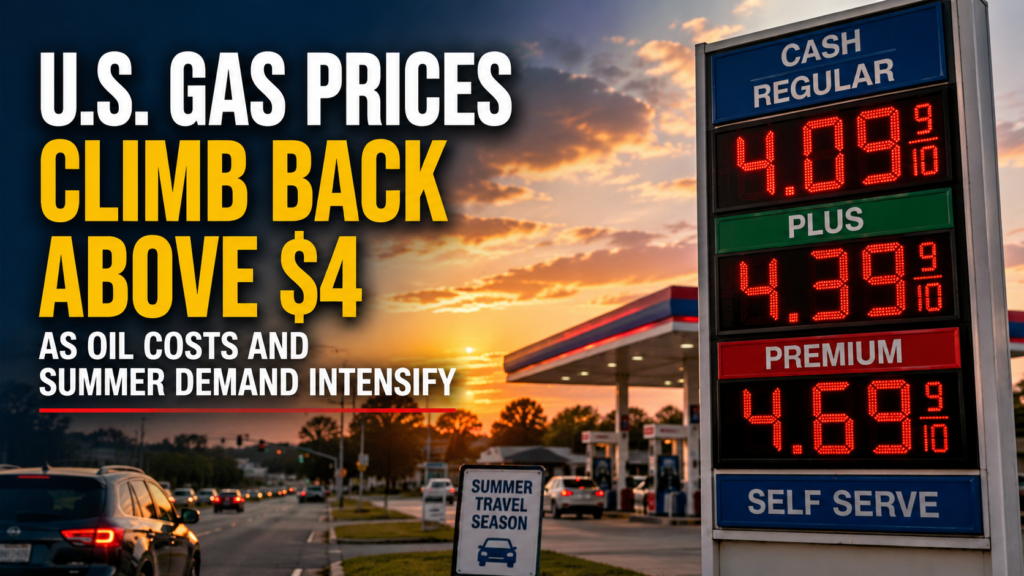
American drivers are once again paying more than $4 for a gallon of gasoline, putting renewed pressure on household budgets during the busiest travel season of the year. The national average edged above that closely watched level on Monday after increasing about 13 cents in a single week, according to AAA.
The latest rise follows a brief period of relief at the pump. Gasoline reached a four-year high of $4.56 a gallon in early May before retreating below $4 in June. Prices have since turned higher as crude oil costs increased and disruptions at overseas refineries tightened the supply of finished fuel.
Before the current surge, the U.S. average was $2.98 a gallon, meaning drivers are now paying more than a dollar extra for every gallon they purchase.
Track the Rise in Global Oil Costs
Crude oil has become considerably more expensive, lifting the cost of refining and distributing gasoline. Brent crude briefly traded above $90 a barrel on Monday for the first time since early June and gained roughly 16% over the previous week. West Texas Intermediate, the main U.S. benchmark, has risen by about $12 a barrel this month.
Those increases tend to reach retail stations through higher wholesale gasoline prices. Many independently operated stations work with narrow profit margins, so they often pass rising costs to customers quickly. Price cuts usually take longer because retailers first need to recover the expense of higher-priced inventory.
Account for Overseas Refinery Disruptions
Supply concerns are also growing as refinery disruptions reduce fuel exports from major producers. Russia, historically a net gasoline exporter, has recently needed to import fuel, raising the risk of a broader shortage in the international market for refined products.
Because gasoline is traded globally, reduced exports abroad can affect U.S. wholesale prices even when domestic refineries continue operating normally.
Prepare for Uneven Regional Prices
The national average masks wide differences among states. AAA data cited in the reference shows that Indiana has the lowest average at $3.35 a gallon, while California is the most expensive at $5.49. Washington and Hawaii are also averaging more than $5, although about half of all states remain below $4.
For households and businesses monitoring transportation expenses, GrowBusinessMag notes that these regional gaps can materially change commuting, delivery, and operating costs.
Expect More Pressure Through Summer
Tom Kloza, an independent oil analyst and adviser to Gulf Oil, expects gasoline prices to rise another 10 to 25 cents over the next week based on recent moves in gasoline futures.
With summer driving demand near its annual peak, pump prices are unlikely to fall quickly. A return to the earlier national average of $2.98 may take months, particularly if crude oil remains elevated and overseas fuel supplies stay constrained through Labor Day.