
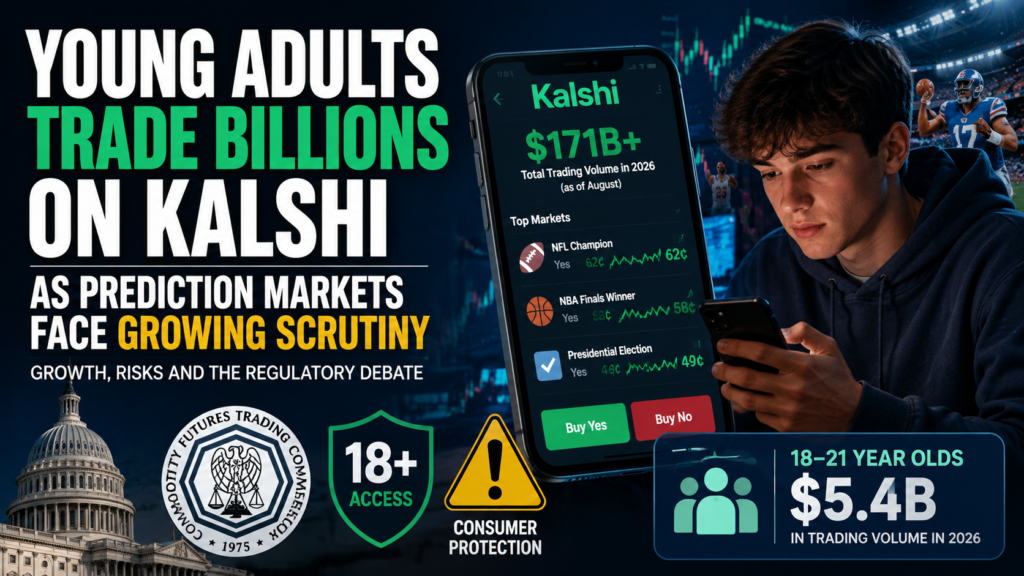
Young adults aged 18 to 21 have generated billions of dollars in trading activity on Kalshi in 2026, highlighting the rapid expansion of prediction markets and intensifying questions about age limits, consumer protection and sports-related trading. According to a CNN analysis published August 28, users in this age group accounted for an estimated $5.4 billion in Kalshi trading volume so far this year.
Examine the Scale of Young Adult Trading
CNN reported that approximately $3.9 billion of the estimated $5.4 billion traded by users aged 18 to 21 involved sports markets and parlays. Kalshi allows participants to buy and sell contracts linked to the outcomes of events including sports competitions, elections, economic developments, entertainment and weather.
The platform operates differently from a traditional sportsbook. Kalshi is regulated at the federal level by the Commodity Futures Trading Commission, or CFTC, which allows eligible users to participate from age 18. Many state-regulated sportsbooks and casinos, by comparison, require customers to be at least 21.
Public data cited by CNN showed that Kalshi had recorded more than $171 billion in overall trading volume during 2026 as of late August. A Kalshi spokesperson told CNN that users aged 18 to 21 represented 3.14% of the platform’s total trading volume.
Assess Concerns Around Sports-Focused Markets
Sports-related contracts have become a major part of prediction-market activity. CNN reported that sports and parlay-style products account for roughly 80% of Kalshi’s overall volume.
That concentration has attracted criticism from gambling-industry representatives, state officials and consumer advocates. Their concern is that sports prediction contracts may expose younger adults to risks similar to sports betting while remaining outside traditional state gambling rules.
Kalshi has previously pointed to protections designed to reduce harmful behavior. These include deposit limits, warnings for users displaying risky trading patterns and financial support for problem-gambling prevention. The company has also contributed $2 million to the National Council for Problem Gambling.
Follow the Federal Regulatory Debate
The legal status of prediction markets remains contested. Kalshi and similar platforms operate as federally regulated financial exchanges, while multiple state attorneys general, tribal organizations and casino-industry groups have challenged that framework.
Major sports organizations, including the NCAA, NFL and NBA, have urged regulators to raise the minimum age for prediction-market participation to 21. The CFTC, however, has continued developing regulations that maintain the existing 18-and-over standard.
Some companies have voluntarily adopted stricter limits. Fanatics and Novig both require users to be at least 21.
Evaluate the Broader Impact on Consumers
The growth of Kalshi illustrates how financial trading and event-based wagering are increasingly overlapping. Supporters argue that adults who can legally trade stocks and other regulated products should also have access to prediction contracts.
Critics counter that sports-heavy markets, mobile accessibility and younger participation deserve stronger safeguards. As prediction-market volume continues to rise, regulators are likely to face increasing pressure to clarify age requirements, consumer protections and the legal boundaries between financial trading and gambling.