
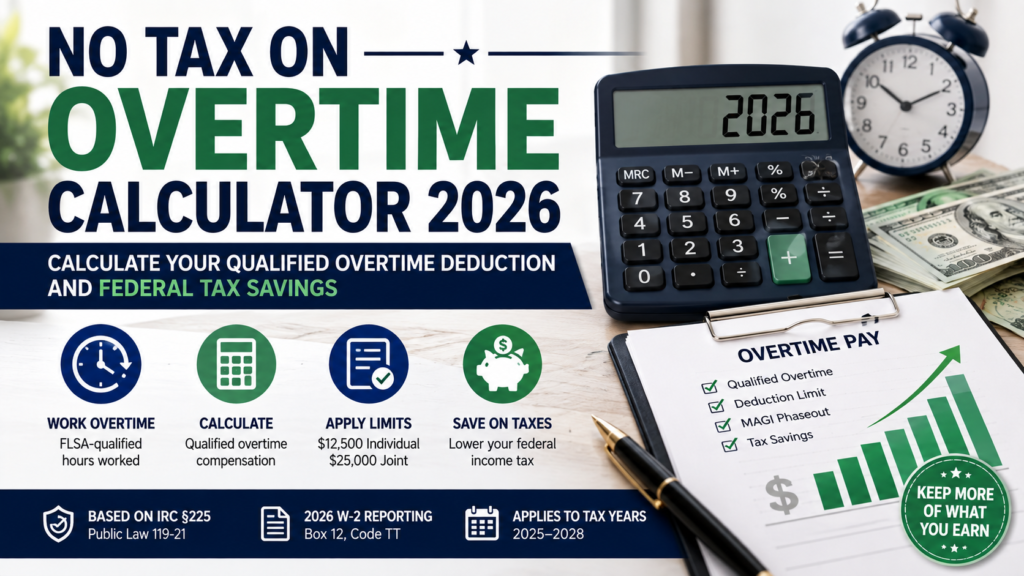
A no tax on overtime calculator estimates how much qualified overtime compensation you may deduct from your federal taxable income and how much that deduction could reduce your federal income tax. The calculation is based on the federal qualified overtime compensation deduction created under Public Law 119-21 and Internal Revenue Code Section 225.
The phrase “no tax on overtime” needs an important qualification. The law does not make every dollar earned during overtime hours tax-free. For a worker receiving standard time-and-a-half pay under the Fair Labor Standards Act, or FLSA, the deductible amount is generally the additional one-half portion of the overtime rate, not the worker’s full overtime wages. The IRS confirmed this interpretation again in its August 6, 2026 update to Fact Sheet FS-2026-13.
For tax year 2026, an individual can generally deduct up to $12,500 of qualified overtime compensation. Married taxpayers filing jointly can deduct up to $25,000. The deduction begins to decrease when modified adjusted gross income, or MAGI, exceeds $150,000 for most taxpayers or $300,000 for married couples filing jointly. The deduction applies to tax years beginning after December 31, 2024, and before January 1, 2029.
This guide explains how to calculate the deduction, determine which overtime qualifies, use the new 2026 Form W-2 reporting rules, estimate your federal tax savings, and avoid the most common calculation errors.
Important: This calculator methodology provides a federal tax estimate for educational purposes. Payroll structures, FLSA exemptions, bonuses, commissions, multiple hourly rates, compensatory time, state overtime laws, and individual tax circumstances can change the result. Use your employer’s tax documents and current IRS instructions when filing a return.
Gather Your Overtime Pay Information
Start your no tax on overtime calculator with your regular rate of pay, qualifying overtime hours, total qualified overtime compensation, filing status, and modified adjusted gross income. For many hourly workers, these inputs are enough to produce a useful estimate.
Under the FLSA, covered and nonexempt employees generally must receive at least one and one-half times their regular rate for hours worked beyond 40 in a workweek. A workweek is a fixed period of seven consecutive 24-hour periods. The FLSA does not generally require overtime merely because an employee works a Saturday, Sunday, holiday, or other regularly scheduled day off.
Your regular rate can also differ from the hourly rate printed near the top of a pay stub. The Department of Labor explains that the regular rate can include certain bonuses, commissions, shift differentials, and other forms of compensation. In general, the regular rate is determined from includable compensation divided by hours worked during the applicable workweek.
For a straightforward hourly employee, gather these numbers:
| Calculator Input | Example |
|---|---|
| Regular hourly rate | $25 |
| FLSA overtime hours | 400 per year |
| Standard overtime rate | $37.50 |
| Qualified overtime premium | $12.50 per overtime hour |
| Filing status | Single |
| Modified adjusted gross income | $85,000 |
| Estimated marginal federal tax rate | 22% |
If your 2026 Form W-2 is already available, check Box 12, code TT. Starting with tax year 2026, employers generally use code TT to separately report total qualified overtime compensation.
Confirm That Your Overtime Qualifies Under the FLSA
Verify FLSA eligibility before calculating a deduction. The federal tax deduction applies to overtime compensation required under Section 7 of the Fair Labor Standards Act. Receiving something called “overtime” on a paycheck does not automatically make that compensation eligible for the federal deduction.
The IRS states that a worker generally must be both covered by the FLSA and nonexempt from its overtime requirements. If a worker is not eligible for overtime under the FLSA, overtime paid because of a company policy, collective bargaining agreement, state law, or another arrangement does not become qualified overtime compensation merely because the employer labels it overtime.
Common FLSA exemptions can apply to qualifying executive, administrative, professional, computer, outside sales, commissioned retail, transportation, agricultural, and seasonal employees. The specific requirements vary by exemption. Job titles alone do not establish eligibility. An employee called a “manager,” for example, is not automatically exempt unless the applicable legal requirements are satisfied.
The August 2026 IRS guidance also addresses employee-owners. An employee who owns at least a bona fide 20 percent equity interest in the business and is actively engaged in its management is generally treated as a bona fide executive for this purpose and therefore is not FLSA overtime eligible.
For most workers using a no tax on overtime calculator, the first eligibility question should therefore be:
Was this overtime compensation required under Section 7 of the FLSA?
If the answer is no, that compensation generally should not be entered as qualified overtime compensation.
Separate Qualified Overtime From Total Overtime Wages
Separate your total overtime pay from the smaller portion that qualifies for the deduction. This is the most important calculation in the entire process.
Suppose your regular rate is $20 per hour and your employer pays standard time-and-a-half overtime of $30 per hour.
Each overtime hour contains:
- $20 of regular-rate compensation
- $10 of additional overtime premium
- $30 of total overtime wages
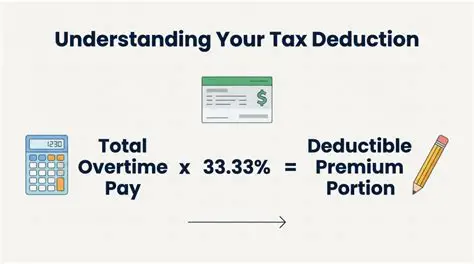
For purposes of the qualified overtime deduction, the relevant amount is generally the $10 premium, not the entire $30 payment.
The IRS describes qualified overtime compensation as the amount required by the FLSA that exceeds the employee’s regular rate. Its 2026 Form W-2 instructions specifically explain that, for time-and-a-half compensation, only the “half” portion is reported as qualified overtime compensation under code TT.
For a basic time-and-a-half employee, use:
Qualified overtime compensation = FLSA overtime hours × regular rate × 0.5
For example:
Regular rate: $20
Qualifying overtime hours: 300
300 × $20 × 0.5 = $3,000
The employee may have received $9,000 in total wages for those overtime hours:
300 × $30 = $9,000
But only approximately $3,000 represents the qualified overtime premium for this simplified calculation.
Understanding this distinction prevents a calculator from overstating the deduction by two or three times the correct amount.
Calculate Your Annual Qualified Overtime Compensation
Multiply your qualifying overtime hours by the FLSA premium when you are estimating the deduction before receiving your year-end tax documents.
For a standard hourly worker paid time-and-a-half:
Qualified overtime = Overtime hours × Regular rate × 0.5
Assume an employee earns $28 per hour and completes 8 qualifying overtime hours per week for 48 weeks during 2026.
Annual qualifying overtime hours:
8 × 48 = 384 hours
Qualified premium per hour:
$28 × 0.5 = $14
Estimated qualified overtime compensation:
384 × $14 = $5,376
The worker’s total pay for those overtime hours would be considerably higher:
$28 × 1.5 = $42 overtime rate
384 × $42 = $16,128 total overtime wages
However, the potential qualified overtime deduction begins with $5,376, not $16,128.
This simplified formula works best for employees with a fixed hourly rate and traditional time-and-a-half overtime. Workers receiving nondiscretionary bonuses, commissions, piece-rate compensation, multiple hourly rates, or other compensation may have a different FLSA regular rate. The Department of Labor states that overtime generally depends on the employee’s actual regular rate rather than merely the base rate printed in an employment agreement.
Exclude Overtime That Does Not Meet Federal Requirements
Remove premium pay that exists only because of state law, employer policy, scheduling rules, or contractual arrangements when that pay is not required by Section 7 of the FLSA.
For example, an employer may voluntarily pay time-and-a-half after eight hours worked in a day. A state may also impose daily overtime requirements that go beyond federal law. Those circumstances can increase an employee’s paycheck, but the federal qualified overtime deduction is specifically tied to overtime required under the FLSA. The IRS states directly that overtime compensation not required by the FLSA is not eligible for the deduction.
Weekend and holiday premiums require similar care. Federal law generally does not require extra compensation simply because work occurs on Saturday, Sunday, a holiday, or another regular day of rest. An employer can still agree to provide premium pay, but that agreement by itself does not convert the premium into qualified overtime compensation.
Consider an employee with a $25 regular rate who receives double time of $50 per hour for federally qualifying overtime. The entire extra $25 above the employee’s regular rate should not automatically be entered into the calculator. The federal deduction is linked to the premium required under Section 7, not necessarily every extra dollar an employer voluntarily pays.
This boundary is especially important for union workers, employees in states with broader overtime rules, and workers whose employers provide generous premium schedules.
Apply the $12,500 or $25,000 Deduction Limit
Cap your qualified overtime deduction after determining your total annual qualified overtime compensation.
For 2026, the federal limit is:
| Filing Situation | Maximum Qualified Overtime Deduction |
|---|---|
| Individual return | $12,500 |
| Married filing jointly | $25,000 |
These are maximum deduction amounts, not guaranteed deductions and not tax credits. A worker with $4,000 of qualified overtime compensation cannot claim $12,500 merely because $12,500 is the limit. The starting deduction would generally be $4,000 before any MAGI phaseout.
Likewise, a single taxpayer receiving $18,000 of otherwise qualified overtime compensation starts with no more than $12,500 before applying the income limitation.
For a married couple filing jointly, the statutory limit rises to $25,000. If both spouses receive qualified overtime compensation, their eligible amounts can contribute to the joint calculation, subject to the overall $25,000 limit and the applicable income phaseout.
Married taxpayers need to pay particular attention to filing status. Internal Revenue Code Section 225 requires a married taxpayer to file a joint return to claim the qualified overtime deduction. The taxpayer receiving qualified overtime compensation must also satisfy the applicable Social Security number requirement.
Reduce the Deduction When MAGI Exceeds the Threshold
Apply the MAGI phaseout after the annual deduction cap.
The deduction begins to decrease when modified adjusted gross income exceeds:
$150,000 for most taxpayers
$300,000 for married taxpayers filing jointly
Internal Revenue Code Section 225 reduces the otherwise allowable deduction by $100 for each $1,000 that MAGI exceeds the applicable threshold.
For estimation purposes, this equals a 10 percent reduction based on the income exceeding the threshold:
Estimated phaseout reduction = MAGI above threshold × 10%
Suppose a single taxpayer has $10,000 of qualified overtime compensation and MAGI of $170,000.
The taxpayer exceeds the $150,000 threshold by:
$170,000 − $150,000 = $20,000
Estimated phaseout:
$20,000 × 10% = $2,000
Estimated deductible amount:
$10,000 − $2,000 = $8,000
Now consider a single taxpayer with the maximum $12,500 deduction and MAGI of $200,000.
Income above threshold:
$200,000 − $150,000 = $50,000
Phaseout:
$50,000 × 10% = $5,000
Estimated remaining deduction:
$12,500 − $5,000 = $7,500
The deduction cannot be reduced below zero.
For an actual tax return, use the applicable Schedule 1-A instructions rather than relying solely on a simplified calculator, particularly when MAGI falls between calculation increments or other adjustments affect the statutory MAGI definition.
Estimate Your Federal Income Tax Savings
Multiply the final estimated deduction by an appropriate marginal federal income tax rate for a quick approximation of the tax benefit.
Use:
Estimated federal tax savings = Allowed deduction × Marginal federal income tax rate
Suppose your final qualified overtime deduction is $5,000 and that amount would otherwise fall within the 22 percent federal income tax bracket.
Estimated tax reduction:
$5,000 × 22% = $1,100
The $5,000 deduction does not mean you receive a $5,000 refund. A deduction reduces the income on which federal income tax is calculated. A tax credit, by contrast, generally reduces tax liability dollar for dollar.
Here are simplified examples:
| Final Deduction | Illustrative Marginal Rate | Approximate Income Tax Savings |
|---|---|---|
| $2,000 | 12% | $240 |
| $4,000 | 12% | $480 |
| $5,000 | 22% | $1,100 |
| $7,500 | 22% | $1,650 |
| $10,000 | 24% | $2,400 |
| $12,500 | 24% | $3,000 |
| $12,500 | 32% | $4,000 |
These examples are deliberately simplified. Federal tax brackets are progressive, so a large deduction can cross multiple brackets. Credits, other deductions, filing status, investment income, business income, capital gains, alternative minimum tax considerations, and other tax provisions can also affect the final benefit.
A higher-quality calculator should therefore calculate estimated federal income tax twice: once before the overtime deduction and once after it. The difference provides a more precise estimate than simply multiplying the entire deduction by one marginal rate.
Keep Social Security and Medicare Taxes in Your Estimate
Continue treating overtime compensation as wages for payroll tax purposes. The “no tax on overtime” label does not create a blanket exemption from Social Security, Medicare, federal unemployment taxes, or federal income tax withholding.
The IRS’s updated August 2026 guidance states that the qualified overtime deduction does not mean overtime compensation is excluded from gross income. Overtime compensation generally remains subject to employment taxes, including applicable income tax withholding and Social Security taxes.
The IRS’s 2026 Employer’s Tax Guide similarly explains that overtime compensation generally remains subject to both the employee and employer portions of Social Security and Medicare taxes.
This means an employee can qualify for the overtime deduction and still see federal taxes withheld from an overtime paycheck.
For example, assume a worker earns $500 of overtime compensation during one pay period. The employer does not simply remove all taxes because some of that pay may later qualify for the deduction. Payroll taxes and withholding rules continue to operate during payroll processing.
The tax benefit is generally realized through the employee’s federal income tax calculation, although workers can potentially adjust withholding prospectively through Form W-4.
Check Form W-2 Box 12 Code TT Before Filing
Compare your estimate with the qualified overtime compensation reported by your employer.
For tax year 2026, employers generally must separately report qualified overtime compensation on Form W-2, Box 12, code TT. The amount shown with code TT represents total qualified overtime compensation reported by the employer.
This reporting rule represents an important change from tax year 2025. Employers received transitional reporting relief for 2025, but separate reporting applies beginning in 2026.
The amount reported with code TT is not automatically the final deduction. An employee may still need to apply:
- The $12,500 individual limit
- The $25,000 joint-return limit
- The MAGI phaseout
- Filing-status requirements
- Social Security number requirements
For example, an employer could report $20,000 of qualified overtime compensation in Box 12 with code TT for a single employee. The employee does not automatically deduct $20,000 because the individual statutory limit is $12,500 before any income phaseout.
IRS Fact Sheet FS-2026-13 specifically explains that the amount reported in Box 12 with code TT can exceed the amount ultimately deductible by the employee.
If your own records materially disagree with code TT, review your payroll records and contact your employer before filing. Do not simply replace an employer-reported figure based on a rough online calculator.
Use the Complete No Tax on Overtime Calculator Formula
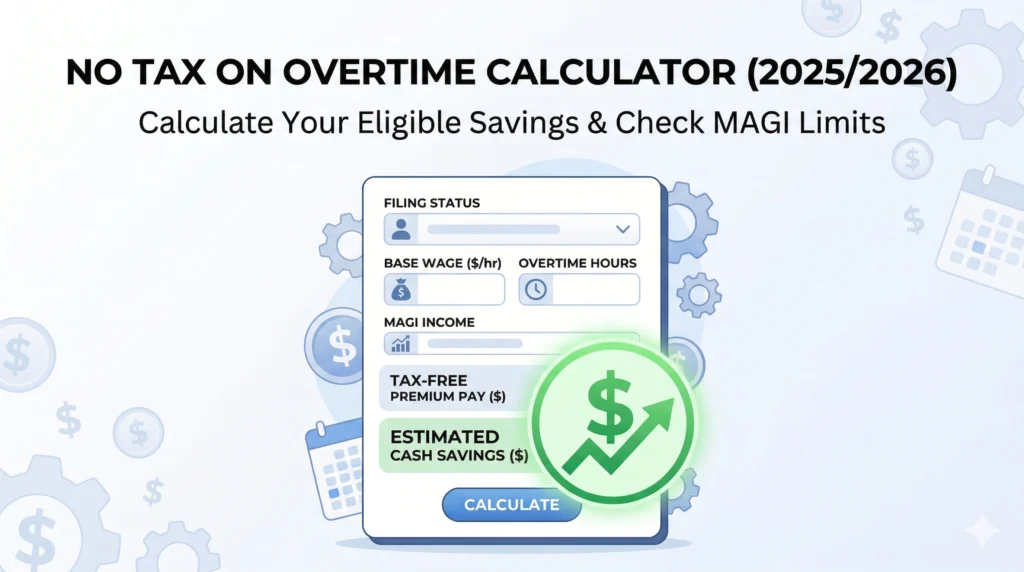
Calculate a quick estimate with the following sequence.
Step 1: Determine qualifying overtime hours
Use overtime required under Section 7 of the FLSA.
Step 2: Determine the regular rate
For a simple hourly employee, this may equal the base hourly rate. For employees receiving bonuses, commissions, or other compensation, the FLSA regular rate can require additional calculations.
Step 3: Calculate the qualified premium
For traditional time-and-a-half overtime:
Overtime hours × Regular rate × 0.5
Step 4: Apply the annual limit
For most returns:
Maximum = $12,500
For married filing jointly:
Maximum = $25,000
Step 5: Calculate MAGI above the threshold
Single and other eligible filing statuses:
MAGI − $150,000
Married filing jointly:
MAGI − $300,000
Use zero when MAGI is below the applicable threshold.
Step 6: Estimate the phaseout
MAGI excess × 10%
The statutory language describes the reduction as $100 for each $1,000 of MAGI above the threshold.
Step 7: Calculate the estimated deduction
Capped qualified overtime − phaseout reduction
Do not reduce the result below zero.
Step 8: Estimate federal income tax savings
Final deduction × applicable marginal tax rate
This final number is an estimated federal income tax benefit, not the amount of qualified overtime compensation and not necessarily the amount of your refund.
Test the Calculator With a Realistic Example
Assume a single employee earns $30 per hour and works 500 FLSA-qualified overtime hours during 2026.
The employee receives standard time-and-a-half compensation.
Regular rate:
$30
Overtime rate:
$45
Qualified premium:
$45 − $30 = $15 per overtime hour
Annual qualified overtime compensation:
500 × $15 = $7,500
Now assume the employee’s MAGI equals $160,000.
The employee exceeds the $150,000 threshold by:
$160,000 − $150,000 = $10,000
Estimated phaseout:
$10,000 × 10% = $1,000
Estimated deduction:
$7,500 − $1,000 = $6,500
If the deduction reduces income otherwise taxed at an illustrative 22 percent marginal rate:
$6,500 × 22% = $1,430
The worker’s estimated federal income tax benefit is approximately $1,430.
Notice the four different figures involved:
Total overtime wages: $22,500
Qualified overtime compensation: $7,500
Estimated deductible amount after phaseout: $6,500
Estimated federal income tax savings: $1,430
A reliable no tax on overtime calculator must keep those amounts separate.
Adjust Your Form W-4 When Appropriate
Consider updating Form W-4 when you expect a meaningful qualified overtime deduction and want to account for it during the year.
Employers cannot simply stop withholding federal income tax from qualified overtime compensation. IRS guidance states that overtime compensation remains subject to federal income tax withholding unless the employee provides an updated valid Form W-4 that accounts for the expected deduction.
The 2026 Form W-4 was updated so employees can account for the expected qualified overtime deduction through Step 4(b). The IRS Tax Withholding Estimator has also been updated to account for the deduction.
Estimate conservatively when adjusting withholding. Overtime hours can decrease because of staffing changes, seasonal demand, job changes, vacations, illness, or employer scheduling. MAGI can also increase unexpectedly because of bonuses, investment income, additional employment, or a spouse’s earnings.
Reducing withholding too aggressively can increase the amount due when the return is filed. Workers who expect substantial overtime may therefore want to recheck their withholding after several months rather than assuming an early-year projection will remain accurate.
Claim the Deduction Through the Federal Tax Return
Use the applicable Schedule 1-A or successor form when claiming the qualified overtime deduction.
The IRS created Schedule 1-A to calculate several deductions enacted by Public Law 119-21, including the qualified overtime deduction. The overtime deduction is available whether a taxpayer takes the standard deduction or itemizes deductions.
For 2026, workers should generally begin with the qualified overtime compensation reported by their employer in Form W-2 Box 12, code TT, and then apply the statutory limitations through the tax return calculation.
The law currently applies to tax years 2025 through 2028. Internal Revenue Code Section 225 states that no deduction is allowed under the provision for a tax year beginning after December 31, 2028, unless Congress subsequently changes the law.
Keep supporting records such as:
- Forms W-2 and W-2c
- Year-end payroll statements
- Pay stubs
- Records of overtime hours
- Employer statements concerning qualified overtime
- Documentation relevant to your regular rate
- Copies of your filed tax return and Schedule 1-A
Good recordkeeping is particularly valuable when your regular rate changes during the year or your compensation includes bonuses, commissions, shift differentials, or multiple rates.
Avoid Common Overtime Deduction Calculation Errors
Check your result against the most common errors before using it for tax planning.
The first error is entering all overtime wages instead of qualified overtime compensation. At standard time-and-a-half, the deductible portion is generally the extra one-half premium.
The second error is assuming every type of overtime qualifies. The deduction focuses on overtime required by Section 7 of the FLSA. State-only overtime requirements and voluntary employer premiums do not automatically qualify.
The third error is treating the deduction as a tax credit. A $6,000 deduction does not reduce federal tax by $6,000. It reduces taxable income by as much as $6,000, subject to the relevant limitations.
The fourth error is forgetting the MAGI phaseout. A taxpayer can have qualified overtime below the $12,500 maximum and still lose part or all of the deduction because income exceeds the threshold.
The fifth error is removing Social Security and Medicare taxes from overtime wages. The deduction generally does not eliminate those payroll taxes.
The sixth error is overlooking Box 12 code TT on the 2026 Form W-2. Employer reporting becomes particularly important for tax years 2026 through 2028.
Verify the Calculation Against Authoritative Sources
Use current primary sources when confirming a no tax on overtime calculator result. Tax guidance can change, and the IRS specifically updated its overtime FAQs on August 6, 2026.
This article was checked against the following authoritative materials available as of August 25, 2026:
Internal Revenue Code Section 225: establishes qualified overtime compensation, deduction limits, MAGI thresholds, filing requirements, and the 2028 termination date.
IRS Fact Sheet FS-2026-13: provides the latest IRS answers on FLSA eligibility, employer reporting, withholding, employee issues, and qualified overtime compensation. It superseded the January 2026 FAQ version.
2026 IRS Form W-2 and W-3 Instructions: confirm that qualified overtime compensation is reported in Box 12 using code TT and explain that standard time-and-a-half generally includes only the additional half as qualified overtime compensation.
U.S. Department of Labor FLSA guidance: explains the federal 40-hour overtime standard, workweek rules, regular-rate calculations, and circumstances in which FLSA overtime applies.
Using primary government materials improves accuracy and avoids relying on headlines or calculators that incorrectly interpret “no tax on overtime” as making all overtime wages completely tax-free.
Review Frequently Asked Questions About the No Tax on Overtime Calculator
Is all overtime pay tax-free in 2026?
No. “No tax on overtime” refers to a federal income tax deduction for qualified overtime compensation. For standard time-and-a-half pay, the qualifying amount is generally the additional half above the regular rate. The entire overtime payment is not automatically tax-free.
How do I calculate my qualified overtime deduction?
For a straightforward hourly worker paid time-and-a-half, multiply FLSA-qualified overtime hours by the regular hourly rate and then by 0.5. Apply the $12,500 or $25,000 annual limit and then apply any MAGI phaseout.
How much overtime can a single worker deduct in 2026?
The maximum deduction is generally $12,500 for an individual tax return. The amount can be lower when qualified overtime compensation is below $12,500 or when MAGI exceeds $150,000.
How much can married couples filing jointly deduct?
Married couples filing jointly can potentially deduct up to $25,000 of qualified overtime compensation. The deduction begins to phase out when joint MAGI exceeds $300,000. Married taxpayers generally must file jointly to claim the deduction.
Does no tax on overtime eliminate Social Security and Medicare tax?
No. Qualified overtime compensation generally remains subject to Social Security and Medicare taxes as well as federal income tax withholding rules. The deduction primarily affects the federal income tax calculation on the taxpayer’s return.
Where is qualified overtime shown on a 2026 W-2?
Employers generally report qualified overtime compensation in Form W-2 Box 12 using code TT beginning with tax year 2026. The amount reported there can exceed the amount ultimately deductible because the statutory cap and MAGI phaseout still apply.
Calculate Your 2026 Overtime Tax Benefit With the Correct Rules
A reliable no tax on overtime calculator should begin with FLSA-qualified overtime compensation, not total overtime wages. For a typical worker receiving time-and-a-half, the relevant amount is generally the additional one-half of the regular rate paid for qualifying overtime hours.
After calculating that amount, apply the $12,500 individual limit or $25,000 joint-return limit. Next, reduce the deduction when MAGI exceeds $150,000 for most taxpayers or $300,000 for married couples filing jointly. Finally, estimate the federal income tax benefit based on how the deduction changes taxable income.
For 2026, Form W-2 reporting makes the process more transparent. Employers generally report qualified overtime compensation in Box 12 with code TT, providing workers with an important figure for their federal return. The amount still needs to pass through the deduction limits and income phaseout before the final tax benefit can be determined.
Most importantly, “no tax on overtime” should not be interpreted as “all overtime is tax-free.” The provision is a federal income tax deduction with specific FLSA eligibility rules, dollar limits, income limits, filing requirements, and reporting requirements. Using those rules in the calculator produces a far more trustworthy estimate of how much qualified overtime you can deduct and how much federal income tax you may actually save.