
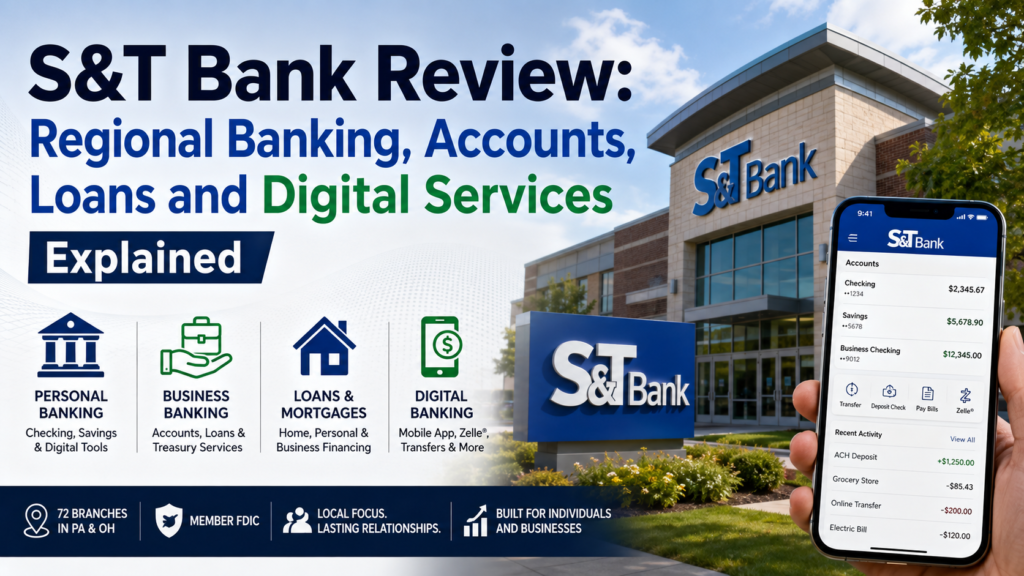
For consumers and business owners comparing regional financial institutions, S&T Bank stands out as a long-established bank with a concentrated presence in Pennsylvania and Ohio. Rather than competing primarily through nationwide scale, the institution combines local and regional banking relationships with personal accounts, commercial services, lending products, online banking and mobile tools.
S&T Bank was established in 1902 and is headquartered in Indiana, Pennsylvania. According to its current corporate fact sheet, the bank operates 72 branches across Pennsylvania and Ohio. Its parent company, S&T Bancorp, Inc., is also headquartered in Indiana and trades on the Nasdaq Global Select Market under the ticker STBA.
For readers researching regional banking options through GrowBusinessMag, the most useful way to evaluate S&T Bank is to look beyond name recognition. Account structure, lending capabilities, branch accessibility, digital banking features and business services all help determine whether the institution fits a customer’s actual financial needs.
Review S&T Bank’s History and Regional Presence
S&T Bank traces its origins to May 19, 1902, when the Savings and Trust Company opened with one office in Indiana, Pennsylvania. The institution later expanded across western Pennsylvania through mergers, acquisitions and additional locations. S&T’s historical materials identify 1966 as an important point in that geographic expansion.
The bank’s modern footprint is more focused than that of a national institution. Current S&T materials identify Pennsylvania and Ohio as its operating states, while a February 2026 corporate fact sheet lists 72 branches across those markets.
That footprint matters because branch availability remains an important consideration for customers who prefer in-person service. S&T maintains an online location finder that allows prospective customers to search for nearby branches and ATMs rather than relying on older branch lists or counts that may become outdated.
S&T has also continued investing in physical banking locations. In February 2025, the bank opened a full-service branch in Pittsburgh’s East Liberty neighborhood. In February 2026, it announced a broader branch-refresh initiative designed to modernize some of its locations.
These investments indicate that S&T continues to treat branches as part of its operating model even as more customer activity shifts to mobile and online channels.
Compare S&T Bank Personal Checking Options
S&T Bank offers multiple personal checking accounts rather than a single standardized option. That structure allows customers to choose an account based on factors such as balance levels, age, interest preferences and expected banking behavior.
Its personal banking lineup includes checking products supported by debit-card access, online banking and mobile banking. Customers considering a checking account should compare current maintenance fees, minimum opening deposits, balance conditions and eligibility requirements directly through the bank because individual account terms can change over time.
This is particularly important when comparing regional banks. A checking account that looks attractive based on one feature may become less competitive if it carries a maintenance fee that does not match the customer’s typical balance.
Prospective customers should also consider how they expect to use the account. Someone who performs nearly all transactions digitally may prioritize mobile deposit, online bill payment and electronic transfers, while someone who handles cash regularly may care more about nearby branches and ATM access.
Explore S&T Bank Savings Products
S&T Bank also provides savings products for customers looking to separate spending funds from short-term reserves or longer-term deposits.
Its broader personal banking offerings include savings accounts and other deposit products intended for different savings goals. Customers should review the bank’s current account disclosures to understand applicable interest structures, balance requirements, maintenance fees and withdrawal conditions.
Because savings rates can move with market conditions, it is especially important not to rely on an old advertised annual percentage yield when evaluating the bank. A current quote or official disclosure will provide a more accurate comparison.
Customers comparing S&T with online banks should also consider the tradeoff between yield and access. Online institutions sometimes emphasize deposit rates, while a regional bank such as S&T combines savings products with physical branches, lending relationships and additional financial services.
Neither model is automatically better. The more relevant question is whether the customer’s priority is maximizing deposit yield, consolidating multiple financial services, retaining local branch access or some combination of those factors.
Use S&T Bank Online and Mobile Banking
S&T Bank provides digital banking tools for customers who prefer to handle routine transactions without visiting a branch.
According to the bank’s current online banking information, its mobile application allows customers to view account activity, deposit checks, pay bills, transfer money between accounts and send money through Zelle.
The bank also allows customers to transfer money between S&T accounts and other financial institutions. Its transfer tools can be used for moving funds and making payments to eligible S&T loan accounts.
These capabilities are important because digital banking has reduced one of the traditional differences between regional and national banks. A geographically concentrated institution can still offer many of the same day-to-day digital functions that customers expect from a larger bank.
S&T’s mobile functionality includes check deposits, balance access, bill payment and person-to-person payments. That means customers who live within the bank’s operating region may be able to complete most routine banking tasks without depending on frequent branch visits.
Potential customers should still evaluate the app and online platform based on their own needs. People who require specialized integrations, international services or advanced financial-management capabilities may have different expectations from customers primarily using checking, transfers and bill payment.
Consider S&T Bank Mortgage and Consumer Loan Options
S&T’s services extend beyond deposit accounts into consumer lending.
The bank provides borrowing products for individuals, including mortgage and other consumer-financing options. Loan availability, approval standards, rates and terms depend on the specific product and applicant, so prospective borrowers should obtain current information directly from S&T rather than relying on historical offers.
For mortgage customers, the relationship with a regional bank may be attractive when borrowers value access to local or regional lending staff. However, mortgage decisions should still be based on measurable factors such as annual percentage rate, closing costs, loan term and total financing expense.
Consumers considering any personal loan should use the same approach. The most relevant comparison is the total cost of borrowing, not simply whether the lender is a regional or national institution.
Customers who already maintain deposits with S&T may find it convenient to keep borrowing and banking under one financial relationship. Convenience alone, however, should not replace comparison shopping.
Evaluate S&T Bank’s Business Banking Services
Business banking is an important part of S&T’s product offering.
The bank provides business checking, financing and cash-management solutions designed for companies with varying operational needs. Its current business banking site highlights deposit accounts, treasury-management services and business loans.
S&T’s business checking lineup includes Account Analysis Checking, which the bank describes as being designed for companies with multiple checking accounts or more sophisticated account-management requirements.
That illustrates an important distinction between consumer and business banking. Companies often need services beyond basic deposits and withdrawals, including payroll processing, payment controls, cash-flow management, ACH transactions and credit facilities.
S&T’s regional model may be particularly relevant for businesses operating primarily within Pennsylvania and Ohio. A company with customers, suppliers and operations concentrated in the same geographic area may place greater value on a bank with regional commercial expertise than on a larger branch network outside its operating market.
Access Business Loans and Lines of Credit
S&T Bank offers business financing intended to support operational and capital needs.
Its business lending materials identify lines of credit as one option for companies seeking access to funding for cash-flow and inventory requirements.
For larger or more complex borrowers, S&T also provides commercial financing. Its asset-based lending operation offers revolving lines of credit, term loans and capital-expenditure loans secured by qualifying assets such as receivables, inventory, equipment and real estate. S&T currently states that this program serves loan commitments ranging from $5 million to $25 million.
This commercial capability is significant when comparing S&T with smaller community banks that may have more limited lending capacity.
S&T’s commercial banking site also identifies commercial and industrial financing and commercial real-estate financing among its services.
Business borrowers should still evaluate lending relationships carefully. Credit limits, collateral requirements, covenants, pricing and underwriting standards can vary substantially depending on the company and financing structure.
Manage Business Cash Flow With Treasury Services
S&T Bank offers treasury-management tools for companies that require more control over payments, collections and liquidity.
Its current commercial banking materials list online statements, bill payment, account transfers, direct-deposit payroll and ACH origination among available business online functions.
S&T also offers remote deposit capture through its Treasury Advantage platform. The service allows qualifying businesses to scan checks for deposit without bringing each physical check to a branch.
For a business, these functions can be more important than consumer-facing conveniences. Efficient receivables processing, payroll administration and cash positioning can directly affect day-to-day operations.
This is one area where a regional bank can compete with larger institutions through service depth rather than sheer geographic scale. Businesses should compare actual treasury features, service fees, implementation requirements and support rather than assuming that the biggest bank automatically has the best solution.
Compare S&T Bank With Larger National Banks
The clearest difference between S&T Bank and a large national bank is geographic scale.
S&T’s current footprint consists of 72 branches across Pennsylvania and Ohio. National banks may operate hundreds or thousands of locations across a much broader number of states.
That gives national banks an obvious advantage for customers who travel frequently, relocate often or need branch access in multiple regions.
S&T, however, operates with a more concentrated regional model. Its product portfolio includes consumer banking, business banking, commercial financing and treasury-management services alongside its branch network.
For some customers, that concentration may make the bank easier to evaluate because its markets and operating focus are relatively defined. Business owners may also value access to commercial bankers working within markets where the institution already has an established presence.
Still, claims that regional banks always provide superior personal service should be treated cautiously. Customer experience varies by employee, branch, product and situation. The more reliable comparison is based on documented services, pricing, accessibility and product fit.
Review S&T Bank’s Current Scale and Financial Position
Customers researching a bank may also want evidence that the institution has a substantial operating base.
S&T Bancorp reported $134.2 million in net income for full-year 2025, compared with $131.3 million for 2024. Its June 2026 corporate materials described S&T Bancorp as a $9.9 billion bank holding company.
These figures help establish the scale of the organization but should not be interpreted as a guarantee about future performance. Bank earnings can change as interest rates, credit conditions, deposit costs and economic activity evolve.
Consumers generally do not need to analyze a regional bank like an equity investor. However, checking current regulatory filings and corporate disclosures can provide additional information about the organization behind the bank.
S&T Bancorp maintains annual reports and SEC filings through its investor-relations site, giving researchers access to primary-source financial documentation.
Verify Deposit Insurance and Account Protection
S&T Bank identifies itself as a Member FDIC institution in its official materials.
FDIC insurance protects qualifying deposits within applicable federal limits and ownership rules. Coverage does not mean every financial product offered through a banking relationship is insured, so customers should distinguish deposit accounts from investment or other non-deposit products.
Consumers with balances approaching or exceeding standard insurance limits should review their ownership categories and current FDIC guidance instead of assuming that all funds are automatically protected without limit.
This type of verification is especially important when comparing institutions based on safety. A bank’s marketing language is less useful than confirming its regulatory status and understanding exactly which account types qualify for deposit insurance.
Check Branch and ATM Access Before Opening an Account
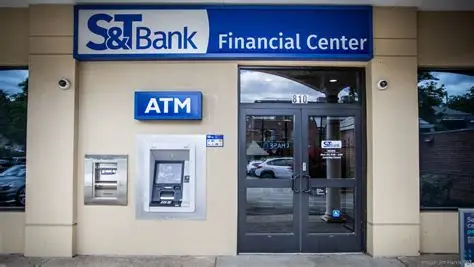
Location remains one of the most practical considerations for prospective S&T customers.
The bank provides an online locator for identifying nearby branches and ATMs.
Using the live locator is preferable to relying on a static list because branch networks can change. Customers should confirm operating hours, available services and ATM access for the locations they expect to use.
Business customers may need additional verification because not every branch necessarily provides the same commercial or specialized services.
Someone who handles frequent cash deposits may prioritize proximity to a physical office. By contrast, a customer who receives income electronically and uses mobile deposit may rarely need branch access.
The value of S&T’s 72-branch network therefore depends heavily on where a customer lives or operates a business.
Confirm Current Fees, Rates and Requirements
Prospective customers should verify current terms before opening any S&T account or applying for financing.
Banking products can change. Interest rates, annual percentage yields, balance thresholds, monthly fees and promotional offers may be different from the terms available when an older article or review was published.
This is especially important for checking and savings accounts because a seemingly small fee can meaningfully change the value of an account over time.
Borrowers should similarly compare APRs, loan terms, closing costs, collateral requirements and other fees.
Businesses may need to review an even broader range of charges, including transaction fees, treasury-management costs and merchant or payment-service pricing.
The safest research approach is to use third-party articles to understand the bank’s overall structure and then confirm current financial terms through official disclosures before applying.
Decide Whether S&T Bank Fits Your Needs
S&T Bank is most relevant to consumers and companies seeking a regional banking relationship in Pennsylvania or Ohio.
Its documented services cover personal banking, digital banking, business accounts, lending, commercial financing and treasury management. Mobile customers can deposit checks, transfer funds, pay bills and use Zelle, while business customers can access additional tools such as ACH origination and remote deposit capture.
The bank’s principal limitation compared with the largest U.S. banks is its geographic reach. A 72-branch network across two states is substantial within its regional market but does not provide national physical coverage.
That tradeoff will matter differently depending on the customer. Someone living and working near S&T branches may see little practical disadvantage, particularly if most banking occurs digitally. A customer who expects to move across the country may prefer a bank with a wider physical network.
The strongest decision therefore comes from matching documented capabilities with personal financial behavior rather than choosing solely on brand size.
Frequently Asked Questions About S&T Bank
Where is S&T Bank headquartered?
S&T Bank is headquartered in Indiana, Pennsylvania. The bank was established there in 1902, and its parent company, S&T Bancorp, Inc., is also headquartered in Indiana.
How many S&T Bank branches are there?
S&T Bank’s February 2026 corporate fact sheet states that it operates 72 branches across Pennsylvania and Ohio. Because branch networks can change, customers should use the bank’s current location finder when searching for a nearby office.
Does S&T Bank have mobile banking?
Yes. S&T’s mobile app supports account-activity viewing, mobile check deposits, bill payment, transfers and Zelle payments.
Does S&T Bank offer business banking?
Yes. S&T provides business checking, lending, digital business banking, treasury-management services and commercial financing solutions.
Is S&T Bank FDIC insured?
S&T Bank identifies itself as a Member FDIC institution. Eligible deposit accounts are therefore covered according to applicable FDIC limits and ownership rules. Customers should verify current federal coverage requirements when maintaining larger balances.
Final Assessment
S&T Bank combines more than a century of operating history with a modern regional banking platform covering Pennsylvania and Ohio. Established in 1902 and headquartered in Indiana, Pennsylvania, the institution currently maintains 72 branches while also providing online and mobile services that reduce customers’ dependence on physical offices.
Its product range extends well beyond basic consumer accounts. S&T serves individuals through deposit and lending services while offering companies business checking, financing, commercial lending and treasury-management capabilities. Digital services include mobile check deposit, transfers, bill payment and Zelle, while business tools include ACH functions and remote deposit capture.
What distinguishes S&T from the largest national institutions is not that one banking model is inherently superior. The difference is primarily scale and geographic focus. S&T concentrates its physical operations in Pennsylvania and Ohio, while national banks typically provide much broader branch coverage.
For prospective customers within S&T’s footprint, that regional concentration can still provide access to a broad mix of personal and commercial banking services. Customers outside that footprint, or those expecting frequent interstate moves, may place greater value on nationwide branch availability.
Anyone seriously considering S&T Bank should therefore verify the nearest locations, review current account disclosures and compare up-to-date fees and rates with competing banks and credit unions. That combination of primary-source research and personal requirements provides a stronger basis for choosing a bank than relying on reputation or promotional claims alone.