
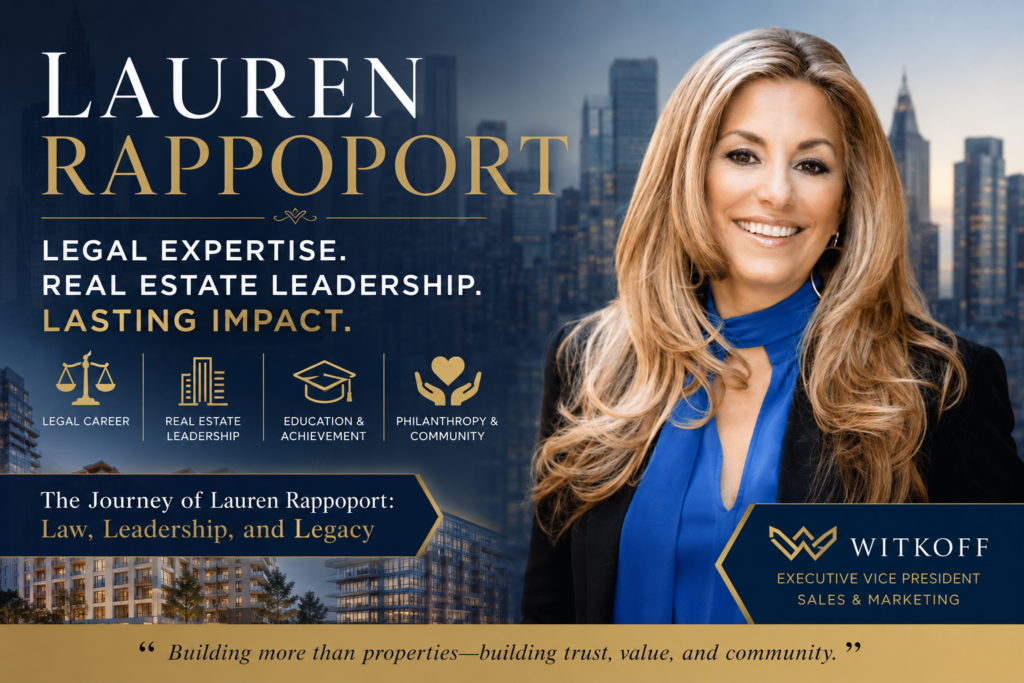
Lauren Rappoport, known professionally as Lauren Witkoff, has developed a career spanning real estate law, brokerage, condominium marketing, development strategy, and charitable service. Interest in her background has increased because of her executive role at Witkoff and her connection to a family closely associated with major property developments in New York and other high-value markets.
Although Rappoport works within a prominent real estate organization, she keeps a comparatively restrained public profile. The clearest account of her professional life comes from Witkoff’s official leadership materials, which document her academic record, legal experience, current responsibilities, notable projects, and philanthropic involvement. Those records show that she established her own credentials in property law and brokerage before moving into a senior corporate position.
Her career reflects an uncommon combination of legal analysis and market-facing leadership. She has worked with commercial leases and real estate transactions, then applied that knowledge to the positioning and sale of luxury residential developments. This background provides a more useful picture of Rappoport than the brief, repetitive profiles that often appear in general web searches.
Confirm Lauren Rappoport’s Professional Identity
The Lauren Rappoport associated with Witkoff is Lauren Rappoport Witkoff, who generally uses the name Lauren Witkoff in professional settings. She serves as executive vice president of sales and marketing at Witkoff, where she leads the company’s sales and marketing activities with a particular focus on new condominium developments.
Her title places her within the company’s senior leadership team rather than in a ceremonial or supporting position. Sales and marketing affect how a development is introduced, differentiated, priced, presented to brokers, and communicated to prospective purchasers. In a luxury condominium business, these responsibilities can shape public perception of a project from its initial launch through the final stages of sales.
Several professionals share the name Lauren Rappoport, which can produce confusing or inaccurate search results. The real estate executive discussed here can be distinguished through her association with Witkoff, her legal background, her work in commercial leasing and property transactions, and her involvement with high-end residential developments in New York and California.
The documented record therefore supports a clear professional identity: Rappoport is a lawyer-trained real estate executive whose career has included legal practice, brokerage, development marketing, strategic positioning, and charitable involvement.
Review Her Education and Legal Training
Rappoport attended the University of Rochester, where she earned a Bachelor of Arts in political science and graduated magna cum laude. She later received a Juris Doctor with honors from the George Washington University Law School. Both distinctions are listed in her official company biography.
Political science provided a foundation in institutions, public systems, research, and the evaluation of competing interests. Legal education added disciplined writing, contractual interpretation, negotiation, and risk analysis. These abilities have direct relevance in real estate, where developments depend on agreements among owners, tenants, lenders, investors, designers, contractors, brokers, and buyers.
Her academic background also helps explain the progression of her career. Property marketing may appear primarily creative from the outside, but major developments are built around legally defined rights, financial obligations, disclosure requirements, and carefully structured transactions. An executive who understands those underlying arrangements can communicate more effectively with legal advisers and identify potential issues before they affect a campaign or sale.
Rappoport’s transition into marketing did not separate her from her legal training. Instead, it allowed her to apply the same precision to a broader business role involving project identity, buyer communication, brokerage relationships, and executive decision-making.
| Qualification | Institution | Documented distinction |
|---|---|---|
| Bachelor of Arts in Political Science | University of Rochester | Magna cum laude |
| Juris Doctor | George Washington University Law School | Graduated with honors |
These educational details are particularly valuable because they come from a first-party professional source rather than from unsourced biography websites.
Trace Her Early Career in Real Estate Law
Before joining Witkoff, Rappoport worked as a real estate attorney and broker in New York. Her official biography identifies Dreyer & Traub and Botein, Hays & Sklar as the firms where she specialized in commercial leasing and real estate transactions.
Commercial leasing requires close attention to provisions that can affect a property for years. Attorneys may address rent structures, operating expenses, renewal rights, permitted uses, assignment provisions, insurance duties, construction responsibilities, guarantees, default remedies, and termination rights. Each clause can influence a building’s income, a tenant’s flexibility, and the parties’ exposure to risk.
Transactional property work also requires coordination. Lawyers frequently communicate with owners, lenders, brokers, architects, contractors, and other advisers while moving an agreement toward completion. The role demands enough commercial awareness to protect a client without creating unnecessary barriers to a workable deal.
Rappoport’s brokerage experience added another layer to that foundation. Brokers must understand market conditions, evaluate properties, manage relationships, negotiate terms, and present complicated information in a form clients can use. Legal practice emphasizes accuracy and risk, while brokerage emphasizes communication and action. Experience in both areas prepared her for an executive position that depends on each discipline.
Her early career established four capabilities that remain relevant to development marketing: interpreting transactions, identifying risks, negotiating among multiple interests, and explaining property value to clients.
Follow Her Transition Into Real Estate Leadership
Rappoport later moved from advising participants in property transactions to helping direct how developments were presented and sold. At Witkoff, she assumed leadership of sales and marketing, concentrating on new condominium projects.
The move was a natural extension of her earlier work. Condominium marketing is not limited to advertising. It requires a detailed understanding of the building, its legal structure, design, intended buyer, neighborhood, competitive position, delivery schedule, pricing strategy, and sales process.
A development campaign must also stay aligned with the property itself. Renderings, model residences, brochures, websites, broker presentations, and public relations materials must accurately reflect architectural plans and approved offerings. Rappoport’s legal training would support that need for precision, while her brokerage background would help her assess how buyers and their advisers interpret the project.
Witkoff credits her with marketing developments including 515 East 72nd Street, 150 Charles Street, 10 Madison Square West, 111 Murray Street, and the residences at the West Hollywood EDITION. The portfolio includes different property types, neighborhoods, design approaches, and buyer expectations.
Industry observers note that successful luxury development marketing depends on close coordination among legal, design, construction, brokerage, and communications teams. Rappoport’s professional path gives her direct experience in several of those areas, strengthening her ability to connect the commercial details of a project with its public presentation.
Examine Her Role at Witkoff
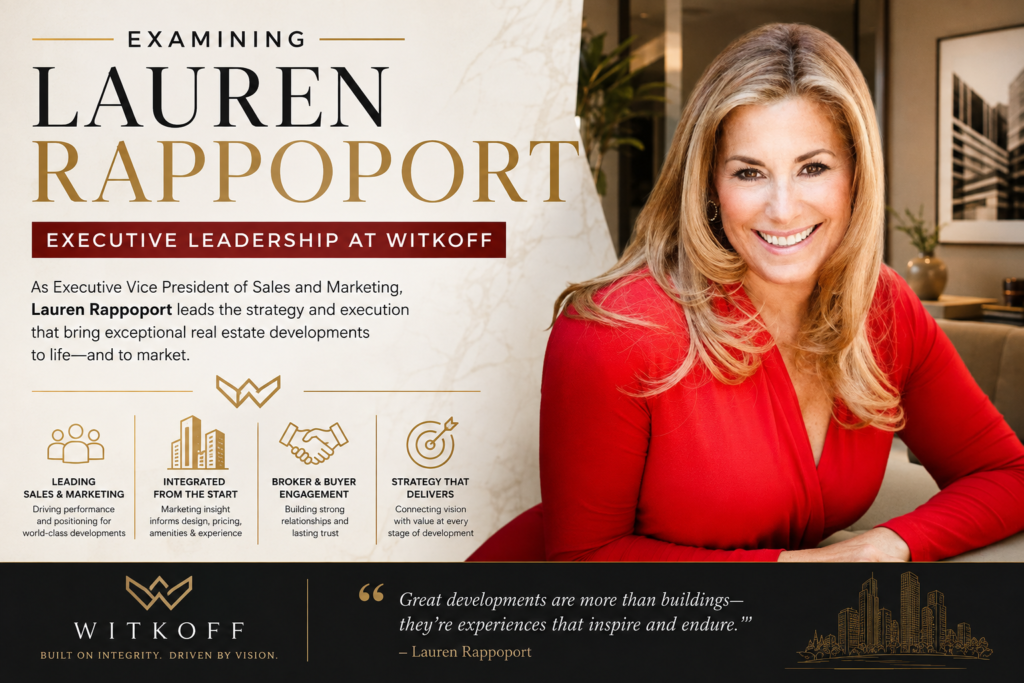
As executive vice president of sales and marketing, Rappoport leads a function that connects a property’s physical characteristics with its commercial identity. Development teams create the asset, while sales and marketing teams establish how buyers encounter, understand, and evaluate it.
Her responsibilities likely involve collaboration across branding, pricing, sales galleries, broker engagement, model residences, launch planning, media strategy, and buyer communications. The precise allocation of her daily duties is not publicly detailed, but Witkoff explicitly identifies her as the executive leading the company’s sales and marketing efforts.
The company’s broader development approach relies on internal expertise across construction, marketing, operations, investment, and design. Witkoff states that these teams contribute throughout its diligence and design processes, indicating that marketing is integrated into development decisions rather than introduced only when a property is ready for sale.
That integration matters in high-end residential projects. Amenities, layouts, materials, service models, common spaces, and visual identity all influence how a development competes. A marketing executive can provide information about buyer expectations while architects and designers are still shaping the product.
Rappoport’s legal and brokerage experience gives her a useful position within that process. She can approach a project as both a transaction and a customer proposition, connecting technical accuracy with persuasive presentation.
Explore the Properties Connected to Her Work
Rappoport’s official biography names five developments that she has successfully marketed. Together, they demonstrate experience with urban condominiums, conversions, ground-up towers, established residential neighborhoods, and hospitality-branded residences.
515 East 72nd Street
Located on Manhattan’s Upper East Side, 515 East 72nd Street operates in a market where buyers compare newer condominium offerings with long-established cooperative and residential buildings. Marketing in that setting requires a clear explanation of lifestyle, services, amenities, interior quality, and neighborhood access.
A development in an established area cannot rely on novelty alone. It must show how its residences address the expectations of buyers who already understand the neighborhood and may be choosing among several ownership formats.
Rappoport’s connection to the project also illustrates how a sales environment can support relationship-building. Model residences can host prospective buyers, brokers, members of the media, and charitable gatherings, allowing the development to be experienced as a living environment rather than merely viewed through floor plans.
150 Charles Street
The 150 Charles Street development occupies a position in Manhattan’s West Village, where limited development opportunities contribute to the value of well-located residential property. Buyers in this market often examine privacy, architectural fit, outdoor space, views, services, and the relationship between a new building and the surrounding neighborhood.
Marketing a development in the West Village requires restraint. The campaign must communicate contemporary comfort without ignoring the architectural and cultural character that makes the area attractive.
Rappoport’s involvement reflects experience with a project whose appeal depended on both its physical offering and the scarcity of comparable residences in the neighborhood.
10 Madison Square West
The development at 10 Madison Square West represents the repositioning of a prominent Manhattan property near Madison Square Park. Conversion projects present a distinct marketing challenge because the campaign must explain how an existing structure has been transformed into a contemporary residential experience.
The sales strategy must connect the building’s architectural history with redesigned interiors, modern services, amenities, and a new identity. Buyers need to understand not only the finished residence but also the quality and ambition of the conversion.
Rappoport’s work on the property demonstrates familiarity with marketing transformation rather than simply promoting newly constructed space.
111 Murray Street
Located in Tribeca, 111 Murray Street is associated with a segment of the market that values large residences, skyline and river views, distinctive architecture, privacy, service, and access to Lower Manhattan.
A high-rise condominium campaign must distinguish the building from other premium towers. Height and location may attract initial attention, but buyers also consider floor plans, finishes, landscaping, wellness facilities, operations, and confidence in the development team.
Rappoport’s involvement with 111 Murray Street shows experience positioning a major luxury project in a neighborhood where buyers have numerous sophisticated alternatives.
West Hollywood EDITION Residences
The residences at the West Hollywood EDITION extended her project experience beyond New York. The development combines private homes with the identity and service expectations associated with a hospitality brand.
Branded residences require buyers to evaluate two propositions at once: the quality of the property and the credibility of the service experience. Architecture, interiors, amenities, privacy, operations, and brand standards must work together.
Witkoff identifies the broader West Hollywood EDITION project as including both hotel accommodations and branded residences. Rappoport’s association with its sales and marketing reflects experience translating a hospitality concept into a residential offering.
| Development | Primary market | Central positioning challenge |
|---|---|---|
| 515 East 72nd Street | Upper East Side, New York | Presenting modern residential value in an established neighborhood |
| 150 Charles Street | West Village, New York | Balancing luxury development with neighborhood character |
| 10 Madison Square West | Manhattan, New York | Communicating the value of a major property conversion |
| 111 Murray Street | Tribeca, New York | Differentiating a high-end tower through design and service |
| West Hollywood EDITION Residences | West Hollywood, California | Combining private ownership with a hospitality brand |
The portfolio shows that Rappoport’s work has involved more than one repeatable sales formula. Each project required a distinct narrative grounded in its location, architecture, service model, and intended audience.
Understand Her Sales and Marketing Approach
Rappoport has not published a detailed personal framework for real estate marketing, so conclusions about her methods should remain tied to her documented experience. Her background nevertheless reveals several qualities relevant to her work.
First, she brings transaction-level knowledge to project communication. Because she practiced real estate law and worked as a broker, she understands that buyers and their advisers evaluate more than visual appeal. They also examine ownership terms, disclosures, timing, reputation, and the credibility of the development team.
Second, her role requires coordination across specialized disciplines. Architects focus on design, construction teams focus on delivery, lawyers focus on compliance, brokers focus on buyers, and communications teams focus on visibility. Effective leadership must keep those groups aligned around an accurate and consistent presentation.
Third, the properties associated with her career occupy the premium end of the residential market. Their campaigns depend on design quality, scarcity, location, privacy, service, and confidence rather than discount pricing. The language and imagery used to market them must therefore appear considered rather than overstated.
Fourth, her work operates within a real estate profession where women have a substantial presence. According to the National Association of Realtors, women have represented the majority of the organization’s membership since 1978, with recent figures placing that share at roughly two-thirds. The figure provides broader industry perspective on Rappoport’s career while also showing that senior female participation is part of a well-established professional landscape.
Her career remains distinctive because it combines that market-facing role with formal legal training and direct experience in commercial transactions.
Recognize Her Work in Luxury Condominium Marketing
Luxury condominium marketing begins with the property’s tangible features but cannot end there. Buyers evaluate size, layout, ceiling height, materials, views, appliances, building systems, and amenities. They also respond to less measurable factors such as privacy, reputation, service quality, architectural identity, and confidence in long-term management.
The sales and marketing function must combine those elements into a clear proposition. A campaign cannot create lasting demand for a weak property, but poor communication can prevent a strong development from expressing its full value.
Model residences play a central role because they convert drawings and specifications into a physical experience. Visitors can assess proportions, movement between rooms, light, finishes, views, and possible furniture arrangements. Sales teams can then connect those observations with the building’s broader amenities and service model.
Digital presentation has become equally important. Renderings, photography, video, virtual experiences, websites, and broker materials may shape a buyer’s first encounter with a property. Each format must reinforce the same identity and avoid discrepancies that could reduce confidence.
Rappoport’s executive role places her close to these decisions. Her value lies not only in promoting a finished development but also in helping maintain consistency between the building’s commercial promise and the experience ultimately delivered to buyers.
Consider Her Charitable Involvement
Witkoff’s official biography states that Rappoport has served on the boards of charitable organizations including City of Hope and the Jeffrey Modell Foundation. It also records her fundraising support for the ASPCA and the Humane Society.
These affiliations span medical care, health research, immune-related conditions, and animal welfare. They indicate that her public work outside real estate has involved more than a single organization or one-time event.
Board participation can include governance, fundraising, advocacy, strategic planning, and relationship development, although the exact scope of Rappoport’s service has not been fully detailed in publicly available sources. A careful biography should acknowledge the documented affiliations without assigning responsibilities that have not been confirmed.
Her fundraising for animal-welfare organizations also aligns with a broader form of community engagement in which professional networks and real estate venues can support charitable causes. Luxury developments often host events because model residences and amenity spaces provide controlled settings for donors, supporters, and community partners.
The available record presents philanthropy as a continuing element of Rappoport’s professional identity, particularly in health and animal welfare.
Place Her Within the Witkoff Family Business
Rappoport’s career is closely connected to Witkoff, but her professional qualifications predate her senior position at the company. She had already completed an honors-level education, earned a law degree, worked at New York law firms, handled commercial leasing matters, participated in property transactions, and gained brokerage experience.
That chronology is important because public profiles sometimes reduce women in family-controlled businesses to their relationships. In Rappoport’s case, the available evidence shows a defined professional path and a current executive mandate.
Within Witkoff, her focus on sales and marketing complements the responsibilities of other executives working in development, construction, investments, legal affairs, design, accounting, and capital markets. The company’s leadership structure presents real estate development as a coordinated business requiring multiple specialized functions.
Family association can still shape public interest, particularly when several relatives participate in the same business. Responsible coverage, however, should separate documented corporate responsibilities from assumptions about private influence or ownership.
Rappoport’s record supports a straightforward conclusion: she occupies a senior operating role built around the marketing and sale of residential developments, and her earlier legal and brokerage experience provides relevant preparation for that work.
Distinguish Verified Facts From Online Speculation
Searches for Lauren Rappoport often return biography pages that repeat similar claims without identifying original sources. Some mix accurate professional information with unsupported statements about wealth, lifestyle, personality, property ownership, or private relationships.
The most reliable facts are those documented by Witkoff. Rappoport graduated magna cum laude from the University of Rochester, earned her law degree with honors from George Washington University, worked as a real estate attorney and broker, specialized in commercial leasing and property transactions, and became Witkoff’s executive vice president of sales and marketing. The company also identifies the developments she marketed and the charitable organizations she supported.
Claims about her individual net worth deserve particular caution. Witkoff is privately held, and publicly accessible materials do not provide the information needed to calculate her personal assets, compensation, liabilities, or ownership interests. A family’s business prominence cannot be converted into a credible individual wealth estimate without financial documentation.
The same caution applies to claims about her daily life or private family dynamics. Repetition across multiple low-authority websites does not turn an unsupported statement into a verified fact.
A credible profile should therefore distinguish between confirmed career information and material that exists mainly to fill gaps in the public record.
Evaluate Her Influence in Real Estate Marketing
Rappoport’s professional influence is most visible through the developments attached to her record. She has helped market residential properties in the Upper East Side, West Village, Madison Square area, Tribeca, and West Hollywood.
Each project required its own commercial identity. A West Village development cannot be positioned in the same manner as a Tribeca tower or a West Hollywood branded residence. Neighborhood character, buyer expectations, architectural form, service, scale, and competitive supply all influence the message.
Her legal experience gives her career additional depth. Executives who come from advertising or public relations may bring strong communication skills, while Rappoport also brings experience with the mechanics of leases and transactions. That background can improve coordination with counsel and reinforce accuracy in project materials.
Her brokerage experience provides another practical advantage. Brokers operate between the property and the buyer, translating specifications into decisions. Understanding their concerns can improve sales materials, presentations, information flow, and responses to objections.
Rappoport’s influence is therefore not measured through public visibility alone. It appears in the way projects are positioned, presented to intermediaries, and carried through complex sales processes.
Assess the Public Interest in Lauren Rappoport
Interest in Rappoport reflects several overlapping search intentions. Readers want information about her education, legal career, corporate position, development portfolio, charitable work, and relationship to the Witkoff family.
Her reserved public presence contributes to that curiosity. She holds a senior role at a recognized development company but does not maintain the highly visible personal brand associated with many executives. As a result, thin biography pages can outrank more substantive sources by publishing broad claims around a frequently searched name.
The best response to that information gap is not speculation. It is a careful account built from verifiable records. Those records show a progression from political science and law into commercial property work, brokerage, condominium marketing, and executive leadership.
They also show the range of her responsibilities. Her work involves residential developments in more than one market, including traditional condominiums and branded residences. Her charitable involvement extends into medical and animal-welfare causes.
This documented record offers a fuller and more credible explanation of why Lauren Rappoport attracts attention than sensational descriptions or unverified estimates.
Build an Accurate Summary of Her Career
Rappoport’s professional development follows a coherent sequence. She completed her undergraduate education with high academic distinction, earned an honors law degree, practiced real estate law, worked as a broker, and moved into a senior sales and marketing role at Witkoff.
At Witkoff, she became responsible for leading sales and marketing, especially for new condominium developments. The company credits her with successfully marketing 515 East 72nd Street, 150 Charles Street, 10 Madison Square West, 111 Murray Street, and the West Hollywood EDITION residences.
Her work brings together legal analysis, property knowledge, broker communication, project branding, luxury positioning, and buyer engagement. Each element supports the others. Legal training promotes precision, brokerage experience supports negotiation, and marketing leadership turns development details into a coherent commercial story.
Her charitable record adds another dimension. Board affiliations and fundraising efforts connect her public profile with organizations focused on medical care, health research, and animal protection.
Taken together, these facts establish Rappoport as a real estate professional with a substantial career of her own, not merely as a person connected to a prominent family.
Conclusion
Lauren Rappoport, professionally known as Lauren Witkoff, has built a career at the intersection of law, brokerage, residential development, luxury sales, and strategic marketing. Her education at the University of Rochester and George Washington University Law School prepared her for a legal career, while her experience at New York law firms introduced her to commercial leasing and property transactions.
She later brought that foundation to Witkoff, where she serves as executive vice president of sales and marketing. Her documented portfolio includes major residential projects in Manhattan and West Hollywood, ranging from neighborhood-focused condominiums to high-rise developments and hospitality-branded residences.
Her career demonstrates how legal knowledge can strengthen real estate marketing. Property campaigns must be visually compelling, but they must also remain accurate, commercially grounded, and responsive to the concerns of buyers, brokers, lawyers, and development partners.
Rappoport’s charitable service further broadens her record through involvement with health and animal-welfare organizations. Although online profiles frequently add unsupported personal claims, the verified information is substantial: she is an experienced real estate executive whose legal training and market expertise have contributed to the sale and positioning of prominent residential developments.
Frequently Asked Questions
Who is Lauren Rappoport?
Lauren Rappoport, also known professionally as Lauren Witkoff, is a former real estate attorney and broker who serves as executive vice president of sales and marketing at Witkoff.
Where did Lauren Rappoport study?
She earned a Bachelor of Arts in political science magna cum laude from the University of Rochester and a Juris Doctor with honors from the George Washington University Law School.
Did Lauren Rappoport practice law?
Yes. She worked in New York as a real estate attorney and broker, specializing in commercial leasing and property transactions at Dreyer & Traub and Botein, Hays & Sklar.
Which developments has Lauren Rappoport marketed?
Her official biography lists 515 East 72nd Street, 150 Charles Street, 10 Madison Square West, 111 Murray Street, and the residences at the West Hollywood EDITION.
What is Lauren Rappoport’s position at Witkoff?
She is executive vice president of sales and marketing and leads the company’s marketing and sales efforts, particularly for new condominium developments.
Which charitable causes has Lauren Rappoport supported?
Witkoff states that she has served organizations including City of Hope and the Jeffrey Modell Foundation and has raised funds for the ASPCA and the Humane Society.