
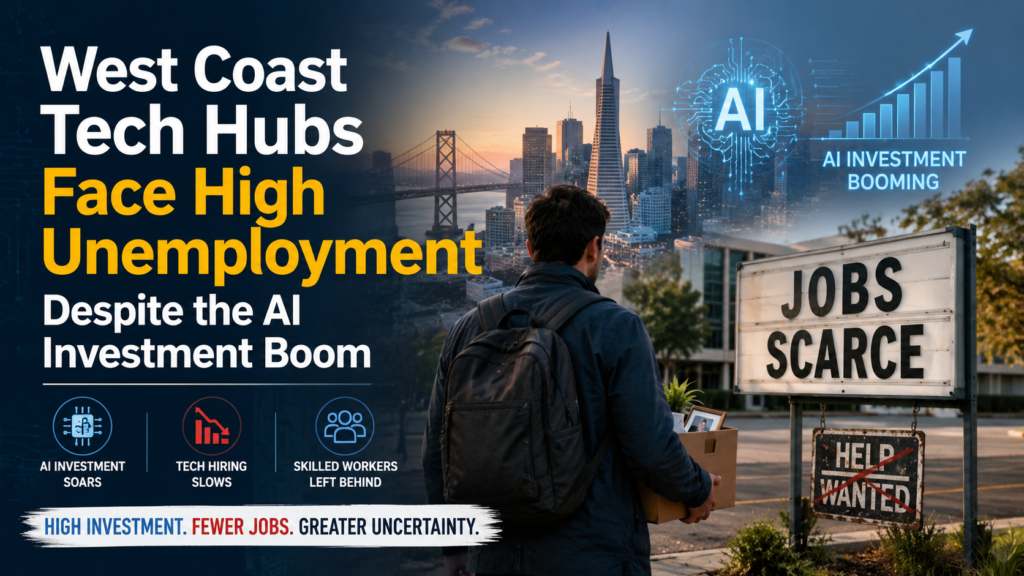
The artificial intelligence spending boom is reshaping corporate budgets across the technology industry, but it is not producing a matching surge in jobs. Across major West Coast tech centers, companies are pouring money into AI infrastructure and software while keeping hiring restrained, leaving experienced technology workers competing for fewer openings.
Juan Ruiz has experienced that shift firsthand. Despite AI skills and more than a decade in technology management, he has been searching for work in California since October 2024 and has submitted hundreds of applications without securing a new position.
Track the Widening Gap Between AI Investment and Hiring
The labor-market weakness is visible in government data. In June, California, Oregon and Washington each posted a 5.2% unemployment rate, tying for the second-highest rate in the country, according to the U.S. Bureau of Labor Statistics data cited in the reference report.
Technology hiring has slowed even as spending on AI accelerates. Companies increasingly direct capital toward AI systems, computing infrastructure and enterprise tools rather than expanding payrolls at the pace seen during earlier technology booms.
Laura Ullrich, director of economic research at Indeed, said improving AI technology means companies may need fewer software developers and data analysts. She also noted that heavy spending on enterprise AI can reduce the portion of corporate budgets available for labor unless overall spending increases.
California illustrates the pressure. Employment in the state’s information industry fell to a six-year low in April and recovered only slightly by June. For readers tracking technology and business trends through publications such as GrowBusinessMag, the figures highlight a significant change in how investment translates into employment.
Watch Major Employers Reshape Regional Tech Workforces
Large technology companies have contributed to the contraction. Microsoft’s overall headcount recently declined for the first time in about a decade, while Amazon has cut more than 30,000 jobs since October.
In Oregon, Intel has reduced its workforce to roughly 81,000 employees, down from more than 130,000 in 2022. The cuts have helped push employment in the state’s semiconductor industry to a 30-year low.
The slowdown is also affecting highly educated workers. UCLA economist Ben Hyman has observed rising unemployment claims among people previously working in occupations with significant exposure to AI, particularly advanced-degree professionals in the Bay Area and related technology sectors.
Prepare for a More Selective Technology Job Market
For displaced workers, fewer vacancies have intensified competition. Former Portland project manager Matt Carter struggled to return to technology work after being laid off and eventually sold his home after his unemployment benefits expired.
The near-term outlook remains challenging. AI investment could create new roles as technologies mature, but West Coast employers are currently emphasizing automation, productivity and infrastructure spending over broad workforce expansion.