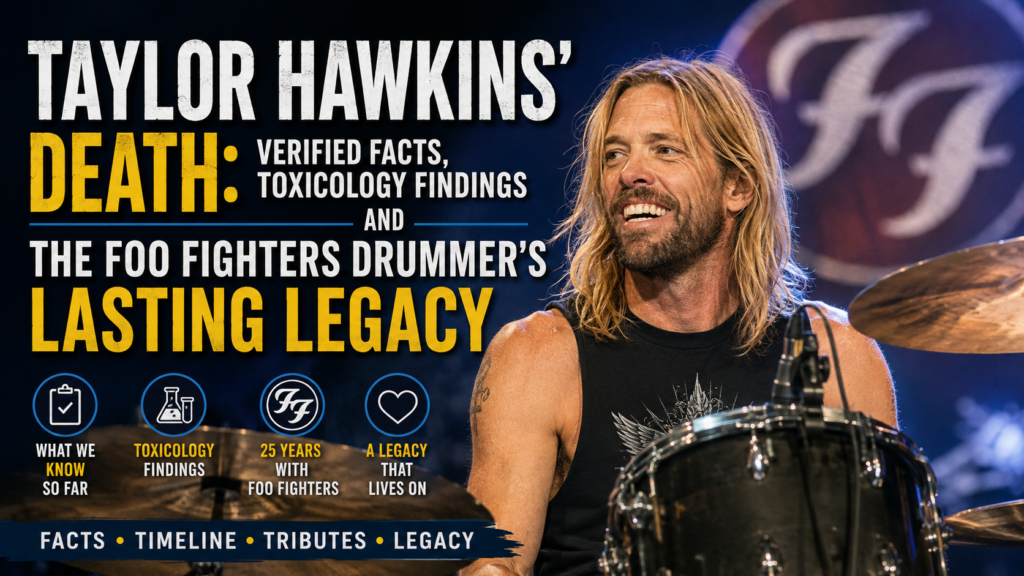
Taylor Hawkins was one of the most recognizable rock drummers of his generation. Best known for his 25-year career with Foo Fighters, Hawkins combined powerful musicianship with an energetic stage presence that made him a central part of the band’s identity. His sudden death in Bogotá, Colombia, on March 25, 2022, at age 50 prompted widespread mourning and intense public interest in the circumstances surrounding his final hours.
Searches for the Taylor Hawkins cause of death often produce conflicting or overly definitive claims. The publicly documented record is more limited. Colombian authorities released preliminary toxicology findings showing multiple substances in Hawkins’ system, but they did not publicly announce a final official cause of death. Major news organizations continued to report years later that no definitive cause had been publicly released.
That distinction is essential. Toxicology results can contribute to a death investigation, but the presence of substances alone does not establish precisely how a person died. A careful account therefore needs to separate confirmed findings from speculation.
Taylor Hawkins Built a 25-Year Career With Foo Fighters
Oliver Taylor Hawkins was born on February 17, 1972. Before joining Foo Fighters, he developed his professional career as a touring drummer and became widely known through his work with Alanis Morissette during the 1990s.
Hawkins joined Foo Fighters in 1997 and remained with the band until his death in 2022. Over roughly a quarter-century, he became one of its longest-serving and most identifiable members. The Recording Academy has described him as a major creative force in the group, while its official Foo Fighters profile identifies Hawkins among the band’s core members.
His tenure covered much of Foo Fighters’ rise from a successful alternative-rock project into one of the world’s leading arena-rock acts. Hawkins performed on major studio albums including There Is Nothing Left to Lose, One by One, In Your Honor, Echoes, Silence, Patience & Grace, Wasting Light, Sonic Highways, Concrete and Gold and Medicine at Midnight.
Hawkins Was More Than the Band’s Drummer
Although drums defined his primary role, Hawkins contributed more broadly to Foo Fighters’ music. He also sang, wrote songs and occasionally moved to the front of the stage during live performances.
His musical personality drew heavily from classic rock. Hawkins frequently celebrated earlier drummers and bands that shaped his playing, particularly acts associated with the 1970s and 1980s. His enthusiasm for Queen and Rush became especially visible through performances, interviews and Rock & Roll Hall of Fame appearances.
In 2013, Hawkins joined Dave Grohl in helping induct Rush into the Rock & Roll Hall of Fame. Eight years later, Foo Fighters themselves were inducted in 2021, with Hawkins among the members officially honored.
That induction provided formal recognition of Hawkins’ contribution to a band that had become a defining force in contemporary rock.
Hawkins Died in Bogotá on March 25, 2022
Foo Fighters were touring South America in March 2022 when they arrived in Bogotá for Festival Estéreo Picnic. The band was scheduled to perform on the evening of March 25.
According to Bogotá health authorities, the city’s emergency regulatory center received a report involving a patient experiencing chest pain. Emergency medical personnel were dispatched to the hotel where Hawkins was staying. Responders attempted resuscitation, but Hawkins could not be revived.
He was 50 years old.
The scheduled Foo Fighters performance was canceled, and news of Hawkins’ death spread internationally later that evening.
Foo Fighters Confirmed His Death in an Official Statement
Foo Fighters confirmed Hawkins’ death through an official statement issued that night. The band described the loss as “tragic and untimely” and said his “musical spirit and infectious laughter” would live on. The statement also asked the public to respect the privacy of his wife, children and family.
At that point, the band did not announce a cause of death.
That is important because some later online accounts blurred the distinction between the circumstances of his death, preliminary toxicology findings and an officially determined medical cause.
Preliminary Toxicology Detected 10 Substances
The day after Hawkins died, Colombia’s Attorney General’s Office released preliminary information from a urine toxicology test.
Authorities said the test detected 10 substances. The substances publicly identified included THC, opioids, tricyclic antidepressants and benzodiazepines. Contemporary reporting emphasized that the results were preliminary and that additional forensic work was continuing.
The toxicology announcement received enormous media attention because it was the first substantive medical information released after Hawkins’ death.
However, Colombian authorities did not say that the detected substances had definitively caused his death.
Toxicology Findings Do Not Automatically Establish Cause of Death
This distinction is central to understanding the available evidence.
A toxicology test can show whether particular substances or their metabolites are present in a biological sample. It does not, by itself, necessarily determine whether those substances caused death, contributed to death or were incidental findings.
A formal cause-of-death determination generally requires medical investigators to evaluate toxicology alongside other evidence, which can include medical history, physical examination, autopsy findings and the circumstances surrounding the death.
In Hawkins’ case, authorities characterized the toxicology results as preliminary. Reports at the time stated that additional studies were underway.
For that reason, claims that Hawkins definitively died from an overdose should not be presented as established fact unless supported by an official final finding.
No Final Official Cause of Death Has Been Publicly Released
For readers specifically researching the Taylor Hawkins cause of death, the most accurate answer is straightforward: a final official cause of death has not been publicly released.
A 2026 review by People, published four years after Hawkins’ death, again reported that his official cause of death had never been made public. The publication separately noted the preliminary toxicology findings released in Colombia.
That later reporting matters because it confirms that the gap in the public record was not simply a matter of early uncertainty in March 2022. Even years afterward, no publicly disclosed final medical ruling had replaced the preliminary findings.
For GrowBusinessMag readers, this is also an example of why source quality matters when dealing with celebrity deaths and medical reporting. Repetition across websites does not turn an inference into an established fact. The most reliable account remains the one supported by official statements and reputable reporting.
Chest Pain Was Reported Before Emergency Responders Arrived
One detail that has been consistently documented is the initial call for medical assistance.
Bogotá health officials said emergency services received a report about a patient experiencing chest pain. Medical professionals went to Hawkins’ hotel, where he was found unresponsive. Attempts to resuscitate him were unsuccessful.
This information establishes part of the timeline but should not be treated as proof of a specific medical event.
Chest pain can accompany many different conditions, and public reporting did not establish that Hawkins suffered a confirmed heart attack or another particular cardiac event.
Responsible coverage therefore separates the documented symptom from any unverified diagnosis.
Foo Fighters Canceled Performances After Hawkins’ Death
Hawkins’ death immediately altered Foo Fighters’ plans.
The group canceled its remaining scheduled tour appearances following the announcement. The band also withdrew from a planned performance at the 2022 Grammy Awards.
The Recording Academy subsequently incorporated a tribute to Hawkins into the Grammy ceremony. The In Memoriam segment opened with footage honoring him just nine days after his death.
The timing underscored how suddenly the loss had occurred. Foo Fighters had been an active touring and recording band immediately before Hawkins died, and he remained deeply integrated into its live performances and creative identity.
Musicians Across the Industry Paid Tribute
The response to Hawkins’ death extended well beyond Foo Fighters.
Artists from multiple generations of rock and popular music publicly commemorated him, reflecting the wide network of friendships and professional relationships he had built through decades of touring and recording.
At the 2022 Grammy Awards, Billie Eilish performed while wearing a Taylor Hawkins T-shirt. The ceremony also devoted part of its memorial programming to Hawkins.
The tributes demonstrated that Hawkins was not viewed merely as the drummer for a commercially successful band. He had developed a reputation as a musician deeply engaged with rock history and with fellow performers across different eras.
That reputation would become even more visible several months later through two major concerts organized in his honor.
Tribute Concerts Celebrated His Life and Music
Foo Fighters and the Hawkins family organized two large-scale Taylor Hawkins tribute concerts in September 2022.
The first took place at Wembley Stadium in London, followed by a second event at the Kia Forum in the Los Angeles area.
The concerts brought together artists associated with numerous major rock acts and reflected Hawkins’ broad musical interests. The Recording Academy described the London and Los Angeles events as tributes that paid homage to his legacy.
One especially notable performance involved Hawkins’ son Shane, who joined Foo Fighters on drums for “My Hero.” The performance became one of the most widely shared moments from the tribute concerts and symbolized the deeply personal nature of the events.
The shows also featured unusual collaborations and reunions, illustrating the extent of Hawkins’ influence and friendships throughout the rock community.
Hawkins Helped Define Foo Fighters’ Modern Sound
Hawkins’ importance to Foo Fighters extended beyond longevity.
His drumming became part of the band’s distinctive combination of heavy guitar arrangements, melodic songwriting and dramatic shifts in intensity. Foo Fighters’ live reputation depended heavily on that dynamic, particularly as the group moved from theaters to arenas and global festival stages.
The Recording Academy has described Hawkins as a driving creative presence in the band.
His work helped support songs that became staples of contemporary rock radio and live performance. While Dave Grohl remained Foo Fighters’ principal frontman and songwriter, Hawkins became a highly visible second personality within the band.
That relationship was particularly notable because Grohl himself had first become internationally famous as Nirvana’s drummer. Hawkins therefore occupied one of rock music’s most closely scrutinized drum seats, yet over time he established a style and identity distinct from Grohl’s earlier work.
Grammy Recognition Documented His Contribution
Foo Fighters received significant Grammy recognition during Hawkins’ years with the group.
At the 64th Annual Grammy Awards in 2022, Medicine at Midnight won Best Rock Album, “Making a Fire” won Best Rock Performance, and “Waiting on a War” won Best Rock Song. Hawkins was among the credited songwriters for “Waiting on a War.”
Those awards were announced shortly after his death and became part of an especially emotional period for the band and its audience.
The honors also offer a measurable indication of Hawkins’ involvement in Foo Fighters’ late-career success. His legacy is therefore supported not just by personal tributes but by decades of commercially and critically recognized recordings.
His Influence Connected Classic and Modern Rock
Hawkins frequently served as a bridge between different generations of rock musicians.
His influences were rooted in classic rock, but his career unfolded inside a band that became one of the dominant mainstream rock acts of the late 1990s, 2000s and 2010s.
His admiration for Rush was especially well documented. Hawkins and Grohl took part in Rush’s Rock & Roll Hall of Fame induction, and Hawkins regularly acknowledged the impact of drummer Neil Peart and other influential players.
He also displayed a strong connection to Queen’s music. Rock Hall materials document Hawkins performing “We Will Rock You” in association with Queen’s induction history, demonstrating another connection between his career and the musicians who influenced him.
These relationships help explain why the tribute concerts following Hawkins’ death drew performers from such a broad range of established rock acts.
Foo Fighters Entered a New Era Without Hawkins
Hawkins’ death left Foo Fighters facing an uncertain future.
For approximately 25 years, he had occupied the drum position and had become central to both the group’s sound and public image. His absence therefore represented more than an ordinary lineup change.
Foo Fighters eventually resumed activity and released But Here We Are in 2023. The album was the group’s first studio project following Hawkins’ death. The Recording Academy described it as marking a major transition for the band.
The band’s continuation does not diminish Hawkins’ role in its history. Instead, the change highlights how much of Foo Fighters’ most commercially successful period unfolded with him behind the drums.
Recordings, concert footage and live performances continue to document that contribution.
Accurate Reporting Matters When Discussing Hawkins’ Death
Celebrity deaths often generate intense public curiosity, and early fragments of medical information can quickly become simplified into definitive-sounding conclusions.
The reporting surrounding Hawkins demonstrates why that can be misleading.
The verified sequence is clear:
- Taylor Hawkins died in Bogotá, Colombia, on March 25, 2022, at age 50.
- Foo Fighters had been scheduled to perform at Festival Estéreo Picnic that night.
- Bogotá health officials said emergency services received a report of chest pain.
- Medical responders attempted to revive Hawkins but were unsuccessful.
- Colombian authorities later reported that a preliminary toxicology test detected 10 substances.
- The substances publicly identified included THC, opioids, tricyclic antidepressants and benzodiazepines.
- Authorities did not publicly announce those findings as a definitive cause of death.
- Reliable reporting in 2026 continued to state that no official cause of death had been publicly released.
Anything beyond those findings should be clearly identified as interpretation or speculation rather than fact.
Taylor Hawkins’ Legacy Extends Far Beyond His Final Hours
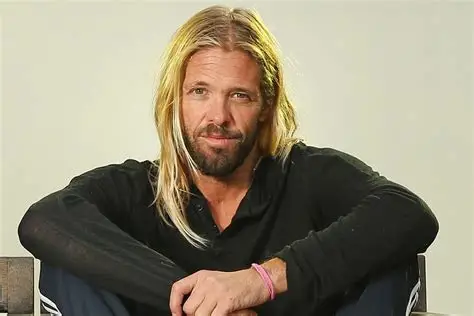
Hawkins spent most of his adult professional life performing and recording music.
His approximately 25 years with Foo Fighters placed him at the center of one of rock’s most successful modern bands. He appeared on major records, performed in arenas and stadiums around the world, contributed vocals and songwriting, and developed an individual musical identity alongside one of rock’s best-known frontmen.
His induction into the Rock & Roll Hall of Fame with Foo Fighters in 2021 formally recognized that career before his death.
The reaction that followed in 2022 added another measure of his impact. Musicians across generations honored him, the Grammy Awards incorporated a tribute, and two major concerts brought together friends, collaborators and artists whose work had influenced him.
Those events reinforce an important perspective: while public interest in the circumstances surrounding Hawkins’ death remains understandable, the documented story of his life is substantially larger.
His legacy rests on decades of performances, recordings and relationships across the music industry.
Frequently Asked Questions
What was Taylor Hawkins’ cause of death?
A final official cause of death has not been publicly released. Colombian authorities disclosed preliminary toxicology findings after Hawkins died, but they did not publicly identify those findings as the definitive cause of his death. Reporting in 2026 continued to state that an official cause had never been made public.
What substances were found in Taylor Hawkins’ system?
Colombian authorities said a preliminary urine toxicology test detected 10 substances. Those publicly identified included THC, opioids, tricyclic antidepressants and benzodiazepines. The announcement was described as preliminary, with additional forensic work continuing.
Did Taylor Hawkins die from an overdose?
No official public finding has established an overdose as Hawkins’ cause of death. Although preliminary toxicology detected several substances, the Colombian authorities did not publicly conclude that an overdose caused his death. Describing an overdose as established fact therefore goes beyond the verified record.
When and where did Taylor Hawkins die?
Taylor Hawkins died on March 25, 2022, in Bogotá, Colombia. Foo Fighters were in the city to perform at Festival Estéreo Picnic. Hawkins was 50.
How long was Taylor Hawkins with Foo Fighters?
Hawkins joined Foo Fighters in 1997 and remained the group’s drummer until his death in 2022, a period of approximately 25 years. He was inducted into the Rock & Roll Hall of Fame with Foo Fighters in 2021.
Conclusion
The most reliable answer to questions about the Taylor Hawkins cause of death requires acknowledging the limits of the public record.
Hawkins died in Bogotá on March 25, 2022, after emergency responders were called following a report of chest pain. Colombian authorities subsequently announced that preliminary toxicology testing had detected 10 substances, including THC, opioids, tricyclic antidepressants and benzodiazepines. However, those findings were not publicly presented as a final cause of death, and reputable reporting years later continued to state that no official cause had been publicly released.
That distinction prevents speculation from being presented as medical fact.
Hawkins’ broader legacy is considerably clearer. For roughly a quarter-century, he helped shape Foo Fighters into one of the defining rock bands of its era. His drumming, vocals, songwriting, live performances and enthusiasm for rock history earned him recognition from fans, fellow musicians, the Recording Academy and the Rock & Roll Hall of Fame.
The tributes that followed his death, from the Grammy Awards to major concerts in London and Los Angeles, reflected the scale of that influence. Taylor Hawkins is remembered not simply because of the unanswered questions surrounding his death, but because of the body of work, performances and musical relationships he built across more than two decades at the highest levels of rock music.