
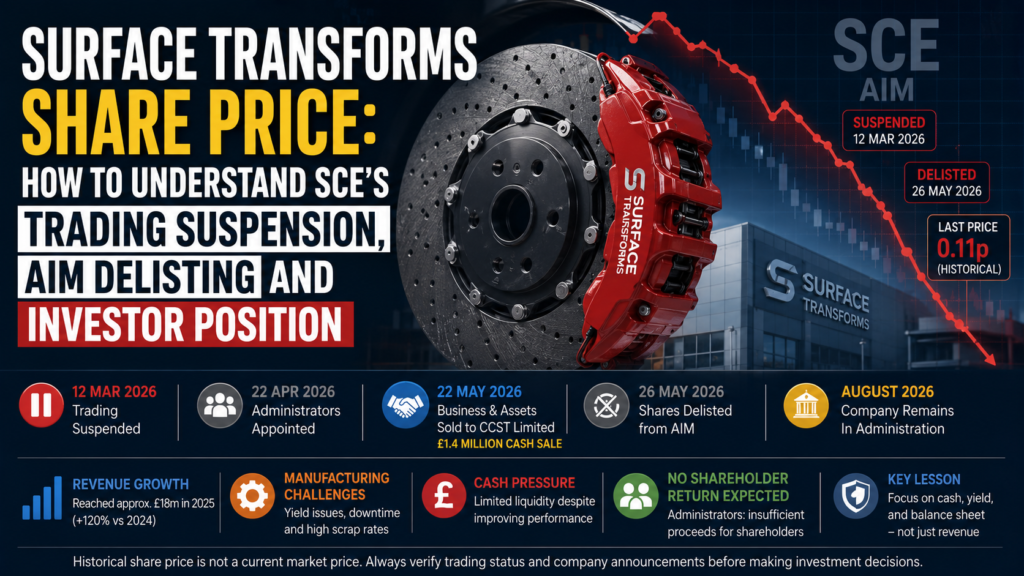
Anyone searching for the Surface Transforms share price today needs to know one fact before looking at historical charts: Surface Transforms plc is no longer trading on AIM. The carbon-ceramic brake manufacturer’s shares were suspended in March 2026, the company entered administration in April, substantially all of its operating business and assets were sold in May, and its shares were delisted from AIM on May 26, 2026. The administrators subsequently stated that the available proceeds were insufficient to provide a return to shareholders.
That sequence fundamentally changes how investors should interpret old Surface Transforms share price data. A quotation of approximately 0.11p that still appears on some financial websites represents the final period of quoted trading rather than a live, investable market price. Historical share-price pages can remain online after a security has ceased trading, so the displayed number should not be mistaken for a current valuation at which investors can freely buy or sell shares.
The story behind SCE is also a useful case study in the risks surrounding small industrial growth companies. Surface Transforms had valuable technology, major automotive customers and rapidly increasing revenue, yet manufacturing difficulties, cash requirements and contract exposure ultimately overwhelmed the listed company. Understanding that progression explains far more about the final Surface Transforms share price than the chart alone.
Check the Current Trading Status Before Reading the Surface Transforms Share Price
The first step is to establish whether a share-price quotation still represents an active market.
Surface Transforms previously traded on the London Stock Exchange’s AIM market under the ticker SCE. On March 12, 2026, trading in its ordinary shares was temporarily suspended at the company’s request pending clarification of its financial position. That suspension meant the quoted price ceased functioning as a normal continuously tradable market price.
The situation subsequently became permanent rather than temporary. Joint administrators were appointed on April 22, 2026. On May 22, the company announced that substantially all of its operating business and assets had been sold to CCST Limited. The announcement confirmed that the shares would be delisted from AIM on May 26, 2026.
As of August 2026, Companies House records Surface Transforms plc as “In Administration.” Its registered corporate entity therefore continues to exist for administration purposes, but that should not be confused with the continuation of a publicly traded operating company.
Distinguish a Historical Quote From a Live Market Price
Some finance websites still display a Surface Transforms share price of around 0.11p. Hargreaves Lansdown, for example, shows a bid and offer around that level on its historical share page, while other market-data providers retain the last closing quotation.
That figure should now be treated as historical information.
A live share price normally reflects ongoing transactions between buyers and sellers on a market. Once trading has been suspended and the security subsequently delisted, the last quoted figure no longer performs that function.
This distinction is especially important for investors using search engines, portfolio applications or old watchlists. Software may continue displaying stale market data even though the underlying security is no longer available for normal exchange trading.
Review the Events That Drove the Surface Transforms Share Price Lower
Understanding the final valuation requires looking beyond the last number on the chart.
Surface Transforms developed and manufactured carbon-fibre-reinforced carbon-ceramic brake discs. The company described itself as the UK’s only manufacturer of carbon-ceramic automotive brake discs and supplied major original equipment manufacturers. Its technology targeted high-performance road and track vehicles, including both internal-combustion and electric vehicles.
The commercial proposition attracted investors because automotive OEM programmes can generate substantial volumes once a component enters series production. The problem was not primarily a lack of potential customer demand. Surface Transforms repeatedly struggled to convert that demand into reliable, profitable manufacturing output.
Track the Manufacturing Yield Problem
The company’s 2024 results identified three major operational problems: inadequate production yield from installed capacity, difficulty establishing consistent and repeatable manufacturing processes, and delays in installing additional capacity. Management said equipment and material-science problems emerged as production scaled, causing downtime and excessive scrap.
These issues mattered directly to the Surface Transforms share price because manufacturing yield determines how much saleable product can be produced from the company’s inputs and equipment.
Low yield creates several problems simultaneously. Fewer discs become available for customers, revenue is restricted, wasted material raises unit costs, production schedules become less predictable, and additional working capital may be required.
Surface Transforms acknowledged that yield performance was critical to its ability to meet customer demand and generate sustainable cash flow. Its 2024 financial statements also warned of material uncertainty over the company’s ability to continue as a going concern.
Monitor Cash Consumption Alongside Revenue Growth
Revenue growth alone did not resolve Surface Transforms’ financial pressure.
For the year ended December 31, 2024, revenue increased 13% to £8.2 million, but the company recorded a £22.3 million loss after tax. Cash used in operating activities reached £14.0 million, while year-end cash stood at only £0.5 million. Surface Transforms had raised £9.5 million through an equity placing and open offer during the year and had also drawn £5.1 million from an ERDF-backed loan facility for capital investment.
Those figures reveal the central investment issue.
A growing industrial company can report rising sales while still becoming financially weaker if its cash costs, production inefficiencies and capital requirements increase faster than incoming revenue.
For shareholders, repeated funding requirements also raise dilution risk. When a company issues substantial numbers of new shares to obtain working capital, each existing share represents a smaller proportion of the enlarged equity base unless the investor participates proportionately.
Compare Revenue Progress With the Company’s Funding Position
Surface Transforms entered 2026 with some operating indicators moving in the right direction.
An unaudited January 2026 trading update reported that 2025 revenue had increased approximately 120% to £18.0 million, compared with £8.2 million in 2024. The company also estimated that its operating loss before interest and tax had narrowed to about £8.7 million from £23.4 million a year earlier.
Manufacturing yield had improved as well. Surface Transforms reported a Q4 2025 yield of 77%, compared with 70% in Q3 and 49% in Q1, although it remained below management’s internal 80% target.
Management was targeting approximately £27 million of revenue in 2026 and EBITDA breakeven. At the same time, however, the company reported gross year-end cash of only £1.0 million, including £0.2 million restricted for capital expenditure, and customer prepayments of £13.3 million. Management described cash as tight but manageable.
That combination illustrates why investors should examine liquidity as closely as growth rates.
Compare the Key Financial Indicators
| Indicator | FY 2024 | FY 2025 Update | Investment Significance |
|---|---|---|---|
| Revenue | £8.2m | Approx. £18.0m | Sales were expanding rapidly |
| Revenue growth | 13% | Approx. 120% | Demonstrated increasing production and deliveries |
| Operating loss before interest and tax | £23.4m | Approx. £8.7m | Losses were narrowing but remained substantial |
| Gross year-end cash | £0.5m | Approx. £1.0m | Liquidity remained limited |
| Customer prepayments | Material support disclosed | £13.3m | Business depended heavily on customer funding |
| Manufacturing yield | Persistent difficulties | 77% in Q4 2025 | Improvement remained essential to profitability |
The 2024 figures come from the company’s audited results, while 2025 figures were provided through an unaudited January 2026 trading update.
The table explains why improving operating performance did not necessarily guarantee recovery in the Surface Transforms share price. A business can move closer to breakeven while remaining vulnerable if it has insufficient liquidity to absorb a major customer change, production problem or financing interruption.
Examine the March 2026 Suspension Before Using Historical Price Charts
March 12, 2026 became the decisive point in the history of the Surface Transforms share price.
The London Stock Exchange announced that trading in Surface Transforms ordinary shares had been temporarily suspended from 12:35 p.m. that day, pending clarification of the company’s financial position.
A suspension is materially different from an ordinary sharp decline.
When a stock falls while continuing to trade, shareholders retain access to the market, although prices may be highly volatile. During a suspension, ordinary exchange transactions stop. Investors cannot assume that trading will resume or that any eventual reopening price will resemble the last quotation.
For Surface Transforms, trading never returned to normal before administration and delisting.
Treat the 0.11p Level as a Final Trading Reference
Historical market-data services place the last Surface Transforms share price at roughly 0.11p per share.
That number is useful for understanding how far investor expectations had deteriorated before suspension, but it does not represent a current recoverable value.
This is a crucial distinction when discussing very low-priced shares. A security trading for a fraction of one penny can appear mathematically capable of huge percentage gains. For example, an increase from 0.1p to 1p would represent a tenfold move.
But percentages alone say nothing about whether the underlying company has the financial resources necessary to survive.
Once insolvency becomes the central issue, debt priorities, secured creditors, administration costs and asset-sale proceeds matter much more than old share-price targets or historic trading ranges.
Follow the Administration Process to Understand Shareholder Value
Surface Transforms entered administration on April 22, 2026, according to the subsequent company announcement and current Companies House records.
Administration changes the economic position of ordinary shareholders substantially.
Shareholders are owners of the company, but they rank behind various creditor claims when an insolvent company’s assets are realised. If asset-sale proceeds are insufficient after administration expenses and creditor claims, there may be no residual value available for ordinary equity holders.
That is what the administrators said had happened in this case.
Review the £1.4 Million Asset Sale
On May 22, 2026, Surface Transforms announced the sale of substantially all its business and assets to CCST Limited for £1.4 million in cash, excluding any applicable VAT. The assets included the operating business, intellectual property, contracts, equipment, computer systems, inventory, records and goodwill, as well as the right to use the Surface Transforms name.
The buyer also agreed to pay £90,000 owed to Close Brothers in relation to financed assets. A dynamometer located in Germany was excluded from the initial transaction, although the buyer received an option to acquire it for an additional £200,000.
Ten employees remaining in the business immediately before completion transferred to the buyer, and the purchaser planned to restart carbon-ceramic brake-disc manufacturing at the existing Knowsley site.
Importantly, the continuation of manufacturing under a purchaser does not mean holders of the old Surface Transforms plc shares automatically retain an economic interest in that operating business.
The operating assets were sold. The old listed company remained in administration.
Separate the Surface Transforms Business From the Former SCE Shares
This distinction is perhaps the most important part of interpreting Surface Transforms after May 2026.
An investor may see reports that carbon-ceramic brake production is restarting under a buyer and assume that the former listed company’s shares could therefore regain value.
That interpretation is incorrect based on the announced transaction structure.
Surface Transforms plc sold substantially all of its operating assets to CCST Limited. The consideration was cash paid to the company in administration, not shares in the purchaser distributed to former shareholders. The announcement explicitly stated that no shares or other securities formed part of the consideration.
The administrators further stated that, after the asset disposal, the company would have no continuing trading operations.
The technology and manufacturing activity may therefore continue commercially, but that continuing activity belongs to the buyer under the terms of the asset transaction.
Recognize the Difference Between a Brand and an Equity Security
The Surface Transforms name can also cause confusion.
The asset sale included the right for the purchaser to use the Surface Transforms name. That means consumers, automotive industry participants or online searchers may continue encountering the brand even though the former AIM-listed company’s shares have been delisted.
A continuing brand does not create a continuing exchange-listed security.
Investors researching the Surface Transforms share price should therefore distinguish among three separate things:
- The historical AIM-listed Surface Transforms plc.
- The old SCE ordinary shares that ceased trading and were delisted.
- The operating assets and Surface Transforms name acquired by CCST Limited.
Only the first two relate directly to the historical SCE share-price chart.
Use the Delisting Date to Interpret Old Market Data Correctly
Surface Transforms shares were scheduled for removal from AIM on May 26, 2026, following completion of the asset sale.
After delisting, there is no normal AIM order book producing an updated market quotation.
Financial websites may retain the ticker, graph, historical market capitalization, old analyst forecasts and final price. Those records are useful for research, but they should be clearly labelled or understood as historical.
Follow the Key Surface Transforms Timeline
| Date | Event | Relevance to Surface Transforms Share Price |
|---|---|---|
| 10 June 2025 | FY 2024 results published | Revealed £22.3m loss and material going-concern uncertainty |
| 19 January 2026 | FY 2025 trading update | Revenue reached approximately £18m, but cash remained tight |
| 12 March 2026 | AIM trading suspended | Normal share-price discovery stopped |
| 22 April 2026 | Administrators appointed | Equity became subject to insolvency outcome |
| 22 May 2026 | Business and assets sold to CCST Limited | £1.4m cash sale completed |
| 26 May 2026 | Shares delisted from AIM | SCE ceased to have an exchange-traded share price |
| August 2026 | Company remains in administration | No live AIM share price exists |
These events are documented through company announcements, the London Stock Exchange and Companies House.
Ignore Outdated Surface Transforms Share Price Forecasts
Search results may still surface old analyst price targets or automated share-price forecasts.
Investors should treat those forecasts as obsolete unless they explicitly account for the administration, asset disposal and delisting.
Some market-data pages still show an old analyst target of 18.60p, for example. Such figures were created for a different corporate situation and should not be interpreted as a forecast for a currently tradeable SCE security.
The underlying assumptions have changed completely.
Before administration, an analyst might value Surface Transforms using forecast revenue, manufacturing capacity, contract volumes, EBITDA margins and long-term automotive demand. After the disposal of substantially all operating assets and the statement that shareholders are not expected to receive a distribution, those operating forecasts no longer provide an appropriate valuation framework for the old shares.
Prioritize Corporate Events Over Algorithmic Targets
Automated stock-prediction websites can be particularly misleading around suspended or delisted companies because their models may continue processing historical price data.
A model might technically generate a projected percentage increase from the last traded price without understanding that the security no longer trades.
For this reason, regulatory announcements should take priority over algorithmic forecasts.
When a company enters administration, the central questions become:
- How much can its assets realise?
- Which creditors have priority?
- What are the costs of administration?
- How much secured and unsecured debt exists?
- Is any residual value expected for ordinary shareholders?
For Surface Transforms, the administrators directly addressed the last question. They said the available realisations were insufficient to produce a shareholder return.
Learn From the Factors That Changed the Surface Transforms Share Price
The Surface Transforms story provides broader lessons for investors following small-cap industrial businesses.
A large order book or strong technological proposition does not automatically create a financially sustainable company.
Surface Transforms had growing automotive demand and several multi-year OEM contracts. Its 2024 results reported six OEM contracts already in series production. Yet manufacturing constraints prevented the company from converting available demand into sufficient profitable output.
Measure Production Economics, Not Just Customer Demand
For manufacturers, revenue capacity depends on more than receiving orders.
Investors need to examine production yield, scrap rates, equipment uptime, installed capacity, capital expenditure and working-capital requirements.
Surface Transforms’ own reporting repeatedly connected manufacturing yield with revenue potential, production costs and cash generation.
A company can have attractive customers but still destroy shareholder value when the economics of fulfilling those contracts remain unfavorable.
Watch Customer Concentration
Customer concentration can create another layer of risk.
Surface Transforms reported that approximately 36.8% of its 2024 revenue, or about £3.0 million, came from a single customer.
Large customers can provide valuable volume, technical support and credibility. They can also create significant dependency.
For small suppliers, the loss, delay or renegotiation of a major programme can affect production planning, cash flow and financing requirements disproportionately.
Examine Balance-Sheet Strength Before Growth Forecasts
Surface Transforms’ revenue trajectory appeared strong going into 2026, but liquidity remained limited.
The company reported approximately £1.0 million of gross cash at the end of 2025 while depending on significant customer prepayments.
This demonstrates why investors should not evaluate growth companies solely through revenue projections.
Cash runway determines whether management has enough time to solve operational problems.
When that runway becomes too short, even genuine technological advantages and future customer demand may not be enough to protect existing shareholders.
Verify Surface Transforms Information Through Primary Sources
Anyone researching the Surface Transforms share price should prioritize formal company and regulatory records.
Companies House currently identifies Surface Transforms plc, company number 03769702, as being in administration.
The London Stock Exchange provides the March 2026 suspension notice, while the May company announcement documents the administration-related asset sale and AIM delisting.
Historical annual reports and company results remain useful for understanding how the financial position developed, particularly the 2024 audited accounts and subsequent 2025 trading update.
Secondary financial websites can supplement these sources with historic charts and quotations, but they should not override later regulatory events.
Answer the Most Common Questions About the Surface Transforms Share Price
Can I still buy Surface Transforms shares?
Surface Transforms plc’s former AIM shares were delisted on May 26, 2026, after trading had already been suspended in March. There is therefore no normal AIM market through which investors can currently purchase SCE shares.
What was the last Surface Transforms share price?
Historical market-data providers show a final quotation around 0.11p per share. Because trading was subsequently suspended and the shares were delisted, this should be regarded as a historical reference rather than a current market price.
Why was the Surface Transforms share price suspended?
The London Stock Exchange stated that trading was suspended at the company’s request on March 12, 2026, pending clarification of its financial position. The company later entered administration.
Will Surface Transforms shareholders receive money from the asset sale?
The administrators stated that the £1.4 million sale consideration would be used toward administration costs and payments to creditors and that there were insufficient realisations to provide a return to shareholders.
Is Surface Transforms still operating?
The old public company disposed of substantially all of its operating assets and was left with no continuing trading operations. The buyer, CCST Limited, said it would recommence carbon-ceramic brake-disc manufacturing at the existing Knowsley site and acquired the right to use the Surface Transforms name.
Could the old SCE share price recover?
There is no normal quoted SCE market price to recover because the shares have been delisted. More importantly, the administrators explicitly stated that available realisations were insufficient to produce a return for shareholders. Investors should therefore distinguish historic share-price movements from the current administration process.
Treat the Surface Transforms Share Price as a Historical Investment Case
The Surface Transforms share price tells only part of the company’s story. The more important sequence was operational and financial: Surface Transforms developed a differentiated carbon-ceramic braking technology, secured major automotive programmes and eventually produced substantial revenue growth, but it struggled for years to establish manufacturing yields and cash generation capable of supporting its expansion.
Revenue rose to approximately £18 million in 2025 and losses narrowed, yet the company entered 2026 with tight liquidity. Trading was suspended on March 12, administrators were appointed on April 22, substantially all operating assets were sold on May 22, and the shares were delisted from AIM on May 26.
For investors arriving through a search for a “current Surface Transforms share price,” the practical conclusion is straightforward: there is no current AIM-traded SCE share price. The approximately 0.11p figure still visible on some market-data websites reflects the historical final trading period, not an active quoted security.
The wider lesson is more durable. When assessing small industrial growth companies, investors should examine manufacturing economics, cash runway, customer concentration, funding requirements and going-concern disclosures alongside revenue growth and order potential. Surface Transforms demonstrated that promising technology and strong customer demand can coexist with severe financial risk.
Anyone conducting further research should use the company’s regulatory announcements, London Stock Exchange notices and Companies House insolvency records as the primary sources for the latest corporate position rather than relying on stale price charts or outdated analyst targets.
This article is for informational purposes only and does not constitute investment advice or a recommendation to buy, sell or hold any security.